
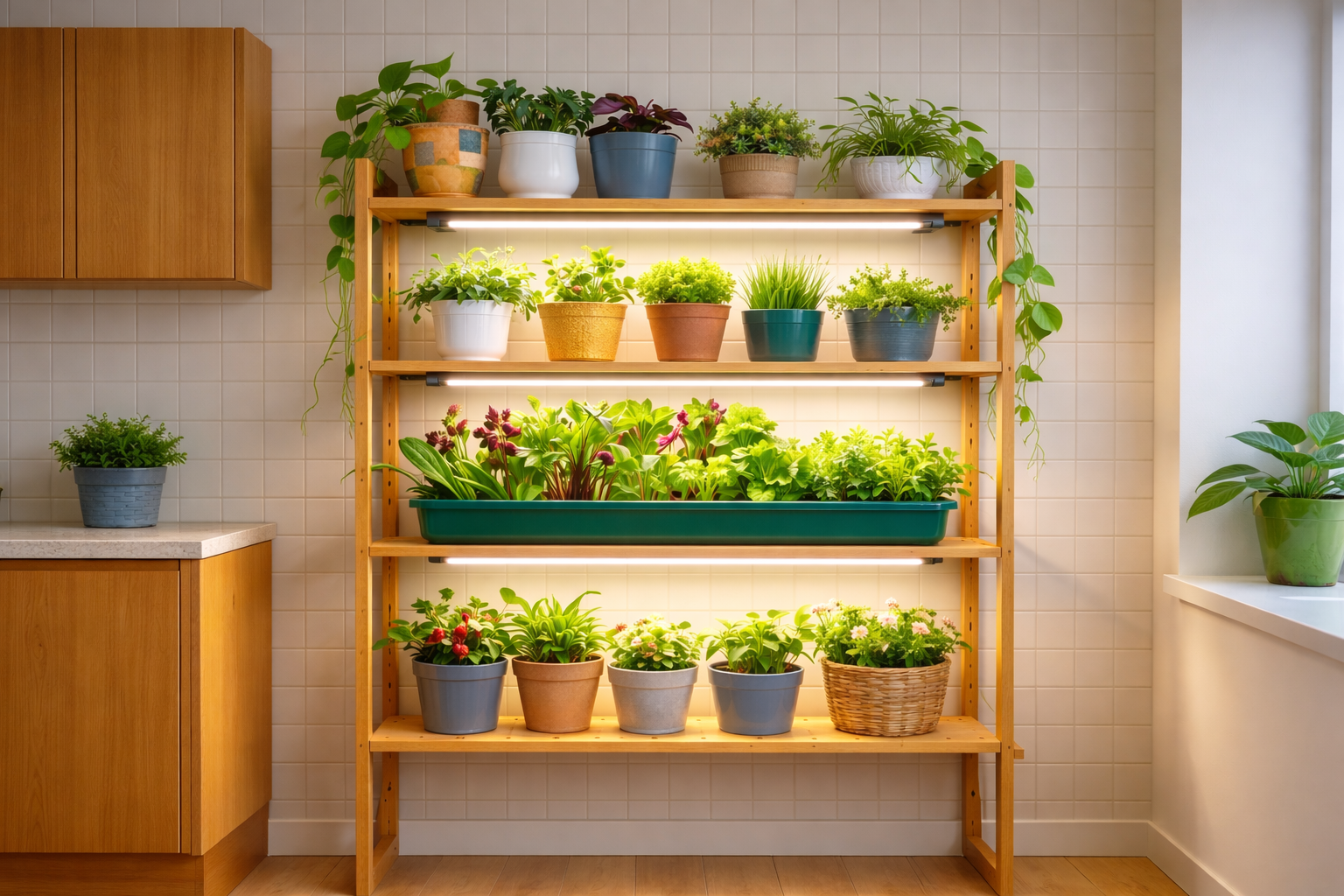
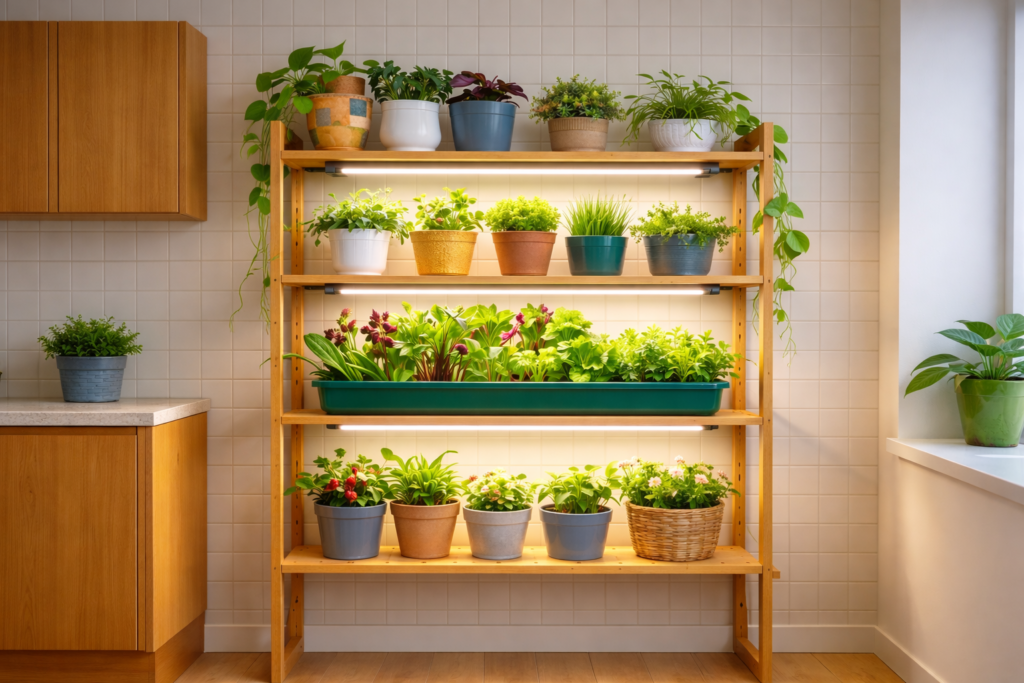
The UK isn’t known for reliable year-round sunshine, and that creates a real problem for anyone trying to grow indoors.
Put basil on a north-facing windowsill in November and the result is usually pale, stretched growth that never really gets going. For a lot of home growers, light is the actual limiting factor — not water, compost or feed.
This guide explains what grow lights are, how they work, and how to use them sensibly in a typical UK home. Think of it as a map rather than a manual: it covers the main principles and links out to more detailed guides where the practical decisions actually get made.
Who This Guide Is For
This guide is for UK home growers who want to:
- Grow herbs or leafy greens indoors
- Start seedlings earlier in the year
- Supplement weak natural light over winter
- Grow in a flat, spare room, shed or garage
- Understand grow lights properly before buying one
It’s not aimed at commercial grow rooms or high-intensity setups. The focus is practical, realistic home growing.
Do Grow Lights Actually Work?
Plants don’t need sunlight specifically. They need usable light energy for photosynthesis, and a suitable grow light can provide that effectively indoors.
They’re particularly useful in the UK when daylight hours are short — especially from autumn to early spring — or when a room is shaded or north-facing. They’re also useful if you want more consistent growth year-round, or if you’re growing somewhere away from windows altogether.
They matter a lot less when plants already get plenty of strong natural light, such as in a bright conservatory during summer.
Used properly, they’re a reliable way to fill the gaps in natural light through much of the UK growing year.
Main Types of Grow Lights
LED grow lights are now the standard choice for most home growers. They are energy-efficient, relatively cool-running and available in a wide range of designs, from slim bars and bulbs to larger panels.
Fluorescent tubes, particularly T5s, can still work well for seedlings and low-intensity growing when kept close to the plants. Modern horticultural LEDs are generally more efficient and offer a wider choice of output, coverage and form factor.
HPS and metal-halide lights are largely outdated for home use. They still grow plants effectively, but they run hot, use more electricity and usually need more space and ventilation than a typical domestic setup can comfortably provide.
This guide focuses on the main concepts. More detailed product comparisons are covered later in the buying guides.
Understanding Grow Light Wattage
Seen a grow light claiming to be “1000W” for the price of a takeaway? Your instinct is probably right: that figure is usually marketing rather than the light’s real power draw.
Wattage measures how much electricity a light uses. It doesn’t tell you how much usable light actually reaches your plants. What matters more is the light’s real power draw, how efficiently it converts that electricity into usable light, and how evenly the light spreads across the growing area.
Our guide to Grow Light Wattage explains how to spot inflated power claims, while the Grow Light Efficiency guide looks at why two lights drawing the same wattage can still perform very differently.
What It Costs to Run a Grow Light
At around 26p per kWh, a genuine 100W grow light running for 14 hours a day costs approximately £11 over a 30-day month. A smaller 30W light over the same hours works out closer to £3.30.
Your actual cost depends on the light’s real power draw, how many hours it runs each day, your electricity tariff, and whether it’s dimmed.
Our Grow Light Running Cost Calculator will work out the daily, monthly and yearly figure for your own setup. We’ve also looked at how that electricity use compares more broadly in our guide to the Environmental Impact of Grow Lights.
Spectrum Without the Marketing Noise
Grow lights are often sold as “full spectrum”, “red and blue”, or “sunlight simulation”. Spectrum does matter — different wavelengths genuinely influence growth and flowering — but it shouldn’t be considered on its own.
For most home growers, overall light intensity, coverage across the growing area, distance from the plants, and how evenly the light is spread usually make a bigger practical difference.
A well-designed white LED grow light with suitable intensity and coverage will generally be more useful than a weak fixture chosen mainly because its packaging highlights particular colours. We break this down properly in Full Spectrum vs Red and Blue Grow Lights.
How Long Should Grow Lights Be On?
Plants respond to day length as well as brightness, so leaving a light on longer doesn’t automatically mean better growth.
Seedlings, herbs and many actively growing indoor plants do well with around 12–16 hours of light a day, though the right schedule depends on the plant, its growth stage, the strength of the light, and how much natural daylight it’s already getting.
Consistency matters more than hitting an exact number, and a timer makes that far easier. I run mine from a smart plug with scheduling and energy monitoring, which I’ve covered in my Tapo P110 Smart Plug Review.
Full lighting schedules are covered in How Long Should Grow Lights Be On?
How Far Should Grow Lights Be from Plants?
Light intensity drops off quickly as distance from the source increases, so placement matters more than most beginners expect.
Too close, and you may see bleaching near the top of the plant, curling leaves, dry or crispy edges, or general heat stress. Too far away, and plants tend to stretch towards the light, develop long weak stems, slow down, or lean noticeably towards the brightest spot.
There’s no single correct distance for every grow light. A weak clip-on light might need to sit only a few inches from seedlings, while a more powerful LED panel could need much more separation or a lower dimmer setting.
Start with the manufacturer’s guidance, then use our Grow Lights Distance Chart and adjust gradually according to how the plants respond.
Setting Up Grow Lights at Home
Most people aren’t working with a dedicated grow room — they’re fitting a light onto a shelf, into a spare room, inside a shed, or into a corner of somewhere they already live.
A good setup is one that’s easy to adjust as the plants grow. Mount the light securely, leave enough room to raise or lower it as needed, and use a timer so the schedule stays consistent without you having to think about it.
Position plants so the light reaches them evenly, keep an eye on light spill if you’re growing somewhere shared, and keep plugs and connections well away from water.
Where ceiling suspension isn’t practical, a shelf, clamp or freestanding frame is often easier to manage. Our Best Grow Light Stand Systems UK guide compares the main options, while How to Set Up Grow Lights Indoors covers the complete process.
Grow Light Safety in UK Homes
Modern LED grow lights produce less radiant heat than older HPS or metal-halide systems, which makes them easier to use in smaller domestic spaces. They still generate heat at the fixture and driver, so ventilation and positioning matter.
A few basic precautions make most home setups much safer:
- Use reputable equipment with undamaged plugs, cables and connectors
- Do not daisy-chain extension leads
- Keep the total load within the rating of the socket or extension lead
- Leave space around heat sinks, drivers and fans
- Keep plugs and electrical connections well away from water
- Use a drip loop so water cannot run down the cable into a socket
- Mount suspended lights with proper ratchets, chains or brackets
- Avoid placing lights directly against curtains, fabric or timber
Most problems come from poor-quality equipment, insecure mounting, inadequate ventilation or unsafe electrical practices around water.
For more detailed guidance on electrical loading, mounting and everyday precautions, see Grow Light Safety UK.
Choosing a Light for Your Plants and Space
Before comparing models, work out what the light actually needs to do.
Ask yourself:
- What are you growing?
- How large is the area you need to light?
- Will the grow light be the plant’s main light source or supplement a window?
- How much height is available above the plants?
- Do you need a bulb, bar, panel, clamp light or stand system?
- Are you prioritising simplicity, low cost or maximum output?
Beginners usually benefit more from a reliable, easy-to-position light than from buying the most powerful model available. See our Best Grow Lights for Beginners guide for straightforward options.
Lower-cost setups can still work well for seedlings, herbs and leafy greens, provided their limited coverage and output are understood. These are covered in Best Cheap Grow Lights UK.
For grow tents, our Best Grow Lights for Every Tent Size guide matches light output and coverage to common tent dimensions.
For a broader comparison across different budgets and uses, see Best LED Grow Lights UK.
What I’ve Found from Using Different Grow Lights
In my own setups, the shape and spread of the light have often mattered more than the headline wattage. A panel that covers the full canopy evenly is usually easier to work with than a small, intense point source that leaves plants at the edges reaching towards it.
The ViparSpectra XS1500 Pro has worked well for tomatoes and chillies, but it makes most sense when its coverage is properly used rather than squeezed over a very small area.
At the other end of the scale, the SANSI E27 bulb has been useful for starting seedlings, although its limitations become clear once plants grow beyond the early stages.
The Wolezek gooseneck light can work for small plants at close range, but it does not have the output or coverage needed for fruiting crops.
I also measure actual power draw with a smart plug rather than relying only on the wattage printed on the box. It is the simplest way to see what a light is really using and what it costs to run.
Common Grow Light Mistakes
A few mistakes come up again and again:
- Trusting marketing wattage instead of checking the real power draw
- Choosing a light that’s too weak or too powerful for the space
- Obsessing over spectrum while ignoring intensity, coverage and distance
- Positioning a light once and never adjusting it as plants grow
- Running lights too long without a proper dark period
- Ignoring running costs when planning a larger setup
- Expecting a small bulb or clip-on light to support mature fruiting plants
Most of these are far easier to avoid at the start than to fix once plants are already stretching, overheating or growing unevenly.
Final Thoughts
Grow lights don’t need to be complicated. What matters is understanding how much light your plants actually need, matching the light to the space, and setting it up safely.
A sensible setup usually beats chasing the biggest wattage claim or the most impressive-looking specification sheet. Start with what you’re actually growing, choose a light that suits the space, and adjust it as the plants develop.
Whether you’re growing herbs on a kitchen shelf or helping seedlings through a grey February, a grow light can make indoor growing far more reliable in the UK.
For further reading from a trusted UK source, the RHS has a useful overview of how houseplants respond to artificial lighting.
📎 Essential grow light guides
- How to Set Up Grow Lights Indoors
A practical walkthrough covering mounting, positioning, timers, and safe use in UK homes. - Grow Lights Distance Chart UK
Starting distances for seedlings, leafy greens, and larger plants, with guidance on adjusting the height. - How Long Should Grow Lights Be On?
Daily lighting schedules, dark periods, and timer advice for common indoor plants. - Grow Light Wattage Explained
How to identify real power draw, avoid misleading claims, and estimate suitable output.