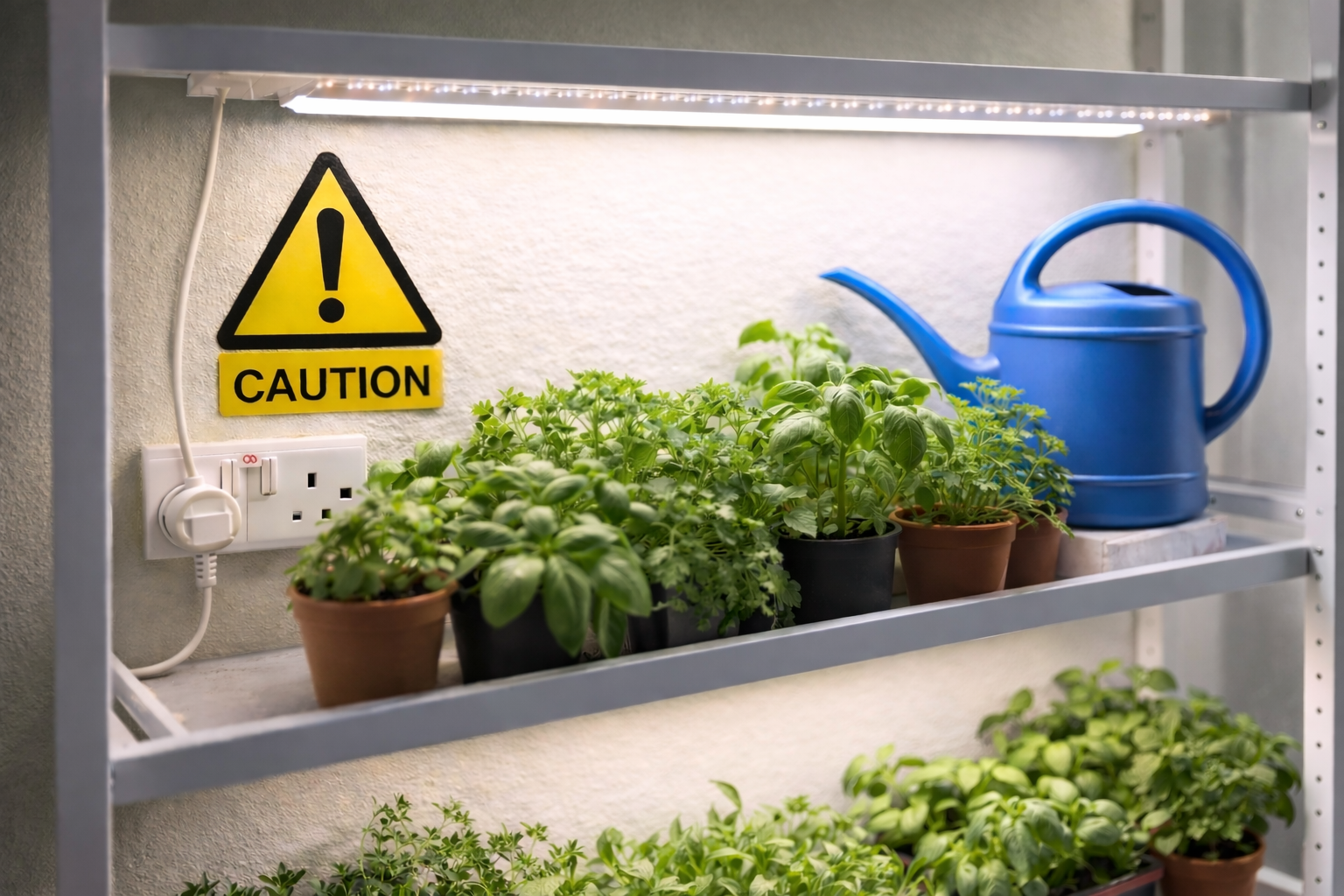

LED grow lights are suitable for use in UK homes when they are installed and used properly, but they are still mains-powered electrical equipment that may run for 12–16 hours at a time.
The main things to think about are straightforward: electrical load, secure mounting, ventilation, and keeping water away from plugs and connections.
Every grow light is different, so the manufacturer’s instructions should always take priority over general advice. Check the guidance for mounting, ventilation, electrical supply and the environment in which the light is designed to operate.
For a broader introduction to how grow lights work, the different types available, and how they’re used at home, see our Grow Lights Explained guide.
Are LED Grow Lights a Fire Risk?
Any electrical appliance can present a fire risk if it is damaged, overloaded, poorly installed or allowed to overheat. Grow lights also have a few particular considerations because they are often suspended above plants, used close to watering areas and left running for long periods.
Modern LED grow lights can be used safely in a normal home setup, but don’t treat them as fit-and-forget equipment.
Make sure the light is securely mounted, keep ventilation openings clear and periodically check plugs, cables, timers and connectors for damage or unusual heat.
Higher-powered LED panels can generate a noticeable amount of heat even though they are much more efficient than older grow-light technologies.
Electrical Safety for Grow Lights
Don’t overload extension leads or sockets
You don’t normally need to dedicate an entire wall socket to a single grow light. What matters is the combined electrical load of everything connected to it.
If you use an extension lead or power strip, check its maximum rating and make sure the total load of the equipment connected to it stays within that limit. Never connect one extension lead to another to create extra sockets.
Electrical Safety First advises checking the current rating marked on an extension lead rather than assuming what it can safely supply. Many are rated at 13A, but some are rated lower.
For grow lights, it is worth checking the actual power consumption in watts, rather than relying on names such as “1000W LED”. Some grow lights use wattage-style model names that bear little resemblance to their actual power draw.
You can read more about this in our Grow Light Wattage Explained guide.
Check plugs, cables and connections
Don’t continue using a grow light if you find a damaged cable, cracked plug, loose connection, exposed wiring or signs of overheating.
A plug, timer or connector becoming unusually hot is also a reason to switch the setup off and investigate rather than simply leaving it running.
Keep cables tidy and position them where they won’t be repeatedly pulled, crushed or tripped over.
Use timers and smart plugs within their ratings
A timer isn’t essential simply because a grow light is electrically unsafe without one. Its main safety benefit is making it much less likely that the light will accidentally remain on for far longer than intended.
It also gives plants a consistent light and dark cycle.
I use a Tapo smart plug with my own grow-light setups so I can control the lighting schedule and monitor when the light is running. A smart plug doesn’t replace the usual electrical checks, though: it still needs to be suitable for the load connected to it and used within the manufacturer’s specifications.
For plant lighting schedules, see How Long Should Grow Lights Be On?.
Mounting and Ventilation
Secure mounting becomes particularly important with larger LED panels.
The light should not be able to fall, swing into something or gradually work itself loose. Use hangers, brackets, ratchets or a stand capable of supporting the weight of the fixture.
With my VIPARSpectra XS1500 Pro LED panel, I deliberately left plenty of open space around the light so heat could dissipate. I hung it from a metal clothes rail using adjustable ratchet hangers rather than fixing it closely underneath a shelf.
That arrangement also makes it much easier to raise or lower the light as the plants grow.
I personally wouldn’t choose a close under-shelf installation for a relatively powerful panel like this unless the manufacturer specifically supported that arrangement and there was ample clearance and ventilation. Apart from heat, a fixed position would remove much of the useful height adjustment.
My smaller Wolezek lights and the SANSI bulb I’ve used produce much less heat in comparison, so ventilation has been less of an issue in those particular setups. They still have space around them, however, and higher-powered SANSI bulbs than the one I have used and other compact lights may behave differently.
The important point isn’t that one type of LED needs ventilation and another doesn’t. All grow lights should have the clearance and airflow specified by their manufacturer.
Don’t cover cooling fans, ventilation slots, drivers or heat sinks, and don’t surround the light with fabric or other materials that could restrict airflow.
If you’re deciding how high to hang the light above your plants, our Grow Lights Distance Chart UK gives practical starting points.
Water, Humidity and Condensation
Water and mains electricity need to be kept well separated.
That’s particularly relevant with grow lights because watering cans, trays, misting and damp compost may all be directly beneath the electrical equipment.
Keep plugs, extension leads and electrical connections away from watering areas and preferably raised rather than lying on the floor.
Arrange cables so water cannot easily travel along them towards a plug or connector. A simple drip loop, where the cable drops below the level of the connection before rising towards it, can help prevent water running straight into the electrical connection.
Don’t water plants in a way that splashes the light, driver, sockets or plugs.
If condensation has formed on electrical equipment, don’t simply switch it on while wet. Allow it to dry and deal with the cause of the excessive moisture.
What about IP ratings?
Some grow lights and electrical equipment carry an IP rating describing their resistance to dust and water ingress.
An IP rating can be useful when deciding where equipment is suitable, but it isn’t a general licence to expose a grow light to water. The manufacturer’s intended environment and installation instructions still matter.
Equipment designed only for dry indoor use shouldn’t be moved into a damp shed, greenhouse or outdoor environment simply because it happens to work there initially.
Grow Lights in Sheds, Garages and Outbuildings
An indoor spare room is quite different from an unheated shed.
Outbuildings can experience greater temperature changes, damp and condensation, and the electrical supply itself may require more consideration.
Use grow lights and associated electrical equipment only in environments they are designed for. If equipment is being used outdoors or where it may become wet, appropriate weather protection and electrical protection are important.
If you’re unsure about the suitability of the electrical installation in an outbuilding, that is a situation where advice from a qualified electrician makes more sense than improvising with extra extension leads.
Using Grow Lights in Flats and Rented Homes
You don’t usually need permanent electrical or structural changes to create a useful grow-light setup.
Free-standing shelving, plant stands and clothing rails can provide mounting points without drilling into walls or ceilings.
In a rented or shared property, also think about where cables run, whether the light spills into other rooms and whether cooling fans will be intrusive.
A temporary setup shouldn’t mean an unstable one. Make sure whatever supports the grow light is strong and difficult to knock over.
CE and UKCA Marking
When buying a mains-powered grow light for use in the UK, look for appropriate conformity marking along with clear manufacturer or importer information, electrical ratings and instructions.
Both CE and UKCA marking can currently be used for relevant products placed on the market in the UK, so a product carrying CE rather than UKCA should not automatically be regarded as inferior or unsuitable.
More important warning signs include completely untraceable manufacturers, missing electrical specifications, poorly fitting plugs, damaged cables or obviously poor construction.
A conformity mark is useful, but it isn’t a substitute for buying electrical equipment from a reputable source and using it correctly.
Common Grow Light Safety Mistakes
Several problems are particularly easy to avoid.
Don’t daisy-chain extension leads, exceed the stated rating of a power strip, block cooling vents or squeeze a hot-running light into a poorly ventilated space.
Keep electrical connections away from watering areas and don’t continue using damaged plugs, cables or connectors.
It’s also worth checking a setup again after it has been running for a while. Something that looked fine when cold may reveal a ventilation or connection problem once the light and driver have reached their normal operating temperature.
And don’t assume equipment intended for a dry indoor room will also be suitable for a damp shed, greenhouse or outdoor setup.
Grow Light Safety Checklist
Before leaving a grow light running for an extended period, I would check that:
- The light is securely mounted and cannot fall or swing into anything.
- There is adequate clearance around the light, driver, fans and heat sinks.
- The combined electrical load is within the rating of any extension lead, timer or smart plug being used.
- Extension leads aren’t daisy-chained.
- Plugs, leads and connectors show no signs of damage or excessive heat.
- Electrical connections are well away from watering areas.
- Cables are positioned so they aren’t a trip hazard or likely to be pulled.
- The lighting schedule is set correctly.
- The equipment is suitable for the environment in which it is being used.
I also like to check a new setup after it has been running for a few hours rather than assuming everything is fine immediately after installation.
When Extra Care Is Needed
It is worth being particularly cautious if you’re running several grow lights in one area, using an older electrical installation, growing in a shed or garage, or operating the setup throughout the year.
None of those automatically makes grow lights unsafe. They simply increase the importance of checking the electrical load, controlling moisture and making sure there is enough ventilation.
If you’re considering permanent wiring changes or aren’t confident that an existing circuit or outbuilding supply is suitable, use a qualified electrician rather than trying to solve the problem with additional adaptors and extension leads.
Final Thoughts
Grow light safety doesn’t require an elaborate setup, but it does require a little planning.
Secure the light properly, give it the ventilation it needs, keep electricity away from water and make sure every extension lead, timer or smart plug is being used within its rating.
My own setups vary depending on the light. A relatively powerful VIPARSpectra panel gets plenty of open space around it and adjustable ratchet hangers, while my smaller lights have been easier to accommodate. The principle is the same in both cases: make the setup fit the equipment rather than forcing the equipment into an unsuitable space.
And always follow the instructions supplied with your particular light, especially where they specify mounting, clearance or operating conditions.
Grow Light Safety FAQs
Are LED grow lights safe to run overnight in a UK home?
A suitable LED grow light can be operated overnight if it is installed and used in accordance with the manufacturer’s instructions. Running at night does not make the light inherently safer or less safe. What matters is secure mounting, adequate ventilation, sound electrical connections, and keeping the equipment away from water. A timer or smart plug can also help prevent the light being accidentally left on outside its intended schedule.
How do I know if I’m overloading a socket or extension lead?
Check the maximum current or wattage rating shown on the extension lead and compare it with the combined load of everything connected to it. Do not assume that having spare sockets means you can safely fill them all with high-powered equipment. Avoid daisy-chaining extension leads. If a plug, adaptor, timer, or cable becomes unusually hot, switch the setup off and investigate the cause.
Does “1000W LED” on the box mean it uses 1000 watts?
Not necessarily. Grow-light model names and marketing descriptions sometimes use figures that are different from the actual electrical consumption. For electrical load and running-cost calculations, look for the actual input power or power consumption in watts on the specifications or product label. See our Grow Light Wattage Explained guide for more detail.
What should I look for on a grow light label in the UK?
Look for appropriate CE or UKCA conformity marking, together with a traceable manufacturer or importer, model information, input voltage, and electrical rating. For a mains-powered grow light supplied with a UK plug, the plug and fuse should also be appropriate for the equipment. Be wary of products with missing electrical information, no identifiable manufacturer or importer, visibly poor wiring, or damaged plugs and cables.
Are grow lights safe in humid spaces such as sheds or grow tents?
They can be, provided the particular equipment is suitable for those conditions. Humidity and condensation increase the importance of keeping electrical connections away from water, maintaining ventilation, and following any IP rating and environmental limits specified by the manufacturer. A grow tent can also retain heat, so make sure the fixture and driver have adequate airflow.
How much clearance should I leave around an LED grow light?
There is no single correct clearance for every grow light. Follow the manufacturer’s mounting and ventilation instructions and avoid pressing heat sinks, drivers, or fan openings directly against shelves, walls, fabric, or insulation. Larger LED panels can produce considerably more heat than small bulbs or light bars, so the appropriate setup depends on the light itself.
Can I safely use grow lights with smart plugs or smart timers?
Yes, provided the smart plug or timer is suitable for the electrical load and is used within its manufacturer’s specifications. I use a Tapo smart plug with my own grow-light setup because it makes scheduling and monitoring much easier, but the smart plug is still part of the electrical system and needs to be properly rated for what is connected to it.
What are the most common grow light safety mistakes?
Common avoidable problems include overloading or daisy-chaining extension leads, blocking ventilation, insecurely mounting the light, allowing water near electrical connections, and continuing to use damaged equipment. Most can be prevented by keeping the installation uncluttered, checking equipment periodically, and following the light manufacturer’s instructions.
📎 Related articles
- Grow Lights Explained: A Complete Guide for UK Home Growers
A clear overview of how grow lights work, when they’re useful, and how to use them sensibly in UK homes. - How to Set Up Grow Lights Indoors
Step-by-step guidance on mounting, positioning, timers, and everyday safety considerations. - Grow Lights Distance Chart UK
Helps prevent leaf scorch and stress by showing safe grow light distances for different plants and stages.