
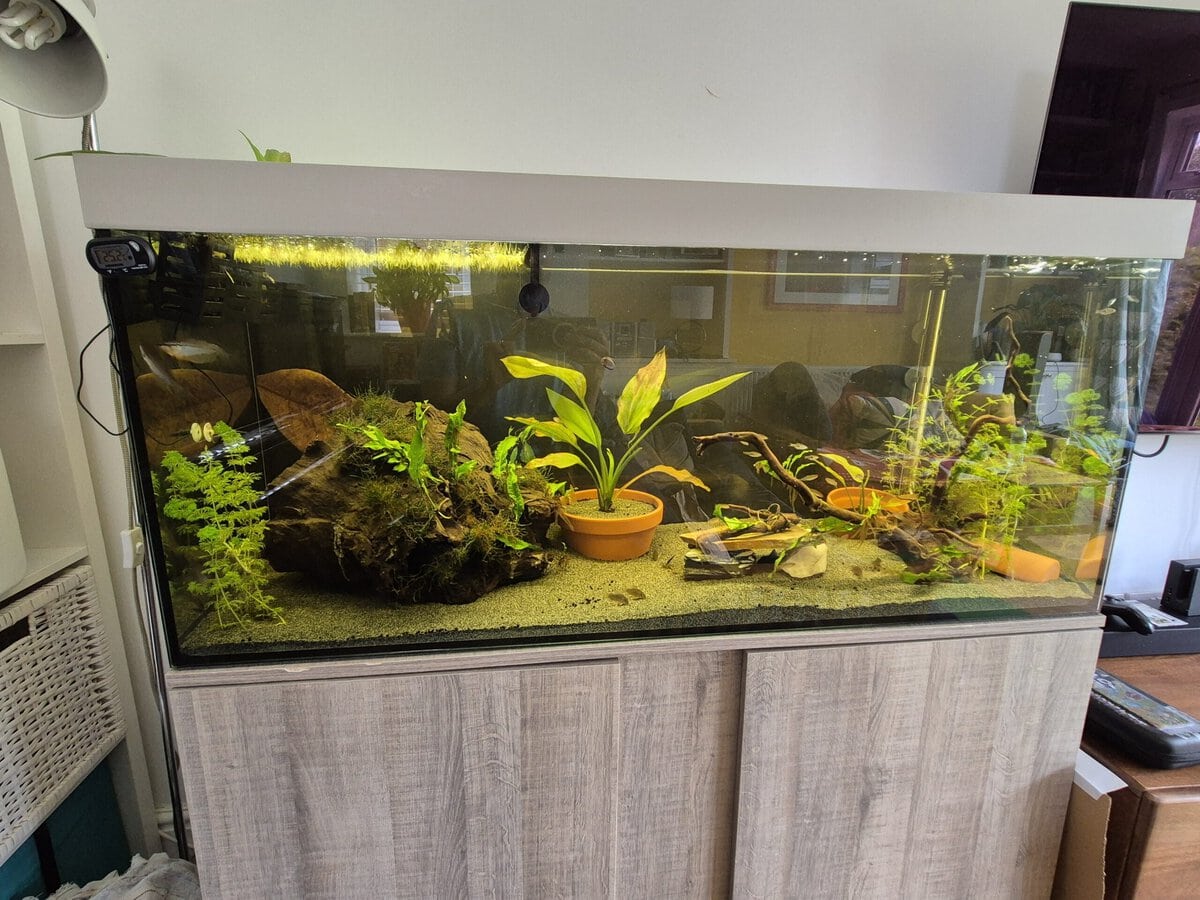
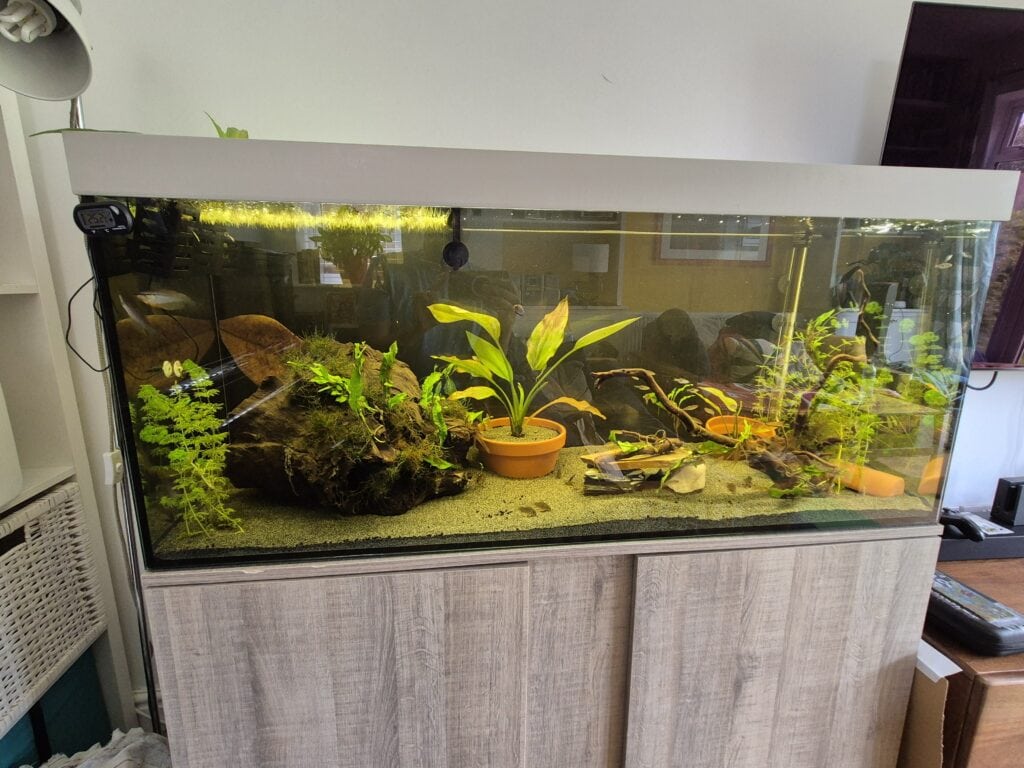
I recently set up my first aquarium, and it has made me think about backup power in a much more personal way.
An aquarium is not a cheap thing to put together. By the time you have bought the tank, filter, heater, light, plants, substrate, fish and food, it becomes a proper investment. More importantly, once the fish are in there, you have a duty of care to keep them safe.
That is what made me wonder: can a solar generator run an aquarium during a power cut?
Most UK power cuts are short, and many of us may never have a serious problem. But if the power did go off for several hours, the filter would stop, water movement would stop, the heater would switch off, and the tank temperature would slowly begin to fall.
I already write about backup power and solar generators on HomeGrower, so I wanted to look at this properly using my own aquarium as the example. The tank is around 240 litres, with a 200W heater, a 35W external filter and an LED light. That makes it a useful real-world test case rather than just a theoretical calculation.
The main thing I found is simple:
- The filter is usually easy to run.
- The aquarium light is optional in an emergency.
- The heater is what drains the battery.
This guide looks at whether a solar generator can run an aquarium during a power cut, how long different power stations might last, and how much solar charging could help in summer, spring, autumn and winter.
If you are already comparing models, start with our main guide to the best solar generators in the UK. If you are mainly looking at EcoFlow models, our EcoFlow solar generator guide compares the main options in more detail.
Quick Answer: Can a Solar Generator Run an Aquarium?
Yes, a solar generator can run an aquarium during a power cut, but the runtime depends heavily on whether the heater is running.
A small aquarium filter might only use 5–20 watts. A larger external filter might use 30–40 watts. That is manageable for most portable power stations.
A tropical aquarium heater is different. A heater may draw 100–300 watts when active. It does not usually run constantly, but during a cold-room power cut it may cycle on much more often.
The practical emergency rule is:
- Run the filter or maintain water movement.
- Keep the aquarium light off.
- Use the heater to stop the tank dropping too far.
- Do not waste battery trying to run the tank exactly as normal.
For many tropical community tanks, the aim in an emergency is not necessarily to hold the aquarium perfectly at its normal temperature. It may be more realistic to let the tank drift down slowly and use the heater to protect a lower emergency minimum.
In the example tank used in this guide, the normal target is 25°C, but around 23°C would be a sensible emergency minimum. That could save a lot of battery power compared with trying to hold 25°C throughout the whole outage.
The Aquarium Setup Used in This Example
This guide uses a real tropical aquarium setup rather than a generic calculation.
The tank is around 240 litres. It is normally kept at 25°C. The room is usually around 20–21°C, although in a power cut the room temperature would gradually start to fall.
The equipment includes:
- A 200W Eheim aquarium heater.
- An AllPondSolutions 1400EF external filter rated at 35W.
- An Eheim 120cm LED aquarium light.
- A tropical community fish mix.
| Equipment | Example used | Power use | Emergency priority |
|---|---|---|---|
| Heater | Eheim aquarium heater | 200W when heating | Important in cold conditions |
| Filter | AllPondSolutions 1400EF external filter | 35W | Essential |
| Light | Eheim 120cm LED aquarium light | Likely around 17W depending on model | Turn off during an outage |
Heater
Example used: Eheim aquarium heater
Power use: 200W when heating
Emergency priority: Important in cold conditions
Filter
Example used: AllPondSolutions 1400EF external filter
Power use: 35W
Emergency priority: Essential
Light
Example used: Eheim 120cm LED aquarium light
Power use: Likely around 17W depending on model
Emergency priority: Turn off during an outage
The exact numbers will vary from tank to tank, so always check the label on your own equipment. A plug-in energy meter is even better because it can show what your aquarium actually uses over a full day.
The key point is that the heater rating is not the same as average power use.
A 200W aquarium heater does not necessarily use 200W all day. It switches on and off. In a warm room, it may only run part of the time. In a cold room during a winter outage, it may run much more often.
What Actually Matters During an Aquarium Power Cut?
During a power cut, the main risks are:
- Filtration stops.
- Water movement stops.
- Oxygen levels may fall.
- The tank temperature may drop.
- The aquarium light turns off.
Those things are not equally important.
The filter and water movement are usually the first priorities. They help keep oxygen moving through the tank and protect the bacteria living in your filter media.
Temperature matters for tropical fish, especially if the room starts cooling.
HomeGrower Pro Tip: Insulation is the cheapest battery extension
Before buying a bigger power station, it is worth thinking about heat loss. In a power cut, insulation can be one of the cheapest ways to make your aquarium backup power last longer.
A roll of reflective insulation, some cardboard, towels or blankets can help slow heat loss from the glass. That means the heater should switch on less often, which saves far more energy than worrying about a small LED light or low-wattage filter.
The aim is not to seal the aquarium dangerously or cover electrical equipment. It is simply to reduce heat loss from the sides and back of the tank while keeping the lid closed. For a tropical aquarium, this can be especially useful if the room temperature starts falling.
The light matters least. In most emergency situations, the aquarium light should stay off.
Fish can cope with darkness. Aquarium plants can cope with a short blackout. Battery power should be saved for the equipment that keeps the fish alive.
Do You Need to Keep a Tropical Aquarium at 25°C During a Power Cut?
Not necessarily.
In normal conditions, many tropical aquariums are kept around 24–26°C. The example tank in this guide is kept at 25°C.
But in an emergency, the goal is not always to maintain the perfect normal temperature. The goal is to avoid a dangerous drop, especially a fast one.
A slow, temporary fall is usually less stressful than a sudden temperature crash. For many community fish, allowing the tank to drift down slightly can save a lot of battery power.
For the example tank, which includes fish such as rummy nose tetras, harlequin rasboras, pearl gourami, sterbai corydoras and Bolivian rams, 23°C would be a sensible emergency minimum target.
That does not mean 23°C is ideal for every fish. It simply gives the power station a more realistic job.
Instead of forcing the heater to hold 25°C constantly, the heater can be used to stop the tank falling below 23°C.
| Tank temperature | Emergency meaning | What to do |
|---|---|---|
| 25°C | Normal target temperature | No emergency heating adjustment needed |
| 24°C | Still comfortable for many tropical community tanks | Continue monitoring |
| 23°C | Sensible emergency minimum for the example tank | Use the heater to stop further decline |
| 22°C | Likely survivable short-term for many fish, but not ideal for warmer-water species | Avoid staying here if possible |
| 21°C or below | Increasing concern for warm-water tropical fish | Prioritise heat and insulation |
25°C
Emergency meaning: Normal target temperature
What to do: No emergency heating adjustment needed
24°C
Emergency meaning: Still comfortable for many tropical community tanks
What to do: Continue monitoring
23°C
Emergency meaning: Sensible emergency minimum for the example tank
What to do: Use the heater to stop further decline
22°C
Emergency meaning: Likely survivable short-term for many fish, but not ideal for warmer-water species
What to do: Avoid staying here if possible
21°C or below
Emergency meaning: Increasing concern for warm-water tropical fish
What to do: Prioritise heat and insulation
This is one of the most important parts of aquarium backup planning.
If you try to hold the tank at 25°C throughout the whole power cut, the heater may drain the battery quickly. If you allow the tank to drift slowly to 23°C and only heat from there, the same power station may last much longer.
Always check the needs of your own fish. Some species are much more temperature-sensitive than others.
How Much Power Does an Aquarium Use?
Aquarium power use depends on the equipment and the season.
The main loads are:
- Filter: usually predictable because it runs continuously.
- Light: predictable, but not essential during an outage.
- Heater: variable because it cycles on and off.
The heater is the difficult part because it depends on:
- Room temperature.
- Tank temperature.
- Tank size.
- Whether the tank has a lid.
- How much surface movement there is.
- How quickly the room cools.
- Whether the tank is insulated.
For the example 240-litre tank, the likely emergency loads look like this:
| Scenario | Equipment running | Estimated average load | What it means |
|---|---|---|---|
| Filter only | External filter | 35W | Best battery life, but no active heating |
| Warm-room backup | Filter + heater cycling lightly | 65–95W | Room still close to normal temperature |
| Cool-room backup | Filter + heater cycling more often | 105–135W | Room has started cooling |
| Cold-room backup | Filter + heater working hard | 155–195W | More likely in a long winter outage |
| Worst case | Filter + heater constantly on | 235W | Battery drains quickly |
| Light added | Filter + heater + LED light | Add around 17W | Usually not worth it during an outage |
Filter only
Equipment running: External filter
Estimated average load: 35W
What it means: Best battery life, but no active heating
Warm-room backup
Equipment running: Filter + heater cycling lightly
Estimated average load: 65–95W
What it means: Room still close to normal temperature
Cool-room backup
Equipment running: Filter + heater cycling more often
Estimated average load: 105–135W
What it means: Room has started cooling
Cold-room backup
Equipment running: Filter + heater working hard
Estimated average load: 155–195W
What it means: More likely in a long winter outage
Worst case
Equipment running: Filter + heater constantly on
Estimated average load: 235W
What it means: Battery drains quickly
Light added
Equipment running: Filter + heater + LED light
Estimated average load: Add around 17W
What it means: Usually not worth it during an outage
This is why aquarium backup calculations need to be realistic.
A solar generator might run the filter for a day or two, but only run the same tank for a few hours if the heater is working hard.
Real-World Aquarium Energy Use From My Tank
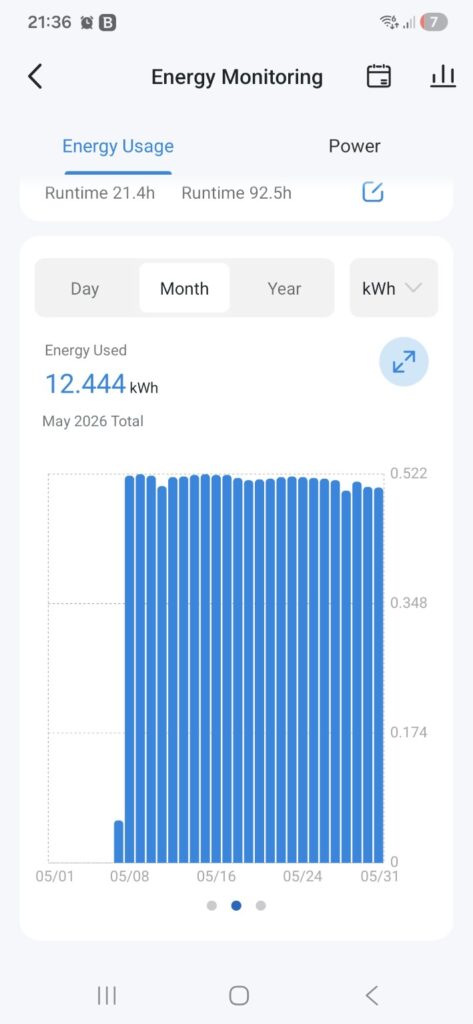
In one monthly reading, the tank used around 12.444 kWh. Spread across 30 days, that works out at roughly 0.415 kWh per day, or about 17W on average.
That is much lower than simply adding together the maximum wattage of the equipment. The reason is that the heater does not run constantly. The filter runs all the time, but the heater only switches on when the tank needs warming back up.
This is an important point for anyone asking can a solar generator run an aquarium. Normal daily energy use may be quite modest, especially in a room kept around 20–21°C. But a power cut is not the same as normal operation. If the room starts cooling, the heater may switch on more often and the battery will drain much faster.
HomeGrower note: measured use is better than guessing
A plug-in energy monitor or smart plug can give you a much clearer idea of your own aquarium’s backup needs. I used the Tapo P110 smart plug to check my own setup, but the main point is to measure your tank over several days, ideally in different seasons. Heater use will be much higher in a cold room than in a warm one.
How to Estimate Solar Generator Runtime
Solar generator capacity is usually listed in watt hours, or Wh.
A 1024Wh power station can theoretically supply:
- 1024 watts for one hour.
- 512 watts for two hours.
- 100 watts for just over ten hours.
In real life, you will not usually get the full capacity into your aquarium equipment. If you are using AC plugs, the inverter uses some energy too.
For simple planning, it is sensible to assume around 85% usable battery capacity.
The basic formula is:
Runtime in hours = usable battery capacity ÷ average aquarium load
For example:
- A 1024Wh power station has around 870Wh usable energy after allowing for losses.
- If the aquarium is using 115W on average, the runtime is around 7.6 hours.
- If the aquarium is only running a 35W filter, the runtime is around 25 hours.
That is why the average heater load matters so much.
How Long Could a Solar Generator Run This Aquarium?
The following table uses the example tank:
- 35W external filter.
- 200W heater.
- Aquarium light switched off.
- 85% usable battery capacity after inverter losses.
| Solar generator | Battery capacity | Filter only at 35W | Filter + heater averaging 75W | Filter + heater averaging 115W | Worst case at 235W |
|---|---|---|---|---|---|
| EcoFlow River 2 | 256Wh | ~6 hours | ~3 hours | ~1.9 hours | ~55 minutes |
| EcoFlow River 2 Max | 512Wh | ~12 hours | ~5.8 hours | ~3.8 hours | ~1.9 hours |
| EcoFlow River 2 Pro | 768Wh | ~18.5 hours | ~8.7 hours | ~5.7 hours | ~2.8 hours |
| EcoFlow Delta 2 | 1024Wh | ~25 hours | ~11.6 hours | ~7.6 hours | ~3.7 hours |
| EcoFlow Delta 2 Max | 2048Wh | ~50 hours | ~23 hours | ~15 hours | ~7.4 hours |
| EcoFlow Delta Pro | 3600Wh | ~87 hours | ~41 hours | ~26.6 hours | ~13 hours |
EcoFlow River 2
Battery capacity: 256Wh
Filter only at 35W: ~6 hours
Filter + heater averaging 75W: ~3 hours
Filter + heater averaging 115W: ~1.9 hours
Worst case at 235W: ~55 minutes
EcoFlow River 2 Max
Battery capacity: 512Wh
Filter only at 35W: ~12 hours
Filter + heater averaging 75W: ~5.8 hours
Filter + heater averaging 115W: ~3.8 hours
Worst case at 235W: ~1.9 hours
EcoFlow River 2 Pro
Battery capacity: 768Wh
Filter only at 35W: ~18.5 hours
Filter + heater averaging 75W: ~8.7 hours
Filter + heater averaging 115W: ~5.7 hours
Worst case at 235W: ~2.8 hours
EcoFlow Delta 2
Battery capacity: 1024Wh
Filter only at 35W: ~25 hours
Filter + heater averaging 75W: ~11.6 hours
Filter + heater averaging 115W: ~7.6 hours
Worst case at 235W: ~3.7 hours
EcoFlow Delta 2 Max
Battery capacity: 2048Wh
Filter only at 35W: ~50 hours
Filter + heater averaging 75W: ~23 hours
Filter + heater averaging 115W: ~15 hours
Worst case at 235W: ~7.4 hours
EcoFlow Delta Pro
Battery capacity: 3600Wh
Filter only at 35W: ~87 hours
Filter + heater averaging 75W: ~41 hours
Filter + heater averaging 115W: ~26.6 hours
Worst case at 235W: ~13 hours
The table shows why size matters.
HomeGrower Pro Tip: Do an emergency test before you need it
Do not wait for a real power cut to find out how your aquarium behaves. If you already own a portable power station, plug the aquarium filter and heater into it for an hour or two while you are at home and watching the tank.
Check the power station display when the heater switches on. The wattage may jump much higher than the filter-only load. This simple test tells you far more than a theoretical calculation and gives you a better idea of how long your own aquarium could run in a real outage.
Even with that real-world test, the table shows why size matters.
A small power station can be useful for short outages or filter-only backup. But if you want proper backup for a large tropical aquarium, especially in winter, a larger model makes much more sense.
For this sort of setup, the EcoFlow Delta 2 is the point where things start to feel practical. The Delta 2 Max gives much more breathing room.
If you are choosing between newer and older Delta models, read our EcoFlow Delta 2 vs Delta 3 comparison before buying.
Should You Run the Aquarium Light During a Power Cut?
Usually, no.
The aquarium light should normally be switched off during a power cut.
That is because:
- Fish do not need it in an emergency.
- Aquarium plants can cope with a short blackout.
- The light adds unnecessary power use.
- The battery should be saved for the filter, water movement and heat.
Even an efficient LED light can make a difference over time.
If a light uses 17W, that is:
17W × 24 hours = 408Wh per day
That is a large share of a small portable power station.
So the practical advice is simple:
During a power cut, keep the aquarium light off unless the outage is clearly short and the battery is comfortably full.
How Much Can Solar Charging Extend Aquarium Runtime?
Solar charging can help, but it does not make an aquarium backup unlimited in all conditions.
Portable solar panels are much more useful in summer than in winter. They can also help in spring and autumn, especially if the tank heater is not working too hard.
In winter, portable solar should be treated as a bonus rather than the main plan.
That is because winter gives you the worst combination:
- Shorter daylight hours.
- Lower sun angle.
- More cloud and rain.
- Higher aquarium heating demand.
- A cooling room if the power is off for long enough.
The table below gives rough, practical estimates for UK conditions. These are not perfect laboratory numbers. They are more realistic figures for planning.
| Portable solar panel | Summer usable top-up | Spring/autumn usable top-up | Winter usable top-up |
|---|---|---|---|
| 110W panel | ~250–400Wh/day | ~100–200Wh/day | ~20–80Wh/day |
| 220W panel | ~500–800Wh/day | ~200–400Wh/day | ~40–160Wh/day |
| 400W panel | ~900–1,400Wh/day | ~400–800Wh/day | ~80–300Wh/day |
110W panel
Summer usable top-up: ~250–400Wh/day
Spring/autumn usable top-up: ~100–200Wh/day
Winter usable top-up: ~20–80Wh/day
220W panel
Summer usable top-up: ~500–800Wh/day
Spring/autumn usable top-up: ~200–400Wh/day
Winter usable top-up: ~40–160Wh/day
400W panel
Summer usable top-up: ~900–1,400Wh/day
Spring/autumn usable top-up: ~400–800Wh/day
Winter usable top-up: ~80–300Wh/day
These numbers show the seasonal difference clearly.
In summer, solar charging can make a meaningful difference.
In spring and autumn, it can still buy useful extra hours.
In winter, it may help, but it is unlikely to keep a heated tropical aquarium running indefinitely unless the aquarium load is very low.
How Much Extra Runtime Could Solar Add?
Let’s use a cool-room aquarium load of 115W.
That could represent the example tank with:
- The 35W filter running continuously.
- The heater cycling moderately.
- The aquarium light switched off.
- The room starting to cool.
At 115W, the aquarium uses:
115W × 24 hours = 2,760Wh per day
Now compare that with likely solar top-up.
| Solar input | Extra runtime at 115W average load | Practical meaning |
|---|---|---|
| 220W panel in summer | +4–7 hours/day | Useful daily extension |
| 220W panel in spring/autumn | +1.5–3.5 hours/day | Helpful, but not a full solution |
| 220W panel in winter | +20–80 minutes/day | Bonus only |
| 400W panel in summer | +8–12 hours/day | Significant extension |
| 400W panel in spring/autumn | +3.5–7 hours/day | Very useful in decent conditions |
| 400W panel in winter | +40 minutes–2.5 hours/day | Helpful, but still limited |
220W panel in summer
Extra runtime at 115W average load: +4–7 hours/day
Practical meaning: Useful daily extension
220W panel in spring/autumn
Extra runtime at 115W average load: +1.5–3.5 hours/day
Practical meaning: Helpful, but not a full solution
220W panel in winter
Extra runtime at 115W average load: +20–80 minutes/day
Practical meaning: Bonus only
400W panel in summer
Extra runtime at 115W average load: +8–12 hours/day
Practical meaning: Significant extension
400W panel in spring/autumn
Extra runtime at 115W average load: +3.5–7 hours/day
Practical meaning: Very useful in decent conditions
400W panel in winter
Extra runtime at 115W average load: +40 minutes–2.5 hours/day
Practical meaning: Helpful, but still limited
Solar top-up helps, but the heater still dominates the calculation.
If the tank is using more than 100W on average, even a decent solar panel may only extend the runtime by a few hours in spring or autumn.
In summer, solar is much more useful because the room is warmer and the heater may barely run.
For general UK solar guidance, the Energy Saving Trust explains how solar panels perform in UK conditions, including the importance of orientation, shading and daylight.
Solar Helps Much More If You Only Need the Filter
The picture changes completely if the priority is filter-only backup.
The example filter uses 35W.
That means it uses:
35W × 24 hours = 840Wh per day
Now solar top-up becomes much more powerful.
| Solar top-up | Extra filter-only runtime | Practical meaning |
|---|---|---|
| 220W panel in summer | +14–23 hours/day | Could nearly cover filter use in good conditions |
| 220W panel in spring/autumn | +6–11 hours/day | Useful extension |
| 220W panel in winter | +1–4.5 hours/day | Small but still helpful |
| 400W panel in summer | +26–40 hours/day | More than enough for filter use in good sun |
| 400W panel in spring/autumn | +11–23 hours/day | Can make a major difference |
| 400W panel in winter | +2–8.5 hours/day | Useful, but not guaranteed |
220W panel in summer
Extra filter-only runtime: +14–23 hours/day
Practical meaning: Could nearly cover filter use in good conditions
220W panel in spring/autumn
Extra filter-only runtime: +6–11 hours/day
Practical meaning: Useful extension
220W panel in winter
Extra filter-only runtime: +1–4.5 hours/day
Practical meaning: Small but still helpful
400W panel in summer
Extra filter-only runtime: +26–40 hours/day
Practical meaning: More than enough for filter use in good sun
400W panel in spring/autumn
Extra filter-only runtime: +11–23 hours/day
Practical meaning: Can make a major difference
400W panel in winter
Extra filter-only runtime: +2–8.5 hours/day
Practical meaning: Useful, but not guaranteed
This is why a solar generator can be excellent for filter backup, even if it is not a perfect winter heating solution.
In a long outage, the strategy may be to run the filter continuously and use the heater more selectively.
What If the Power Cut Is Intermittent?
Not all power cuts are one long uninterrupted blackout.
Sometimes power goes off, comes back on for a while, then goes off again later.
This is where a portable power station can be more useful than the headline runtime table suggests. If the mains electricity comes back even briefly, you may be able to recharge the power station from the wall before the next outage.
That changes the question.
Instead of asking whether the power station can run the aquarium continuously for 24 hours, the real question may be whether it can bridge the gaps between periods of mains power.
In an intermittent outage, the best approach would usually be:
- Keep the aquarium light off.
- Run the filter continuously where possible.
- Let the tank drift slowly from its normal temperature.
- Use the heater to stop the aquarium falling below your emergency minimum.
- Recharge the power station from the mains whenever power returns.
- Use solar as an extra top-up if conditions allow.
For the example tank, the normal target is 25°C, but around 23°C would be a sensible emergency minimum. This means the heater does not necessarily need to run constantly. The battery can be used to slow or prevent further temperature drop while the filter keeps water moving.
Intermittent mains power therefore makes a big difference. A smaller power station may be enough to get through several short cuts, while a larger model such as the Delta 2 or Delta 2 Max gives more breathing room if the gaps between mains power are longer.
Best Solar Generator Size for an Aquarium
The right size depends on the tank.
A small coldwater tank may only need filter or air pump backup. A large tropical tank needs much more capacity if you want to support the heater too.
| Aquarium type | Likely backup need | Sensible power station size |
|---|---|---|
| Small coldwater tank | Filter or air pump only | 250–500Wh |
| Small tropical tank | Filter + small heater | 500–1000Wh |
| Medium tropical tank | Filter + cycling heater | 1000Wh+ |
| Large tropical tank | Filter + 200W+ heater | 1000–2000Wh+ |
| Large tank in winter | Heating and heat retention | 2000Wh+ or extra backup plan |
Small coldwater tank
Likely backup need: Filter or air pump only
Sensible power station size: 250–500Wh
Small tropical tank
Likely backup need: Filter + small heater
Sensible power station size: 500–1000Wh
Medium tropical tank
Likely backup need: Filter + cycling heater
Sensible power station size: 1000Wh+
Large tropical tank
Likely backup need: Filter + 200W+ heater
Sensible power station size: 1000–2000Wh+
Large tank in winter
Likely backup need: Heating and heat retention
Sensible power station size: 2000Wh+ or extra backup plan
For a large tropical aquarium, I would not size the backup around the filter alone. That can be misleading.
The filter may only use 35W, but the heater could draw 200W when active.
For the 240-litre example tank, a small power station is useful for short outages. But for proper aquarium backup, the Delta 2 is a more sensible starting point, and the Delta 2 Max is more reassuring if winter outages are a concern.
You can compare the wider options in our guide to the best solar generators for UK homes .
For EcoFlow-specific choices, see our best EcoFlow solar generators guide.
Practical Emergency Plan for an Aquarium Power Cut
A solar generator is only one part of the plan.
The way you use it matters.
For a tropical aquarium, I would use this order of priorities:
| Priority | Action | Why it matters |
|---|---|---|
| 1 | Keep the filter or water movement running | Supports oxygen and filter bacteria |
| 2 | Turn the aquarium light off | Saves battery for essential equipment |
| 3 | Monitor temperature | Shows when heating is actually needed |
| 4 | Use the heater to protect a minimum temperature | Extends battery life compared with holding perfect normal temperature |
| 5 | Insulate the tank | Slows heat loss |
| 6 | Avoid heavy feeding | Reduces waste and oxygen demand |
1. Keep the filter or water movement running
Why it matters: Supports oxygen and filter bacteria
2. Turn the aquarium light off
Why it matters: Saves battery for essential equipment
3. Monitor temperature
Why it matters: Shows when heating is actually needed
4. Use the heater to protect a minimum temperature
Why it matters: Extends battery life compared with holding perfect normal temperature
5. Insulate the tank
Why it matters: Slows heat loss
6. Avoid heavy feeding
Why it matters: Reduces waste and oxygen demand
This is where real-world aquarium backup differs from a simple wattage calculation.
You do not need to run everything as normal.
You need to keep the tank safe.
How to Make the Battery Last Longer
There are several simple ways to extend aquarium backup runtime.
Turn the Aquarium Light Off
This is the easiest saving.
The light is not essential during an outage, and even a modest LED can use hundreds of watt hours over a full day.
Keep the Lid Closed
Heat escapes faster from open water.
Keeping the lid closed helps slow heat loss and reduces how hard the heater has to work.
Insulate the Glass
You can wrap the sides and back of the tank with:
- Towels.
- Blankets.
- Cardboard.
- Insulation board.
- Bubble wrap in a genuine emergency.
Do not cover electrical equipment dangerously, and do not block ventilation around the power station.
Let the Temperature Drift Slowly
If your tank is normally 25°C, you may not need to hold it there.
For many community tanks, a slow temporary drop to 23°C is more realistic than trying to maintain perfect normal conditions.
Use a Battery Air Pump as a Backup
A USB or battery-powered air pump uses very little energy and can help maintain oxygen.
It will not heat the tank, but it is a useful second layer of protection.
Avoid Unnecessary Feeding
Fish can usually go without food for a short period.
Feeding heavily during a power cut increases:
- Waste.
- Oxygen demand.
- Load on the filter bacteria.
Measure Your Actual Power Use
A plug-in energy meter can show how much your aquarium really uses over 24 hours.
This is especially useful because heater use changes with room temperature.
Should You Use a UPS Instead?
A computer-style UPS can be useful for very short power interruptions, but it is usually not the best choice for long aquarium backup.
A UPS may be useful if you want automatic switchover for:
- A small filter.
- An air pump.
- A circulation pump.
The limitation is capacity. Most small UPS units are designed to keep computers running briefly, not to power an aquarium heater for several hours.
Some portable power stations also have an EPS mode, which stands for Emergency Power Supply. This allows the unit to sit between the wall socket and your equipment, then switch to battery power automatically if the mains fails.
If you want aquarium backup for times when you are not home, EPS mode is worth looking for. It is not the same as a full online UPS, and switchover times vary by model, but it can still be very useful for filters, pumps and aquarium equipment.
For longer outages, a portable power station usually gives much more usable energy than a small UPS, especially if you need to run both a filter and a heater.
The ideal aquarium emergency setup might include:
- A battery air pump for oxygen.
- A portable power station for the filter and heater.
- EPS mode if you want automatic switchover.
- A solar panel for daytime top-up.
- A plan to recharge from the mains if power comes back intermittently.
- Insulation to reduce heat loss.
Is Winter Solar Backup Realistic for an Aquarium?
For a heated tropical aquarium, winter is the hardest case.
The aquarium heater may need more power just when solar panels are producing less.
That does not mean solar is useless. It can still add useful energy, especially on clear days. But in a dark, cloudy UK winter outage, portable solar should not be treated as the main plan.
For winter, the more reliable strategy is:
- Start with enough battery capacity.
- Keep the aquarium light off.
- Insulate the tank.
- Use the heater to protect a minimum temperature.
- Recharge from the mains whenever power returns.
- Use solar as a bonus.
Spring, summer and autumn are easier. In those seasons, the room may stay warmer, the heater may cycle less often, and solar charging can add much more useful energy.
Final Thoughts: Is a Solar Generator Worth It for an Aquarium?
A solar generator can be a very useful aquarium power backup, but it needs to be sized realistically.
For a coldwater tank or filter-only backup, even a smaller power station can make a big difference.
For a large tropical aquarium, the heater changes everything.
A 35W filter is easy to support. A 200W heater is not. The heater will not run constantly in normal conditions, but if the room cools during a long outage, battery runtime can fall quickly.
The best emergency strategy is not to run the aquarium exactly as normal. It is to prioritise the essentials:
- Run the filter.
- Keep water moving.
- Turn the light off.
- Let the temperature drift slowly if needed.
- Use the heater to protect a safe minimum rather than holding a perfect 25°C.
For the example 240-litre tropical tank in this guide, the EcoFlow Delta 2 is the point where aquarium backup starts to feel genuinely practical. The Delta 2 Max is more reassuring for winter outages or wider home backup use.
Solar charging can extend the runtime in summer and help in spring and autumn. In winter, it is better treated as a useful bonus rather than a guarantee.
If you are choosing a model, read our full <a href=”https://homegrower.co.uk/best-solar-generators-uk/”>Best Solar Generators UK</a> guide first. If you are already leaning towards EcoFlow, our <a href=”https://homegrower.co.uk/best-ecoflow-solar-generators-uk/”>Best EcoFlow Solar Generators UK</a> guide will help you compare the main options.
The simple rule is:
For aquarium backup, size the solar generator around the heater, not just the filter.
📎 Related Articles
FAQs: Can a Solar Generator Run an Aquarium?
Can a solar generator run an aquarium filter?
Yes, a solar generator can usually run an aquarium filter quite easily. Most aquarium filters use much less power than a heater, so even a smaller portable power station may keep a filter running for several hours or more.
Can a solar generator run an aquarium heater?
A solar generator can run an aquarium heater, but the heater is usually the main battery drain. A 200W heater does not normally run constantly, but in a cold room during a power cut it may switch on much more often.
Should I run my aquarium light during a power cut?
In most cases, no. The aquarium light should usually stay off during a power cut so the battery can be saved for the filter, water movement and heater. Fish and plants can cope with a short period without light.
What size solar generator do I need for an aquarium?
For a small filter-only backup, 250–500Wh may be enough. For a tropical aquarium with a heater, 1000Wh or more is more realistic. For a large tropical tank in winter, 2000Wh or an additional backup plan is more reassuring.
Can solar panels keep an aquarium running during a power cut?
Solar panels can extend aquarium backup time, especially in summer and shoulder seasons. In winter, portable solar charging should be treated as a helpful bonus rather than the main plan, because solar output is lower just when the heater may need more power.