
When you purchase through links on our site, we may earn an affiliate commission at no extra cost to you.
Our Top Picks by Setup
These LED grow lights cover everything from compact home growing at around 100W to powerful 600–1000W fixtures for much larger indoor setups. All are capable of growing flowering and fruiting plants when matched to an appropriately sized growing area, and most are available in other wattages within the same or closely related range.
Best Budget Grow Light
Mars Hydro TS600
Hands-on tested. Affordable 100W-class LED grow light for compact setups where keeping purchase cost low matters most.
Best for More Coverage in a Compact Setup
ViparSpectra XS1500 Pro
Hands-on tested. A stronger 150W option that gives noticeably more usable coverage than a typical 100W panel without becoming difficult to manage at home.
Best for Medium-Sized Setups
Lumatek ATS 300W Pro
Well-suited to wider canopies and several mature plants where a compact 100W or 150W panel would not provide enough coverage.
Best for Large Grow Areas
Lumatek Zeus Pro 600W
High-efficiency bar-style fixture designed to spread strong, even light across a substantially larger growing area.
Best Smart Large-Area Light
AC Infinity IONFRAME EVO10 1000W
Very high-output fixture for large indoor setups, combining broad canopy coverage with AC Infinity’s integrated smart-control ecosystem.
Jump to: Mars Hydro TS600 | Spider Farmer SF1000 | ViparSpectra XS1500 Pro | Lumatek ATS 300W PRO | Lumatek Zeus 600W Pro | AC Infinity IONFRAME EVO10
Choosing the best LED grow lights for a UK home setup comes down to matching the quality and output of the light to your growing space, the plants you want to grow and the coverage you actually need. This guide compares six representative LED grow lights from ViparSpectra, Mars Hydro, Spider Farmer, Lumatek and AC Infinity, covering models from around 100W up to 1000W.
I start at around 100W because, for a proper LED panel, I consider this roughly the lower end of what is genuinely useful for growing more demanding flowering and fruiting plants indoors rather than just seedlings, herbs or supplemental lighting. A good 100W light can still grow productive plants in a small area, while higher-powered models mainly give you more usable intensity and coverage.
The individual lights featured here are representative models from each range rather than the only suitable wattage. Most of the brands covered offer the same or closely related lights in several different sizes and power levels, so within each section I also point to alternative wattages where they may be a better fit for a smaller or larger grow area.
I have already published detailed hands-on reviews of the ViparSpectra XS1500 Pro, Spider Farmer SF1000 and Mars Hydro TS600, with links to those full reviews below. This guide brings those first-hand experiences together with several other leading models, with more individual reviews to follow as I test and cover them in greater detail.
If you are looking for lower-cost alternatives such as bulbs, strip lights or simpler shelf setups rather than full LED panels, see our Best Cheap Grow Lights UK guide.
Quick Comparison Table


Important: All wattage figures in this guide refer to actual power draw at the wall — not “equivalent” or “replacement” wattage.
If a light here is listed as 150W, that’s what it really uses when it is running on full power.
Detailed Reviews of Each Grow Light
Below, you’ll find a closer look at each grow light, including its main strengths, limitations and the type of indoor setup it suits best.

The Mars Hydro TS600 is one of the more affordable 100W LED panels from a recognised grow-light brand, making it a sensible starting point for smaller indoor setups.
Best for: budget-conscious growers using a small tent, cupboard or compact indoor setup who want a light capable of taking flowering and fruiting plants through a full grow without stepping up to a larger panel.
I tested the TS600 with a large bush tomato that I brought indoors in September as outdoor light levels and temperatures began to fall. Rather than starting with a seedling, this gave the light the more demanding job of maintaining an established fruiting plant through the end of the season.
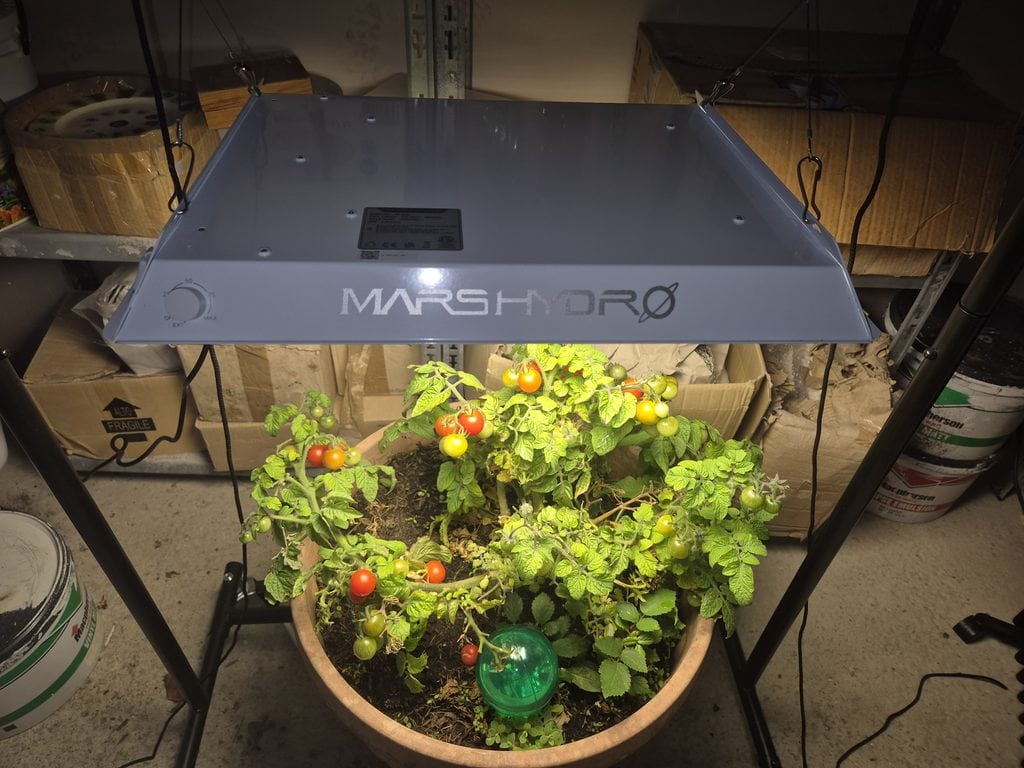
My Mars Hydro TS600 in use with a fruiting bush tomato.
In my setup, the TS600 was positioned roughly 25–30cm above the canopy. I initially ran it for around 16 hours a day, later reducing that to about 14 hours as the plant settled into the indoor setup. The tomato continued to grow and ripen fruit under the light, which is a useful real-world indication of what a good 100W panel can do when it is concentrated over a compact canopy.
The current 2026 TS600 is more flexible than older versions because it now includes dimming. Output can be reduced for seedlings and younger plants, then increased as they develop.
It draws around 100W at full output and is best suited to a compact growing area. That puts it in the same broad power class as the Spider Farmer SF1000, although the two lights differ in their design, controls and light distribution.
The current TS600 also supports compatible Mars Hydro multi-light control through its control connection, with smart and app functions available when used with a compatible Mars Hydro controller. These features are not built directly into the light itself.
Passive cooling means there is no fan noise, and the slim aluminium-backed fixture is easy to accommodate in a cupboard, small tent or open indoor setup. As with any enclosed setup, reasonable airflow is still important.
The main limitation is coverage. At 100W, the TS600 is best used over a compact canopy rather than trying to spread its output across several mature fruiting plants. If you need more growing area, the larger TS models below provide a straightforward step up in power and coverage.
Other Mars Hydro TS sizes
- Mars Hydro TS1000 – 150W step-up for a larger compact growing area.
- Mars Hydro TSL2000 – 300W model with a longer, narrower footprint.
- Mars Hydro TSW2000 – 300W option designed around a squarer growing area.
- Mars Hydro TS3000 – 450W option for a substantially larger grow space.
What we like
- Low entry price for a recognised grow-light brand
- Personally tested with an established fruiting tomato
- Dimmable on the current 2026 version
- Compatible multi-light control
- Optional smart control with a compatible Mars Hydro controller
- Silent, fanless operation
Things to be aware of
- 100W output is best concentrated over a compact canopy
- Not intended to cover several mature fruiting plants at once
- Smart control requires additional compatible hardware
- Older TS600 versions may have different controls, so check the exact model being sold
Bottom line
The Mars Hydro TS600 is a good budget choice if you want a compact 100W panel that is genuinely capable of supporting a fruiting plant rather than just seedlings or herbs. In my own test, it kept a mature bush tomato growing and ripening indoors after I moved it in at the end of the outdoor season.
You can read my full Mars Hydro TS600 review for photographs of the setup, measured power use and direct comparisons with the Spider Farmer SF1000 and ViparSpectra XS1500 Pro.
I have used the Spider Farmer SF1000 in my own indoor setup with fruiting plants and written a full hands-on review based on that experience.
Best for: compact indoor setups where efficiency and lower power use matter, while still having enough output to take one or two fruiting plants through a complete grow.
In my setup, the SF1000 was powerful enough for a tomato and chilli plant, with around two mature fruiting plants being a sensible practical limit. At 100W, that makes it a useful option for growers who want to keep electricity use relatively low without dropping down to a weaker shelf or propagation light.
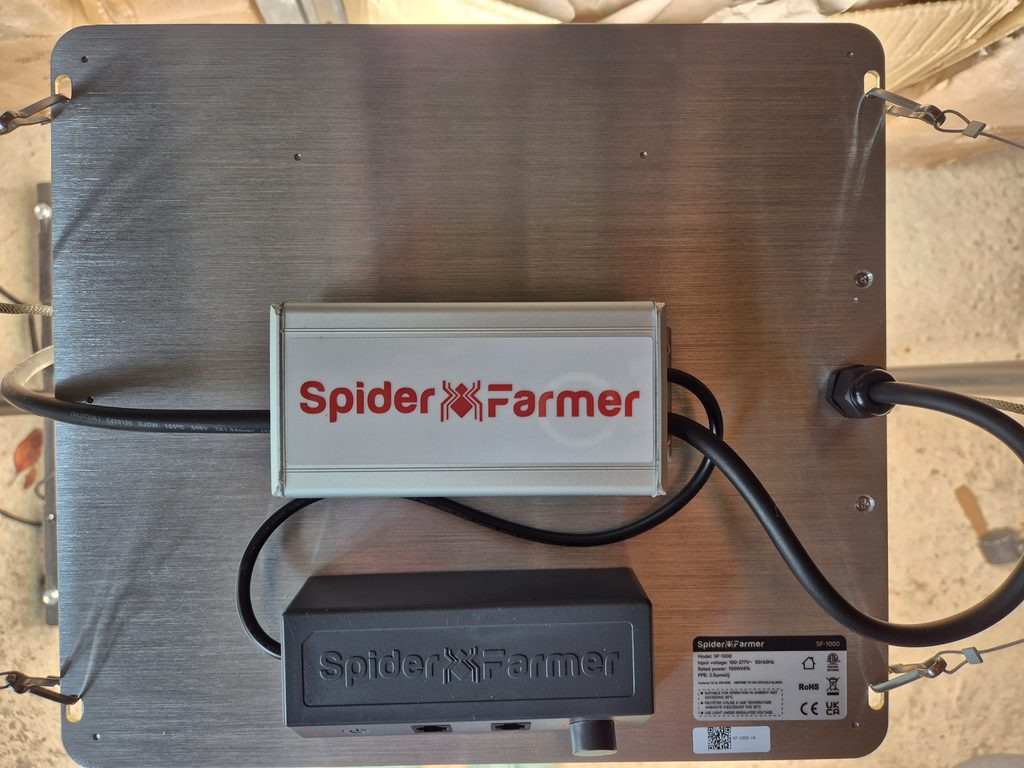
Spider Farmer SF1000 100W LED grow light photographed during my hands-on test.
The built-in dimmer lets you reduce the output for seedlings and younger plants before increasing the intensity as they become established and move into flowering and fruiting.
The SF1000 also supports daisy chaining, allowing compatible Spider Farmer lights to be linked and controlled together. Smart and app control can be added through Spider Farmer’s compatible GGS controller, although it is not built directly into the light.
It is fanless, so there is no cooling noise. The metal board becomes warm during use, but I did not find heat difficult to manage in my setup.
The main limitation is coverage. Its 100W output is best concentrated over a compact canopy, and it cannot spread useful flowering intensity across the same area as a stronger 150W or 200W panel.
Build quality feels more budget-focused than the ViparSpectra XS1500 Pro I have also used, although Spider Farmer’s five-year limited warranty is reassuring at this price.
Other Spider Farmer SF sizes
- Spider Farmer SF2000 Pro – 200W step-up with Samsung LM301H EVO LEDs and more coverage for a larger canopy.
- Spider Farmer SF4000 – around 450W for substantially larger growing areas.
- Spider Farmer SF7000 – around 650W for very large indoor setups where much wider coverage is required.
What we like
- Good practical fit for one or two mature fruiting plants
- Efficient 100W power draw for a compact full-cycle grow light
- Built-in dimmer
- Daisy-chain support
- Optional smart control through a compatible GGS controller
- Silent fanless operation
- Five-year limited warranty
Things to be aware of
- 100W output limits the usable growing area
- Less coverage than a good 150W or 200W panel
- Smart control requires an additional controller
- Build quality feels more budget than mid-range
Bottom line
The Spider Farmer SF1000 performed well in my small indoor setup and makes most sense if you want to keep power consumption relatively low while still having enough light for one or two mature fruiting plants. Its strength is efficient performance in a compact area rather than maximum coverage.
For photographs, setup details, hanging distances and my full growing results, read my Spider Farmer SF1000 Grow Light Review .
I have used the ViparSpectra XS1500 Pro in my own indoor setup with tomatoes, chillies and peppers, and written a full hands-on review based on that experience.
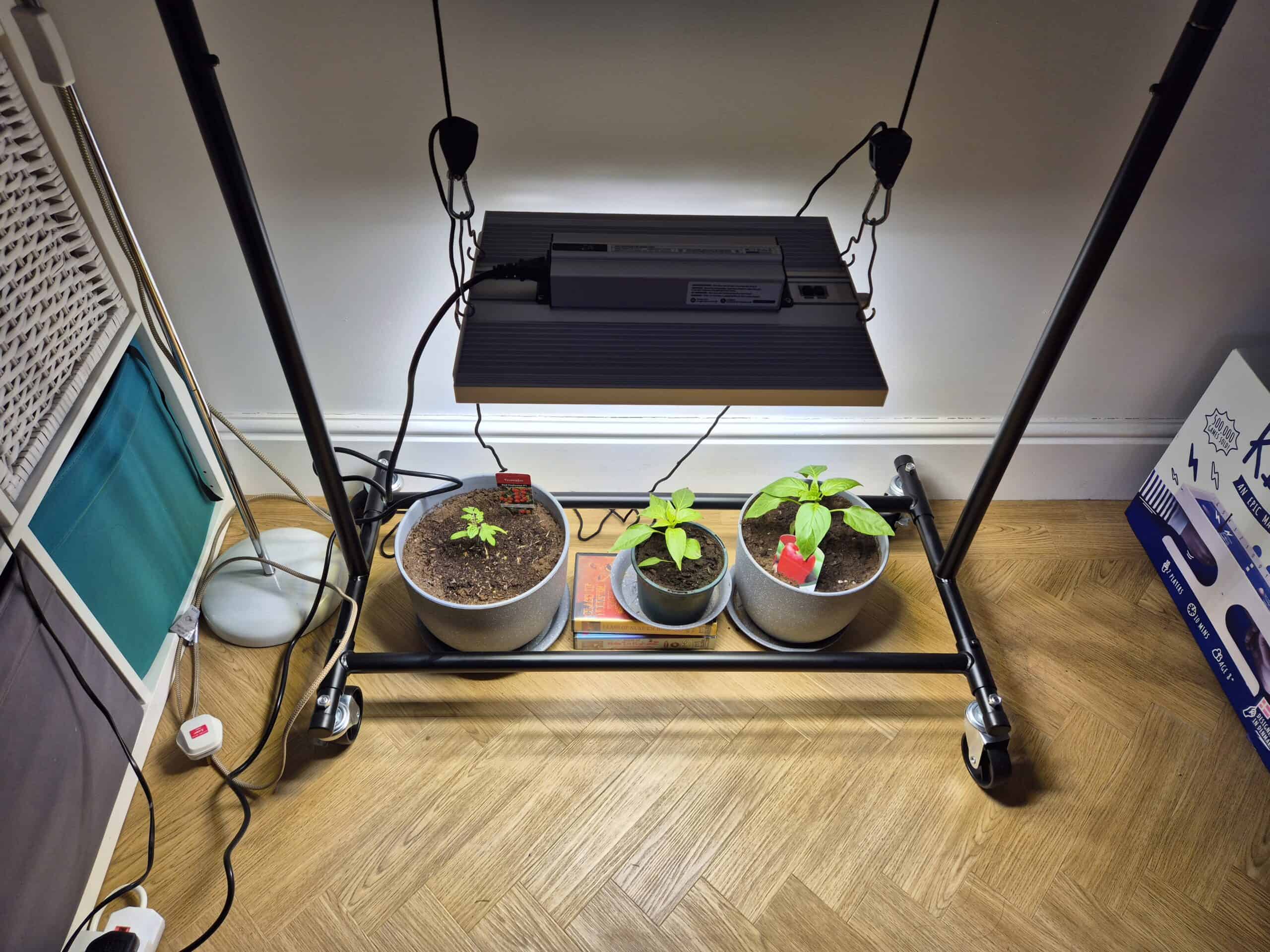
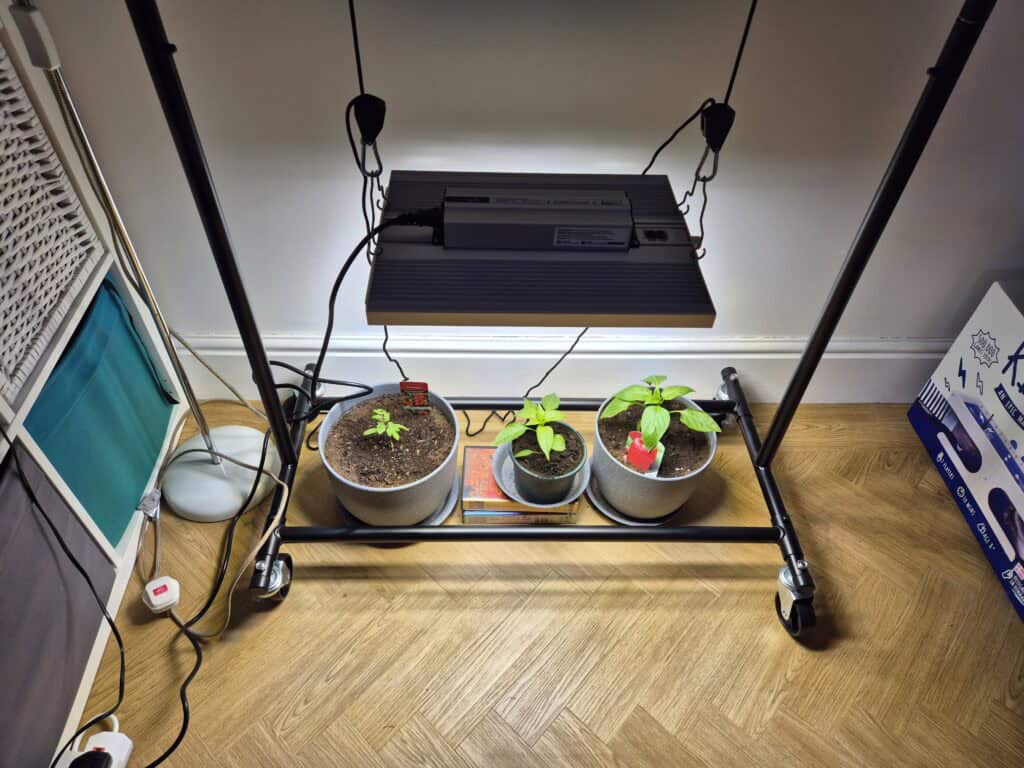
Best for: small indoor setups where you want more usable coverage than a typical 100W panel. In my setup, the 150W XS1500 Pro has comfortably supported around three productive plants rather than the one or two I would normally expect from a compact 100W light, provided the plants are not allowed to spread too widely.
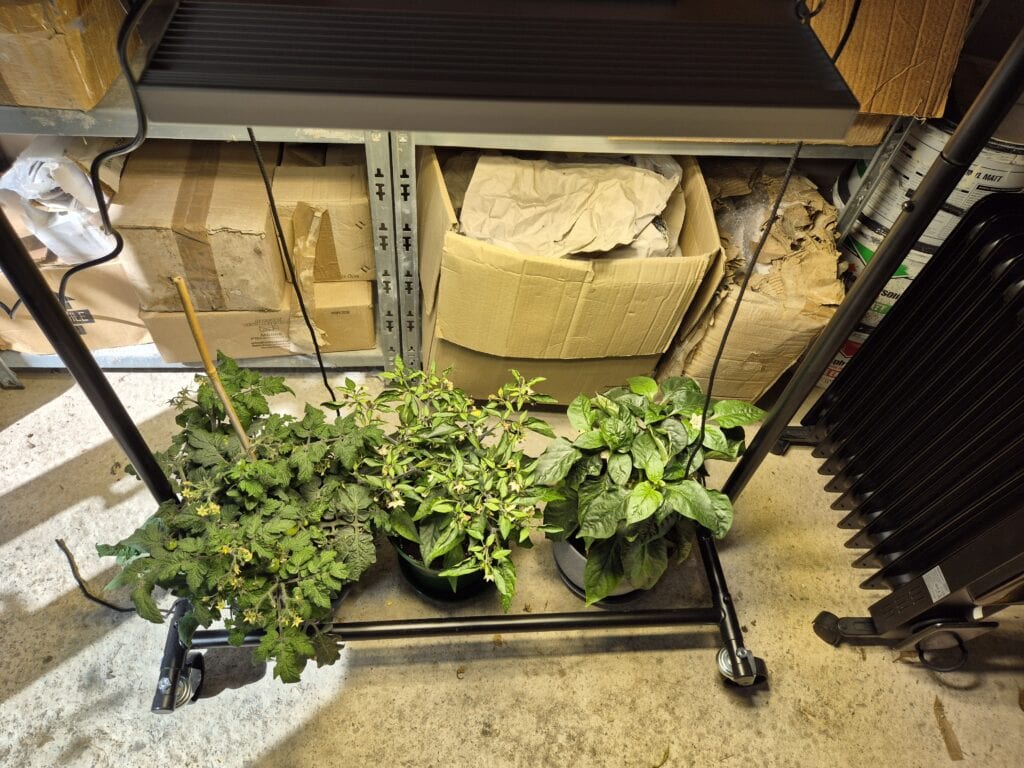
ViparSpectra XS1500 Pro covering three different fruiting plants in my indoor setup — tomato, chilli and pepper. Different species can respond differently to the same light intensity, while three plants of the same type would usually give a more uniform canopy and response.
In my setup, the XS1500 Pro hangs from a standard clothes rail using the supplied adjustable hangers. It is light enough to move easily, but feels solid and well made, and I have found it simple to raise as the plants grow.
I started at around 60% power for younger plants and increased the output as they developed. The built-in dimmer is one of its most useful features because it lets you control intensity without constantly changing the hanging height. I have generally kept it around 25–35cm above the canopy and run it for roughly 14–16 hours a day.
The main difference compared with relying on a windowsill has been the quality of the growth. The plants have grown faster and remained more compact, with deep green leaves and much less stretching towards the light.
The extra output over the 100W lights in this guide also gives me noticeably more usable growing area. I have comfortably grown around three plants beneath the XS1500 Pro, compared with roughly one or two mature fruiting plants being more realistic under the smaller 100W panels. The limitation is plant width: three compact plants can fit well, but coverage becomes less even if they develop very broad canopies.
The XS1500 Pro also supports daisy chaining if you later want to run compatible lights together. There is no built-in app control, so I use a Tapo smart plug to automate the daily light schedule instead.
In everyday use, the XS1500 Pro runs silently, produces manageable heat and has delivered consistent output without making the setup complicated.
Other ViparSpectra options
- ViparSpectra XS3000 Pro – 300W step-up in the same XS Pro family for a larger growing area.
- ViparSpectra P2000 – higher-output alternative from the P series if you want more coverage than the XS1500 Pro.
What we like
- Noticeably more usable coverage than the 100W lights I have tested
- Good practical fit for around three compact fruiting plants
- Strong enough for tomatoes, chillies and peppers
- Built-in dimmer
- Daisy-chain support
- Silent operation with manageable heat
- Simple to hang and adjust as plants grow
Things to be aware of
- No built-in smart or app control
- Three plants need reasonably compact canopies; very wide plants reduce usable coverage
- More power than most people need for herbs or seedlings alone
Bottom line
From my experience, the ViparSpectra XS1500 Pro is the most useful step up from the 100W lights I have tested when you want more growing area without moving to a much larger fixture. Its 150W output has been enough for around three compact fruiting plants in my setup, while still being easy to hang, dim and manage at home.
For photographs of the setup, exact distances, power levels and longer-term growing notes, read my ViparSpectra XS1500 Pro Review .
The Lumatek ATS 300W PRO sits in the middle of this guide in terms of power. It is aimed at growers who want substantially more output and coverage than a compact 100W or 150W panel without moving up to the much larger 600W and 1000W fixtures covered later in the guide.
Best for: medium-sized indoor setups, wider canopies and several flowering or fruiting plants where a smaller compact panel would not provide enough coverage.
At around 300W actual power draw, the ATS 300W PRO is a substantial step up from the smaller lights in this guide. Its wider LED layout helps spread that output across roughly a 1 × 1m growing area rather than concentrating most of the intensity in the centre.
That makes it better suited to several mature plants or a broad canopy where maintaining useful light levels towards the edges becomes more important. The full-spectrum output is designed for use through vegetative growth, flowering and fruiting.
The light is dimmable, so you do not need to run the full 300W output when plants are young. Output can be increased as the canopy develops, which also gives you some control over electricity use and heat.
Cooling is passive, with no internal fan, so operation is silent. A 300W fixture will still add noticeably more heat to a room or tent than the smaller panels in this guide, making good airflow and ventilation more important.
The main drawback is cost. The ATS 300W PRO is considerably more expensive than the compact lights earlier in this guide, so it makes most sense if you will genuinely use the extra output and growing area. For one or two plants, seedlings or a very small cupboard setup, a lower-powered light would be easier and cheaper to run.
I have not yet tested the ATS 300W PRO personally, but this is the next grow light I plan to test. Once I have used it with plants, I will update this section with my own photographs, setup details and real-world growing results.
Other Lumatek ATS option
- Lumatek ATS 200W PRO – smaller version of the same ATS range for growers who want Lumatek build quality in a more compact setup.
What we like
- Strong 300W output for medium-sized growing areas
- Broad, even coverage across a larger canopy
- Built-in dimming for different growth stages
- Suitable for demanding flowering and fruiting plants
- Silent, fanless operation
- Well suited to growers stepping up from compact 100W to 150W panels
Things to be aware of
- Higher purchase price than the smaller lights in this guide
- Higher electricity use and heat output than 100W to 150W panels
- Too powerful for shelves and very compact setups
- Good ventilation becomes more important at 300W
- Not yet hands-on tested by HomeGrower
Bottom line
The Lumatek ATS 300W PRO makes sense for growers who need a clear step up in output and coverage from a compact panel but do not need the scale of a 600W or 1000W fixture. It should be a good fit for several mature fruiting plants or a medium-sized canopy where even light distribution matters.
As this is the next light I plan to test, I will be able to add my own real-world results and compare it directly with the 100W and 150W lights already covered hands-on in this guide.
The Lumatek Zeus 600W Pro is the first genuinely large-area light in this guide. It uses a wide multi-bar design rather than a compact board, which helps spread its output much more evenly across a broad canopy.
Best for: larger indoor setups, wide canopies and growers who need substantially more usable growing area than a 300W-class fixture can provide.
Power consumption is around 600W, with the current Zeus 600W Pro rated at roughly 2.9 µmol/J. That gives it a combination of high output and strong efficiency, making it much better suited to large canopies than the compact 100W to 300W panels covered earlier in this guide.
The main advantage of the Zeus design is coverage. Instead of concentrating most of the light in the middle of one board, multiple LED bars spread the diodes across a much larger frame. This should help maintain stronger PPFD towards the edges of the growing area and makes the light better suited to a broad, even canopy.
Lumatek rates the Zeus 600W class for a large growing footprint, and its full-spectrum output is intended for complete grows from vegetative growth through flowering and fruiting. The key advantage of moving to 600W is not simply more intensity, but the ability to maintain useful light levels across a much larger area.
The fixture is dimmable, allowing output to be reduced when plants are young or when the full 600W is unnecessary. Lumatek also supports external control on compatible Zeus fixtures, which can be useful in larger or more advanced setups.
Cooling is passive, so there are no cooling fans built into the light. That keeps operation silent, although a 600W fixture still converts a substantial amount of electrical power into heat within the growing space, so good ventilation becomes much more important than it is with a 100W or 150W panel.
The main drawback is cost. At around £600 when I checked, this is a significant investment, and there is little reason to spend this much unless you genuinely need the coverage and output. For a small cupboard, shelf or one or two plants, one of the lower-powered lights earlier in the guide will make far more sense.
Other Lumatek Zeus sizes
- Lumatek Zeus 465W Pro – lower-powered Zeus option for growers who want the same wide bar-style approach in a somewhat smaller growing area.
- Lumatek Zeus 1000W Pro – much higher-output version designed for very large indoor growing areas.
What we like
- Powerful 600W output for large growing areas
- High efficiency for a 600W fixture
- Multi-bar layout designed for broad, even canopy coverage
- Dimmable for different growth stages and smaller plants
- Suitable for complete flowering and fruiting grows
- Silent passive cooling
- External control support for more advanced setups
Things to be aware of
- High purchase price compared with compact LED panels
- 600W power consumption means noticeably higher running costs
- Produces substantially more heat than the smaller lights in this guide
- Physically much larger and requires a suitable hanging structure
- Excessive for small growing spaces
Bottom line
The Lumatek Zeus 600W Pro is the large-area choice in this guide for growers who need much broader coverage than a compact or mid-powered panel can provide. Its efficient multi-bar design and strong output make it particularly well suited to larger canopies and several mature plants.
I have not yet used the Zeus 600W Pro personally, so this recommendation is based on its published specifications, design and position within Lumatek’s established LED range rather than a hands-on grow test. If I move to a substantially larger indoor setup, this is one of the high-output lights I would be most interested in testing.
The AC Infinity IONFRAME EVO10 1000W is the most powerful light in this guide and is aimed at growers who need genuinely large-area coverage rather than simply more intensity over a small space.
Best for: very large indoor growing areas, broad canopies and growers who want a high-output fixture that also integrates with AC Infinity’s wider smart-control ecosystem.
The EVO10 uses a wide bar-style layout with Samsung LM301H EVO LEDs, spreading the diodes across a large frame rather than concentrating them onto a compact board. This type of design is intended to provide more even coverage across a broad canopy and reduce the drop-off in intensity towards the edges of the growing area.
AC Infinity rates the EVO10 for up to around 7 × 7 ft in vegetative growth and 6 × 6 ft in flowering. Those are very large coverage figures compared with the smaller lights in this guide and help explain why a 1000W fixture only really makes sense when you have a genuinely broad canopy to illuminate.
At around 1000W, this is far beyond what most small home growers will need. Its main advantage is not simply extra power, but the ability to maintain useful flowering and fruiting intensity across a very large growing area.
The light is dimmable, allowing output to be reduced when plants are young or when the full 1000W is unnecessary. That flexibility is particularly useful with a fixture this powerful, as maximum output will not be needed at every stage of a grow.
One of the biggest reasons to consider the IONFRAME range is AC Infinity’s smart-control ecosystem. Compatible controllers can bring lighting together with equipment such as fans and environmental controls, allowing a larger indoor setup to be managed as one system rather than as a collection of separate devices.
Cooling is passive, so there are no built-in cooling fans adding noise. However, a 1000W grow light still introduces a substantial amount of heat into the growing space, so suitable extraction and airflow become essential at this level of power.
The main drawbacks are price, physical size and running costs. At over £1,000 when I checked, this is a serious investment and only makes sense if you can genuinely use its large coverage area. For a typical home grow, one of the lower-powered IONFRAME models will usually be much more practical.
Other AC Infinity IONFRAME sizes
- AC Infinity IONFRAME EVO3 280W – much smaller option for growers who want the IONFRAME platform without the scale or power consumption of the EVO10.
- AC Infinity IONFRAME EVO6 500W – strong mid-to-large-area option offering much more coverage than the EVO3 while remaining considerably easier to manage than the 1000W flagship.
What we like
- Very high output for genuinely large growing areas
- Rated for up to around 7 × 7 ft in veg and 6 × 6 ft in flower
- Wide bar-style design for broad, even canopy coverage
- Samsung LM301H EVO LEDs
- Built-in dimming for different growth stages
- Strong integration with AC Infinity’s smart-control ecosystem
- Suitable for complete flowering and fruiting grows
- Silent passive cooling
- Smaller IONFRAME models available using the same general platform
Things to be aware of
- Very high purchase price
- 1000W maximum output means substantial electricity use
- Produces significant heat despite passive cooling
- Physically large and requires a suitable hanging structure
- Far more powerful than most home setups require
Bottom line
The AC Infinity IONFRAME EVO10 1000W is the smart large-area choice in this guide. Its combination of very high output, broad bar-style coverage and integration with AC Infinity’s control ecosystem makes it most relevant to growers running a genuinely large indoor setup.
For most home growers, the more practical appeal of the IONFRAME range may be the smaller EVO3 and EVO6 models. They offer the same general platform and smart-control approach without requiring the space, power consumption or budget of the 1000W EVO10.
I have not personally tested the IONFRAME EVO10, so this recommendation is based on its specifications, design and position within AC Infinity’s range rather than a hands-on grow test. You can also read my AC Infinity UK brand review for a broader look at the company’s grow lights, ventilation and smart-control equipment.
How Much Do LED Grow Lights Cost to Run?
Based on the wattage figures above, you can use the calculator below to estimate what each light costs to run using your own electricity unit rate.
Grow Light Running Cost Calculator (UK)
Enter your grow light’s actual wattage, how many hours you run it, and your electricity unit rate. You’ll get an instant estimate of the running cost per day, month and year.
UK tip: Check your latest bill or energy app and look for “Unit rate” or “Price per kWh”.
This calculator works regardless of how energy prices change in the future.
Standing charges aren’t included because they don’t change when you switch a grow light on or off.
Estimated running cost
Show the maths in plain English
Note: This estimate is for the grow light only. Fans, heaters, dehumidifiers and pumps can add extra usage.
How to reduce running costs without buying anything
- Use a plug-in timer so the light follows a consistent schedule and is not left on accidentally.
- Don’t run lights longer than needed — extra hours increase costs and do not necessarily improve growth.
- Set the distance carefully — placing the light too far away wastes usable output, while placing it too close may stress plants.
- Adjust the setup as plants develop — seedlings and young plants may not need the same intensity as mature fruiting crops.
How to Compare LED Grow Lights
Choosing the right LED grow light is mainly about matching the fixture to your growing area, plants and budget. Wattage matters, but coverage, efficiency, shape and controls all affect how useful a light will be in practice.
Look at Efficiency and Total Output
LED grow light efficiency is usually expressed in µmol/J, while PPF measures the fixture’s total usable light output. A more efficient light can produce more plant-usable light from the same amount of electricity, but efficiency should not be considered on its own.
A lower-wattage light may be highly efficient but still produce less total light than a larger fixture. For fruiting plants and wider growing areas, total output and how evenly that light is distributed matter just as much.
Match the Light to Your Growing Area
Coverage figures can be misleading if you compare them without looking at how the light will actually be used. A compact square panel may suit one or two plants, while a longer panel or bar-style light can spread its output across a wider canopy.
- Small tents and cupboards: compact LED panels are usually the easiest fit.
- Wider or rectangular areas: larger panels and bar-style fixtures can provide more even coverage.
- Shelves and propagation areas: slim lights are often more practical where growing height is limited.
Treat manufacturer coverage figures as a starting point rather than a guarantee. The same light may cover a larger area for seedlings or vegetative growth than it can for mature flowering and fruiting plants.
Choose a Practical Full-Spectrum Light
Most modern white full-spectrum LED grow lights can support plants through vegetative growth, flowering and fruiting. Extra features such as UV or infrared are not essential for most home growers.
For a fuller explanation of spectrum, efficiency, light types and setup, see our Grow Lights Explained guide.
Check the Controls
Useful controls can make a grow light much easier to adapt as plants develop.
- Dimming: lets you reduce intensity for younger plants and increase it later.
- Daisy-chain control: useful if you plan to run several compatible lights together.
- Smart or app control: available on some lights directly or through an additional controller.
- Timers or smart plugs: useful for keeping the daily light schedule consistent.
Consider Purchase Price and Running Costs Together
A cheaper light may save money upfront, but efficiency and coverage determine how much useful light you get from the electricity it uses. A 100W light will consume roughly the same amount of electricity regardless of brand, but two 100W fixtures can still perform quite differently.
Use the calculator above to compare likely running costs using your own electricity tariff and daily schedule.
Follow the Manufacturer’s Height Guidance
There is no single correct hanging height for every LED grow light. The right distance depends on the fixture, its power setting, the plant and its growth stage.
Start with the manufacturer’s recommendation and adjust gradually based on plant response. For more detailed guidance, see our Grow Light Distance Chart UK.
Final Thoughts
The best LED grow light is the one that matches your growing area, plant type and budget rather than simply the model with the highest wattage.
For a compact setup, the Mars Hydro TS600 is the lowest-cost option in this guide, while the Spider Farmer SF1000 is a strong 100W choice if efficiency and lower power use are priorities. From the lights I have personally tested, the ViparSpectra XS1500 Pro gives the most useful step up in coverage, supporting around three compact fruiting plants in my setup.
For larger growing areas, the Lumatek ATS 300W Pro is better suited to a medium-sized canopy, while the Lumatek Zeus 600W Pro moves into genuinely large-area coverage. The AC Infinity IONFRAME EVO10 sits at the top end of the guide for very large setups where high output and smart-system integration are both important.
Whichever size you choose, focus on actual input power, realistic coverage, efficiency, useful controls and how well the fixture matches your available space. Those factors matter far more than exaggerated equivalent-wattage claims.
Related Guides
FAQs
How many plants can a 100W LED grow light support?
For mature flowering or fruiting plants, a good 100W LED is usually best concentrated over a compact canopy. In my own tests, one or two mature plants has been a sensible practical limit, depending on how wide they grow. Compact chillies and bush tomatoes are easier to cover than large, spreading plants.
Is 150W noticeably better than 100W for indoor growing?
Yes, mainly because of the extra usable coverage rather than simply more brightness. In my setup, a 150W light such as the ViparSpectra XS1500 Pro has been able to cover around three reasonably compact fruiting plants, whereas the 100W lights are better suited to roughly one or two mature plants.
Can LED grow lights be used without a grow tent?
Yes. I use grow lights in an open indoor setup rather than a grow tent. They can be hung from shelves, stands or simple rails. A tent is useful for containing stray light and making temperature, humidity and airflow easier to manage, but it is not essential.
Do I need a 600W or 1000W grow light for home growing?
Usually not. Lights at 600W and above make most sense when you are trying to illuminate a genuinely large canopy or several mature plants over a wide area. For a small home setup, a 100W to 300W fixture is often easier to manage, cheaper to run and better matched to the available space.
How much electricity does an LED grow light use?
Electricity use depends on the fixture’s actual input power and how long it runs. A 100W light used for 12 hours consumes about 1.2kWh per day, while a 300W light on the same schedule uses about 3.6kWh. Use the running-cost calculator above with your own tariff and daily schedule for a more accurate estimate.
How far should an LED grow light be from plants?
There is no single correct distance for every light. Start with the manufacturer’s guidance, then adjust according to the fixture, dimmer setting, growth stage and plant response. Seedlings usually need less intensity than mature flowering or fruiting plants.
Do grow lights provide enough heat for an unheated room?
Usually not. LED grow lights still release heat, especially larger 300W to 1000W fixtures, but they should not be relied on as room heating. In a cold conservatory, shed or unheated room, plant temperature can still become the limiting factor even when the light itself is performing normally.
Is a dimmer worth having on an LED grow light?
Yes. Dimming lets you reduce intensity for seedlings and younger plants, then increase output as the canopy develops. It can also help control heat and electricity use without constantly changing the hanging height.