
When you purchase through links on our site, we may earn an affiliate commission at no extra cost to you.
🏆 Best Jackery Solar Generators UK – Our Top Picks
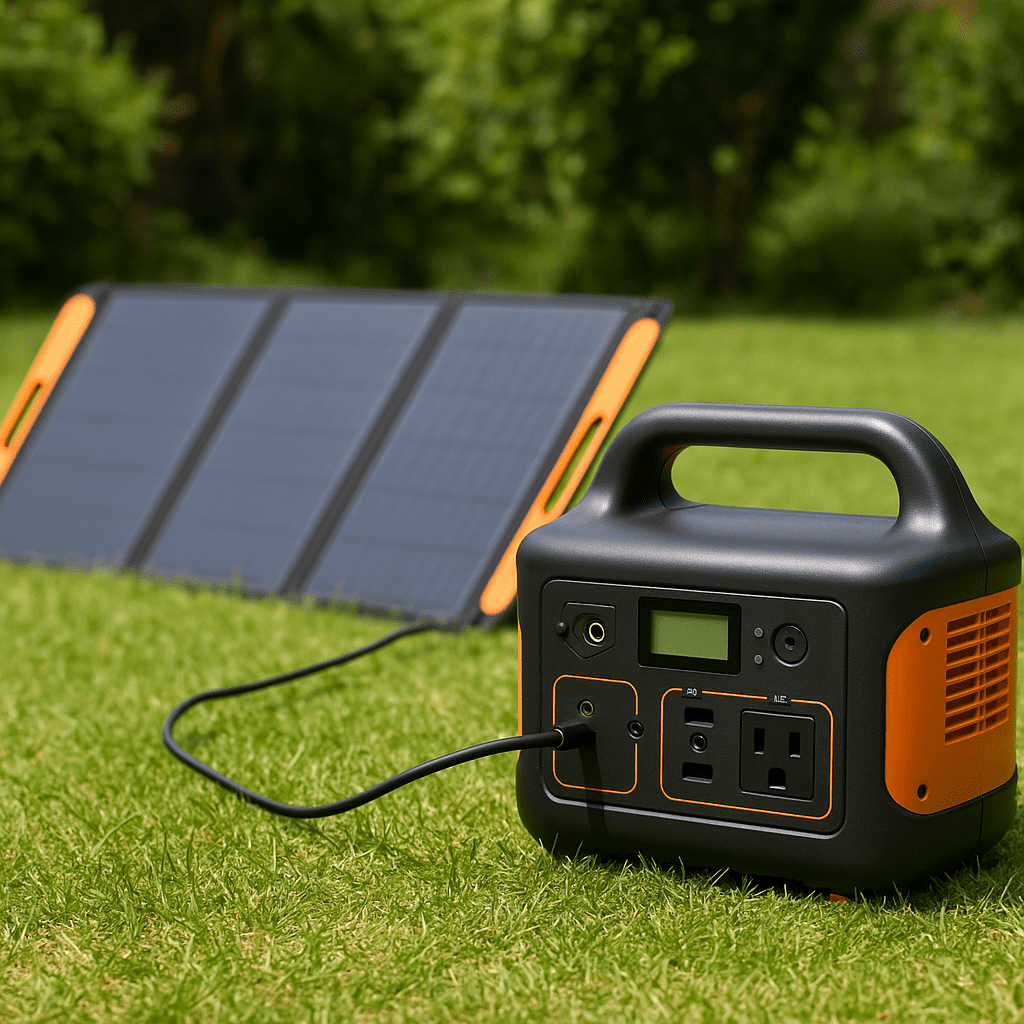
These are my top picks for the best Jackery solar generators UK buyers should consider. Each Jackery Explorer is a portable power station that can also be used as a solar generator when paired with compatible solar panels.
Jackery has substantially updated its Explorer range over the last few years, with the latest V2 models bringing LiFePO₄ batteries, faster charging and more modern electronics across much of the lineup.
The Explorer units themselves are portable power stations, and when paired with compatible solar panels they can also form a solar generator setup. In this guide, I focus on the models I think make the most sense for UK buyers, from the compact Explorer 240 v2 through to the much larger Explorer 3000 v2.
That doesn’t mean the older Jackery models are suddenly poor choices. The original Explorer 500 and Explorer 1000 are still widely available, particularly on the used and clearance market, and can represent good value if the price is low enough.
For that reason, this guide concentrates on the current V2 range while also covering the older V1 models further down the page.
A note on testing: I haven’t yet tested these Jackery power stations personally, so the comparisons below are based on manufacturer specifications, independent testing and my research into how the different models fit typical UK home-backup, camping and off-grid uses. Where I get hands-on experience with individual models, I’ll update this guide accordingly.
If you’d rather compare Jackery with EcoFlow, Bluetti and other brands, see our Best Solar Generators UK guide.
Jackery Explorer V2 Comparison
The table below compares the five main Jackery Explorer V2 portable power stations, from the genuinely portable Explorer 240 v2 to the 3kWh Explorer 3000 v2.



Which Jackery Is Best for You?
The headline capacity is only part of the decision.
You also need to consider maximum AC output, solar charging, weight and how you actually expect to use the power station.
Someone who mainly wants to charge phones, laptops and cameras while camping has completely different requirements from someone hoping to keep a fridge, freezer, broadband router and other household equipment running during a power cut.
Below, I take a closer look at each of the five V2 models.
The Jackery Explorer 240 v2 is the model I would choose if portability matters more than runtime.
It has a 256Wh battery and 300W AC output, so this isn’t intended to replace a larger home-backup power station.
Instead, it gives you a compact source of portable mains and USB power that weighs only around 3.6kg.
Genuinely portable
There is a significant difference between something that technically has a carrying handle and something you’d actually be happy carrying regularly.
The Explorer 240 v2 falls into the latter category.
It can easily be moved around a campsite, taken into the garden or kept in a vehicle without using much space.
For photographers, campers and people mainly concerned with keeping electronics charged, that can be more useful than owning a much larger battery.
256Wh capacity
The 256Wh capacity is enough for devices such as phones, cameras, laptops, lighting and other relatively low-powered electronics.
It can also support some small 230V appliances, but the 300W continuous output is the figure to watch.
This isn’t a power station for kettles, heaters or other high-draw household equipment.
100W solar input
The Explorer 240 v2 supports around 100W of solar input, which is sensible for a battery of this size.
A compact portable panel can therefore form a very simple small solar-generator setup for camping or travel.
You don’t need several large panels spread across a garden just to recharge it.
Who is the Explorer 240 v2 best for?
I think it makes the most sense for camping, photography, day trips, charging electronics and very light emergency use.
If you want to power larger devices or need substantially longer runtime, I would move up to the Explorer 500 v2 or 1000 v2.
Verdict: The Explorer 240 v2 is the best Jackery here if you actually intend to carry your power station regularly. It gives up capacity and inverter output, but that’s exactly why it remains genuinely portable.
The Jackery Explorer 500 v2 fills an interesting gap between small portable batteries and the more substantial 1kWh models.
It has a 512Wh LiFePO₄ battery and 500W continuous AC output, while weighing only around 5.7kg.
For someone who doesn’t need to run high-powered household appliances, that can be a very useful combination.
Much easier to carry
Weight is probably the biggest advantage of the Explorer 500 v2.
At around 5.7kg, it weighs roughly half as much as the Explorer 1000 v2.
That makes it much better suited to situations where the power station will regularly be moved around.
I can see it making particular sense for camping, campervans, garden use and short power cuts.
It should comfortably handle things such as phones, tablets, laptops, lights, routers and other lower-powered devices, provided their power requirements stay within the 500W inverter limit.
200W solar input
The Explorer 500 v2 supports up to 200W of solar input.
That feels reasonably well matched to a battery of this size.
A single compatible 200W panel, or a pair of suitable 100W panels, can therefore provide useful charging without requiring a very large solar setup.
For camping in particular, I think that’s a more practical combination than carrying several large panels just to achieve the theoretical maximum input of a much bigger power station.
Long-life LiFePO₄ battery
Another major improvement over the original Explorer 500 is the move to LiFePO₄ battery chemistry.
Jackery rates the 500 v2 for up to 6,000 cycles, which makes it a much better prospect for frequent use than Jackery’s older generation of NMC-powered Explorers.
That matters if you’re planning to cycle the battery regularly rather than leave it stored for occasional emergencies.
The 500W output matters
The main reason I wouldn’t automatically recommend the Explorer 500 v2 over the 1000 v2 is power output.
A 500W inverter is perfectly useful for electronics and smaller devices, but plenty of normal household appliances draw considerably more than this.
Kettles, heaters, larger cooking appliances and many power tools are obvious examples.
So although the 512Wh battery stores a useful amount of energy, you shouldn’t assume it can power an appliance simply because the battery has enough capacity.
Who is the Explorer 500 v2 best for?
I think it’s particularly strong for camping, campervan use, portable electronics and relatively light emergency backup.
It is also a good option if the Explorer 1000 v2 is simply more battery than you realistically need.
Verdict: The Explorer 500 v2 is the value choice in this guide. It provides a useful amount of capacity while remaining genuinely easy to carry, and the newer LiFePO₄ battery makes it much more attractive for frequent use than the old Explorer 500.
The Jackery Explorer 1000 v2 is the model I think makes the most sense for the widest range of buyers.
Its 1,070Wh LiFePO₄ battery is large enough to provide genuinely useful backup power without pushing the unit into the size and weight of the larger 2kWh and 3kWh models.
At the same time, its 1,500W continuous AC output is considerably more useful than the 500W available from the Explorer 500 v2.
That combination makes it suitable for home backup, campervans, camping, garden buildings and general off-grid power.
A big improvement over the original Explorer 1000
The original Explorer 1000 was one of Jackery’s best-known power stations, and used examples can still be worth considering.
However, the newer version makes several important improvements.
The Explorer 1000 v2 uses a 1,070Wh LiFePO₄ battery rated for 4,000 cycles to 70%+ capacity, compared with the older battery chemistry used in the original model.
Output has also increased from 1,000W to 1,500W, giving the V2 considerably more flexibility with higher-powered appliances.
Charging is another big difference.
The newer model can charge much faster from the mains, including a faster emergency charging mode available through the Jackery app.
Useful solar charging
The Explorer 1000 v2 supports up to 400W of solar input.
That is enough to make portable solar genuinely useful rather than simply a way of slowly topping up the battery.
In good conditions, a suitably sized solar array can put a meaningful amount of energy back into a roughly 1kWh battery during the day.
That makes the 1000 v2 particularly interesting for campervan use, longer camping trips and emergency situations where mains electricity may not be available.
Still reasonably portable
At around 10.8kg, the Explorer 1000 v2 is relatively light for a power station with this much capacity.
It isn’t something I’d want to carry long distances, but moving it between the house, shed, campervan or garden should be fairly straightforward.
For me, that is one of the biggest attractions of the 1kWh class.
Once you move into 2kWh and 3kWh models, portability starts to become a much looser description.
Who is the Explorer 1000 v2 best for?
I think it makes the most sense for someone who wants one Jackery to cover several jobs: home emergency power, campervans, camping, sheds, garden offices and portable solar setups.
If you only need to run small electronics, the Explorer 500 v2 could save money and weight.
If your priority is keeping household appliances running for considerably longer, the Explorer 2000 v2 or 3000 v2 is the more appropriate step up.
Verdict: The Explorer 1000 v2 is the Jackery I would choose for most buyers. Around 1kWh is a useful middle ground, and its 1,500W output, 400W solar input and manageable weight make it the strongest all-rounder in the current range.
The Jackery Explorer 2000 v2 is an interesting step up from the 1000 v2.
It has a 2,042Wh LiFePO₄ battery and 2,200W continuous AC output, providing roughly twice the stored energy of the 1000 v2 without becoming as large or heavy as the Explorer 3000 v2.
For many people wanting home backup, that could actually make it the most practical larger Jackery.
Much more capacity for an outage
At just over 2kWh, the Explorer 2000 v2 gives you substantially more breathing room when powering household essentials.
That could include equipment such as fridges, freezers, broadband routers, lighting, TVs, laptops and aquarium equipment, depending on the combined load.
Actual runtime will always depend on what is connected and how much power those devices draw, so I wouldn’t take manufacturer runtime examples too literally.
But moving from roughly 1kWh to roughly 2kWh can make a meaningful difference during a longer power cut.
2,200W AC output
The 2,200W continuous output also allows the 2000 v2 to support more demanding appliances than the Explorer 1000 v2.
That matters because capacity and inverter output solve different problems.
A large battery gives you longer runtime, while a higher inverter limit determines whether a demanding appliance can actually be powered in the first place.
Surprisingly manageable weight
One of the most appealing things about the Explorer 2000 v2 is its weight.
At around 17.5kg, it is considerably lighter than many older 2kWh-class power stations.
I would still describe it as movable rather than lightweight, but 17.5kg is a very different proposition from the 27kg Explorer 3000 v2.
If you expect to move the battery between your house, garage, campervan or garden building, this could matter quite a lot.
The main compromise is solar input
One slightly unusual feature of the Explorer 2000 v2 is that maximum solar input remains at 400W.
That’s the same headline solar input as the smaller Explorer 1000 v2 despite the battery being almost twice as large.
For mains-charged emergency backup, that may not matter at all.
But if you’re hoping to rely heavily on portable solar, particularly through a British winter, recharging a battery of this size from a 400W maximum solar input can take time.
This is also where it’s important not to confuse the Explorer 2000 v2 with the Explorer 2000 Plus.
The 2000 Plus is a different, expandable model with much stronger solar capability.
Who is the Explorer 2000 v2 best for?
I think it makes most sense for buyers who want substantially more home-backup capacity than a 1kWh unit without moving all the way to a 27kg 3kWh power station.
That makes it particularly interesting for emergency backup and larger campervans.
Verdict: The Explorer 2000 v2 is probably the sweet spot in Jackery’s larger models if you want significantly more capacity but still expect to move the power station occasionally. The main limitation is its relatively modest 400W maximum solar input.
The Jackery Explorer 3000 v2 sits at the top of the current Explorer V2 range and is the model I would look at if backup power for the home is more important than easy portability.
It has a substantial 3,072Wh LiFePO₄ battery and 3,600W continuous AC output, with Jackery quoting up to 7,200W surge output.
That gives it considerably more headroom than the Explorer 2000 v2 and moves it into a different class of use.
Rather than mainly powering electronics and a few essential appliances, the 3000 v2 is designed to cope with much more demanding equipment and several loads running at the same time.
3kWh is a meaningful amount of stored energy
The main advantage is capacity.
At just over 3kWh, it stores roughly three times as much energy as the Explorer 1000 v2 and around 50% more than the Explorer 2000 v2.
That makes it much better suited to situations where you want to keep important household equipment running for an extended period rather than simply bridge a short power cut.
A fridge, freezer, broadband equipment, lighting, aquarium equipment, laptops and other relatively modest loads could potentially be supported together for much longer than they could with one of the smaller Explorer models.
Actual runtime will depend on the equipment connected and inverter losses.
Much higher appliance output
The other major difference is its 3,600W continuous output.
That is substantially higher than the 2,200W available from the Explorer 2000 v2 and means the 3000 v2 can support combinations of appliances that would exceed the inverter limit of the smaller models.
This is therefore the Jackery I would consider if you expect to run several household loads simultaneously or have equipment with particularly high startup or running requirements.
Much stronger solar charging
Solar charging also takes a major step forward.
The Explorer 3000 v2 supports up to 1,000W of solar input, compared with 400W on both the 1000 v2 and 2000 v2.
That is a particularly important difference on a battery of this size.
Jackery says the 3000 v2 can connect up to four compatible SolarSaga 200W panels, giving up to 800W of rated panel capacity.
The 1,000W figure is the unit’s maximum solar input limit, so it also leaves room for other compatible panel arrangements that can make fuller use of that ceiling.
That does not mean you will actually see 1,000W from portable panels throughout a typical UK day, particularly in winter.
But if solar charging is an important part of your emergency or off-grid plan, the 3000 v2 is much better matched to its battery capacity than the 2000 v2.
Still movable, but no longer truly portable
At around 27kg, I wouldn’t think of the Explorer 3000 v2 in the same way as the 500 or 1000 v2.
This is better described as a movable home-backup battery.
You can relocate it when necessary or load it into a vehicle, but it isn’t something most people will want to carry around frequently.
Jackery even offers a folding trolley for the model, which makes sense at this weight.
The 2000 v2 therefore remains the better option if you need a large battery but expect to move it regularly.
Who is the Explorer 3000 v2 best for?
I think it makes most sense for buyers whose priority is longer emergency backup, higher-powered household appliances or a substantial off-grid power supply.
For general camping, campervan use or occasional household backup, I would still prefer the Explorer 1000 v2 or 2000 v2 because they’re cheaper and considerably easier to move.
But if capacity, inverter power and stronger solar charging matter more than portability, the 3000 v2 is clearly the strongest standalone model in Jackery’s current V2 range.
Verdict: The Explorer 3000 v2 is the best choice in this guide for serious home backup. Its 3,072Wh battery, 3,600W output and 1,000W solar input provide a substantial step up from the 2000 v2, although you pay for that extra capability in both price and weight.
What About the Jackery Plus Models?
Jackery’s Explorer Plus range is slightly different from the standard V2 models.
The main reason to consider one is battery expansion.
For example, the Explorer 1000 Plus starts with around 1.26kWh of storage and can accept additional battery packs, allowing you to expand the system considerably beyond its original capacity.
It also offers 2,000W AC output, putting it above the Explorer 1000 v2 in terms of inverter power.
The larger Explorer 2000 Plus takes that modular approach further and is designed much more like an expandable home or off-grid backup system.
That is an important distinction because the Explorer 2000 Plus and Explorer 2000 v2 are not simply different generations of exactly the same product.
The newer 2000 v2 prioritises compact size, lower weight and simplicity.
The 2000 Plus prioritises expansion and stronger solar capability.
Likewise, the Explorer 3000 v2 gives you 3,072Wh in a single unit but isn’t designed around the same expandable-battery system as the Plus range.
If you want a relatively compact standalone battery, I think the 1000 v2, 2000 v2 and 3000 v2 are easier choices.
If you know from the start that you may eventually want several additional kilowatt-hours of battery storage, the Plus models become much more interesting.
Are the Older Jackery V1 Models Still Worth Buying?
I wouldn’t remove the original Jackery Explorer models from consideration completely.
They were popular for a reason, and there are now a lot of them on the used market.
The important thing is understanding what you’re giving up compared with the newer V2 range.
Original Jackery Explorer 500
The original Explorer 500 has roughly 518Wh capacity and 500W output.
Those headline figures look remarkably similar to the Explorer 500 v2.
The important difference is what sits behind them.
The newer V2 uses LiFePO₄ cells, charges much faster and is designed for far more battery cycles.
If you’re buying new and the prices are anywhere close, the 500 v2 is the obvious choice.
But an original Explorer 500 at a genuinely low used or clearance price could still make sense for occasional camping, campervan or emergency use.
Original Jackery Explorer 1000
The original Explorer 1000 has a 1,002Wh battery and 1,000W AC output.
It was one of Jackery’s best-known models and remains perfectly capable of powering many everyday devices.
It’s also reasonably portable at around 10kg.
However, the 1000 v2 increases output to 1,500W, moves to LiFePO₄ battery chemistry and dramatically improves charging speed.
The original version therefore becomes much more interesting as a discount purchase than as a direct alternative at similar money.
A cheap, healthy used Explorer 1000 could still provide a useful amount of emergency battery storage.
Original Explorer 240
The old Explorer 240 was one of the products that helped establish Jackery in the portable power-station market.
Used examples still appear regularly.
For light camping and device charging, there is nothing inherently wrong with one that has been well looked after.
But the new 240 v2 offers modern LiFePO₄ battery chemistry, faster charging, app support and a higher 300W AC output.
Again, price is what determines whether the original still makes sense.
Explorer 2000 Pro
The Explorer 2000 Pro is another previous-generation model worth watching if clearance or used prices become attractive.
Its roughly 2.1kWh capacity and 2,200W output remain substantial.
However, it uses older battery chemistry rather than the LiFePO₄ cells found in the Explorer 2000 v2.
The newer 2000 v2 is also considerably lighter.
I would therefore only favour the older 2000 Pro where the saving is substantial.
Explorer 3000 Pro
The older Explorer 3000 Pro is also still likely to appear on the used and clearance market.
It offers a similarly large battery class and around 3,000W of AC output, so it remains a serious piece of equipment.
However, the Explorer 3000 v2 is a major redesign.
The newer model increases output to 3,600W, uses LiFePO₄ battery chemistry and weighs around 27kg despite its 3,072Wh capacity.
As with the smaller V1 models, that doesn’t make an older 3000 Pro useless.
It simply means I would expect a meaningful price reduction before choosing one instead of the newer V2.
My rule for buying an older Jackery
I wouldn’t reject a V1 model simply because a V2 exists.
Instead, I would ask one question:
How much cheaper is it?
If an older Explorer costs only slightly less than the equivalent V2, I’d buy the newer model.
If you find a lightly used or heavily discounted V1 for a fraction of the price, the calculation changes considerably.
For occasional backup or camping, an older power station doesn’t suddenly become useless because Jackery has released a newer generation.
Battery condition matters more when buying used, though, so I would want to know how the unit has been stored and used before paying strong money for an older NMC model.
Jackery V1 vs V2 – What Actually Changed?
The biggest improvement across much of the range is battery chemistry.
Many of the original Jackery Explorers used conventional lithium-ion NMC cells.
The newer V2 range uses LiFePO₄ batteries, which generally provide a much longer cycle life and are particularly attractive when a power station will be used regularly.
Charging speeds have also improved substantially.
Another major difference is inverter output.
The original Explorer 1000, for example, provides 1,000W continuous AC output, whereas the Explorer 1000 v2 increases that to 1,500W.
The current range also adds features such as app control, much faster mains charging and UPS-style backup functionality on several models.
For someone buying new today, those improvements generally make V2 the better choice.
But they don’t erase the value of older units at sufficiently low prices.
Jackery Portable Power Station or Solar Generator?
The terminology can be confusing because both descriptions are commonly used.
The Jackery Explorer itself is technically a portable power station.
It contains the battery, inverter, charging electronics and output sockets.
Once you connect compatible solar panels, the complete setup is commonly described as a solar generator.
There is no petrol or diesel engine involved.
The solar panels generate electricity, while the Explorer stores that energy and converts it into usable power for your devices.
That also means the power station is useful without solar panels.
You can charge one from the mains before a power cut, use it in a campervan or take it camping.
Adding solar simply provides another way of putting energy back into the battery.
Which Jackery Size Do You Actually Need?
The easiest way to choose between the current models is to consider capacity and maximum output separately.
Capacity, measured in watt-hours or Wh, determines roughly how much energy is stored.
Output, measured in watts, determines how powerful an appliance or combination of appliances the inverter can support.
For phones, cameras, laptops and basic camping equipment, the Explorer 240 v2 may be all you need.
For longer camping trips, campervans and moderate portable use, the Explorer 500 v2 gives you twice as much stored energy while remaining easy to carry.
For general home backup and mixed use, I think the Explorer 1000 v2 is the strongest middle ground.
The Explorer 2000 v2 makes sense when you want substantially more runtime but still need the battery to remain reasonably movable.
And if your main concern is keeping several household essentials running during a prolonged outage, the Explorer 3000 v2 gives you substantially more battery capacity, inverter power and solar-charging capability.
Buying the largest battery available isn’t automatically the best solution.
Larger batteries cost more, take up more space and become increasingly difficult to move.
The right size is the smallest unit that comfortably covers the loads and runtime you realistically expect to need.
How Much Difference Does Solar Input Make?
Solar input is one area where the five V2 models don’t simply scale evenly with battery size.
The approximate maximums are:
- Explorer 240 v2 – 100W
- Explorer 500 v2 – 200W
- Explorer 1000 v2 – 400W
- Explorer 2000 v2 – 400W
- Explorer 3000 v2 – 1,000W
That means the Explorer 2000 v2 has twice the battery capacity of the 1000 v2 but the same maximum solar input.
This isn’t necessarily a problem if you mainly intend to charge from the mains and use solar as an occasional top-up.
But for more serious off-grid use, it’s worth noticing.
The Explorer 3000 v2 is different because its maximum solar input jumps to 1,000W, which is much better matched to a battery exceeding 3kWh.
Even then, UK conditions matter.
A 1,000W-rated panel array will not continuously produce 1,000W from morning until evening, and winter output can be dramatically lower than summer output.
So if emergency preparedness is the main reason you’re buying one, I would treat solar as an important additional charging option rather than assume it guarantees unlimited electricity through a long winter outage.
Are Jackery Solar Panels Worth Buying?
Jackery’s SolarSaga panels are designed to work directly with its power stations and are the simplest option if you want a complete system from one manufacturer.
The downside is price.
Portable solar panels use fairly standard photovoltaic technology, and compatible third-party panels can sometimes cost considerably less.
If you plan to use a non-Jackery panel, however, don’t choose purely by its advertised wattage.
You need to check the open-circuit voltage, operating voltage, current, connector type and input limits of the particular Explorer model.
This is especially important when combining multiple panels.
The maximum solar input also varies considerably across the Jackery range, so buying far more panel wattage than a particular power station can accept won’t necessarily make it charge any faster.
For most buyers, I would decide which power station I wanted first and then choose the solar array around that model’s electrical limits.
Jackery V2 or Plus – Which Range Makes More Sense?
The simplest distinction is this:
V2 models are primarily standalone power stations.
Plus models are more focused on expandable battery systems.
If you want something compact that you can buy, charge and use without thinking about future battery expansion, the V2 range is easier to understand.
The 1000 v2 is the obvious general-purpose model.
The 2000 v2 gives you substantially more runtime while remaining reasonably movable.
The 3000 v2 gives you serious standalone home-backup capacity and much stronger solar input.
The Plus range makes more sense if you already know that your eventual goal is a modular setup containing several kilowatt-hours of additional battery storage.
Neither approach is automatically better.
They’re aimed at slightly different buyers.
Final Thoughts
For most buyers, I think the Jackery Explorer 1000 v2 is the strongest all-round choice.
Its 1,070Wh battery provides enough capacity to be genuinely useful for backup power, while the 1,500W output, 400W solar input and roughly 10.8kg weight keep it flexible enough for camping, campervans and portable use.
The Explorer 500 v2 is my value choice if you want something smaller and easier to carry, while the Explorer 240 v2 makes most sense when maximum portability is the priority.
For larger backup requirements, I think the choice between the other two models is particularly interesting.
The Explorer 2000 v2 gives you 2,042Wh and 2,200W output while keeping the weight down to around 17.5kg. That makes it a strong option if you still expect to move the battery fairly regularly.
The Explorer 3000 v2 is the better fit when serious home backup matters more than portability. Its 3,072Wh capacity, 3,600W output and 1,000W maximum solar input make it a significant step up.
I also wouldn’t dismiss Jackery’s older models.
The original Explorer 500, Explorer 1000 and larger Pro models have clearly been overtaken technically by the newer LiFePO₄ range, but a well-priced older Jackery can still provide useful portable or emergency power.
The key is price.
At similar prices, I’d buy V2.
At a significant clearance or second-hand discount, some of the older Jackery models can still be well worth considering.
For a wider comparison with EcoFlow, Bluetti and other brands, see our Best Solar Generators UK guide.
📎 Related Articles
- The HomeGrower Guide to Home Solar Generators (UK)
A complete UK guide to home solar generators, explaining how portable power stations work, realistic use cases, sizing, limitations, safety and how they fit into self-sufficient living. - Best Solar Generators UK
A practical comparison of the best solar generators available in the UK, covering real-world performance, battery chemistry, power output and suitability for home backup and garden use. - Best EcoFlow Solar Generators UK
Our comparison of EcoFlow’s River and Delta portable power stations, covering compact camping models, 1kWh all-rounders and larger home-backup options.