
When you purchase through links on our site, we may earn an affiliate commission at no extra cost to you.
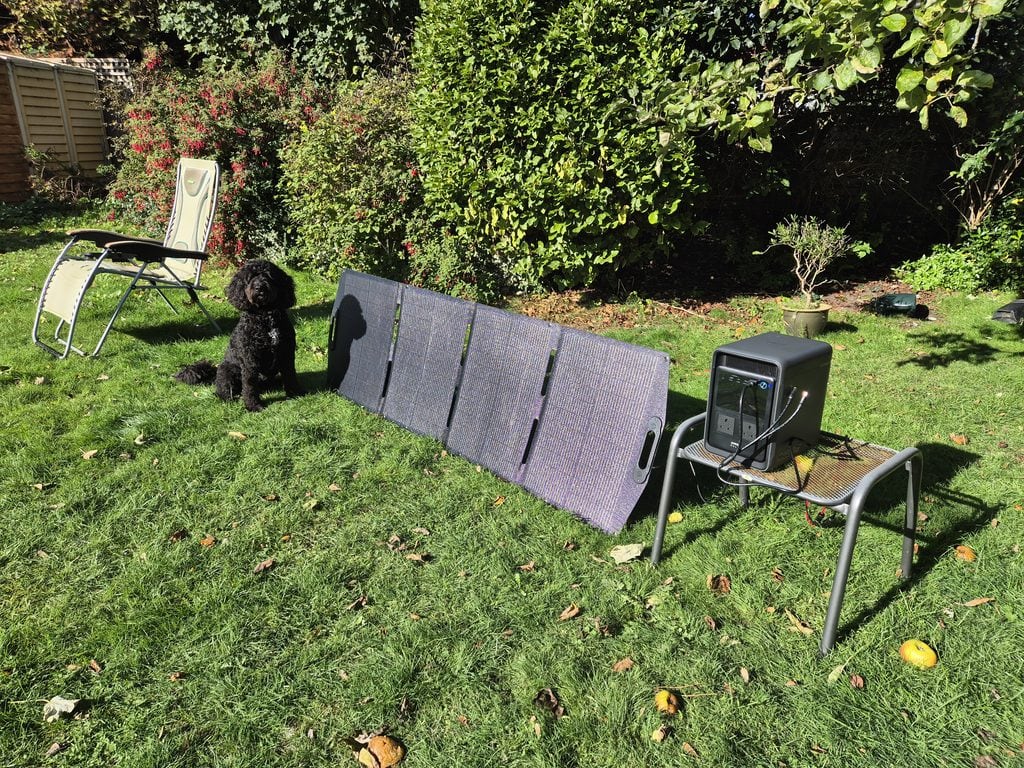
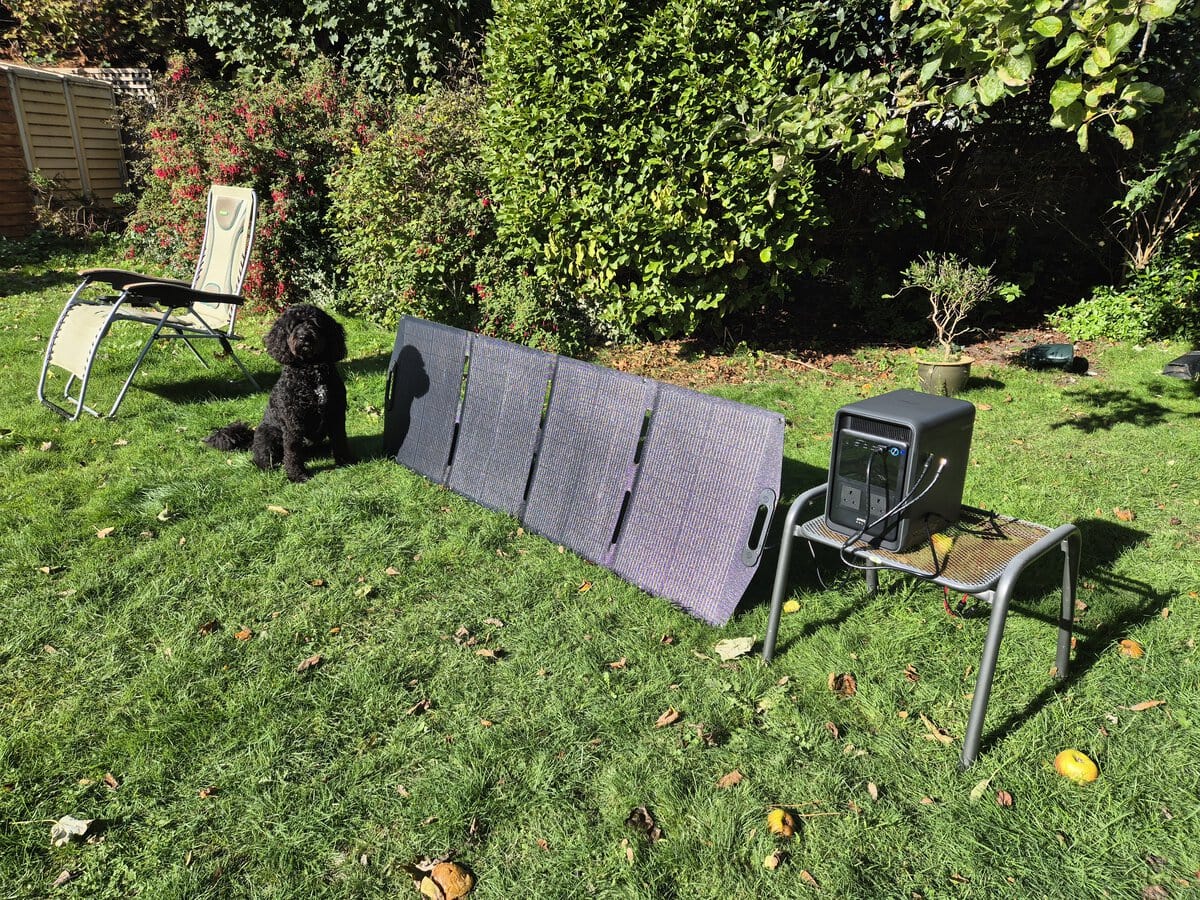
Testing the Anker SOLIX S2000 with an ECO-WORTHY 200W solar panel. For demonstration purposes only: the S2000 is not waterproof and should be kept indoors or in a suitable dry, well-ventilated location.
Anker SOLIX S2000 Review Summary
★ 4.5/5I’m impressed with the Anker SOLIX S2000, particularly when available at a discounted price. With a 2,010Wh battery, 1,500W continuous AC output and 3,000W peak surge capacity, it offers plenty of power for household backup. In my testing, it ran my fridge-freezer for 24 hours with 47% battery remaining, suggesting almost two days of backup power.
I also recorded 172W solar input from a 200W panel in October. At just 16.2kg, it’s one of the lightest 2kWh power stations available, while fast mains charging and an easy-to-use app add to its appeal.
What I Like
- Excellent value when discounted
- One of the lightest in its class at 16.2kg
- 1,500W output with 3,000W surge capacity
- Impressive fridge-freezer backup performance
- Fast mains charging and useful app monitoring
What I’d Improve
- No proper carrying handle
- 400W maximum solar input
A note on pricing: The S2000 is a relatively new model, and I’ve already seen its price vary considerably between promotions, from £649 to over £1,000. The price displayed in my product box below may occasionally lag behind Amazon’s latest offer, so I recommend clicking Check Price to see the current selling price before making a decision.

If you’re still comparing options, take a look at my Best Anker Solar Generators UK guide for a comparison of the SOLIX range, including the C2000 Gen 2. I’ve also compared models from Anker, EcoFlow, Jackery and Bluetti in my Best Solar Generators UK buying guide.
Anker SOLIX S2000 Specifications
The Anker SOLIX S2000 combines a 2,010Wh LiFePO4 battery with 1,500W continuous AC output in a surprisingly compact design. Here are the main specifications, including its charging capabilities, dimensions and battery lifespan.
| Specification | Details |
|---|---|
| Battery capacity | 2,010Wh (2.01kWh) |
| Battery chemistry | LiFePO4 (LFP) |
| Battery cycle life | Up to 6,000 cycles to 80% capacity, or 10,000 cycles to 60% capacity (manufacturer claims) |
| Continuous AC output | 1,500W |
| Peak surge output | 3,000W |
| AC sockets | 4 UK sockets |
| USB ports | 1 × USB-A (12W), 1 × USB-C (15W), 1 × USB-C (100W) |
| Maximum solar input | 400W (MPPT) |
| Standard mains charging | Up to 1,150W; approximately 2.3 hours |
| UltraFast mains charging | Up to 1,600W; approximately 1.8 hours |
| Silent charging mode | 600W or less |
| UPS switchover | Under 10 milliseconds |
| Dimensions (W × D × H) | 20.8 × 28.2 × 32.3cm |
| Weight | 16.2kg |
| App connectivity | Wi-Fi and Bluetooth |
| Warranty | 5 years |
Charging the Anker SOLIX S2000
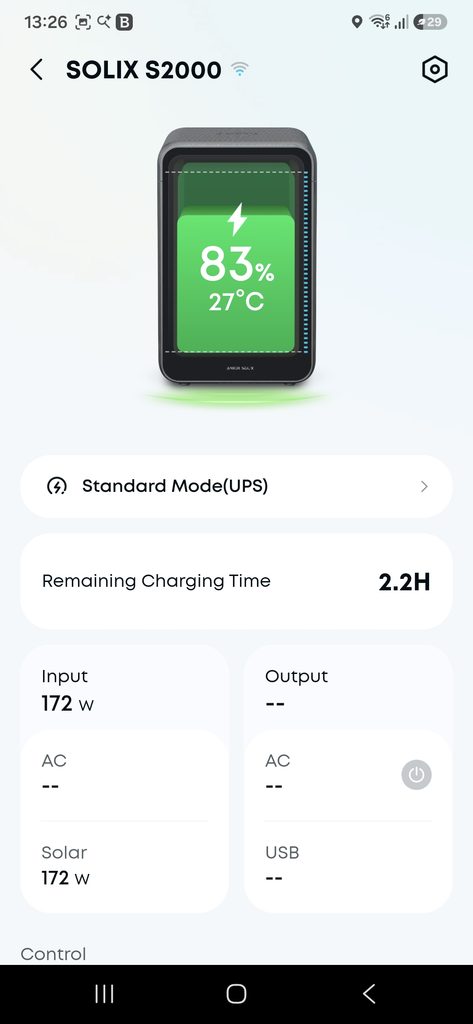
My Anker SOLIX S2000 receiving 172W of solar power from a 200W panel in October
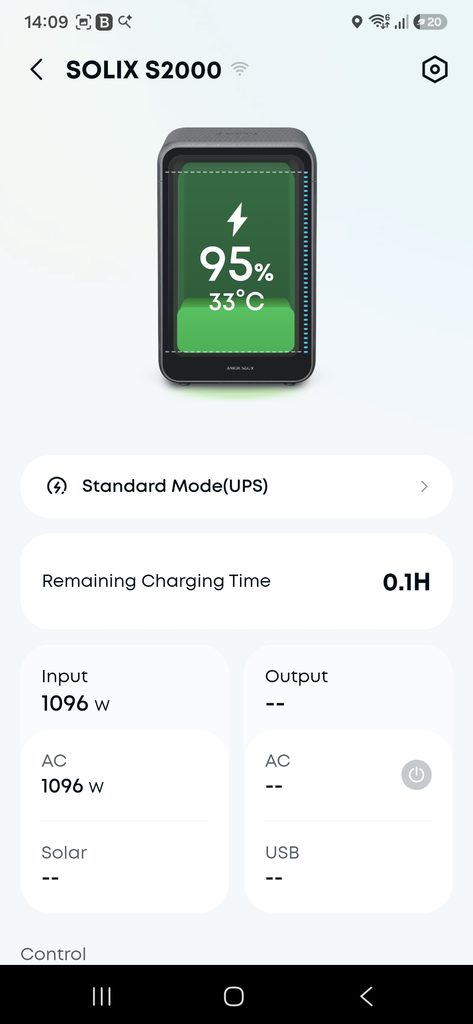
Anker SOLIX S2000 review showing 1,096W mains charging input in Standard charging mode.
Solar Charging With My ECO-WORTHY 200W Panel
I tested solar charging using an ECO-WORTHY 200W folding solar panel on 11 October 2026. Despite the relatively low autumn sun here in the UK, I was impressed with the results.
The highest input I recorded was 172W, or 86% of the panel’s rated output. The output fluctuated from around 60W to over 170W depending on cloud cover and the angle of the panel.
I propped the panel up facing the sun and monitored the charging performance through the Anker app. Being able to see the input change in real time made it easy to experiment with positioning.
One thing I particularly like is that the S2000 doesn’t require Anker-branded solar panels. My ECO-WORTHY panel uses MC4 connectors, so I connect it using a compatible adapter cable. This gives me the flexibility to choose potentially cheaper third-party panels.
The S2000 supports up to 400W of solar input, so I could potentially add a second 200W panel to increase charging speed. However, I’d need to check the combined electrical specifications before connecting two panels.
For anyone considering third-party solar panels, the important specifications are:
- Maximum solar input: 400W.
- Voltage: 11–60V operating range. Check the panel’s open-circuit voltage (Voc), including the increase that can occur in cold weather.
- Current: The panel configuration must remain within Anker’s permitted input current limits, which vary with voltage.
- Connectors: A suitable adapter may be needed if the panel uses MC4 connectors.
Two panels can be connected in series or parallel in some solar systems, but the correct arrangement depends on their voltage and current ratings. I’d check Anker’s connection guidance before expanding my setup.
For now, I think a single 200W folding panel makes a useful starting point for camping, campervan trips or occasional off-grid use. I’ll consider adding another if I need faster solar charging for extended home backup.
One important precaution: the S2000 isn’t waterproof. I photographed it outdoors for demonstration purposes, but I wouldn’t leave it exposed to rain. A suitably rated solar extension cable would allow me to position the panel outside while keeping the power station in a dry, well-ventilated location.
Mains Charging: Standard, UltraFast and Silent Modes
Mains charging is considerably quicker than solar charging, particularly with a single 200W panel.
I recorded 1,096W of AC input in Standard mode, which is close to the maximum 1,150W specified for this setting.
The Anker SOLIX S2000 offers three main charging options:
- Standard mode: Up to 1,150W, with a claimed full recharge time of approximately 2.3 hours.
- UltraFast mode: Up to 1,600W, with a claimed full recharge time of approximately 1.8 hours.
- Silent mode: Reduced charging power of up to approximately 600W, designed for quieter operation.
I can adjust the charging settings through the Anker app, which is particularly useful when I don’t need the fastest possible recharge.
Does Slower Charging Extend Battery Life?
The S2000 uses LiFePO4 (LFP) battery chemistry, which is known for its long cycle life.
In general, slower charging can reduce heat and stress on lithium batteries, potentially helping them last longer. However, I haven’t seen independent evidence showing how much difference this makes to the S2000 specifically.
For everyday use, I’m inclined to leave it on Standard mode or use slower charging when convenient. UltraFast mode is useful when I need to recharge quickly before going out or preparing for a potential power cut.
I wouldn’t avoid faster charging altogether, as the power station is designed to support it.
Can I Save Money by Charging Overnight?
Another potential benefit of the S2000 is the ability to charge it using cheaper overnight electricity, provided I’m on a suitable time-of-use tariff.
For example, allowing for charging losses, a full recharge could cost approximately 18–20p at 8p/kWh, compared with around 58–62p at 26p/kWh. These are illustrative figures rather than costs measured on my own electricity tariff.
However, I wouldn’t buy the S2000 purely to save money on electricity. Charging and discharging losses, battery wear and potentially higher daytime tariff rates could outweigh the savings. For someone already buying a power station for emergency backup, cheaper overnight charging could be a useful additional benefit.
How Long Can the Anker SOLIX S2000 Run a Fridge-Freezer?
One of my main reasons for buying the Anker SOLIX S2000 was to keep essential household appliances running during a power cut. My fridge-freezer seemed like the ideal first test, particularly as it needs electricity around the clock.
I connected my Samsung RB29FSRNDWW fridge-freezer, with a total capacity of 290 litres, to the fully charged S2000 at 19:18 on 11 October 2026. I left it running for 24 hours without mains or solar assistance to see how much battery capacity it would use.
My 24-Hour Fridge-Freezer Test Results
After 24 hours, the S2000 still had 47% battery remaining, meaning my fridge-freezer had used 53% of its battery capacity. At the same rate of consumption, this suggests a total runtime of approximately 45 hours.
| Test measurement | Result |
|---|---|
| Appliance | Samsung RB29FSRNDWW, 290L fridge-freezer |
| Starting battery | 100% |
| Battery after 24 hours | 47% |
| Battery consumed | 53% |
| Estimated full runtime | Approximately 45 hours |
| Solar input | None |
I’m pleased with this result. It suggests that the S2000 could keep my fridge-freezer running for almost two days during a power cut, without relying on any additional electricity generation.
However, the estimated 45-hour runtime is based on battery consumption over 24 hours, rather than a complete discharge test. Actual performance will vary with room temperature, how frequently the doors are opened, and the fridge-freezer’s compressor and defrost cycles.
How Much Longer Could Solar Charging Keep It Running?
My 24-hour test suggests the fridge-freezer consumed the equivalent of approximately 44Wh of stored battery energy per hour, including the power station’s conversion and standby losses.
If I could replenish the battery with 400Wh of usable solar energy during the day, that could theoretically provide another nine hours of fridge-freezer operation. With 600Wh, the additional runtime could increase to around 13–14 hours.
These are illustrative calculations, not measured solar-assisted runtimes. Actual results would depend on how much solar energy I could collect, particularly during the shorter and cloudier days of a UK autumn or winter.
Nevertheless, combining the S2000 with my 200W solar panel could make a meaningful difference during a prolonged power cut. I’ll update these figures when I’ve completed further testing with solar charging connected.
What Else Can the Anker SOLIX S2000 Power?
My fridge-freezer was the first appliance I tested, but with a 2,010Wh battery, 1,500W continuous AC output and 3,000W peak surge capacity, the Anker SOLIX S2000 should be capable of powering a wide range of household appliances, electronics and camping equipment.
It’s worth remembering that battery capacity and power output are two different things. The 2,010Wh capacity determines roughly how long an appliance can run, while the 1,500W continuous output determines how much power I can draw at once.
To put this into perspective, I’ve calculated some approximate runtimes for common household appliances.
| Appliance | Power | Estimated Runtime |
|---|---|---|
| LED television | 80W | 20 hours |
| Laptop | 60W | 27 hours |
| Wi-Fi router | 15W | Approximately 3 days* |
| Electric blanket | 100W | 16 hours |
| LED grow light | 300W | 5–6 hours |
| Microwave (1,200W input) | 1,200W | Up to 80 minutes total use |
| Low-power kettle | 1,000W | Up to 1.6 hours total use |
*A 15W router could theoretically run for around three days when allowing for approximately 6W of additional inverter consumption. Actual runtime will depend on the power station’s standby consumption and operating conditions.
These are theoretical estimates based on approximately 1,600Wh of usable AC energy, allowing for conversion losses. I haven’t individually tested these appliances yet. Actual runtimes may be lower, particularly with high-power appliances or where inverter overhead is significant.
Can I Use a Multi-Socket Extension Lead?
Yes. I can plug a suitable multi-socket extension lead into the Anker SOLIX S2000 and power several appliances at the same time.
This could be particularly useful during a power cut. For example, I could potentially run my fridge-freezer, television, Wi-Fi router and LED lighting from a single power station.
Here’s an example of what that combined load might look like:
| Appliance | Estimated Power |
|---|---|
| Fridge-freezer (compressor running) | 100W |
| LED television | 80W |
| Wi-Fi router | 15W |
| LED lighting | 30W |
| Laptop charger | 65W |
| Total | 290W |
That would be comfortably within the S2000’s 1,500W continuous output limit. However, these figures are illustrative, and I would still need to account for brief startup surges from appliances such as the fridge-freezer.
Importantly, the 1,500W limit applies to the combined output of all AC sockets, not to each socket individually.
I would use a good-quality, suitably rated extension lead, avoid connecting extension leads together and fully unwind any cable reel to prevent overheating. I’d also keep the power station and connections dry and ensure adequate ventilation.
Can I Connect the S2000 to My Home’s Wiring?
No. I would never connect the S2000 directly to a household wall socket to supply electricity to the home’s wiring. This could create a dangerous backfeed situation, potentially putting people and electrical equipment at risk.
Connecting a portable power station to household circuits requires a properly designed transfer arrangement installed by a qualified electrician, with the power station’s earthing and protection requirements taken into account.
For straightforward emergency backup, I would use the S2000’s AC sockets to power individual appliances directly.
What Appliances Can’t the S2000 Power?
The main limitation is its 1,500W continuous AC output. Some high-power appliances may exceed this, including:
- Standard electric kettles rated at 2,000–3,000W.
- Many electric heaters and fan heaters.
- Some high-power hairdryers.
- Electric ovens and induction hobs drawing more than 1,500W.
Although the S2000 has a 3,000W peak surge rating, this is intended for brief startup demands rather than continuously running a 3,000W appliance.
I’d always check an appliance’s actual power rating before connecting it, particularly where heating elements or electric motors are involved.
My Plans for Further Testing
For my own needs, being able to keep the fridge-freezer running, power some lighting, charge phones and laptops, and operate a television makes the S2000 a useful addition to my emergency backup equipment.
I’m also interested in testing it with my aquarium equipment and LED grow lights, as both are relevant to the equipment I regularly use and review on HomeGrower.
I’ll update this review as I test more appliances and discover how the S2000 performs in different situations.
Anker SOLIX S2000 Design, Weight and Portability
One of the things that attracted me to the Anker SOLIX S2000 was its compact size. Despite having a substantial 2,010Wh battery, it weighs just 16.2kg, making it one of the lighter 2kWh portable power stations available.
Its dimensions of approximately 20.8 × 28.2 × 32.3cm also make it relatively easy to store. I can keep it in the house for emergency backup without it taking up too much space, while it’s compact enough to take away in my campervan.
How Easy Is It to Carry?
Although 16.2kg isn’t exactly lightweight, I find the S2000 manageable to carry short distances. Moving it between rooms or taking it outside for testing isn’t particularly difficult, although I wouldn’t want to carry it any great distance.
My main criticism is the lack of a proper carrying handle. Instead, Anker has provided two recessed hand grips on opposite sides of the unit. They’re reasonably comfortable, but I need both hands to carry it securely. A substantial top handle would have made moving it around considerably easier.
Build Quality and Practical Design
My initial impression of the build quality is positive. The casing feels solid, the connections are conveniently arranged and the display makes it easy to check the remaining battery capacity and power consumption without opening the app.
I also appreciate having four UK AC sockets and several USB connections, particularly when using the S2000 as a temporary backup power supply.
Overall, I’m impressed by how much battery capacity Anker has fitted into such a compact unit. Apart from the carrying arrangement, I think the design works well for both home backup and occasional portable use.
Anker SOLIX S2000 App and Smart Features
I’ve found the Anker app surprisingly useful during my testing. Although the S2000 has a built-in display showing battery capacity, power input and output, the app lets me monitor everything remotely without having to stand beside the unit.
This was particularly helpful during my solar charging test. I could see the wattage change in real time as I adjusted the angle of my ECO-WORTHY panel, making it easier to find the best position. I also used the app to monitor the battery level during my 24-hour fridge-freezer test.
What Can I Control Through the App?
The app provides several useful features:
- Battery monitoring: I can check the remaining battery percentage and estimated charging or discharging time.
- Power monitoring: I can see how much electricity is entering the unit from solar or mains charging and how much connected appliances are consuming.
- Charging settings: I can adjust the AC charging speed to suit my needs.
- Output controls: I can switch the AC output on or off without using the physical controls on the power station.
- Battery temperature: I can monitor the internal battery temperature, which is particularly useful during faster charging.
I’ve found the interface straightforward to use and reliable during my initial testing. Wi-Fi and Bluetooth connectivity are particularly convenient when the power station is positioned somewhere less accessible.
Importantly, I don’t need the app to operate the S2000. The physical controls and built-in display let me switch outputs on and off and check basic power information without relying on my phone.
Overall, I think the app is a useful addition rather than an unnecessary extra. I particularly appreciate being able to monitor charging performance and battery consumption during longer tests, and I’ll update this section if I discover any significant limitations.
Anker SOLIX S2000 vs Alternatives: Is It Worth the Money?
The Anker SOLIX S2000 impressed me during testing, but whether I’d recommend it depends heavily on the price. I’ve seen it advertised for as little as £649 and for over £1,000, which puts it against some very capable alternatives.
Three models I’d particularly consider are the Jackery Explorer 2000 v2, Bluetti Elite 200 V2 and Anker SOLIX C2000 Gen 2.
| Power Station | Capacity | AC Output | Max Solar |
|---|---|---|---|
| Anker SOLIX S2000 | 2,010Wh | 1,500W | 400W |
| Jackery Explorer 2000 v2 | 2,042Wh | 2,200W | 400W |
| Bluetti Elite 200 V2 | 2,073.6Wh | 2,600W | 1,000W |
| Anker SOLIX C2000 Gen 2 | 2,048Wh | 2,400W | 800W |
Figures are manufacturer specifications. The S2000 is the only model in this comparison I’ve personally tested.
Which Would I Choose?
At around £650, I think the S2000 offers excellent value. Its relatively low weight, substantial battery capacity and performance in my fridge-freezer test make it a particularly attractive choice for home backup and campervan use.
However, at £900–£1,100, I’d compare alternatives much more carefully. The Jackery Explorer 2000 v2 offers considerably more AC output, while the Bluetti Elite 200 V2 has both higher output and much greater solar charging capacity. The Anker C2000 Gen 2 is another interesting option if I wanted more power while staying with Anker.
For my own needs, the S2000’s 1,500W output is sufficient for essential household appliances, and my 200W solar panel works well within its 400W input limit. But for larger appliances or a more substantial solar setup, one of the alternatives could be a better investment.
You can explore the wider ranges in my Best Anker Solar Generators UK, Best Bluetti Solar Generators UK and Best Solar Generators UK buying guides.
Anker SOLIX S2000 Review: My Final Verdict
After my initial testing, I’m very impressed with the Anker SOLIX S2000. It offers a substantial 2,010Wh battery in a compact, relatively lightweight design, with enough power to run many everyday household appliances.
My most useful test so far has been running my Samsung fridge-freezer for 24 hours, leaving 47% battery remaining. That suggests almost two days of backup power without solar assistance, which is reassuring if I ever experience a prolonged power cut.
I was equally impressed with solar charging. Achieving 172W from my ECO-WORTHY 200W panel in October was better than I expected, and the fast mains charging and straightforward Anker app have made the unit easy to use.
My biggest criticism is the lack of a proper carrying handle, while the 400W solar input limit could be restrictive for anyone planning a larger off-grid setup.
Overall, I give the Anker SOLIX S2000 a rating of 4.5/5. At around £650, I think it offers excellent value for a 2kWh power station. However, at its higher selling prices, I’d compare alternatives carefully before buying.
This is an ongoing hands-on review, and I’ll continue updating it as I carry out further testing, including additional household appliances, solar charging and campervan use.
Related Articles
If you’re comparing portable power stations or exploring solar backup options, I’ve also put together these guides: