Cordless garden tools are easy to buy one at a time. A mower here, a hedge trimmer there, maybe a strimmer when the grass edges start getting out of hand.
But once you own more than one cordless tool, the real decision becomes obvious: the battery platform matters as much as the tool itself.
Most major brands now have their own power share battery systems. The idea is simple. One battery platform can run several tools, from your cordless lawn mower to your hedge trimmer, strimmer, drill or mini chainsaw. Choose well and you can save money for years by buying “bare” tools without extra batteries and chargers. Choose badly and you can end up with a shelf full of mismatched chargers and batteries that only work with one tool each.
This guide compares the main power share battery systems UK gardeners are likely to come across, including Worx PowerShare, Bosch Power For All, Ryobi ONE+, Makita LXT/XGT, DeWalt XR/FlexVolt and Einhell Power X-Change.
It sits within the wider HomeGrower Guide to Garden Tools and Equipment, which looks at how garden tools, battery platforms, storage and long-term use fit together in real UK gardens.
Quick Verdict: Which Battery Platform Should You Choose?
- Best for small to medium UK gardens: Worx PowerShare
- Best for mixed home and garden use: Bosch Power For All
- Best for the biggest all-round ecosystem: Ryobi ONE+
- Best budget entry point: Einhell Power X-Change
- Best for heavy-duty or trade-style use: Makita LXT/XGT or DeWalt XR/FlexVolt
For many UK gardeners, the most sensible choice matches the work you actually do rather than chasing the biggest or most powerful platform.
A small lawn, regular hedge trimming and light edging do not need the same battery setup as a large garden, thick hedges or heavy seasonal cutting. The trick is to choose a platform that still makes sense when you add your second, third and fourth cordless tool.
A power share battery system is a shared battery platform.
Instead of buying a separate battery and charger for every cordless tool, you use one battery type across a whole range of tools from the same brand.
For example, one battery platform might run:
- a cordless lawn mower
- a grass strimmer
- a hedge trimmer
- a leaf blower
- a drill
- a mini chainsaw
- a pole trimmer
The exact tools depend on the brand, but the principle is the same. Once you have the batteries and charger, you can often buy future tools as “bare tools”.
Bare tool vs kit:
A kit usually includes the tool, battery and charger. A bare tool, sometimes called “body only” or “tool only”, is just the tool. Bare tools only make sense if you already own compatible batteries.
That is where power share battery systems start saving money.
A shared battery platform makes most sense when you expect to own more than one cordless tool.
The benefits are practical:
- fewer chargers
- fewer duplicate batteries
- cheaper bare-tool purchases later
- easier storage
- faster battery swaps mid-job
- less risk of buying into a dead-end system
For one cordless tool, the platform does not matter as much. For three or four tools, it matters a lot.
That is especially true with garden tools. A drill might only be used for short bursts, but a mower, strimmer or hedge trimmer can drain batteries quickly. The platform you choose affects how easily you can keep working.
Choosing Once vs Switching Later
In practice, your battery platform quietly becomes part of your garden setup.
Once you own a mower, strimmer and hedge trimmer from the same brand, switching to another system is no longer a simple decision. At that point you’re replacing batteries, chargers and all the future tools you might have bought bare.
That is why I would choose based on your likely five-year use, not just the tool you need today.
If you only have a small garden and trim little and often, a lightweight 18V or 20V system may be all you need. If you have a larger suburban garden, thicker hedges or expect to add more tools over time, it is worth looking at the depth of the range before you commit.
In my own garden, I have ended up using the Worx PowerShare system across several tools. My garden is not huge in rural terms, but it is a decent size for a suburban garden, and the appeal is not just the individual tools. It is being able to keep a few 20V batteries charged and move them between the mower, strimmer, hedge trimmer and smaller Worx tools without thinking too much about it.
You can see more of that setup in my Worx PowerShare Garden Tools UK Guide.
| Brand | Battery system | Voltage options | Best for | Main strength | Main drawback |
|---|---|---|---|---|---|
| Worx | PowerShare | 20V / 40V / 80V depending on tool setup | Small to medium gardens, including larger suburban gardens with the right batteries | Flexible 20V batteries that can be used singly in smaller tools or paired in larger tools | Not the obvious choice for heavy trade use or very large grounds |
| Bosch | Power For All | 18V | Homeowners who want one battery for home and garden jobs | Cross-brand compatibility through the Power For All Alliance | Less focused on heavy-duty garden work than pro-style platforms |
| Ryobi | ONE+ | 18V | People who want a very large DIY, home and garden ecosystem | Huge tool range and strong UK availability | Some tools feel more DIY-focused than premium or trade-grade |
| Einhell | Power X-Change | 18V / 36V using two batteries on some tools | Budget-conscious gardeners who still want a large ecosystem | Good-value entry into a wide cordless range | Fit, finish and refinement may not match the bigger premium brands |
| Makita | LXT / XGT | 18V / 40V | Heavy users, tradespeople and serious gardeners | Durable tools and strong long-term platform support | Higher upfront cost than typical homeowner brands |
| DeWalt | XR / FlexVolt | 18V / 54V | Demanding cutting, construction and heavy-duty work | High power, especially with FlexVolt tools | Usually more expensive and more than many small gardens need |
Voltage: 20V / 40V / 80V depending on tool setup
Best for: Small to medium gardens, including larger suburban gardens with the right batteries.
Main strength: Flexible 20V batteries that can be used singly in smaller tools or paired in larger tools.
Main drawback: Not the obvious choice for heavy trade use or very large grounds.
Bosch Power For All
Voltage: 18V
Best for: Homeowners who want one battery for home and garden jobs.
Main strength: Cross-brand compatibility through the Power For All Alliance.
Main drawback: Less focused on heavy-duty garden work than pro-style platforms.
Ryobi ONE+
Voltage: 18V
Best for: People who want a very large DIY, home and garden ecosystem.
Main strength: Huge tool range and strong UK availability.
Main drawback: Some tools feel more DIY-focused than premium or trade-grade.
Einhell Power X-Change
Voltage: 18V / 36V using two batteries on some tools
Best for: Budget-conscious gardeners who still want a large ecosystem.
Main strength: Good-value entry into a wide cordless range.
Main drawback: Fit, finish and refinement may not match the bigger premium brands.
Makita LXT / XGT
Voltage: 18V / 40V
Best for: Heavy users, tradespeople and serious gardeners.
Main strength: Durable tools and strong long-term platform support.
Main drawback: Higher upfront cost than typical homeowner brands.
DeWalt XR / FlexVolt
Voltage: 18V / 54V
Best for: Demanding cutting, construction and heavy-duty work.
Main strength: High power, especially with FlexVolt tools.
Main drawback: Usually more expensive and more than many small gardens need.
Note: Tool ranges, prices and kit contents change regularly. Always check whether a product includes batteries and a charger before buying.
Worx PowerShare is one of the easiest systems to understand because it is built around 20V batteries.
Smaller tools use one 20V battery. Larger tools can use two 20V batteries together for a 40V setup. Some larger Worx tools also use more batteries for higher-output 80V setups, but for most UK gardeners the useful split is 20V for lighter tools and 40V for mowers.
That flexibility is the main appeal.
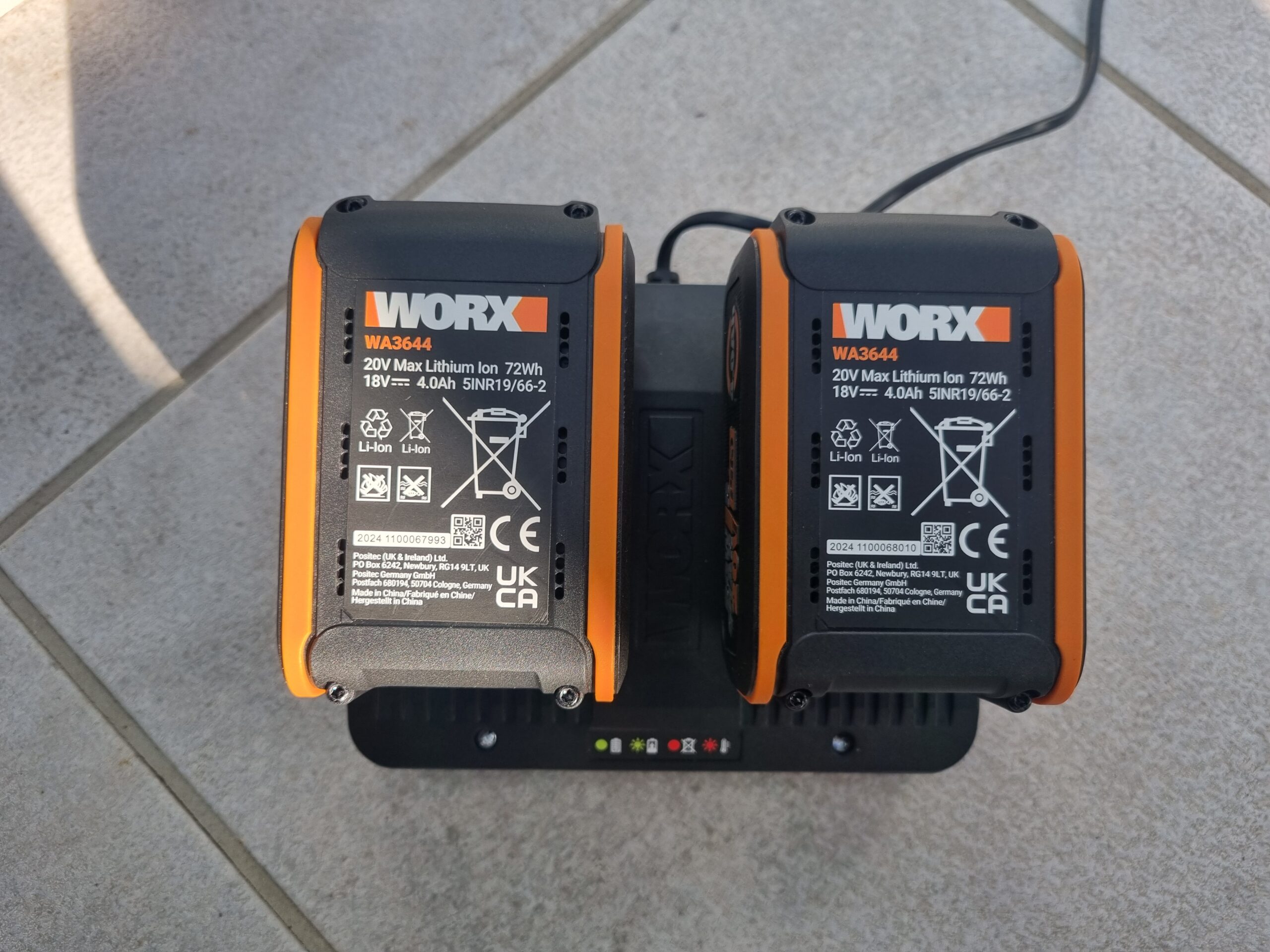
My Worx cordless mower came with two 4.0Ah batteries. In my garden, those two batteries usually get very close to finishing the lawn, but if the grass is wet or has got a bit too long, they can run out just before the end. Because I also have two 2.0Ah Worx batteries, I can swap those in and finish the cut rather than waiting for a recharge.
The smaller 2.0Ah batteries are also useful in a different way. They are lighter, so they make more sense in tools like hedge trimmers and strimmers, where you are holding the tool for longer. The 4.0Ah batteries give more runtime, but the 2.0Ah batteries keep the tool easier to handle.
That is where the system starts to make sense in real use. The mower can use the bigger batteries, the hedge trimmer or strimmer can use the lighter ones, and if one pair runs down you are not stuck.
The dual-battery setup is especially useful on models like the Worx WG737E cordless lawn mower, because the same 20V batteries can still be used individually in smaller Worx tools.
Worx is not just a compact-garden system. I would describe it as best for small to medium gardens, including larger suburban gardens where you want cordless convenience without moving into trade-grade kit.
Bosch Power For All
Bosch Power For All is a strong choice if you want one 18V battery platform for both home and garden jobs.
The real advantage goes beyond Bosch’s own tools — it’s the Power For All Alliance. Bosch 18V batteries can work across compatible Bosch home and garden tools as well as selected partner brands in the alliance.
That makes Bosch a good option if you want a tidier home-and-garden setup rather than a garden-only platform.
For example, someone who wants a cordless drill, hedge trimmer, sander and garden sprayer may find Bosch more appealing than a platform focused mainly on outdoor tools.
The main limitation is that Bosch is not usually the first platform people choose for very heavy-duty garden work. For normal domestic use, though, it sits in a very practical middle ground.
Ryobi ONE+
Ryobi ONE+ is the platform to look at if you want range above almost everything else.
The 18V ONE+ system covers a very large number of tools across DIY, home, garden, cleaning, automotive and hobby use. If you like the idea of slowly adding tools over several years, Ryobi gives you a lot of room to grow.
For gardeners, the appeal is that you can buy into one battery platform and then keep expanding. Mowers, strimmers, hedge trimmers, blowers, saws, drills and odd-job tools all sit within the same general ecosystem.
The trade-off is that Ryobi is still mostly a serious DIY and homeowner platform rather than a premium trade platform. That is not a problem for most gardens, but it is worth knowing before you choose.
Einhell Power X-Change
Einhell Power X-Change deserves a proper place in this comparison because it is one of the strongest budget-friendly battery platforms in the UK.
It uses 18V batteries, with some larger tools using two batteries together for 36V. That gives it a similar practical idea to Worx: one battery type can power smaller tools, while paired batteries can run bigger garden equipment.
The main appeal is value. Einhell is often cheaper than Bosch, Makita, DeWalt or even some Worx and Ryobi options, while still offering a broad range of garden and DIY tools.
It is a good fit if you are starting from scratch, want to avoid petrol and cables, and do not want to spend premium-brand money.
The compromise is refinement. Some Einhell tools may not feel as polished as the bigger names, and the ecosystem is more budget-focused. But for occasional garden use, it can make a lot of sense.
Makita LXT / XGT
Makita is a better fit for heavier users, tradespeople and gardeners who are hard on their tools.
The LXT platform is the familiar 18V system, while XGT is Makita’s higher-output 40V platform. If you already own Makita tools, it often makes sense to stay within that ecosystem.
For garden use, Makita can be excellent, especially if you want durable tools and long-term battery support. The downside is cost. Makita is usually more expensive than typical homeowner brands, and for a small garden it may be more platform than you need.
If you use your tools often, or if the same batteries also support your DIY or trade tools, Makita becomes easier to justify.
DeWalt XR / FlexVolt
DeWalt is another premium option, especially if you already own DeWalt power tools.
The XR range covers 18V tools, while FlexVolt batteries can switch voltage depending on the tool. That allows serious power for demanding jobs while still keeping compatibility across parts of the DeWalt cordless range.
For most small gardens, DeWalt is probably more than necessary. For heavy cutting, construction work, larger jobs or people already invested in the DeWalt ecosystem, it can make sense.
DeWalt positions itself as a performance platform that happens to include garden tools, rather than a budget-focused garden brand.
What Ah Battery Do You Need for Garden Tools?
Voltage gets most of the attention, but amp-hours matter just as much in real use.
A 2.0Ah battery may be fine for a drill, light hedge trimming or a quick strim around the edges. For a mower, blower or longer hedge-cutting session, it can feel limiting.
As a rough guide:
- 1.5Ah to 2.0Ah: light DIY, quick trimming, smaller handheld tools
- 2.0Ah to 4.0Ah: hedge trimmers, strimmers and routine garden jobs
- 4.0Ah and above: cordless mowers, blowers and longer cutting sessions
- Two batteries together: useful for mowers and more demanding tools
This is where shared battery platforms become practical. A larger 4.0Ah battery may be useful in a mower, while a lighter 2.0Ah battery may be better in a hedge trimmer because it keeps the tool easier to hold.
If you are switching from petrol, do not just look for an equivalent power figure. Look at whether the batteries will let you finish the job without stopping. Runtime matters more than the headline voltage once you are halfway through a wet lawn in May.
A Word on Third-Party Batteries
You will see cheap “compatible” batteries on Amazon, eBay and other marketplaces.
Some may work. The problem is that cheaper third-party batteries may not have the same thermal protection, cell balancing or build quality as the original brand batteries.
That matters most in high-drain garden tools such as:
- cordless lawn mowers
- hedge trimmers
- leaf blowers
- chainsaws
- pole saws
These tools pull a lot from the battery. If a pack overheats, fades quickly or cuts out under load, the saving may not look so clever later.
For low-drain occasional use, some people take the risk. For cutting tools and mowers, I would stick with genuine batteries where possible.
Battery Storage in UK Sheds
Lithium batteries do not love being left in cold, damp sheds all winter.
A lot of UK gardeners store tools in an unheated shed or garage, which is fine for the tools themselves but not ideal for batteries during prolonged cold spells.
A simple rule helps:
- store the tools in the shed if needed
- bring the batteries indoors during frost or long cold periods
- keep batteries dry
- avoid leaving them fully flat for long periods
For more general battery and tool-care advice, see my guide on how to maintain cordless garden tools.
When a lithium-ion tool battery reaches the end of its life, don’t put it in household waste or normal recycling. Use a proper battery recycling point instead; Recycle Your Electricals has a useful UK guide to recycling batteries.
There is no single best system for everyone.
The right choice depends on your garden, your budget and what tools you expect to buy next.
- you have a small to medium garden
- you want lightweight tools
- you like the idea of using 20V batteries singly or in pairs
- you want a practical garden-focused platform
- you already own or are considering Worx cordless tools
Choose Bosch Power For All if:
- you want one battery for home and garden jobs
- you like Bosch tools
- cross-brand alliance compatibility appeals to you
- you want a tidy 18V platform for normal domestic use
Choose Ryobi ONE+ if:
- you want a huge range of tools
- you expect to keep adding tools over time
- you want good UK availability
- you want one ecosystem for DIY, garden, cleaning and odd jobs
Choose Einhell Power X-Change if:
- budget is a major factor
- you want a large platform without premium pricing
- you are starting from scratch
- you are happy with a more value-focused system
Choose Makita or DeWalt if:
- you already own their tools
- you use tools heavily
- you want trade-style durability
- you have tougher jobs than routine garden maintenance
For many ordinary UK gardens, Worx, Bosch, Ryobi and Einhell are the most realistic platforms to compare first. Makita and DeWalt are excellent, but they make most sense if you already use those systems or need heavier-duty kit.
Quick Decision Guide
- Small urban garden: Worx or Bosch
- Medium suburban garden: Worx, Bosch or Ryobi
- Larger suburban garden: Worx with enough batteries, Ryobi, Makita or DeWalt
- Biggest tool range: Ryobi ONE+
- Best budget route: Einhell Power X-Change
- Heavy-duty use: Makita or DeWalt
- Home and garden crossover: Bosch Power For All
One useful test is to think about your hardest garden job, not your easiest one.
Almost every brand makes a decent drill. Fewer make a mower, hedge trimmer or long-reach tool that feels comfortable after twenty minutes. Choose your battery platform around the tool that will work hardest.
Final Thoughts
Choosing between power share battery systems is really about avoiding platform regret.
The first cordless tool is easy to buy. The third or fourth is where you realise whether you chose well.
For small to medium UK gardens, Worx PowerShare is a practical garden-focused system, especially if you like the flexibility of using 20V batteries singly in lighter tools or paired in a mower. Bosch Power For All is strong if you want one platform across home and garden jobs. Ryobi ONE+ is hard to beat for range. Einhell is a serious budget option. Makita and DeWalt are better suited to heavier users or people already invested in those brands.
Whichever route you choose, the advice is the same: look beyond the first tool. Check the battery sizes, the bare-tool prices, the garden-tool range and the tools you are likely to want in a few years.
That is where the real saving is.
Power share battery systems let you use the same rechargeable battery across several cordless tools from one brand. Instead of having a different battery and charger for every tool, you can swap one compatible battery between tools such as a mower, hedge trimmer, strimmer or drill.
Are Worx, Bosch and Ryobi batteries interchangeable?
No. Most cordless tool battery platforms are brand-specific. A Worx PowerShare battery will not fit a Bosch Power For All tool or a Ryobi ONE+ tool. Once you start buying into one system, it usually makes sense to stay within that platform.
What Ah battery do I need for cordless garden tools?
For light trimming or quick jobs, a 2.0Ah battery may be enough. For mowers, blowers and longer hedge-trimming sessions, 4.0Ah or higher is usually more practical. Smaller batteries can still be useful in handheld tools because they keep the tool lighter.
Is 18V or 20V enough for garden tools?
Yes, for many UK gardens. An 18V or 20V platform is usually enough for routine trimming, hedge cutting and smaller lawns. Larger mowers and more demanding tools may use two batteries together to create a higher-voltage setup, such as 36V or 40V.
A shared battery platform makes most sense if you plan to own more than one or two cordless tools. Once you have batteries and a charger, you can often buy bare tools more cheaply and avoid building up several incompatible chargers.
Can I use third-party batteries with cordless garden tools?
You can find third-party compatible batteries online, but they are not always the safest or most reliable choice. In high-drain tools such as mowers, hedge trimmers and blowers, genuine batteries are usually the better option because they are designed with the tool’s power demand, heat management and protection systems in mind.