
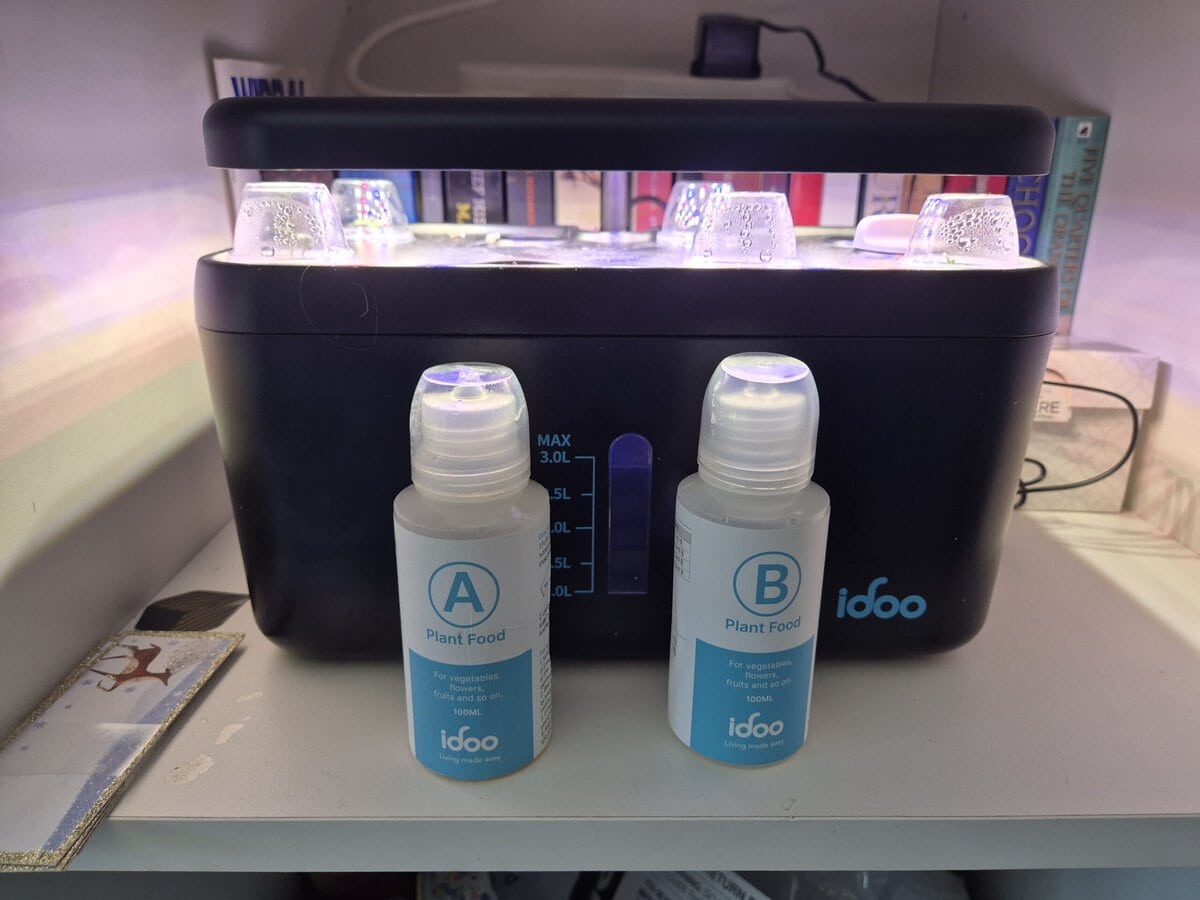
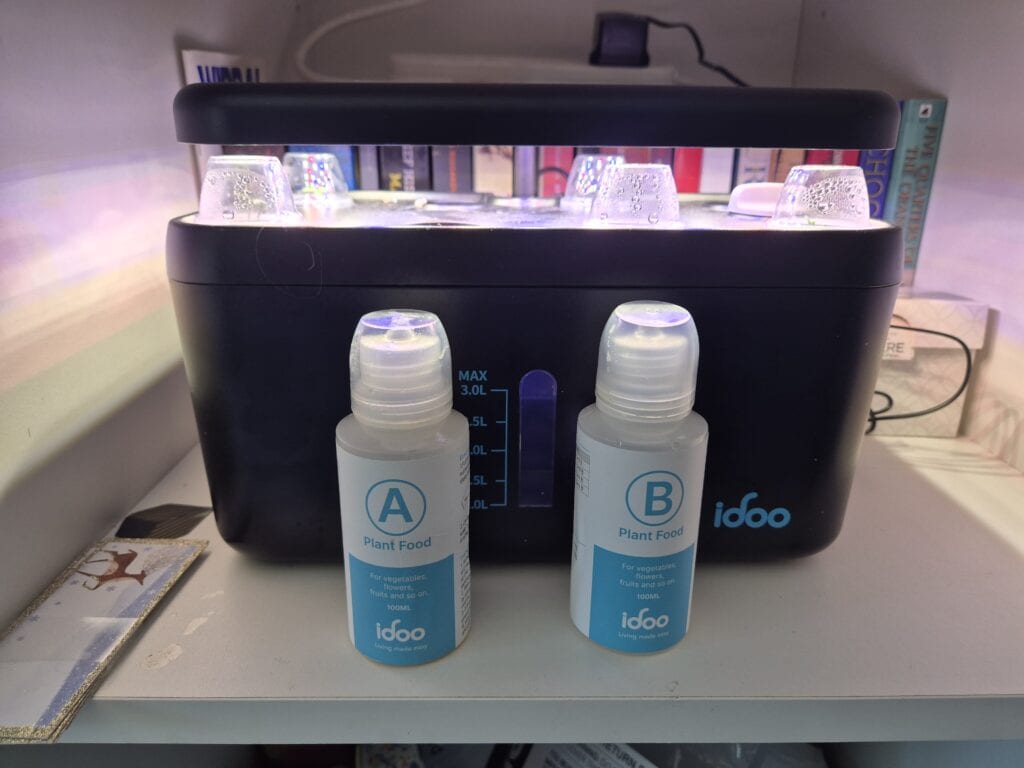
I recently started growing with hydroponics for the first time using the iDOO hydroponics growing system, which is a simple way to begin growing herbs and salad leaves indoors.
That kind of countertop system takes a lot of the guesswork out of the process, including the nutrients. You usually get a simple A and B plant food supplied with the kit, add it to the water, and follow the instructions.
But once you start looking beyond ready-made indoor systems and into more DIY-style hydroponics, the subject of plant food quickly becomes more confusing.
There are liquid nutrients, powder nutrients, A and B feeds, pH levels, EC meters, hard water issues and plenty of specialist additives. It can feel like a big step up from simply filling a small tank and adding the supplied bottles.
In this guide to hydroponic nutrients for beginners, I’ll share what I have learnt so far about how hydroponic nutrients work, why they are different from normal plant food, and how to keep things simple when you are just getting started.
If you are still choosing a setup, you may also find my guide to the best hydroponic growing systems in the UK useful, as different systems make nutrient mixing, water changes and plant care easier or harder.
What Are Hydroponic Nutrients?
Hydroponic nutrients are liquid or powdered plant feeds designed to be dissolved directly into water.
Instead of roots taking nutrition from compost or soil, the plant gets what it needs from the water around its roots. That means the nutrient solution has to provide the main elements plants need for healthy growth, including nitrogen, phosphorus, potassium, calcium, magnesium and trace minerals.
In soil growing, compost helps buffer mistakes. In hydroponics, the water is the growing environment, so the nutrient mix matters more.
The good news is that beginner systems usually make this easier by using pre-mixed nutrients rather than expecting you to build a formula yourself.
Why Normal Plant Food Is Not Usually Best for Hydroponics
Standard houseplant feed or tomato feed is not usually the best choice for hydroponics.
Some feeds may work in a very basic way, but most ordinary plant foods are designed for soil or compost. In those systems, the growing medium provides some buffering and may already contain nutrients of its own.
Hydroponic nutrients are different because they are made to be complete in water. They are usually balanced for root-zone feeding and often include calcium, magnesium and trace elements that ordinary plant feeds may not provide in the same way.
For a casual experiment, you might get some growth with ordinary liquid feed. But if you want reliable herbs, lettuce or leafy greens, a proper hydroponic nutrient is the better starting point.
The Main Types of Hydroponic Nutrients for Beginners
There are several types of hydroponic nutrients, but beginners do not need to understand every advanced feeding programme.
The main options are simple liquid feeds, two-part A and B nutrients, powder nutrients, organic-style feeds and crop-specific formulas.
The right nutrient also depends partly on the system you are using. A compact countertop hydroponic garden is usually simpler to manage than a larger DIY setup, which is why I cover system choice separately in my guide to the best hydroponic growing systems in the UK.
| Type of nutrient | Best for | Main advantage | Main drawback |
|---|---|---|---|
| One-part liquid nutrient | Simple herbs and leafy greens | Very easy to measure and mix | Less flexible than multi-part feeds |
| Two-part A and B nutrient | Beginner hydroponic kits and indoor gardens | Complete and still fairly simple | You need to add both parts separately |
| Three-part nutrient | More serious hydroponic growers | More control over growth stages | More bottles and more decisions |
| Powder nutrient | Larger reservoirs or regular growers | Good value and long shelf life | Slightly less convenient for beginners |
| Organic-style hydroponic nutrient | Growers wanting a more natural approach | Appeals to organic-minded growers | Can be harder to manage in small water systems |
One-part liquid nutrient
Best for: Simple herbs and leafy greens.
Main advantage: Very easy to measure and mix.
Main drawback: Less flexible than multi-part feeds.
Two-part A and B nutrient
Best for: Beginner hydroponic kits and indoor gardens.
Main advantage: Complete and still fairly simple.
Main drawback: You need to add both parts separately.
Three-part nutrient
Best for: More serious hydroponic growers.
Main advantage: More control over growth stages.
Main drawback: More bottles and more decisions.
Powder nutrient
Best for: Larger reservoirs or regular growers.
Main advantage: Good value and long shelf life.
Main drawback: Slightly less convenient for beginners.
Organic-style hydroponic nutrient
Best for: Growers wanting a more natural approach.
Main advantage: Appeals to organic-minded growers.
Main drawback: Can be harder to manage in small water systems.
What Do the Different Hydroponic Nutrient Options Mean?
Before choosing a nutrient, it helps to understand what the main options actually are. Most beginner growers do not need anything complicated, but the labels can be confusing when you first start looking.
One-Part Liquid Hydroponic Nutrients
A one-part liquid nutrient is the simplest option. Everything is already combined in one bottle, so you measure the recommended amount and add it to your water.
This can work well for simple herbs, lettuce and leafy greens. The downside is that one-part nutrients are less flexible, and some minerals are harder to keep stable together in one concentrated bottle.
Two-Part A and B Hydroponic Nutrients
Two-part nutrients come in separate A and B bottles. This is common in hydroponics because certain minerals can react with each other if they are stored together in concentrated form.
Once diluted in water, they work together as a complete plant feed. This is the style of nutrient supplied with many beginner systems, including the iDOO hydroponics growing system.
Three-Part Hydroponic Nutrients
Three-part nutrients usually split the feed into separate bottles for different parts of plant growth. For example, one bottle may support leafy growth, another may support flowering or fruiting, and another may provide a base nutrient.
This gives more control, but it also adds more decisions. For a beginner growing basil, lettuce or salad leaves, a three-part feed is usually more than you need.
Powdered Hydroponic Nutrients
Powdered nutrients come as dry salts or powder that you mix into water yourself. They can be good value, especially if you are running a larger system or growing regularly.
The drawback is that they feel less beginner-friendly. You need to measure carefully, dissolve them properly, and store the powder somewhere dry. For a small countertop system, liquid nutrients are usually easier.
Organic-Style Hydroponic Nutrients
Organic-style hydroponic nutrients appeal to growers who want a more natural approach, but they can be trickier in small indoor systems.
They may cloud the water, leave more residue, or increase the chance of smells and build-up if the system is not managed well. For beginners, a clean mineral hydroponic nutrient is usually simpler and more predictable.
Crop-Specific Hydroponic Nutrients
Some nutrients are designed for particular crops or growth stages, such as leafy greens, tomatoes, peppers or flowering plants.
These can be useful later, especially if you move into larger DIY hydroponics. But for your first herbs and salad leaves, a general complete hydroponic nutrient is normally enough.
For Most Beginners, A and B Nutrients Are the Easiest Choice
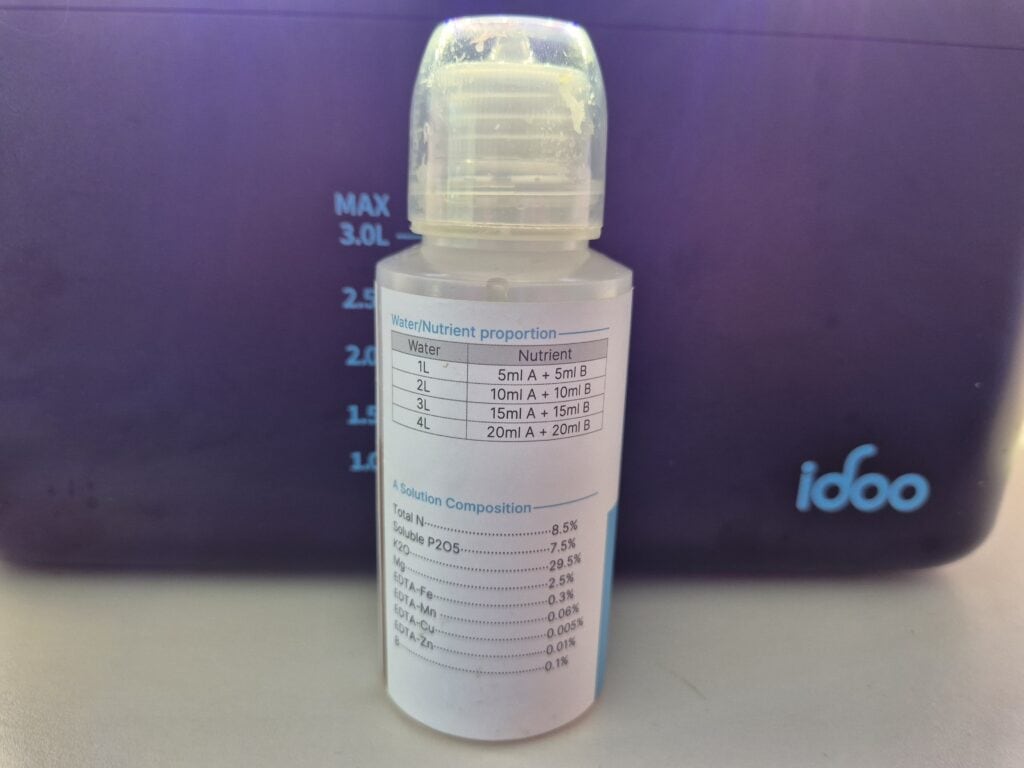
The iDOO nutrient bottle gives simple per litre measurements, which makes beginner hydroponic feeding much easier.
Many small hydroponic systems use two bottles labelled Nutrient A and Nutrient B.
This is common because some minerals do not store well together in a concentrated bottle. Keeping them separate helps prevent unwanted reactions before they are diluted in water.
In use, it is simple. You add the recommended amount of Nutrient A to the water, mix it, then add the recommended amount of Nutrient B and mix again.
The main rule is not to mix the concentrated A and B liquids directly together before adding them to water. Add them separately to the reservoir instead.
HomeGrower Pro Tip: The A + B Rule
Think of Nutrient A and Nutrient B as two parts of a formula that should only meet once they are diluted in water.
Add A to the reservoir, mix it into the water, then add B and mix again. Do not pour the concentrated liquids together in a jug or splash one bottle into the other.
If concentrated A and B nutrients are mixed directly, you may see cloudiness or sediment. That usually means some of the nutrients have reacted together and become less available to the plants.
How Much Hydroponic Nutrient Should You Use?
The safest answer is to follow the instructions on your nutrient bottle or hydroponic system.
Different products vary, and small reservoirs can become too strong if you guess. As a general beginner principle, it is better to start slightly weak than too strong.
Young seedlings and small herbs do not need a heavy feed straight away. Too much nutrient can stress plants, especially in compact indoor systems where there is not much water to dilute mistakes.
For many small A and B hydroponic kits, the instructions are based on a simple amount per litre of water. With iDOO-style systems, this is often a measured amount of Nutrient A and Nutrient B per litre, but you should always check the instructions for your exact model and bottles.
What About Hard Water?
This is worth mentioning for UK growers because tap water varies a lot depending on where you live.
If you are in a hard water area, your tap water already contains more dissolved minerals. That does not mean you cannot grow hydroponically, but it can make the nutrient solution stronger than expected.
If your plants look burnt, crispy or stressed even though you followed the nutrient instructions, the water itself may be part of the issue.
For beginners, I would not worry about this on day one. Start simple and observe the plants. But if you repeatedly get burnt leaf tips or poor growth, it may be worth trying filtered water, rainwater, or a mix of tap water and rainwater to see if the plants respond better.
Do not overcorrect too quickly. In beginner hydroponics, a clean reservoir and fresh nutrient mix are often the best first step before buying extra products.
Do You Need an EC or TDS Meter?
An EC or TDS meter measures how strong the nutrient solution is.
Serious hydroponic growers use these regularly, especially for tomatoes, cucumbers, peppers and larger plants. They are useful tools, but they can also make a beginner setup feel more technical than it needs to be.
For hydroponic nutrients for beginners, a meter is useful rather than essential.
If you are growing basil, lettuce or herbs in a small indoor system and following the supplied nutrient instructions carefully, you can start without one.
A meter becomes more useful when you want to compare different nutrients, reuse water for longer, grow larger plants, or understand why plants are struggling.
The beginner rule is simple: if the plant looks healthy, growing strongly and producing good leaves, you do not need to keep changing things.
What About pH?
pH matters in hydroponics because it affects how easily plants can absorb nutrients from the water.
If the pH is too far out, plants may struggle even when the nutrient level itself is correct.
For simple beginner systems, you can usually get started by using tap water and following the nutrient instructions. If plants look healthy and are growing well, you may not need to adjust anything at first.
However, if leaves are yellowing, growth is poor, or you are moving beyond basic herbs and salad leaves, testing pH becomes more useful.
A simple pH test kit or pH meter can help you check whether the water is in a suitable range. But again, observation comes first. Do not turn a simple windowsill hydroponic setup into a chemistry project unless the plants are giving you a reason to.
How Often Should You Change the Nutrient Water?
In a small hydroponic system, the water level gradually drops as plants drink and as some water evaporates.
You can usually top up with water between changes, but the nutrient balance can drift over time. Plants take up different minerals at different rates, so the solution left behind is not always the same as the solution you started with.
A practical beginner approach is to refresh the reservoir every couple of weeks, or sooner if the water looks dirty, smells stale, or the plants start struggling.
With compact indoor systems, it is also worth cleaning the tank between crops. Old roots, algae and residue can build up, especially if the system has been running for several weeks.
HomeGrower Pro Tip: The Simple First Aid Fix
If your hydroponic plants suddenly stall, look pale, or start behaving oddly, do not immediately add more feed.
The simplest first aid step is usually to empty the reservoir, rinse it, and refill it with fresh water and a correctly mixed nutrient solution.
That one reset solves a lot of beginner problems.
Signs Your Hydroponic Nutrients Are Too Weak
If the nutrient mix is too weak, plants may still survive, but they can look pale, slow or underpowered.
Common signs include:
- Pale green or yellowing leaves
- Slow growth after the seedling stage
- Thin, weak stems
- Small leaves compared with normal growth
- Plants that seem to stall even with enough light
Weak nutrients are more likely if the reservoir has been topped up with plain water several times without being refreshed.
It can also happen when fast-growing plants have used up a lot of the available feed.
Signs Your Hydroponic Nutrients Are Too Strong
Too much nutrient can also cause problems. This is one reason beginners should avoid the temptation to add extra feed in the hope of faster growth.
Common signs include:
- Brown or burnt-looking leaf tips
- Leaf edges turning dry or crispy
- Plants wilting even though roots are in water
- Salt-like residue around the reservoir or pod area
- Seedlings struggling soon after nutrients are added
If in doubt, emptying and refilling the reservoir with a fresh, correctly mixed solution is often better than trying to fix a mystery problem by adding more feed.
Best Beginner Crops for Simple Hydroponic Nutrients
Basic hydroponic nutrients work best when matched with easy crops.
Herbs and leafy greens are much more forgiving than large fruiting plants. They grow quickly, stay relatively compact and do not usually need the same heavy feeding as tomatoes, cucumbers or peppers.
Good beginner choices include:
- Basil
- Lettuce
- Pak choi
- Rocket
- Mint
- Parsley
- Coriander
- Small leafy greens
These crops are well suited to small indoor systems because they grow quickly, stay relatively compact and do not need a large root zone.
Larger fruiting crops usually need stronger lighting, more root space, more support and more careful feeding. That does not mean they are impossible, but they are not the easiest place to start.
For a fuller list of easy crops and what to avoid at the beginning, see my guide to what plants you can grow hydroponically indoors.
Should Beginners Use Specialist Nutrients?
Specialist nutrients can be useful, but they are not always necessary at the beginning.
Many brands offer separate grow, bloom, calcium-magnesium and additive products. These can make sense for advanced setups, but they can also make hydroponics feel more confusing than it needs to be.
For your first hydroponic herbs or salad leaves, I would keep it simple:
- Use a complete hydroponic nutrient.
- Follow the bottle instructions.
- Start with easy crops.
- Refresh the water regularly.
- Only add meters and extras when you have a reason to.
I will cover specific product choices in a separate guide to the best hydroponic nutrients, but this beginner guide is deliberately about understanding the basics first.
My Simple iDOO Nutrient Setup
My own beginner hydroponic nutrient setup is very straightforward.
With the iDOO system, I use the supplied A and B liquid nutrients, mixed into the water tank according to the instructions.
That is one of the reasons systems like this are useful for beginners. You do not have to choose a separate feed immediately, and you do not have to understand advanced hydroponic feeding schedules before growing your first basil or lettuce.
In my real-world iDOO test, the system was forgiving and low-maintenance. The basil grew well even though the setup was not treated like a perfect laboratory experiment. For beginners, that matters.
How to Store Hydroponic Nutrients
Hydroponic nutrients are usually easy to store, but they should not be left open, overheated or sitting in direct sunlight.
Keep the bottles sealed and store them somewhere cool, dark and dry. A cupboard is usually better than a sunny windowsill or a hot greenhouse.
If nutrients have been sitting around for a long time, check for unusual smells, heavy sediment, leaking bottles or anything that looks very different from when you first bought them.
A little settling can be normal with some products, but badly stored nutrients are not worth risking if the bottle looks clearly spoiled.
Common Beginner Mistakes With Hydroponic Nutrients
Most beginner nutrient problems come from doing too much rather than too little.
Common mistakes include:
- Adding extra feed too early
- Mixing A and B together undiluted
- Never refreshing the reservoir
- Using normal plant food instead of hydroponic nutrients
- Ignoring light levels
- Trying difficult crops first
- Changing too many things at once
Seedlings do not need a strong nutrient solution straight away. A small basil or lettuce plant is not going to grow faster just because you double the feed.
It is also important to remember that nutrients cannot fix every problem. If the light is too weak, the roots are unhealthy, or the water is stale, adding more feed may make things worse.
Simple Beginner Routine
If you want a simple routine for hydroponic nutrients, this is a sensible starting point:
- Fill the reservoir with water.
- Add the recommended amount of Nutrient A and mix.
- Add the recommended amount of Nutrient B and mix again.
- Plant easy herbs or leafy greens.
- Check the water level every few days.
- Top up when needed.
- Refresh the reservoir every couple of weeks or between crops.
- Clean the tank before starting a new crop.
That is enough to get started.
You can always add pH testing, EC readings and more advanced nutrients later. But at the beginning, your main job is to keep the water fresh, avoid overfeeding, and watch how the plants respond.
Final Thoughts: Keep Hydroponic Nutrients Simple at First
Hydroponic nutrients for beginners do not need to be complicated.
For most people starting with herbs, basil, lettuce or leafy greens, a simple complete nutrient is enough.
A two-part A and B feed is a good beginner option because it gives plants the nutrients they need while keeping the process easy to follow.
Once you understand the basics, you can explore stronger feeds, crop-specific formulas, EC meters and pH adjustment.
But at the start, the best approach is simple: use a proper hydroponic nutrient, follow the instructions, grow easy crops, and learn from how the plants respond.
For a broader overview from a gardening authority, the RHS also has a useful introduction to hydroponics for growing vegetables.
📎 Related Articles
Hydroponic Nutrients for Beginners FAQs
What nutrients do you need for hydroponics?
For most beginner hydroponic systems, you need a complete hydroponic nutrient that contains the main minerals plants need in water. Many beginner kits use a two-part A and B liquid nutrient.
Can I use normal plant food for hydroponics?
It is better to use proper hydroponic nutrients. Normal plant food is usually designed for soil or compost and may not provide the right balance of nutrients for water-based growing.
Are A and B nutrients good for beginners?
Yes. A and B nutrients are a good beginner option because they are complete, easy to measure and commonly supplied with small hydroponic systems. Just add each part separately to water rather than mixing the concentrated liquids together first.
Do I need a pH meter for beginner hydroponics?
A pH meter is useful, but it is not always essential for your first small herb or lettuce setup. If you are following the nutrient instructions and plants are growing well, you can start simple and add pH testing later.
How often should I change hydroponic nutrient water?
A practical beginner approach is to refresh the reservoir every couple of weeks, or sooner if the water looks dirty, smells stale, or the plants stop growing well.
What is the easiest hydroponic nutrient for beginners?
The easiest option is usually a simple complete liquid hydroponic nutrient, especially a two-part A and B feed supplied with a beginner indoor growing system.
Can hydroponic nutrients go off?
They can degrade if stored badly. Keep hydroponic nutrients sealed in a cool, dark place and avoid leaving them in direct sunlight or very hot conditions. If a bottle smells strange, leaks, or looks badly separated, it is safer to replace it.