
When you purchase through links on our site, we may earn an affiliate commission at no extra cost to you.

🏆 Our Top Picks
Here are the best cheap grow lights for UK homes, selected for practical usefulness, sensible coverage and overall value.
You don’t need an expensive setup to grow herbs or raise seedlings through a dark UK winter. I’ve used several lights at the budget end of the market, and some are genuinely useful for under £100 — often much less. The important thing is to ignore inflated claims such as “1000W equivalent” and judge each light by its actual power, coverage and intended use.
This guide compares affordable grow lights for UK homes, including simple bulbs, shelf lights and compact LED panels. Where I have tested a light myself, I say so clearly; the remaining recommendations are based on specifications, design and suitability for the job.
For a full breakdown of grow light types and setup, see the HomeGrower Guide to Grow Lights.
Cheap Grow Lights: Quick Recommendations
Short on time? Use this table to quickly find the best cheap grow light for your setup — from simple bulbs to full LED panels.


The products themselves are generally available for under £100, although prices change and the fluorescent tubes require compatible fittings. Running costs vary considerably, so compare the rated power as well as the purchase price.
The options below cover several different types of budget grow light, from a compact LED panel for stronger growth to bulbs, shelf bars and flexible clip-on lights for smaller setups. Each suits a different space, so the best choice depends on how much area you need to cover and what you plan to grow.
For more powerful options, see our Best LED Grow Lights UK 2026 Guide. For simpler first-time setups, see our Beginner Grow Lights guide.
Best Budget Grow Light Panel
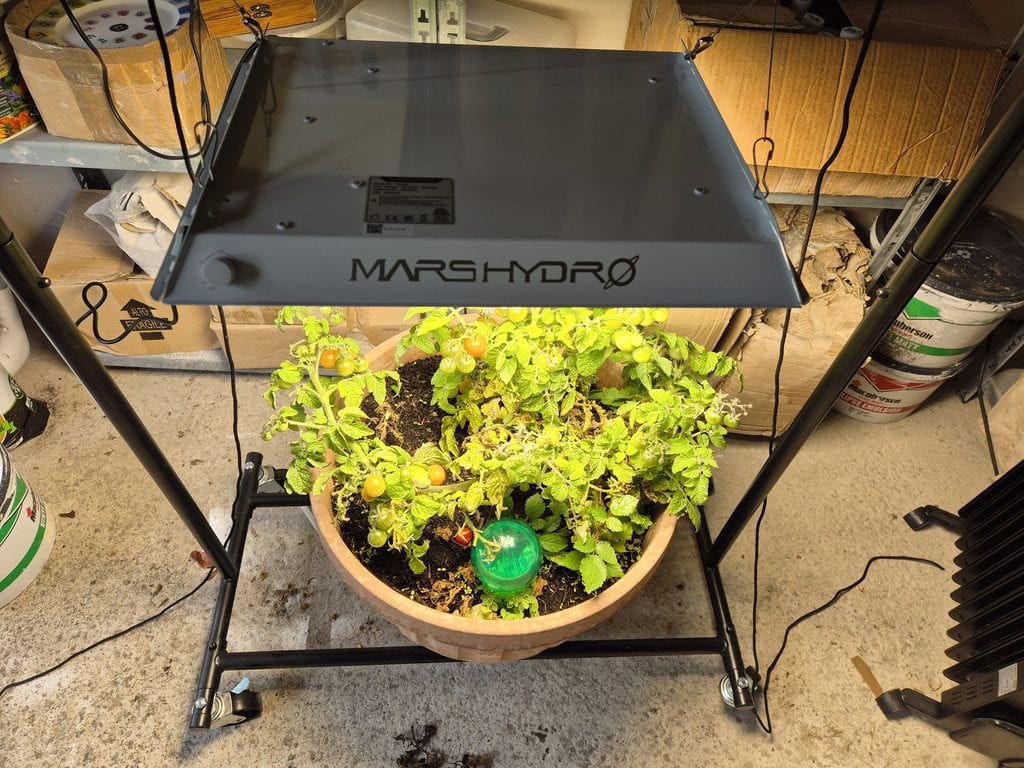

Hands-on tested: I have used and tested an earlier version of the Mars Hydro TS600 myself. The current model has since been updated with dimming control, while keeping the same basic 100W compact-panel format. You can read my full Mars Hydro TS600 review for more detail on my real-world testing.
The Mars Hydro TS600 is my budget panel pick in this guide. With around 100W of actual power draw, it is a significant step up from bulbs, clip-on lights and propagation bars, while still being relatively inexpensive to buy and run. It is powerful enough for seedlings, leafy crops and compact chilli, pepper or tomato plants when the growing area is kept sensible.
Best Uses for the TS600
- Small grow tents and cupboards
- Compact chilli, pepper and tomato plants
- Seedlings and young plants needing stronger light
- Leafy crops grown indoors
- Growers wanting an affordable first proper LED panel
Key details
- Rated power: approximately 100W
- Suggested growing area: best suited to a compact growing space
- Light adjustment: the current version includes dimming control
- Cooling: passive, fanless design
- Spectrum: suitable for seedlings, vegetative growth and flowering
- Best suited to: budget indoor growing rather than large or high-intensity setups
In my testing, the TS600 proved to be a straightforward light to use. My earlier version did not include a dimmer, so I controlled intensity mainly by adjusting the hanging height as the plants developed. The current model is more flexible because the output can also be reduced for seedlings and increased as plants mature. The fanless design also means there is no fan noise, which is useful if the light is being used inside the home.
Limitations
- Needs to be suspended securely above the plants
- Not powerful enough for a large grow area or several demanding mature plants
- More expensive to run than a simple bulb or low-powered propagation light
- Growers wanting significantly higher output or a larger growing area will be better moving up to a bigger panel
Bottom line: The TS600 is a good choice if you want an inexpensive entry point into proper LED grow panels. It provides considerably more usable light than basic bulbs and clip-on lights without moving into the price or power consumption of larger fixtures. For a small growing area, it is one of the easiest budget options to recommend, and my full hands-on TS600 review covers my testing in more detail.
Best Grow Light Bulb for Existing Lamps
Type: Full-spectrum E27 LED grow bulb
Hands-on tested: I have used the smaller 10W SANSI grow bulb in my own indoor setup. I have not tested this exact 36W version, so the assessment below combines my experience with the lower-powered SANSI bulb and the published specifications for this model.
The SANSI 36W is a convenient step up from lower-powered grow bulbs without requiring a hanging LED panel. It screws into a suitable E27 holder and directs its light into a relatively concentrated area, making it a good match for one larger plant, several closely grouped herbs or a compact tray of seedlings.
Best uses for the SANSI 36W
- One medium-sized houseplant or a compact group of smaller pots
- Herbs and seedlings arranged directly beneath the bulb
- Spaces where fitting a hanging panel would be awkward
- Growers who already own a stable, open E27 lamp holder
Key details
- Rated power: 36W
- Fitting: standard E27 screw base
- Colour temperature: 4000K white light
- Beam angle: 60 degrees
- Published light output: 3250 lumens
The focused beam is both its strength and its main limitation. More of the light is directed towards plants immediately below the bulb than with a weak multi-head clip-on light, but coverage becomes less even as the growing area widens. Raising the bulb increases the spread, although it also reduces the intensity reaching the leaves.
Limitations
- The concentrated beam is better for a compact group than a long shelf
- The bulb becomes warm and should not be enclosed in a tight lampshade
- Its size and weight may be unsuitable for a lightweight or unstable desk lamp
- There is no built-in dimmer or timer
Bottom line: The SANSI 36W is one of the simplest ways to provide useful growing light without installing a panel. It makes most sense for focused coverage over one plant or a compact group, while LED bars are a better fit for longer shelves and wider seedling trays.
I tested the lower-powered version in my SANSI grow light bulb review , including its positioning, coverage and performance in a UK home.
Best Budget Grow Light Bars for Shelves
Type: Linkable LED grow-light bars
Research-based recommendation: I have not tested this Barrina kit myself. This assessment is based on the specifications of the linked four-bar set, its design and the type of growing area it is intended to cover.
The Barrina T5 kit is designed for a different job from a bulb or compact LED panel. Instead of concentrating most of its output over one plant, the four slim bars can be spaced across a shelf to provide more even light over seed trays, herbs and young plants.
Where the Barrina bars work best
- Seed trays and propagation shelves
- Herbs, salad leaves and microgreens
- Long, narrow growing areas where a bulb would leave dark edges
- Multi-level racks where each shelf needs its own lighting
Key details
- Rated power: 64W total across four 16W bars
- Kit size: four 3ft LED bars
- Installation: supplied for mounting beneath shelves
- Connection: linkable bars with individual switches
- Light appearance: full-spectrum white light
The main advantage is coverage. The bars can be mounted parallel to one another and spaced to match the width of the trays below. That generally gives seedlings and leafy plants more even illumination than placing a single bulb in the middle of a long shelf.
The 64W total is divided between all four bars, so this should not be compared directly with a concentrated 64W panel. Its purpose is to spread moderate light over a longer area rather than deliver high intensity to flowering plants.
Limitations
- Requires mounting rather than simply clipping or screwing into a lamp
- Not as intense as a compact grow-light panel over a small canopy
- Best suited to seedlings and leafy growth rather than demanding fruiting plants
- Cables and link connections need to be arranged neatly on an open shelf
Bottom line: Choose the Barrina kit when even shelf coverage matters more than maximum intensity. It is a practical option for propagation, herbs and leafy crops, while the Mars Hydro TS600 is the better choice when you need stronger light for a compact growing area or fruiting plants.
Best Flexible Clip-On Grow Light
Type: Multi-head clip-on LED grow light
Hands-on tested: I tested a three-head Wolezek gooseneck light by using it to grow basil indoors. The current linked version has four adjustable heads and a rated output of 15W, so it is not exactly the same model, but it serves the same basic purpose: providing low-level, close-range light for herbs and other undemanding plants.
My results were mixed. With the lights positioned around 10–15cm above the basil, the plants stretched upwards, became weak and produced little useful leaf growth. After I cut the basil back and moved the lights to around 5cm from the top of the plant, growth became noticeably more compact and productive.
That experience shows where this type of light fits. It can work for basil, lettuce and small herbs, but only when the LEDs are kept close. The flexible arms make positioning easy, although they should not be mistaken for strong coverage: the current model’s 15W total output is divided across four separate heads.
What I would use it for
- Basil, lettuce and other small leafy plants
- One or two herb pots on a kitchen counter or shelf
- Low-demand houseplants that need supplementary winter light
- Awkwardly positioned pots where flexible light heads are useful
Key details
- Rated power of the current version: 15W total across four heads
- Mounting: clip-on base with flexible gooseneck arms
- Controls: dimming levels and selectable lighting modes
- Timer: built-in automatic timer
- Realistic positioning: approximately 5cm above basil in my test
The adjustable heads are useful when plants are different heights or arranged around a shelf. However, spreading all four heads over several pots also spreads an already modest amount of power more thinly. For one or two plants, it makes more sense to keep the heads close and concentrate them over the foliage.
Limitations
- Needs to be positioned very close to plants for useful growth
- Can produce stretched, leggy growth when placed too far away
- Limited output despite the visually impressive multi-head design
- Not suitable as the main light for tomatoes, chillies, peppers or other fruiting plants
- Better for one or two small pots than a full seed tray or long shelf
Bottom line: The Wolezek is a convenient light for a small herb setup rather than a substitute for a proper LED panel. It helped my basil once I moved it to around 5cm above the leaves, but it was ineffective at the greater distance I initially used. Choose it for close-range basil, lettuce or low-demand plants; choose the SANSI bulb for stronger focused light over a small area, or the Mars Hydro TS600 when you need a more powerful light for compact fruiting plants.
Read my full Wolezek gooseneck grow light review for photographs, the original basil test and a more detailed explanation of how changing the distance affected growth.
Best for Existing T5 Fittings
Type: Replacement T5 fluorescent tubes
Research-based recommendation: These are replacement tubes rather than a complete plug-in grow light. They only make financial sense if you already own compatible 2ft T5 fittings or are deliberately building a fluorescent propagation setup.
Each tube is rated at 24W, so running all five would use 120W before allowing for any small losses in the fittings. Their strength is broad, gentle coverage rather than high intensity, which makes them better suited to seedlings, cuttings and leafy plants than flowering or fruiting crops.
When these tubes make sense
- Replacing worn tubes in existing T5 grow-light fittings
- Seed-starting shelves and propagation racks
- Cuttings, herbs and young leafy plants
- Cooler growing spaces where a little lamp heat may be useful
Key details
- Rated power: 24W per tube; 120W for all five
- Length: 2ft
- Colour temperature: 6500K daylight
- Published output: approximately 2,000 lumens per tube
- Installation: requires compatible T5 fittings and ballasts
Fluorescent tubes spread light more evenly along a shelf than a single bulb, and seedlings can usually be kept fairly close to them. However, they are less energy-efficient than modern LED bars and require more equipment than the product box initially suggests.
Limitations
- The pack does not include the fittings needed to operate the tubes
- Buying five compatible fittings could make the complete setup expensive
- All five tubes together use considerably more power than the table previously suggested
- Less efficient and shorter-lived than comparable modern LED bars
- Not the best choice for tomatoes, chillies or other demanding fruiting plants
Bottom line: These tubes are a sensible replacement purchase when you already have suitable T5 fittings. For a new shelf setup, the Barrina LED bars are easier to install, more efficient and likely to be the better long-term choice.
What About DIY LED Strip Setups?
Basic LED strips can provide supplementary light for herbs or low-light houseplants, but performance varies considerably between products. Many cheap strips are intended for decoration rather than growing plants, and their actual power, spectrum and heat management may be unclear.
For most beginners, a proper grow-light bulb or linkable LED bar kit is a more predictable choice. A DIY strip setup makes most sense when you already understand the output required and want to build lighting into a custom shelf.
Tips for Getting Better Results from a Cheap Grow Light
- Keep weaker lights close: Distance depends on the light rather than simply whether it is a bulb, bar or panel. My Wolezek only produced acceptable basil growth at around 5cm, while stronger bulbs and panels need more space.
- Use a timer: Most herbs, seedlings and leafy plants do well with a consistent daily schedule. Around 12–16 hours is common, although the right duration depends on the crop and any natural daylight it also receives.
- Watch how the plants respond: Long, thin stems usually indicate insufficient light. Bleaching, curling or unusually pale patches can mean the light is too intense or too close.
- Make use of reflected light: White walls or white card around the growing area can redirect some otherwise wasted light towards the plants. Flat white surfaces generally give a more even reflection than crumpled foil.
- Match the light to the job: Keep weaker bulbs and clip-on lights for herbs, seedlings or supplementary lighting. Use a proper panel when moving on to larger or fruiting plants.
How Much Do Cheap Grow Lights Cost to Run?
Running costs depend on the actual wattage, daily operating time and your electricity tariff. As a simple example, a 40W light used for 14 hours per day consumes 0.56kWh per day.
At the current Ofgem representative electricity rate of 26.11p per kWh, that works out at approximately:
- 15p per day
- £4.39 per 30-day month
- £53.38 per year
Your own tariff may be higher or lower, so use the calculator below with the unit rate shown on your electricity bill. Standing charges are not included because switching on a grow light does not alter the daily standing charge.
The wattage figures in the comparison table give a useful starting point, but your actual running cost depends on the light you choose, how long it runs each day and your electricity unit rate.
Enter the light’s rated or measured power below — not a marketing claim such as “400W equivalent” or “1000W equivalent” — along with your usual daily runtime and the pence-per-kWh figure shown on your energy bill.
Grow Light Running Cost Calculator (UK)
Enter your grow light’s rated or measured wattage, how many hours you run it, and your electricity unit rate. You’ll get an instant estimate of the running cost per day, month and year.
UK tip: Check your latest bill or energy app and look for “Unit rate” or “Price per kWh”.
The calculator works regardless of how electricity prices change in the future.
Standing charges are not included because they do not change when you switch a grow light on or off.
Estimated running cost
Show the maths in plain English
This estimate covers the grow light only. Fans, heaters, pumps and dehumidifiers can add to the total.
How to Reduce Running Costs Without Buying Anything
- Use a plug-in timer so the light does not stay on longer than intended.
- Avoid unnecessary lighting hours once your plants are already receiving enough light.
- Adjust the distance carefully because placing a weak light too far away wastes electricity without producing useful growth.
- Adjust the schedule seasonally if your plants also receive useful natural daylight.
Final Thoughts
Cheap grow lights can work very well, but only when the light matches the plant and the growing area. A low-powered bulb or clip-on may be enough for herbs or a small group of seedlings at close range, while larger trays, shelves and fruiting plants need progressively more even or more intense light.
The main choice is really between three types of setup: a simple bulb for one or two plants, LED bars for shelves and propagation, or a proper hanging panel when you need stronger light over a compact growing area.
That is where the Mars Hydro TS600 fits in. It costs more than a bulb or small set of bars, but it is a much more capable option for anyone wanting to grow chillies, peppers, tomatoes or other higher-light plants indoors. I have also tested the TS600 myself, so you can read my full Mars Hydro TS600 review if you want a closer look at its real-world performance.
Do not choose by price or headline wattage alone. Check the actual power draw, think about how widely the light spreads, and watch how your plants respond after installation. Stretched growth usually means they are not getting enough usable light, whether that means moving the lamp closer or stepping up to a stronger fixture.
For most beginners, the best approach is to buy the simplest light that genuinely suits the job rather than simply choosing the cheapest option available.