
When you purchase through links on our site, we may earn an affiliate commission at no extra cost to you.
HomeGrower rating: ⭐⭐⭐⭐☆ 4/5
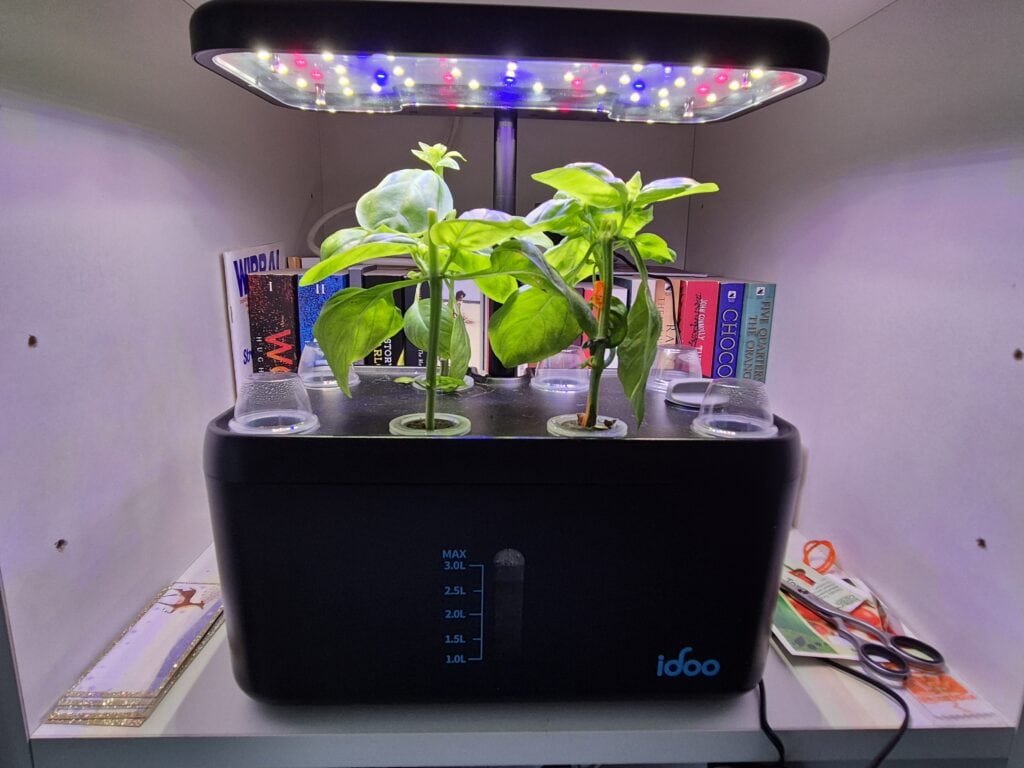
Quick verdict: The iDOO hydroponics growing system is a simple, low-maintenance indoor garden that works especially well for basil, herbs and small leafy crops.
I tested the 8-pod version with basil, and even after forgetting about it for a week or two at times, the plants still grew well. It is not perfect — the light is fairly modest, plant height needs managing, and some seedlings may need support — but for easy indoor herbs, it is a genuinely useful system.
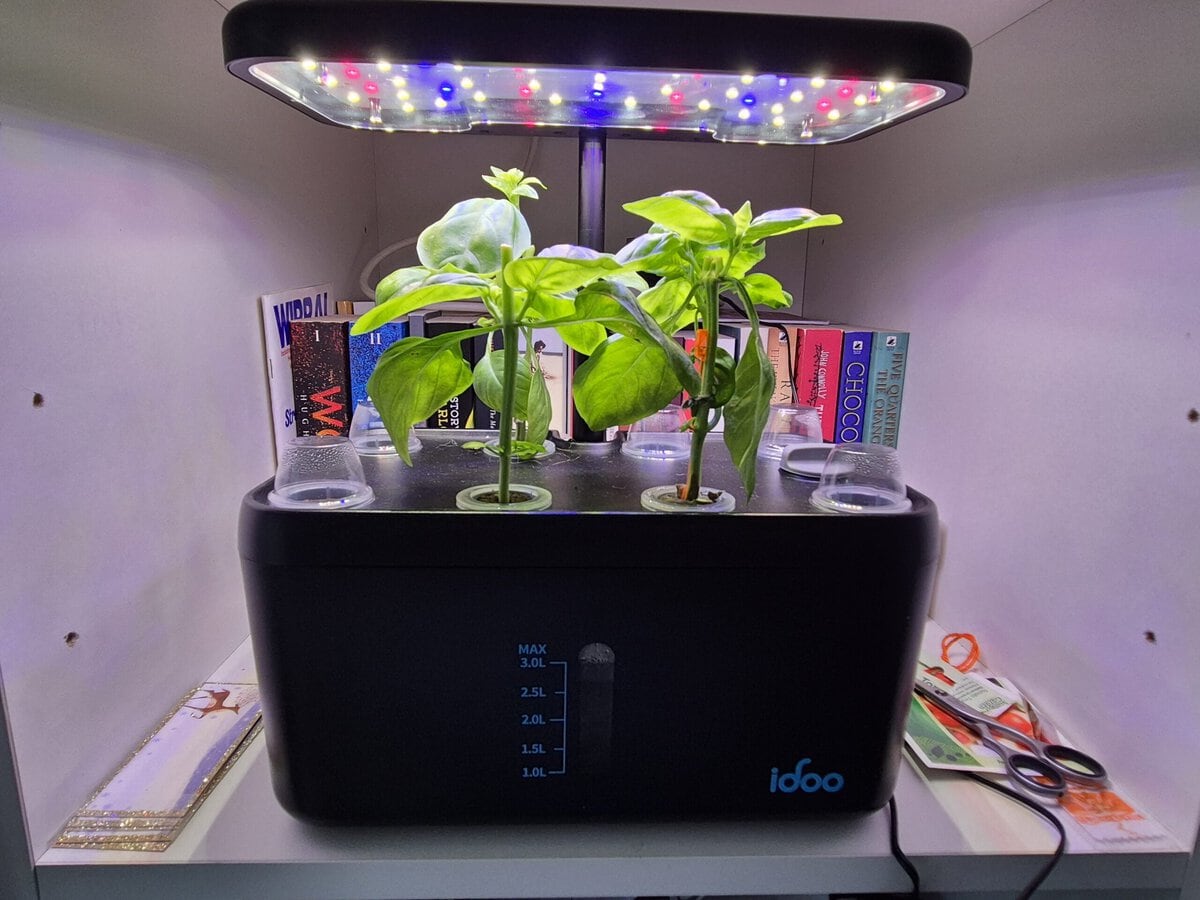
iDOO hydroponics growing system review: I’ve been testing the 8-pod iDOO system at home to see whether it is actually useful for indoor herbs, with basil as my first proper test.
The iDOO hydroponics growing system is a compact indoor garden designed for growing herbs, leafy greens and small plants without compost. This review is based on real use rather than just product specs, but I’ve also included wider thoughts on the larger iDOO systems because many of the same strengths and limitations apply across the range.
So far, the biggest surprise has been how forgiving it is. I had mine set up in a spare bedroom and forgot about it for a week or two at times, yet the basil still grew well. That is where this type of system makes most sense: it removes most of the watering work and gives beginners a simple way to grow indoors with very little daily effort.
It is not perfect. The light is fairly modest, the height needs adjusting as plants grow, and some seedlings may need extra support. But for basil, herbs and small leafy crops, the iDOO system has been much more useful than I expected.
For a wider comparison of similar indoor gardens, see my full guide to the best hydroponic growing systems UK.
How Easy Is the iDOO Hydroponics Growing System to Set Up?
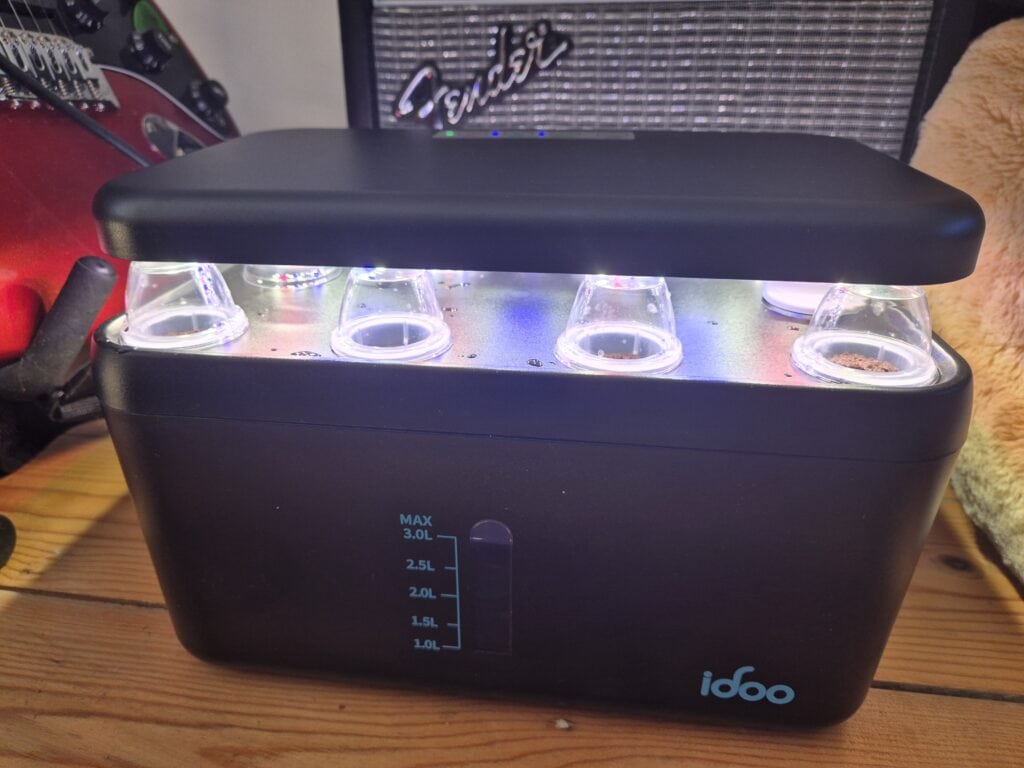
One of the best things about the iDOO hydroponics growing system is how easy it is to set up. It looks more technical than a normal pot of basil, but in practice there is very little to it.
You fill the water tank up to the marked line, add the liquid hydroponic nutrients, place the grow sponges into the pod baskets, then add your seeds. If your iDOO kit comes with two bottles of feed, these are usually labelled Nutrient A and Nutrient B.
The exact amount can vary by model, so always check the instructions that come with your system. As a general guide, many iDOO-style systems use around 5ml of Nutrient A and 5ml of Nutrient B per litre of water.
Before adding the seeds, I would make sure the grow sponges are fully damp. Don’t just put dry sponges into the baskets and assume they will soak evenly. Give each sponge a quick soak and a gentle squeeze in the water first, then place it into the pod basket. This helps avoid dry pockets inside the sponge, which could reduce germination.
Once the sponges are wet and in place, I added a few basil seeds into each pod rather than relying on a single seed. This gives you a better chance of germination, especially if you are using cheaper seeds or older packets.
If several seeds germinate in the same sponge, you can thin them out later. It is usually better to keep the strongest seedling and remove the weaker ones, rather than letting several plants compete in one small sponge.
The little clear plastic covers, or humidity domes, then go over the pods while the seeds germinate. These help keep moisture around the seeds during the early stage. Once the seedlings have properly emerged and started growing, you remove the plastic covers so the young plants have more space and airflow.
Overall, setup is very beginner-friendly. There is no compost, no messy potting-on stage, and no watering can needed every day. Once the tank is filled, the nutrients are added, the sponges are damp and the light timer is running, the system mostly looks after the early growing stage for you.
How Well Did Basil Grow in the iDOO Hydroponics Growing System?
My first proper test was basil, which is a sensible crop for this kind of indoor hydroponic system. Basil grows quickly, responds well to cutting back, and is much more realistic in a small countertop system than tomatoes or peppers.
Only three of my pods germinated successfully, but I do not think that was the fault of the iDOO system. I used cheap basil seeds, so poor germination was more likely down to the seed quality than the growing system itself.
The basil plants that did germinate grew well. In fact, they did better than I expected considering how little attention I gave them. I had the system set up in a spare bedroom, and there were times when I forgot about it for a week or two. Even so, the basil kept going.
That is probably the biggest strength of the iDOO hydroponics growing system. Once it is set up, it removes most of the watering work. The plants have access to water and nutrients in the tank, so they are much less likely to dry out than herbs in small pots on a windowsill.
For basil, herbs and leafy greens, this makes the system genuinely useful.
The Main Positive: It Is Very Low Maintenance
The thing I liked most about the iDOO system was how little day-to-day work it needed.
With normal indoor herbs, it is very easy to let small pots dry out. Basil especially can sulk quickly if it is left too dry or kept in poor light. With the iDOO system, the roots grow down into the nutrient solution, so the plants are not relying on you remembering to water them every day.
You still need to check the water level, add nutrients when needed, and keep an eye on the plants as they grow. But compared with growing herbs in compost, it feels much more forgiving.
This is why I think the system makes most sense for people who like the idea of growing herbs indoors but do not want another daily job.
The Light Is Useful, But Not Very Powerful
The built-in grow light works for basil and small leafy crops, but it is not a very powerful light.
Because of that, I would keep it fairly close to the plants, especially when they are young. If the light is too high, seedlings can stretch, become weak and struggle to support themselves properly.
On my 8-pod model, the light can be raised up to around 15 inches. That maximum height is useful as the plants grow, but I would not treat it as the ideal growing height. It is the limit of the system, not where the light should sit all the time.
It is tempting to raise the light high so you do not have to adjust it as often, but I think that is a mistake. For basil and young leafy crops, I would rather keep the light fairly low and adjust it every few days as the plants grow.
This matters because stretched seedlings are more likely to become leggy and unstable. Some of my basil plants collapsed later on, and although there were a few possible reasons for that, keeping the light close from the start is one way to reduce the risk.
For herbs and lettuce, the light is enough if you manage the height sensibly. For tomatoes, chillies or peppers, I would treat it as an experiment rather than a guaranteed success.
Plant Heights Can Become Uneven
One issue I noticed was that different basil plants grew at different rates.
This creates a small problem with light height. If one plant grows much taller than the others, raising the light to suit the tallest plant means the shorter plants may end up too far away from the light.
The best solution is to cut back the taller plants. With basil, this is not really a downside, because cutting the top encourages the plant to branch out and become bushier.
So if one basil plant starts racing ahead, do not keep raising the light just for that plant. Trim it back instead, and keep the light close enough for the smaller plants as well.
This is one reason I think herbs suit the iDOO system better than larger fruiting plants. Basil responds well to pruning, so managing uneven growth is fairly easy. With tomatoes or peppers, uneven height and limited light space could become more awkward.
My Main Fail: Some Basil Plants Collapsed
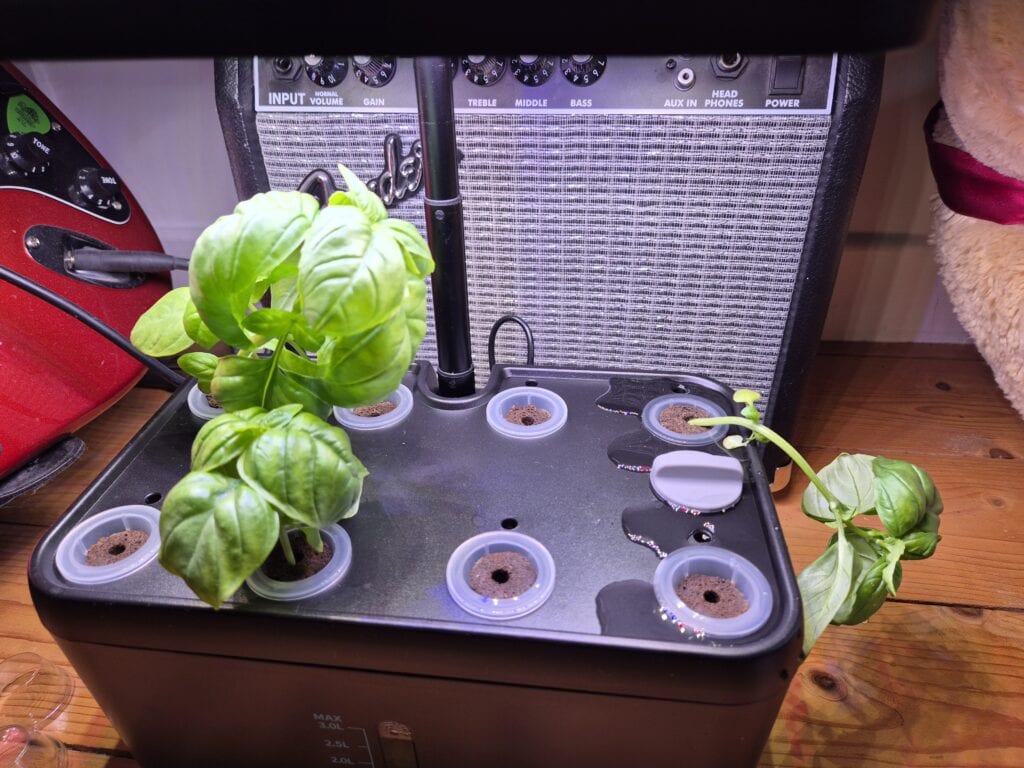
The main problem I had was that some of the basil plants collapsed as they grew.
This was partly my fault, and partly a limitation of the setup. Young indoor seedlings can grow weak if the light is too far away or if they do not get any movement. Outdoors, wind naturally moves the stems and helps them strengthen. Indoors, especially in a still spare room, seedlings can grow softer and less sturdy.
I probably should have paid more attention in the early stage. Gently brushing the stems with your hand each day, or giving them a very light shake, can help seedlings develop stronger stems. You do not need to be rough with them, but a little movement can be useful.
The other issue is the grow sponge. The hole in the sponge is quite wide compared with a young basil stem, so it does not always give much physical support once the plant starts leaning.
This is something to watch for if you are growing basil or other soft-stemmed herbs in the iDOO system.
My Solution: Small Plant Supports
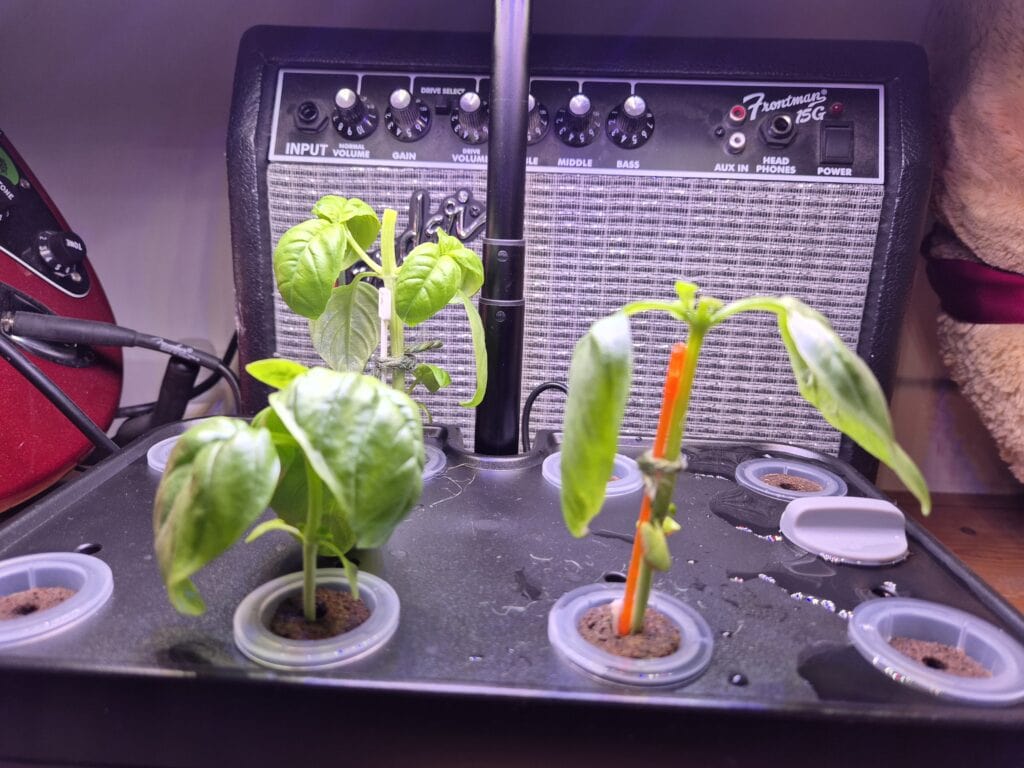
My solution was very simple. I used small plastic cocktail sticks to make little supports for the basil plants.
It was not a beautiful setup, but it worked. The supports held the weak stems upright and gave the plants time to continue growing.
This would make a useful side-by-side image in the review: one photo showing the collapsed basil, and another showing the simple support solution.
Collapsed stems are not necessarily a disaster, but they are a reminder that the iDOO system is low-maintenance rather than completely hands-off. It handles the watering and light cycle, but you still need to observe the plants and make small adjustments as they grow.
Timer and Controls
The timer is simple. On my model, the light runs on a 16-hours-on, 8-hours-off cycle.
That is helpful because you do not need to remember to turn the light on and off manually each day. Once the cycle is running, the system takes care of the daily light routine.
However, there is one annoying design issue. When raising or adjusting the light, it is quite easy to accidentally press the power button and turn the light off.
When you turn it back on, the timer resets. So if the light has already been on for 10 hours, you do not really want it starting another full 16-hour cycle from that point.
In practice, this is annoying rather than disastrous. Basil and leafy herbs are not living on a perfect military schedule, so one slightly odd light day is unlikely to ruin anything. The main thing is to avoid resetting it repeatedly.
Once I realised what was happening, it became easy enough to avoid. You just need to be careful when adjusting the light height.
It is not a deal-breaker, but it is exactly the sort of small real-world issue you only notice once you have used the system.
What Can You Grow in the iDOO Hydroponics Growing System?
The iDOO system is best suited to compact herbs and leafy crops.
Good choices include basil, lettuce, parsley, coriander, mint, rocket and other small leafy greens. These crops make sense because they do not need huge root space, they can be harvested gradually, and they do not need the same level of light as fruiting plants.
Basil has been my main test so far, and it has been a good fit for the system. It grows quickly, responds well to pruning, and does not need as much space as something like a tomato plant.
You can also use the system to start seedlings before moving them elsewhere. This could be useful if you want to start plants indoors and then transplant them into pots, a greenhouse or the garden later.
The more demanding options are things like mini tomatoes, chillies and peppers. These may grow in the system, especially compact varieties, but they need more light, more support and more careful feeding.
I am going to test mini tomatoes next. That will be a much harder test than basil, and I will update the review once I know how they do.
HomeGrower Tip: Thin the Seedlings Early
If several seeds germinate in the same sponge, it is usually better to keep the strongest seedling and remove the weaker ones.
It can feel wasteful, but trying to grow several basil plants from one small sponge often leads to weaker, crowded plants. The seedlings end up competing for light, nutrients and space.
Once you can see which seedling looks strongest, snip the weaker ones off with small scissors rather than pulling them out. Pulling can disturb the roots of the seedling you want to keep.
Can You Grow Tomatoes in an iDOO System?
I am going to test mini tomatoes in the iDOO system next, so I do not want to give a final answer yet.
My suspicion is that tomatoes will be much more challenging than basil. Even compact tomato varieties usually need stronger light, more nutrients, more root space and some physical support as they grow.
That does not mean they cannot work. The larger iDOO systems may give you more room to experiment, and mini tomato varieties are at least more realistic than full-sized plants. But I would still see tomatoes as a harder test rather than the main reason to buy this system.
For now, I feel confident recommending the iDOO system for basil, herbs and leafy greens. Tomatoes are the next experiment, and I will update this review once I know how they perform.
8-Pod vs Larger iDOO Systems
I tested the 8-pod iDOO hydroponics growing system, which is a good size if you want something compact and easy to manage.
The 8-pod system makes sense for a kitchen, spare room, shelf or small indoor growing space. It gives you enough room to grow a few herbs without taking over the room, and it is a sensible starting point if you are new to indoor hydroponics.
The larger 12-pod and 20-pod iDOO systems give you more planting positions, which can be useful if you want to grow several types of herbs, start more seedlings, or have a more productive indoor garden.
But there is an important point here: more pods does not mean you can grow that many full-sized plants.
Plants still need space. Basil, lettuce and leafy greens can all crowd each other if every pod grows strongly. In many cases, the extra pod spaces are best seen as flexibility rather than a promise of 12 or 20 mature plants.
If you want a small, simple herb system, the 8-pod version is enough. If you want more options and have the space, the larger systems are worth considering.
Personally, I would choose based on the space you actually have, not just the number of pods. A smaller system that you can keep nearby and check regularly may be more useful than a larger one tucked away and forgotten about.
iDOO vs Pots vs a Proper Grow Light Setup
The iDOO hydroponics growing system sits somewhere between normal windowsill herbs and a more serious grow light setup.
Compared with growing herbs in pots, the iDOO system is much easier to manage. You do not need to think about compost, drainage, saucers or watering every day. Small pots of basil can dry out quickly indoors, especially on a warm windowsill or near a radiator, while supermarket herbs often struggle because they are crowded and grown for short-term use.
With the iDOO system, the roots have access to water and nutrients in the tank, so the plants are more forgiving if you forget about them for a few days. It is also tidier than using compost indoors, with no loose soil or messy potting-on stage.
The trade-off is that it is less natural-looking than pots, needs a plug socket, and still has limits on height and light strength.
Compared with a proper grow light setup, the iDOO is simpler but more limited. A separate LED grow light over pots, trays or a small hydroponic setup gives you more space, stronger light and more flexibility. That is the better route if you want to grow demanding crops like tomatoes, chillies or peppers indoors.
The iDOO system makes more sense if you want something compact, tidy and beginner-friendly. It is not the most powerful option, but it is much easier to live with.
For easy herbs, I would choose the iDOO system over small windowsill pots. For serious indoor growing, I would choose a separate grow light setup.
| Growing method | Best for | Main advantage | Main limitation |
|---|---|---|---|
| iDOO hydroponics system | Easy herbs, basil, lettuce and beginners | Very low maintenance and no daily watering | Limited light power and plant height |
| Herbs in pots | Simple windowsill growing | Cheap and natural-looking | Small pots dry out quickly indoors |
| Separate grow light setup | More serious indoor growing | More power, space and flexibility | Less tidy and less beginner-friendly |
iDOO hydroponics system
Best for: Easy herbs, basil, lettuce and beginners
Main advantage: Very low maintenance and no daily watering
Main limitation: Limited light power and plant height
Herbs in pots
Best for: Simple windowsill growing
Main advantage: Cheap and natural-looking
Main limitation: Small pots dry out quickly indoors
Separate grow light setup
Best for: More serious indoor growing
Main advantage: More power, space and flexibility
Main limitation: Less tidy and less beginner-friendly
If you are considering a more powerful grow light setup instead, read our guide to the best grow lights available in the UK.
What I Like About the iDOO Hydroponics Growing System
The biggest positive is that it is genuinely low-maintenance.
My basil grew well even though I sometimes forgot about the system for long periods. That makes it much more forgiving than small pots of herbs, especially if you are the kind of person who forgets to water indoor plants.
I also like that there is no compost mess. You are not filling pots, moving trays around or trying to keep small seedlings evenly watered.
The built-in timer is useful, the system is compact, and the whole thing feels approachable for beginners.
It is also quite satisfying once the seeds germinate. You can see the plants developing quickly, and the clear structure of the system makes indoor growing feel more controlled.
What I Do Not Like
The light could be stronger.
It is fine for basil and leafy greens, but I would not expect too much from it with demanding crops. Keeping the light close matters, especially while seedlings are young.
The light height also needs managing. If plants grow at different rates, you may need to trim taller plants so the shorter ones are not left too far from the light.
The grow sponge does not always support soft young stems well, at least with basil. Some of my plants collapsed and needed extra support.
The timer reset issue is also slightly annoying. Accidentally pressing the button while adjusting the light can restart the cycle, which is not ideal.
None of these problems ruined the experience, but they do stop it from being a perfect product.
Who Should Buy the iDOO Hydroponics Growing System?
The iDOO system is a good choice if you want a simple way to grow herbs indoors.
It is especially suitable if you regularly forget to water plants, have limited windowsill light, want to grow basil or lettuce indoors, or like the idea of hydroponics but do not want a complicated setup.
It is also a good option for beginners because it gives you a complete system in one box. You do not need to understand hydroponics in detail before getting started.
For UK homes, I think it makes sense as a compact indoor herb garden, especially during the colder months when outdoor growing slows down.
It is also a good fit if you want something tidy for a kitchen, spare room, utility room or home office. It is not a full indoor growing setup, but it is a convenient way to keep a few useful plants growing indoors.
Who Should Avoid It?
I would avoid it if your main goal is to grow large fruiting plants.
Tomatoes, chillies and peppers are possible experiments, but they are not the natural strength of this kind of compact system.
I would also avoid it if you want full control over light strength, nutrients, airflow and plant spacing. In that case, you would be better with a separate grow light and a more flexible setup.
It is also not completely hands-off. You still need to check water levels, adjust the light, prune plants and support weak seedlings if needed.
So I would think of the iDOO as an easy indoor herb system, not a replacement for a proper grow tent, greenhouse or serious hydroponic setup.
Final Verdict: Is the iDOO Hydroponics Growing System Worth It?
Based on my experience with the 8-pod model, I think the iDOO hydroponics growing system is worth buying if you want an easy way to grow herbs and small leafy crops indoors.
It is not perfect. The light is fairly modest, plant height needs managing, and some seedlings may need extra support. The timer can also be annoying if you accidentally reset it while adjusting the light.
But the main thing is that it works. My basil grew well despite being left in a spare bedroom and occasionally forgotten about for a week or two. That is a real positive.
For basil, herbs, lettuce and beginner indoor growing, I would give it 4 out of 5.
See the iDOO Hydroponics Growing System on Amazon UK
For tomatoes and larger crops, I would be more cautious. I am going to test mini tomatoes next, and I will update this review once I know whether the system can handle them properly.
📎 Related Articles
- The Complete Guide to Indoor Growing in the UK
A beginner-friendly guide to growing indoors in UK homes, including light, space, temperature and simple setup options. - Best Hydroponic Growing Systems UK
A wider comparison of indoor hydroponic systems, including countertop gardens for herbs, lettuce and small plants. - Best LED Grow Lights UK
A stronger next step if you want to grow chillies, tomatoes, peppers or other demanding plants under a proper LED panel.
FAQs
Is the iDOO hydroponics growing system good for beginners?
Yes. The iDOO hydroponics growing system is a good beginner option because it removes most of the daily watering work and gives plants a built-in light cycle. You still need to check the water level, add nutrients and adjust the light height, but it is much easier than managing small pots indoors.
What grows best in an iDOO hydroponics system?
Herbs and leafy greens are the safest choices. Basil, lettuce, parsley, coriander, mint and rocket are all more realistic than large fruiting plants. These crops do not need huge root space and can be harvested gradually as they grow.
Can you grow basil in the iDOO hydroponics growing system?
Yes. Basil is one of the best crops for the iDOO system. In my test, basil grew well even though only three pods germinated and I sometimes forgot about the system for long stretches.
Why did my basil seedlings collapse?
Basil seedlings can collapse if the stems are weak, the light is too far away, or the grow sponge does not support the stem well. Keeping the light fairly close, gently moving the stems as they grow and adding small supports can all help.
What are the little plastic covers for?
The little clear plastic covers are humidity domes. They help keep moisture around the seeds while they germinate. Once the seedlings have emerged and started growing, you remove the covers so the young plants have more space and airflow.
Do you need special iDOO seeds?
No. You can use normal seeds in the iDOO system, although seed quality matters. I used cheap basil seeds and only three pods germinated, so I would use fresher or better-quality seeds next time.
Is the iDOO light powerful enough?
The built-in iDOO light is powerful enough for herbs and small leafy greens, but it is not the same as a proper LED grow light panel. I would keep the light fairly close to the plants and avoid expecting too much from it with demanding crops.
Can you grow tomatoes in an iDOO system?
I am testing mini tomatoes next, so I do not want to give a final answer yet. My suspicion is that tomatoes will be much more challenging than basil because they need more light, more root space, more nutrients and more support as they grow.