
When you purchase through links on our site, we may earn an affiliate commission at no extra cost to you.
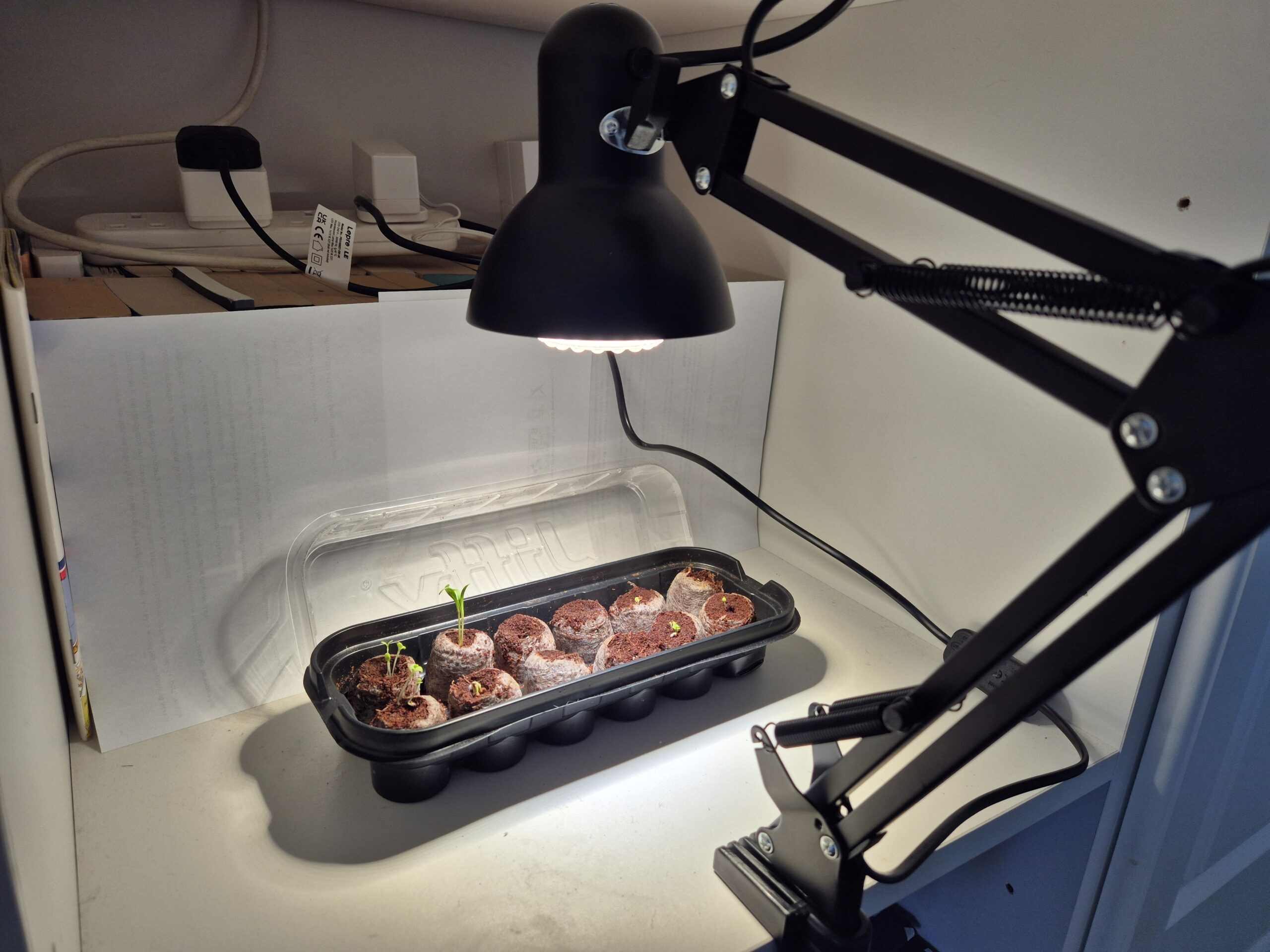
Most people looking for the best grow lights for beginners in the UK don’t need a complicated indoor growing setup.
You might just have seedlings stretching on a windowsill, herbs that struggle through winter, or a few plants that would benefit from more consistent light.
The easiest way to get started is to choose a light that suits the space you already have.
For a couple of plants, that might mean screwing a grow bulb into a suitable lamp. For a shelf or seed trays, LED bars can give better coverage. If you want stronger light for several plants, a small LED panel is the next step up.
You don’t need a grow tent or elaborate hanging system to start growing successfully indoors. What matters most is choosing enough light for your plants, positioning it properly and running it consistently.
This guide focuses on the simplest grow light setups to install and use, rather than simply the cheapest options.
If keeping costs as low as possible is your main priority, see our Best Cheap Grow Lights UK guide. For a deeper explanation of indoor lighting, see our complete guide to grow lights.
Our Top Beginner Grow Light Setups
The three options below suit different kinds of beginner setup rather than simply different budgets.
A grow bulb is the easiest choice for one or two plants if you already have a suitable lamp. LED bars make more sense for shelves and seed trays, where you want light spread across a longer area. A small LED panel is better when you want stronger, more even coverage for several plants.
I’ve focused on how easy each setup is to install, position and use successfully, as well as whether it provides enough light for the job.
Simplest Setup (Use a Lamp You Already Own)


The SANSI 36W is one of the simplest ways to add useful grow light without building a dedicated setup. It screws into a standard E27 fitting, so if you already have a sturdy lamp that can point down towards your plants, there is very little else to install.
It works best for a small growing area rather than a whole shelf — think a couple of herb pots, a few seedlings or a compact group of plants.
- 36W actual power draw
- Standard E27 fitting
- Full-spectrum white light
- No fan or separate driver to set up
- Best suited to one or two plants or a small group of seedlings
Best for: kitchens, desks and windowsills where you already have a suitable lamp or holder.
Testing note: I’ve used the smaller 10W SANSI grow bulb myself rather than this exact 36W model. The larger 36W version uses the same straightforward bulb-style approach, but it is much heavier.
HomeGrower tip: The 36W bulb is surprisingly weighty because of the large heat sink. Avoid flimsy desk lamps or lightweight clip lamps — a solid metal lamp or fixed E27 holder is a much better match.
You can read my full hands-on experience in the SANSI Grow Light Bulb review.
Best for Shelves and Seed Trays

The Barrina T5 kit makes more sense than a single bulb when you need to light a whole shelf or seed tray. This version includes four slim 2ft LED bars, each drawing 10W, so you can spread the light across a longer growing area rather than concentrating it in one spot.
For a beginner, the main advantage is that the bars are straightforward to position. They can be mounted underneath shelving and linked together, making them particularly useful for seedlings, herbs and several small pots grown side by side.
- Four 2ft LED bars
- 40W total actual power draw (4 × 10W)
- Full-spectrum white light
- Linkable design
- Well suited to shelves and seed trays
- Spreads light more evenly across a long area than a single bulb
Best for: seed trays, propagation shelves, herbs and several small plants arranged in a row.
Research-based recommendation: I haven’t tested this exact Barrina T5 kit myself. I’ve included it because its simple bar-style design and 40W output make it a practical fit for the shelf setups covered in this beginner guide.
HomeGrower tip: Position the bars above the plants rather than relying on light coming from the side. If you’re using all four, spreading them across the width of the shelf should give more useful coverage than bunching them closely together.
Best LED Panel for Beginners

The Spider Farmer SF600 is a good next step when a bulb or small set of light bars no longer gives you enough coverage. Its long, slim design spreads light across a wider growing area, making it suitable for several plants, a larger seedling setup or a shelf of leafy greens.
What makes it beginner-friendly is its simplicity. There are no complicated controls to learn: hang it at the right height, connect it to a timer and let it run on a consistent schedule. At 72W, it also gives you considerably more light than the smaller setups above without jumping straight to a high-powered tent light.
- 72W actual power draw
- Long, slim design for wider coverage
- Full-spectrum white light
- Passive cooling with no fan
- No complicated controls
- Best suited to several plants or a larger growing area
Best for: several plants, larger seedling setups, leafy greens and anyone who has outgrown a single bulb or small shelf light.
Research-based recommendation: I haven’t tested the SF600 myself. I’ve included it because its relatively simple design, 72W power draw and broad coverage make it a sensible first larger grow light for someone who doesn’t need the power or complexity of a bigger setup.
HomeGrower tip: Wider coverage doesn’t mean the light should be hung high above the plants. Start with the manufacturer’s recommended hanging height and adjust based on how the plants respond rather than raising it simply to cover a larger area.
If you need more power or want to compare this with larger lights, see our Best LED Grow Lights UK guide for our broader selection of LED panels and higher-output grow lights.
Which Beginner Grow Light Setup Suits Your Space?
1. One or Two Plants: Grow Bulb
If you only want to light a couple of herb pots, seedlings or small plants, a grow bulb is usually the easiest place to start.
You need a sturdy lamp or E27 holder that can point the bulb down towards the plants. There’s no mounting system to build, and adding a plug-in timer makes the setup almost automatic.
Best suited to: one or two plants, kitchen herbs, small windowsills and desks.
Main limitation: coverage is fairly concentrated, so a single bulb becomes less practical as the growing area gets wider.
2. Shelves and Seed Trays: LED Bars
For a long shelf or seed tray, LED bars are generally easier to position effectively than trying to cover everything with one bulb.
Mounting the lights above the plants spreads the light along the length of the shelf, and multiple bars can be spaced out to improve coverage.
Best suited to: seed trays, propagation shelves, herbs and several small pots arranged together.
Main limitation: you need somewhere suitable to attach the bars above the plants.
3. Several Plants: Larger LED Light
Once you’re growing several plants together, a larger LED light such as the Spider Farmer SF600 gives you more usable coverage without making the setup particularly complicated.
It does require hanging rather than simply screwing in a bulb, but once it is positioned correctly and connected to a timer, there is very little day-to-day adjustment needed.
Best suited to: larger seedling areas, leafy greens and several plants grown together.
Main limitation: it needs more space and a secure point from which to hang it.
Beginner Rules That Actually Matter
Forget PAR charts and technical specs — focus on these:
1. Keep the light close enough
One of the easiest beginner mistakes is placing a grow light too far from the plants.
Light intensity drops quickly as you increase the distance, so a perfectly decent grow light can perform badly if it is hung too high. On the other hand, placing a powerful light too close can stress or bleach leaves.
Rather than relying on one fixed distance for every light, start with the manufacturer’s guidance and adjust from there.
Signs the light may be too far away include:
- Tall, stretched stems
- Seedlings leaning strongly towards the light
- Pale or weak growth
Signs it may be too close include:
- Bleached patches
- Leaves curling upwards
- Heat stress around the top of the plant
For more specific guidance, see our Grow Light Distance Chart.
2. Put the light on a timer
For most herbs, seedlings and leafy plants, a consistent daily schedule is more useful than switching the light on whenever you remember.
A simple starting point is around 14–16 hours of light per day, followed by a proper dark period.
You don’t need an expensive controller. A basic plug-in timer is enough for most beginner setups.
I use the Tapo P110 because it also records electricity consumption, which is useful for seeing what a grow light actually costs to run. You can read my Tapo P110 Smart Plug review for more on how I use it.
3. Check the soil more often
Plants growing well under artificial light often use water faster than the same plants sitting on a dim windowsill.
That doesn’t mean watering on a fixed schedule. Check the compost regularly and water according to the plant and how quickly the pot is drying.
This is especially noticeable once seedlings and herbs begin putting on faster growth.
4. Ignore inflated “equivalent wattage” claims
Some cheap grow lights are advertised with huge numbers such as “600W” or “1000W” even though their actual electricity draw is only a fraction of that.
For comparing lights, look for actual power consumption at the wall, not an exaggerated replacement or equivalent wattage figure.
The beginner lights in this guide range from a 36W bulb to a 72W larger grow light, which is plenty for the kinds of small indoor setups covered here.
Seasonal Tip for UK Growers
If you’re starting tomato, chilli or other tender seedlings in late winter or spring, weak windowsill light is often the point where they begin to stretch.
Moving them under a grow light for a few weeks can help keep the growth more compact until outdoor light levels improve or the plants are ready for a greenhouse.
The same idea applies later in the year. Herbs and leafy plants that grow happily on a bright windowsill in summer may benefit from supplementary light once the days shorten.
If you notice seedlings leaning strongly towards the window or producing long, thin stems, that’s usually a good sign that they need more usable light.
Final Thoughts
The best beginner grow light isn’t necessarily the most powerful one. It’s the one that fits your space and is simple enough to position and use consistently.
For one or two plants, a grow bulb may be all you need. LED bars work better across shelves and seed trays, while a larger LED light makes sense once you’re growing several plants together.
Start with the simplest setup that meets your needs. You can always add more light later as your indoor growing expands.
📎 Related Articles
Beginner Grow Light FAQs
Can I use a grow light bulb in a normal lamp?
Yes, as long as the fitting is compatible and the lamp is sturdy enough for the bulb. Many grow light bulbs use a standard E27 fitting, but larger models can be considerably heavier than normal household bulbs. A solid lamp or fixed holder is therefore a better choice than a lightweight desk lamp for something like the 36W SANSI.
How many hours should beginners run grow lights?
Around 14–16 hours per day is a good starting point for many herbs, seedlings and leafy plants. Plants still need a proper dark period, so there is normally no benefit to leaving a grow light on continuously.
A basic timer is enough to automate the schedule. A smart plug can also let you monitor electricity use; I use the Tapo P110 for this, which I cover in my Tapo P110 Smart Plug review.
How far should a grow light be from plants?
There is no single distance that works for every grow light. A bulb, LED bar and larger grow light can all produce very different light levels, so start with the manufacturer’s recommended height and adjust if necessary.
Stretching and weak growth can indicate that the light is too weak or too far away, while bleaching or upward-curling leaves can be signs that a stronger light is too close. See our Grow Light Distance Chart for more detailed guidance.
Do beginner grow lights use much electricity?
Usually not. Smaller grow bulbs and shelf lights have fairly modest power requirements. For example, a 40W light running for 14 hours uses about 0.56 kWh of electricity per day. Larger grow lights use more, so actual cost depends on the wattage, your daily lighting time and your electricity tariff.
You can calculate the running cost of any light using our Grow Light Running Cost Calculator.
When should I move from a bulb or shelf light to a larger LED grow light?
A larger grow light starts to make sense when you are trying to cover several plants, a wider growing area or plants with higher light requirements. If a bulb or set of LED bars no longer provides useful, even coverage across the whole growing area, moving to a larger LED light is usually the simplest next step.
For more powerful options, see our Best LED Grow Lights UK guide.