How far should a grow light be from your plants?
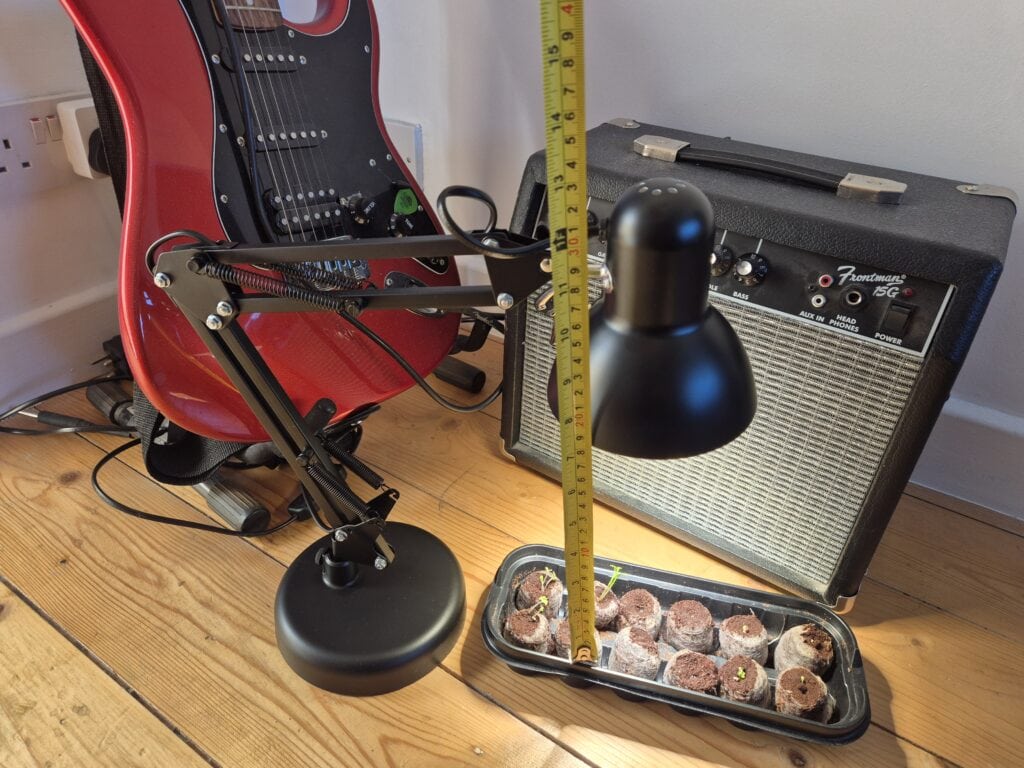
This grow lights distance chart gives practical starting ranges for different types of lights, but there isn’t one correct grow light distance for every setup. A small grow bulb might need to sit quite close to seedlings, while a powerful LED panel could deliver too much light from several times that distance.
That means advice such as “LED grow lights should always be 18–24 inches away” isn’t particularly helpful on its own.
The right distance depends mainly on:
- the actual output of the grow light
- how widely it spreads that light
- whether it can be dimmed
- the crop you’re growing
- the plant’s stage of growth
- how long the light runs each day
I’ve used everything from relatively low-powered grow lights around seedlings and herbs to much more powerful LED panels for tomatoes, chillies or other fruiting plants. The biggest lesson is that the ruler is only a starting point. Plant response — and PPFD measurements where you have them — are much better guides.
This grow light distance chart therefore gives starting points rather than supposedly exact heights.
For the complete process of hanging, positioning, timing and adjusting a light, see our How to Set Up Grow Lights Indoors guide.
Grow Light Distance Chart: Quick Guide
| Type of grow light | Approximate starting distance | Key point |
|---|---|---|
| Small 10–30W bulb or clip-on light | 5–20 cm (2–8 in) | Usually needs to be quite close because output is relatively low. |
| 50–100W LED panel | 20–45 cm (8–18 in) | Start towards the upper end for seedlings and adjust gradually. |
| 100–150W LED panel | 30–60 cm (12–24 in) | Growth stage and dimmer setting can make a large difference. |
| 200–300W LED panel | 40–70 cm (16–28 in) | Manufacturer hanging-height guidance and PPFD maps become increasingly useful. |
| 300W+ high-output LED | 45–80+ cm (18–32+ in) | With powerful dimmable fixtures, reducing output can be better than simply hanging the light very high. |
If you’re still choosing a light rather than adjusting one you already own, see our Best Grow Lights UK guide for our current recommendations, including lights we’ve tested ourselves and research-based options for different setups.
Why Grow Light Distance Matters
Moving a grow light changes the amount of light reaching the plant and how evenly that light is spread across your growing area.
Move it too far away and seedlings in particular may start reaching towards the light.
Move a powerful fixture too close and the upper leaves can receive more light than the plant can use effectively.
Distance also affects coverage.
Lowering a light often increases intensity directly underneath it, but it can also make the difference between the bright centre and darker edges of the growing area more pronounced.
Raising it may reduce peak intensity but give you more even coverage.
So the aim isn’t simply:
“Get the light as close as possible.”
It’s:
“Get enough usable light across the whole area without stressing the plants.”
Why Wattage Doesn’t Give You an Exact Grow Light Distance
Wattage tells you how much electrical power a light draws.
It doesn’t directly tell you how much photosynthetically useful light reaches a leaf 30 cm below it.
For example, two lights drawing 100W can differ in:
- LED efficiency
- fixture dimensions
- diode spacing
- reflectors or lenses
- spectrum
- heat output
- how evenly light is distributed
A broad LED bar fixture may spread its output across a much larger area than a compact panel using the same amount of electricity.
This is why I’d be wary of any chart claiming something as specific as:
“A 150W LED should be exactly 30 cm above flowering plants.”
There are simply too many variables for that to be universally true.
For a more detailed explanation, see Grow Light Wattage Explained.
A Better Way to Set Grow Light Distance
Instead of trying to find one perfect height before switching the light on, use a simple adjustment process.
1. Start With the Manufacturer’s Recommended Height
If the manufacturer gives hanging heights or a PPFD map, use those as your first reference.
This is much more useful than a generic wattage chart because it applies to the actual fixture you’re using.
Pay attention to the dimmer setting too. A recommended distance at 50% power obviously isn’t equivalent to the same distance at full output.
2. Be More Conservative With Young Seedlings
Small seedlings don’t need the intensity required by a large, fast-growing tomato or chilli plant.
Start cautiously, particularly with powerful LED panels.
If you’re using a dimmable light, dimming it can make more sense than hanging it unnecessarily high above a small propagation area.
3. Watch the Plants
Your plants provide useful feedback.
If seedlings are becoming tall, thin and leaning strongly towards the light, they probably aren’t receiving enough useful light.
If the upper leaves directly below a powerful fixture become unusually pale, bleached or stressed while lower growth remains normal, excessive light intensity should be considered.
4. Adjust Gradually
Move the light a little and then see how the plants respond rather than making dramatic changes.
If the fixture has a dimmer, change either height or power, rather than changing several things at once.
That makes it much easier to understand what’s actually helping.
5. Measure Light if You Want More Accuracy
Once you begin measuring PPFD, distance becomes much easier to understand.
Instead of asking:
“Should this light be 30 cm or 45 cm away?”
you can ask:
“How much light are my plants actually receiving at this height?”
That’s a much more useful question.
PPFD Matters More Than Distance Alone
PPFD stands for photosynthetic photon flux density.
In simple terms, it measures the amount of photosynthetically active light arriving at a particular area each second.
This is why two grow lights placed at exactly the same height can perform completely differently.
One might deliver relatively weak light to the canopy while another could be extremely intense.
PPFD maps supplied by better grow-light manufacturers can therefore be useful when choosing a starting height.
A PAR meter gives you the best direct measurement, although some phone-based light measuring apps can provide a useful indication if you understand their limitations.
There is another important factor too: time.
A plant receiving a certain PPFD for eight hours does not receive the same total amount of light as one receiving it for sixteen hours.
That total daily exposure is described as the Daily Light Integral (DLI).
This is another reason I wouldn’t use one universal PPFD number for every seedling, vegetable or flowering plant.
Different species have different requirements.
Seedling Grow Light Distance
Seedlings are where distance problems are easiest to spot.
Too little light commonly produces seedlings that become:
- unusually tall
- thin-stemmed
- leaning towards the light
- weak and difficult to transplant
The obvious response is to move a weak light closer, but this needs some judgement.
With a small grow bulb or modest strip light, reducing the distance may be exactly what is needed.
With a powerful LED panel, lowering the whole fixture may be the wrong solution. You may be better off reducing its power and maintaining good coverage.
This distinction is important because “LED grow light” can describe everything from a small screw-in bulb to a fixture drawing several hundred watts.
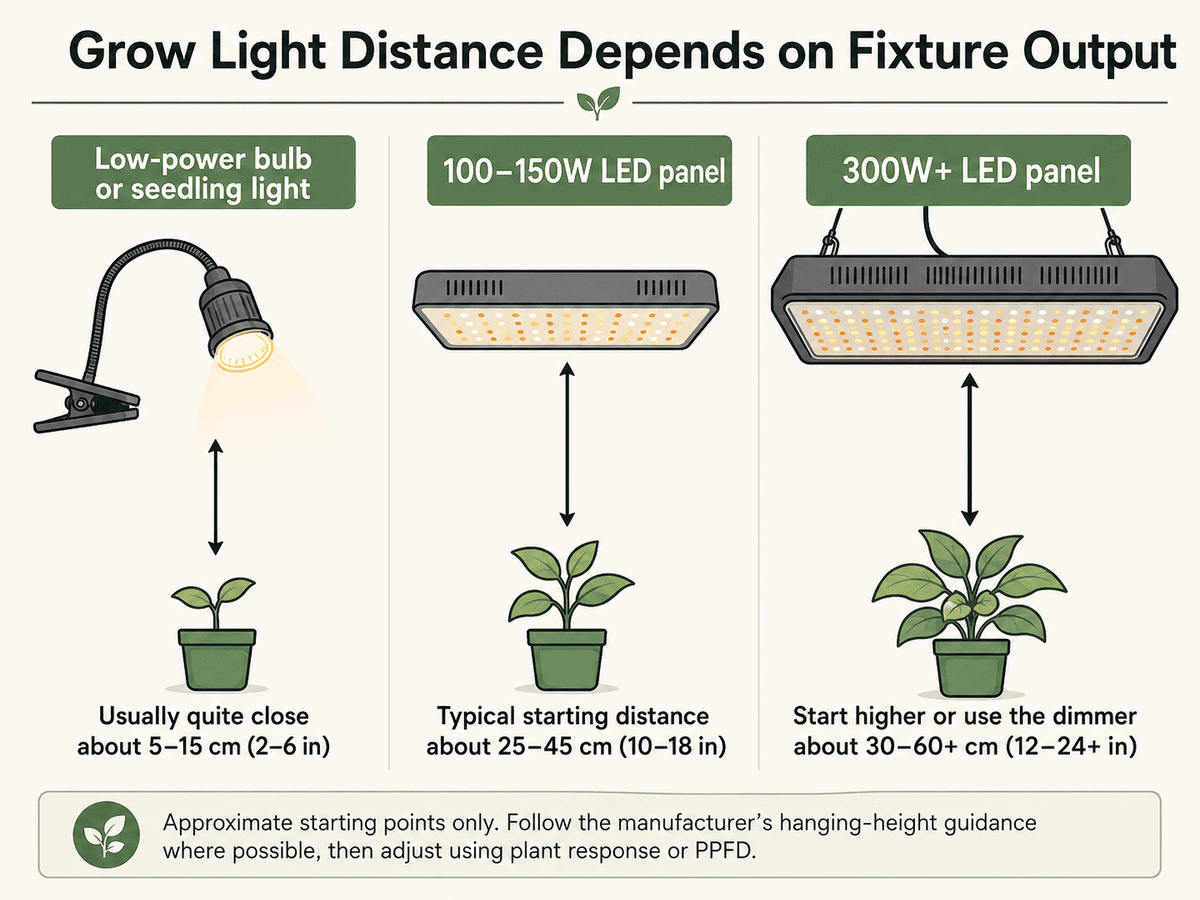
I’ve used smaller grow lights with seedlings myself, and this is one of the areas where I’ve found fixed internet distance rules particularly unhelpful. How the seedlings actually grow tells you much more than whether you’ve matched somebody else’s number of centimetres.
Grow Light Distance for Herbs and Leafy Growth
Once plants have established a larger leaf area, they can generally make use of more light than newly emerged seedlings.
You may therefore be able to:
- increase the dimmer setting
- lower the light
- extend coverage to a larger growing area
But again, there isn’t a particular height at which a plant suddenly changes from “seedling lighting” to “vegetative lighting”.
Adjust the setup progressively.
For herbs and leafy crops, good signs include compact growth, healthy leaf development and plants that aren’t strongly stretching towards the light.
Grow Light Distance for Tomatoes, Chillies and Fruiting Plants
Tomatoes, chillies and other fruiting crops can make use of substantially more light once established than they could as tiny seedlings.
This is where higher-output LED panels become useful.
I’ve grown tomatoes and chillies under a ViparSpectra XS1500 Pro, for example. A light in this class is completely different from a small seedling lamp, so applying the same generic “LED distance” to both would make little sense.
With powerful lights, I prefer to think in terms of intensity plus coverage rather than trying to get the panel as close to the leaves as possible.
A slightly greater distance can sometimes give a more useful spread across several plants, while the dimmer gives you another way to control intensity.
You can read our ViparSpectra XS1500 Pro review for the full hands-on test.
Signs Your Grow Light May Be Too Far Away
The clearest warning sign is stretching.
Look for:
- long, thin stems
- unusually large gaps between leaves
- seedlings leaning towards the light
- weak growth that struggles to support itself
- plants growing strongly towards one part of the fixture
What to do
First consider whether the light actually has enough output for the area you’re trying to cover.
Then either:
- move the light closer
- increase the dimmer setting
- reduce the size of the illuminated area
- move the plants into the stronger part of the light footprint
Make one change at a time.
Signs Your Grow Light May Be Too Close or Too Intense
Possible signs include:
- paling or bleaching concentrated on the uppermost leaves
- stressed or curled upper growth
- problems occurring mainly directly beneath the brightest part of the fixture
- healthy lower foliage but deteriorating top growth
Don’t assume every curled or damaged leaf is caused by the grow light.
Watering problems, temperature, humidity, nutrient issues and pests can produce symptoms that look surprisingly similar.
What to do
Try:
- raising the light slightly
- reducing the dimmer setting
- checking the temperature at canopy level
- improving gentle air movement around the plants
Then monitor the new growth.
New leaves are usually more useful than old damaged leaves when judging whether you’ve corrected the problem.
Light Stress and Heat Stress Aren’t the Same Thing
This distinction is particularly important with modern LEDs.
Older grow-light advice often relied heavily on the hand test: put your hand under the light, and if it feels too hot for your hand it is probably too hot for the plants.
That can still warn you about excessive heat.
But it cannot tell you whether a modern LED is delivering too much light.
A cool-running LED can produce high light intensity without making your hand feel particularly hot.
So use temperature as one clue, not as your light meter.
This also means airflow matters.
A small fan providing gentle movement around the growing area can help reduce pockets of warm, still air, but it doesn’t compensate for a grow light that is simply too intense.
Our How to Set Up Grow Lights Indoors guide covers positioning, airflow, timers, trays, electrical safety and adjusting the fixture as plants grow.
Should Bar-Style LED Grow Lights Be Closer?
Not automatically.
Bar-style fixtures can distribute LEDs across a larger area, which can produce a more even light footprint than concentrating all the diodes into a compact board.
But that does not create a universal rule that a bar light should always hang 5 or 10 cm closer.
A powerful bar fixture can still produce very high intensity.
Use the manufacturer’s PPFD map and recommended hanging height for the individual light.
What About Fluorescent Grow Light Distance?
You’ll often see old advice saying fluorescent tubes should always sit just a few centimetres above plants.
That is too general.
Different fluorescent fittings have different outputs, and even the spacing recommended for T5 systems can vary substantially.
The RHS, for example, has advised positioning T5 high-output tubes around 60 cm above seedlings in one of its artificial-lighting guides.
That’s a useful demonstration of why copying a generic “T5 = 5 cm” rule can be misleading.
Fluorescent lights generally produce less radiant heat than HPS lamps, but you should still follow the guidance for the actual fitting you’re using.
What About HPS Grow Light Distance?
High-pressure sodium lighting produces considerably more heat around the growing area than modern LEDs, so adequate separation and ventilation are particularly important.
There is still no single HPS height because lamp power, reflector design and ventilation all affect the result.
If you’re using HPS, follow the manufacturer’s minimum clearances rather than relying on a generic chart.
For most small home-growing setups today, LEDs are generally easier to manage because they offer good efficiency, relatively low heat output and, on many fixtures, dimming control.
Does Grow Light Spectrum Affect Distance?
Spectrum matters to plant growth, but I wouldn’t use spectrum alone to decide hanging height.
Plants use several wavelengths of light for photosynthesis and development. Blue wavelengths are associated particularly with compact vegetative growth, while red wavelengths play an important role in photosynthesis and flowering responses.
Most modern full-spectrum grow lights combine a broad range of wavelengths and can be used throughout the plant’s life.
But a red-heavy light doesn’t automatically need to be a particular number of centimetres further away, just as a blue-heavy light isn’t automatically safe closer to the leaves.
Actual intensity remains the more useful measurement.
For a good independent introduction to how plants use different wavelengths, see the Royal Horticultural Society guide to how plants use light.
Distance and Dimming Should Work Together
Dimmable LEDs make grow-light positioning much easier.
Imagine you have a powerful LED panel covering a tray of small seedlings.
You could hang it a long way above them at full power.
But that may:
- waste electricity
- spill light beyond the growing area
- make the setup awkward to manage
Another option is to position it at a sensible height for even coverage and reduce the dimmer setting.
Then, as the plants grow and need more light, increase the output gradually.
Later you may need to raise the fixture simply because the canopy itself is getting taller.
Think of height and dimming as two controls for the same setup, rather than two separate rules.
7 Practical Rules for Getting Grow Light Distance Right
1. Start with the manufacturer’s figures
Fixture-specific hanging heights and PPFD maps beat generic internet charts.
2. Treat wattage as a rough clue, not a distance measurement
A 300W fixture will generally belong to a different class from a 20W grow bulb, but wattage alone still doesn’t tell you what reaches the plant.
3. Give seedlings a gentler start
Young seedlings don’t need the same intensity as established fruiting plants.
4. Use the dimmer
If you have one, don’t leave it at 100% simply because the light can run at 100%.
5. Look across the whole canopy
The correct distance should give useful coverage to all your plants, not just an extremely bright spot directly beneath the centre.
6. Change one thing at a time
Alter height or dimming, then observe what happens.
This makes troubleshooting much easier.
7. Watch the plant, not just the ruler
Distance is a setup measurement.
Healthy growth is the result you’re actually trying to achieve.
So, How Far Should a Grow Light Be From Plants?
There isn’t one universal grow light distance.
A small, low-powered grow light may need to sit quite close to the canopy, while a more powerful LED panel may need considerably more clearance or a lower dimmer setting. The useful number is therefore not a fixed height, but a sensible starting range for the type of light you’re using.
Use the chart above as that starting point, then refine the setup using the manufacturer’s guidance, plant response and PPFD measurements where available.
If your plants are growing compactly, evenly and without signs of bleaching or stretching, the distance is probably about right. If not, make small adjustments and reassess rather than chasing an exact number of centimetres.
For help with the rest of the setup, see our How to Set Up Grow Lights Indoors guide.