
When you purchase through links on our site, we may earn an affiliate commission at no extra cost to you.
Choosing the best portable power station for camping depends on what you need to power and how long you’ll be away from electric hook-up. A compact model may be enough to charge phones, tablets and laptops over a weekend, while campervans and motorhomes can benefit from larger batteries for extended off-grid trips.
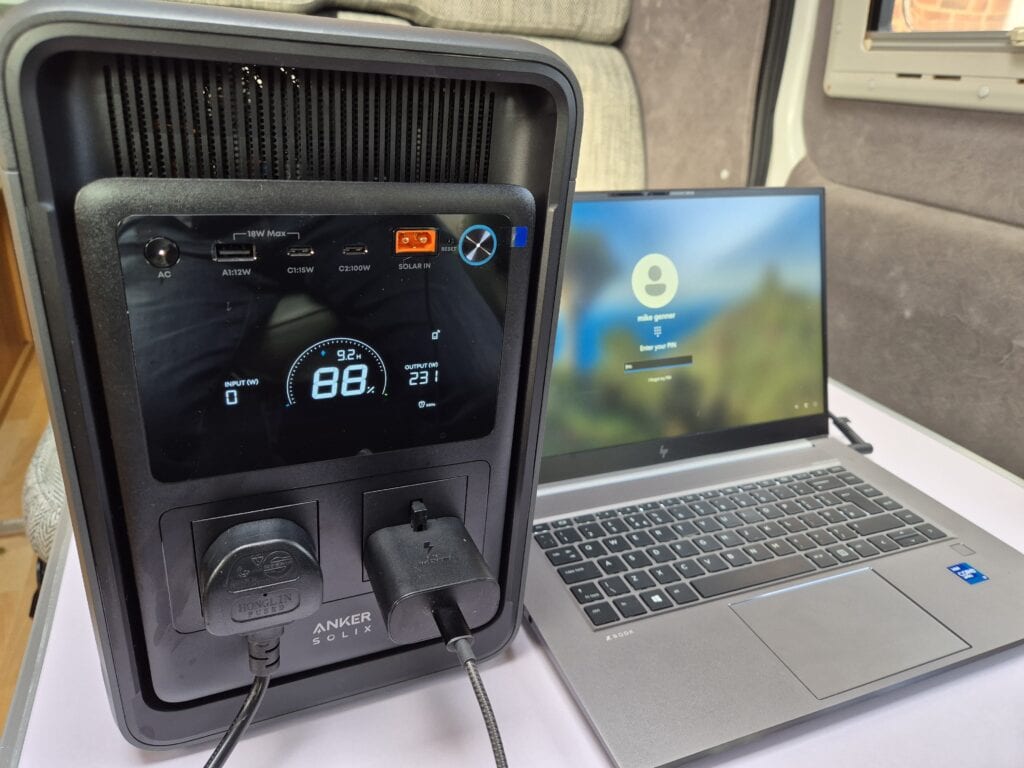
I’ve been using the Anker SOLIX S2000 in my Swift Mondial motorhome, testing its practicality and charging options. I also chose it for emergency home backup, giving me a useful power source both at home and on the road.
This guide compares portable power stations, also commonly called solar generators when paired with solar panels, from EcoFlow, Jackery, Bluetti and Anker. Covering capacities from 286Wh to 2,010Wh, you’ll find quick recommendations, an interactive calculator to estimate how long different batteries could power your devices, and detailed product reviews.
For a broader comparison of portable power stations for home backup and other uses, see my Best Solar Generators UK buying guide.
Our Top Portable Power Stations for Camping, Campervans & Motorhomes
These four portable power stations cover different budgets and power requirements, from lightweight weekend camping to longer off-grid trips in a campervan or motorhome. Each offers a different balance of battery capacity, portability and features.
I’ve included my own Anker SOLIX S2000, which I use and test, alongside smaller options from EcoFlow, Bluetti and Jackery. Compare the quick recommendations below, then use our power calculator to work out which battery capacity best suits your needs before reading the detailed reviews.
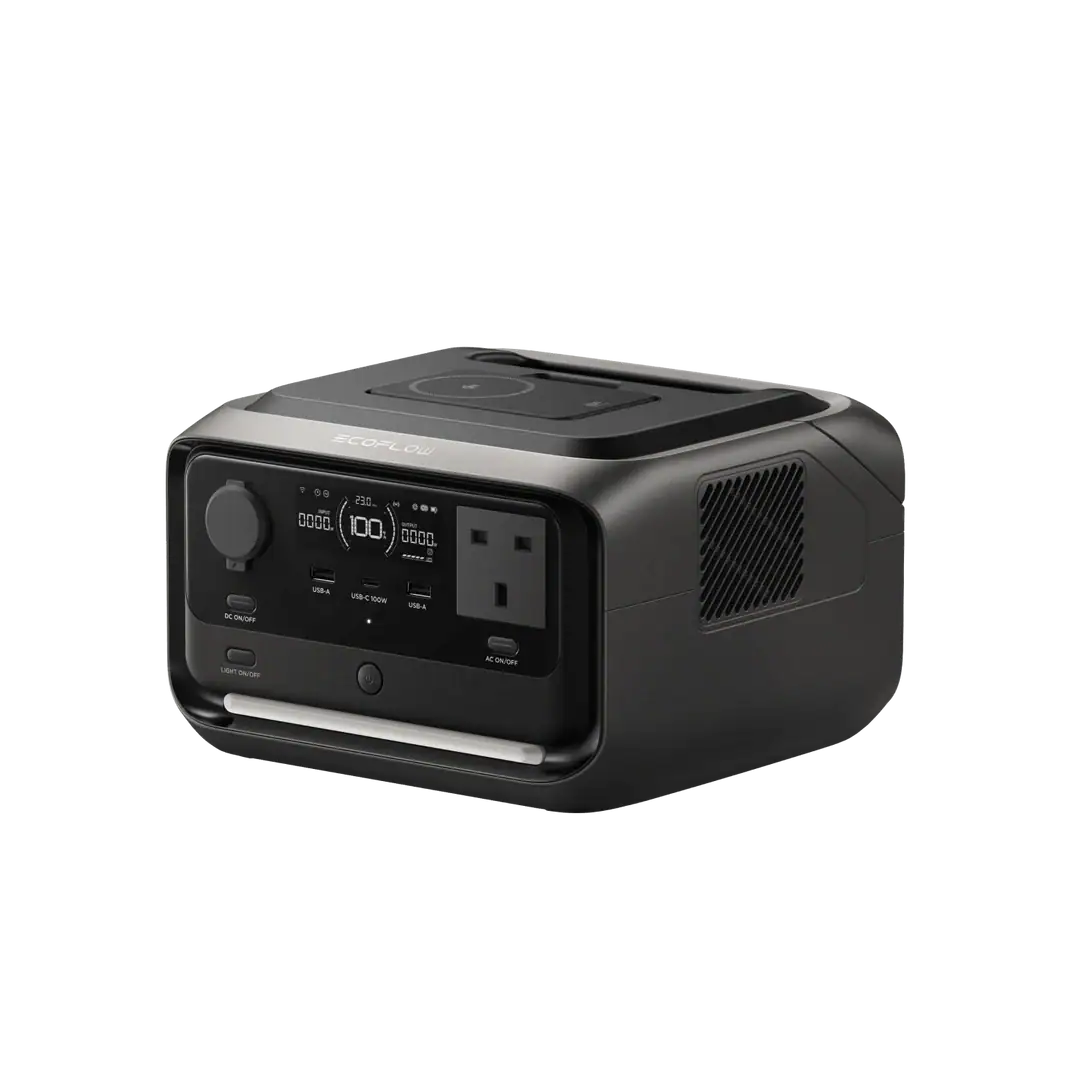
EcoFlow RIVER 3 Plus
A lightweight, compact power station ideal for weekend camping and charging phones, tablets and laptops. At just 4.7kg, it is easy to carry, with solar charging and expandable battery capacity for longer trips.
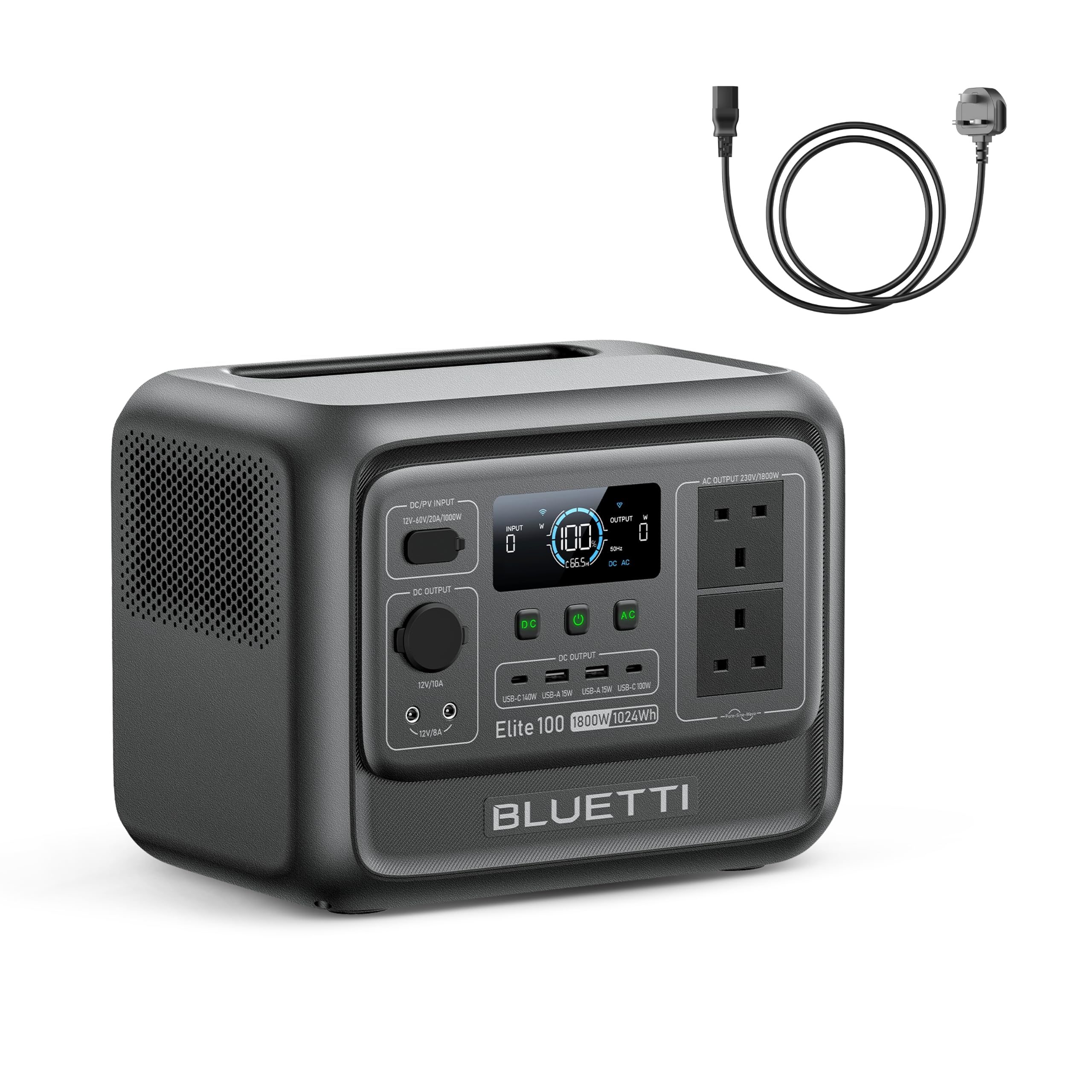
Bluetti Elite 100 V2
A practical mid-sized power station for longer camping trips and campervan use. Enough capacity for several days of electronics charging, with fast mains charging, up to 1,000W solar input and sufficient output for many small appliances.

Jackery Explorer 1000 v2
A compact and relatively lightweight 1kWh power station for campervans, motorhomes and longer camping trips. Ideal for charging everyday electronics and running smaller appliances, with fast mains charging and solar compatibility.
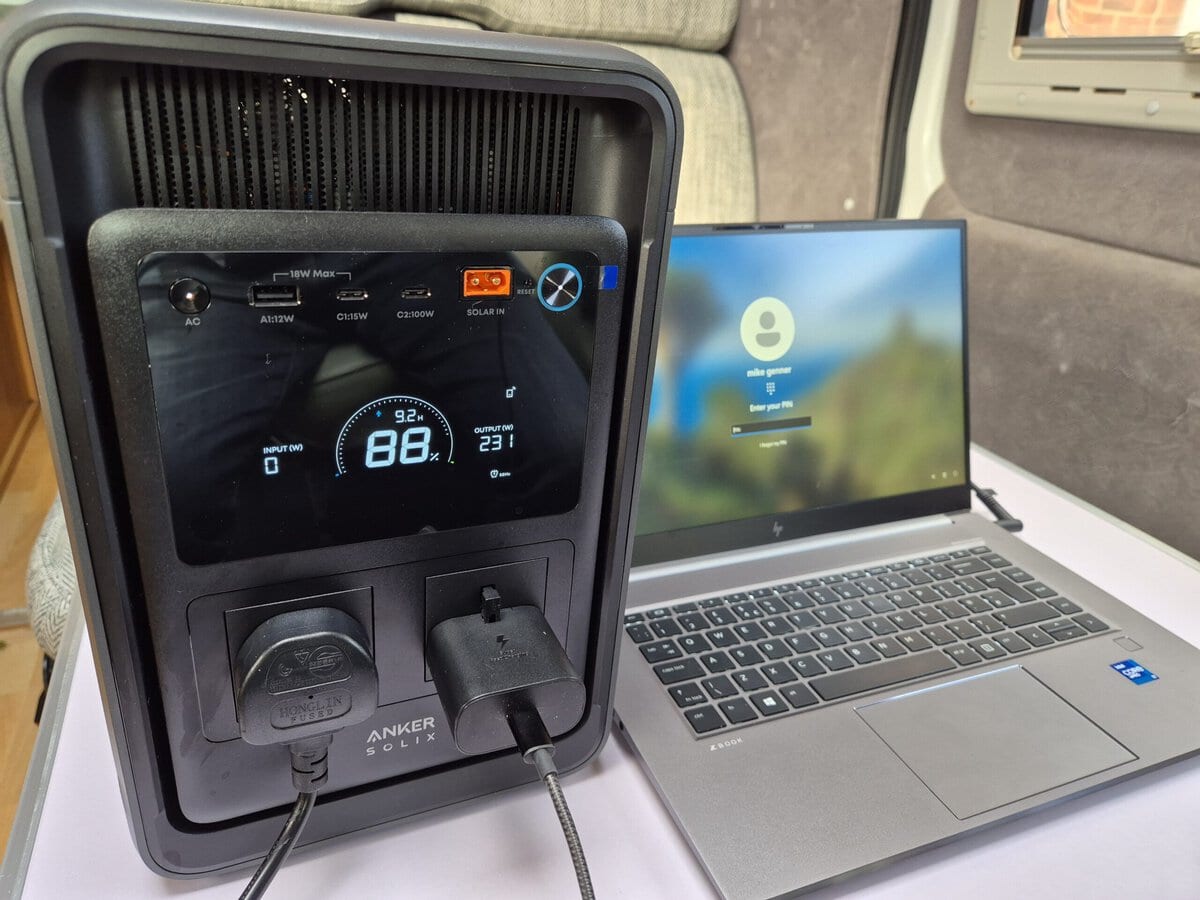
Anker SOLIX S2000
My personal choice for longer off-grid trips in my Swift Mondial motorhome and emergency backup power at home. Despite its large 2kWh capacity, it remains portable at just 16.2kg. I’ve used it for five days off-grid with charge remaining, and tested its solar charging and household backup performance. Excellent value when discounted to £850 or less.
Camping Power Station Calculator: How Much Battery Capacity Do You Need?
Not sure whether you need a small 300Wh power station or a larger 1,000–2,000Wh model? Our interactive calculator helps you estimate how long a portable power station could run your chosen devices, including phones, laptops, tablets, camping lights and other appliances.
Select the devices you expect to use and enter your power station’s battery capacity to see approximately how many days it could last. Motorhome and campervan owners can also factor in their leisure battery and solar panel.
These are estimates to help you plan, not guaranteed runtimes. Actual performance depends on charging losses, appliance consumption, battery condition and weather conditions when using solar power.
1. Choose Your Power Station
Use the battery’s Wh (watt-hour) capacity, not its maximum output rating in W (watts).
2. What Will You Power Each Day?
Enter the number of full charges or the daily usage you expect for each device.
Tip: In campervans and motorhomes, using gas for boiling water, cooking and running a compatible three-way fridge is generally more practical than using stored battery power. Electric kettles consume considerable energy, while compressor fridges require electricity. For a small compressor fridge, allow around 400Wh/day as a starting estimate, although actual consumption varies.
3. Campervan or Motorhome? (Optional)
Essentials include motorhome lighting, water pump, controls and heating fan. Start with 100Wh/day for modest use, but increase it for more demanding systems. We assume roof solar charges the leisure battery, while the power station runs your selected devices. The two batteries are treated as separate systems.
Your Estimated Results
Leisure battery for essentials: —
Estimated roof solar generation: — per day
Solar output is an approximate seasonal average. Cloudy days and heating demand can shorten runtime.
Important: These are planning estimates, not guaranteed runtimes. The calculator uses 80% of nominal power station capacity to allow for charging and conversion losses. Individual appliances, inverter standby power, weather and battery condition can significantly change the result. Assumes batteries begin fully charged and there is no vehicle or mains recharging during the trip.
Best Portable Power Stations for Camping – Detailed Reviews
Below, we look more closely at our four recommended power stations, comparing their capacity, portability, charging options and suitability for camping, campervans and motorhomes. Start with the lightweight EcoFlow RIVER 3 Plus and work up to the larger Anker SOLIX S2000.
An excellent compact option for weekend camping, particularly if your main requirements are charging phones, tablets, laptops and other small electronics. At just 4.7kg, it is easy to carry between the car, tent or campervan. Its 286Wh battery is less suitable for running power-hungry appliances, but solar charging and optional battery expansion add flexibility for longer trips.
Is the EcoFlow RIVER 3 Plus Good for Camping?
The EcoFlow RIVER 3 Plus is particularly well suited to weekend camping, where keeping phones, tablets, laptops and other small electronics charged is the main priority. Its biggest advantage is portability. At just 4.7kg, it is easy to move between the car and tent, or take outside from a campervan without struggling with a heavy battery.
With 286Wh of battery capacity, you can expect approximately 15 full smartphone charges or three to four typical laptop charges, allowing for charging losses. That makes it a sensible choice for a couple spending a weekend camping, especially if they mainly need USB charging rather than running household appliances.
Charging Options and Practical Limitations
Despite its compact size, the RIVER 3 Plus offers a 600W continuous AC output, a 100W USB-C port and up to 220W solar input. It can also recharge from a vehicle's 12V socket using a suitable charging cable, which is useful when travelling between campsites.
Its main limitation is capacity rather than output. Although it can power some relatively demanding appliances, these will drain its small battery quickly. A portable compressor fridge, for example, could use more electricity in a day than the RIVER 3 Plus can store.
The battery is expandable to 858Wh using EcoFlow's compatible additional batteries. However, if you already expect to need that much energy regularly, buying a larger 1kWh power station may be better value.
Our Verdict
Best for: Lightweight camping, weekend trips and charging personal electronics.
The EcoFlow RIVER 3 Plus is our recommendation for campers who want something compact, easy to carry and capable of keeping essential electronics charged. It is also useful as a supplementary power source in campervans and motorhomes with an existing leisure battery. For longer off-grid trips or regular appliance use, we would step up to one of the 1kWh models below.

Is the Bluetti Elite 100 V2 Good for Camping and Campervans?
The Bluetti Elite 100 V2 is one of the most practical battery sizes for regular camping and campervan use. Its 1,024Wh capacity provides over three times the stored energy of the smaller EcoFlow RIVER 3 Plus, making it a better choice for longer off-grid trips or families charging several devices.
Allowing approximately 20% for charging losses, it could provide around 54 full smartphone charges, 27 tablet charges or 13 laptop charges. A couple charging two phones, a tablet and a laptop each day could expect around seven days of use without recharging, provided they aren't running other appliances.
At 11.5kg, the Bluetti is considerably heavier than a small camping power station, but still manageable to move between a vehicle, awning and home. Its integrated carry handle makes transporting it easier.
Charging Options and Practical Limitations
One of the Bluetti's biggest advantages is its charging flexibility. It supports up to 1,000W of solar input, considerably more than many similarly sized power stations. This is particularly attractive for longer off-grid trips where portable solar panels can help replenish the battery during the day.
However, achieving anything close to 1,000W of solar input would require a substantial solar panel setup, which may be impractical for many campers. A smaller portable panel is more realistic, although charging times will depend heavily on sunlight and weather conditions.
The 1,800W continuous AC output is another strength. It can support a wider range of appliances than smaller power stations, including some low-wattage camping kettles. However, heating water electrically can drain the battery quickly, so using gas for cooking and boiling water is generally more practical when camping.
For campervan and motorhome owners, the Bluetti can also help preserve the leisure battery by handling laptops, phones and other portable electronics separately. This leaves more of the vehicle's stored energy available for lighting, water pumps and essential systems.
Our Verdict
Best for: Longer camping trips, campervans and anyone wanting a versatile 1kWh power station without the weight of a larger 2kWh model.
The Bluetti Elite 100 V2 offers an appealing balance of capacity, power output and portability. At a discounted price of around £399–£499, it is particularly competitive. Its higher AC output and solar charging capacity make it a strong alternative to the similarly sized Jackery Explorer 1000 v2, which we look at next.

Is the Jackery Explorer 1000 v2 Good for Camping and Campervans?
The Jackery Explorer 1000 v2 is another strong option for campers and motorhome owners who want around 1kWh of battery capacity without carrying an unnecessarily heavy power station. At 10.8kg, it is slightly lighter than the Bluetti Elite 100 V2, while offering a little more battery capacity at 1,070Wh.
Allowing approximately 20% for charging losses, the Jackery could provide around 57 full smartphone charges, 28 tablet charges or 14 typical laptop charges. For a couple charging two phones, a tablet and a laptop each day, that works out at roughly seven days of use without recharging, assuming no other appliances are connected.
Its compact dimensions and folding carry handle make it practical to move between a campervan, awning or tent. It is considerably heavier than the smaller EcoFlow RIVER 3 Plus, but provides nearly four times the battery capacity.
Charging Options and Practical Limitations
The Jackery supports up to 400W of solar input, making it suitable for recharging with portable solar panels during longer camping trips. However, this is considerably less than the Bluetti Elite 100 V2's maximum 1,000W solar input. For campers using a single 100W or 200W panel, the difference may be less important.
Mains charging is relatively quick, taking approximately 1.7 hours under normal conditions. It can also recharge from a vehicle's 12V socket using a compatible charging cable, although Jackery quotes around 12 hours for a full charge this way.
With a 1,500W continuous AC output, the Jackery can run laptops, televisions, portable fridges and various smaller camping appliances. It also provides a 100W USB-C output, useful for charging compatible laptops directly without needing their mains adapters.
As with other portable power stations, using electricity for cooking or boiling water can rapidly reduce the available battery capacity. In a campervan or motorhome with gas facilities, we would generally recommend reserving the Jackery's stored electricity for electronics and appliances that need it.
Jackery Explorer 1000 v2 vs Bluetti Elite 100 V2
These two power stations are closely matched in battery capacity, which is why we've included both in this guide. The Jackery is approximately 700g lighter, while the Bluetti offers a higher 1,800W AC output and considerably greater maximum solar charging capacity.
For everyday camping use, either could be an excellent choice. The Jackery is particularly appealing if portability and straightforward operation matter most, while the Bluetti is arguably more versatile for running demanding appliances or using larger solar panel setups. Price may ultimately be the deciding factor.
Our Verdict
Best for: Campers and campervan owners wanting a relatively lightweight 1kWh power station for regular off-grid trips.
The Jackery Explorer 1000 v2 offers an excellent balance of portability, battery capacity and useful connections. Its 1,070Wh battery is large enough for several days of typical electronics charging, while its manageable weight makes it practical to take outside the vehicle.
At a discounted price around £400–£500, it is a competitive alternative to the Bluetti Elite 100 V2. We would choose between them based on current pricing, whether the extra solar input and AC output of the Bluetti are important, and how much you value the Jackery's slightly lighter design.

Is the Anker SOLIX S2000 Good for Motorhomes and Off-Grid Camping?
The Anker SOLIX S2000 is my personal choice for motorhome use and longer off-grid trips. With a 2,010Wh LiFePO4 battery and 1,500W continuous AC output, it provides considerably more capacity than the smaller camping power stations in this guide, while remaining relatively portable at just 16.2kg.
Unlike the other models featured here, this is a power station I own and have tested extensively myself. I chose it partly for use in my Swift Mondial motorhome, but also because I wanted a substantial battery that could provide emergency backup power at home.
My Five-Day Off-Grid Motorhome Test
I used the Anker SOLIX S2000 during a five-day off-grid trip in my Swift Mondial motorhome, relying on it for charging my laptop and other personal electronics. After five days, the power station still had charge remaining.
This demonstrates why a larger battery can be useful for motorhome owners. Rather than drawing electricity from the vehicle's leisure battery to charge laptops, phones and other equipment, I could use the Anker as a separate power source. This helped preserve the leisure battery for the motorhome's essential systems, including lighting and the water pump.
My motorhome also has a gas-powered three-way fridge, so I didn't need to use the Anker to run refrigeration. Using gas for cooking, boiling water and a compatible fridge can make a substantial difference to how long a portable power station lasts when camping.
Of course, five days of my particular usage doesn't mean everyone will achieve the same runtime. Someone running a compressor fridge, television or other electrical appliances could use considerably more energy. That's why I've included the battery runtime calculator earlier in this guide.
Solar Charging and Practical Performance
I've also tested the S2000 with an ECO-WORTHY 200W portable solar panel, recording a peak charging input of 172W in suitable conditions. The power station supports up to 400W of solar input, offering a useful way to replenish the battery during longer off-grid stays.
Solar charging is particularly attractive when staying in one location for several days without electric hook-up. However, charging performance depends heavily on the weather, panel positioning and the amount of available sunlight, especially in the UK.
The S2000 can also be recharged from the mains before leaving home or when visiting a campsite with electric hook-up. For motorhome owners, this flexibility makes it a useful supplement to an existing leisure battery and roof-mounted solar panel.
Portability and Practical Limitations
At 16.2kg, the Anker is surprisingly manageable for a power station with around 2kWh of battery capacity. I can move it between the house and motorhome without too much difficulty, although it is substantially heavier than the smaller EcoFlow, Bluetti and Jackery models in this guide.
For someone camping in a tent who mainly needs to charge a phone or tablet, the S2000 would probably be excessive. However, for a motorhome owner spending several days off-grid, the additional capacity provides greater flexibility and reduces the need for frequent recharging.
Its main technical limitation is the 1,500W continuous AC output. This is sufficient for laptops, televisions, many small appliances and some lower-wattage camping kettles, but it is less powerful than the inverters fitted to certain competing 2kWh models. It is better suited to supplying moderate electrical loads for longer periods than running multiple high-powered appliances simultaneously.
Also Useful for Emergency Home Backup
Another important reason I chose the Anker was that I could use it for more than occasional motorhome trips. A portable power station with this much capacity can also provide valuable backup electricity during a household power cut.
During my own testing, I connected the S2000 to our Samsung fridge-freezer and ran it continuously for 24 hours. The fridge-freezer consumed approximately 53% of the battery, suggesting a total runtime of around 45 hours under similar conditions.
That makes it useful for protecting refrigerated and frozen food during an extended outage, as well as keeping phones, laptops, broadband equipment and other essentials running. Actual runtime will depend on the appliances connected and their electricity consumption.
Having one power station that serves both the motorhome and the house makes the investment easier to justify, particularly compared with buying separate backup systems for each.
Price and Value for Money
The main consideration is price. I've seen the S2000 advertised at considerably different prices, and I recommend buying it at £850 or less. Above that, competing power stations with higher inverter output, faster solar charging or additional features may offer better value.
At around £650–£850, however, its combination of 2,010Wh capacity, relatively low weight and versatility makes it particularly attractive for motorhome owners who also want emergency backup power at home.
For detailed photographs, charging measurements, appliance tests and more of my experience using this power station, read my Anker SOLIX S2000 hands-on review.
Our Verdict
Best for: Motorhome and campervan owners who regularly spend several days off-grid, particularly those who also want emergency home backup.
The Anker SOLIX S2000 is my favourite of the four power stations featured here because it suits my own requirements so well. My five-day off-grid trip demonstrated how useful a large battery can be for keeping everyday electronics charged without relying on the motorhome's leisure battery.
Its 16.2kg weight means it remains genuinely portable, while the substantial capacity also makes it useful for household backup. It isn't the cheapest or lightest camping option, but if you need both extended off-grid power and home emergency backup, the S2000 is an excellent all-round choice at £850 or less.
Solar Charging a Portable Power Station While Camping
One of the biggest advantages of modern portable power stations is the ability to recharge them using solar panels. This can be particularly useful when staying off-grid in a campervan or motorhome for several days, allowing you to replenish the battery without driving or connecting to electric hook-up.
A portable power station connected to solar panels is also commonly called a solar generator. The battery itself doesn't generate electricity — the solar panels do. You can buy a power station separately and add compatible panels later, or purchase both together as a solar generator package.
How Much Electricity Can a Camping Solar Panel Produce?
Solar output depends on panel size, positioning, season and weather conditions. In good UK summer conditions, a 100W panel might generate approximately 250–400Wh over a day, while a 200W panel could produce around 500–800Wh. These are illustrative estimates rather than guaranteed yields, and poor weather can reduce generation considerably.
I've tested my Anker SOLIX S2000 with an ECO-WORTHY 200W portable solar panel, recording a peak charging input of 172W in suitable conditions. This demonstrates that useful charging rates are possible, although the panel won't maintain its peak output throughout the day.
For campers mainly charging phones, tablets and laptops, even a modest solar panel can replace a significant proportion of their daily electricity consumption in favourable weather. Larger power stations take longer to recharge, but their greater battery capacity provides a useful reserve for cloudy days.
What About Motorhome Roof Solar Panels?
Many campervans and motorhomes already have roof-mounted solar panels connected to their leisure batteries. These can help maintain power for lighting, water pumps and other essential systems while parked off-grid.
A separate portable power station can complement this arrangement by handling laptop charging, phones and other appliances, leaving the leisure battery available for the motorhome itself. However, the roof solar panel won't automatically charge both batteries unless the electrical system has been designed to do so.
Before buying portable solar panels, check the power station's supported solar input voltage, current, connector type and maximum wattage. Not every panel is compatible with every power station.
If you're considering a larger setup for home emergency backup as well as camping, see our Best Solar Generators UK buying guide, which compares higher-capacity options for a wider range of uses.
Portable Power Station vs Motorhome Leisure Battery
Most campervans and motorhomes already have a leisure battery to run essential 12V equipment such as lighting, water pumps and heating controls. A portable power station doesn't necessarily replace this battery. Instead, it can provide a separate electricity supply for laptops, phones and other appliances while camping off-grid.
A typical 100Ah lead-acid leisure battery stores around 1,200Wh, although only approximately 600Wh is normally considered usable if you want to avoid regularly discharging it too deeply. A 100Ah LiFePO4 battery can provide roughly 1,100Wh of usable energy.
By comparison, a 1,000Wh portable power station might deliver approximately 800Wh of usable electricity after allowing for typical conversion and charging losses. The exact amount depends on how the electricity is used, with direct USB charging generally more efficient than running appliances through an AC inverter.
How They Work Together When Camping Off-Grid
The advantage of having both is that you can reserve the leisure battery for your motorhome's essential systems while using the portable power station for personal electronics and other equipment.
A roof-mounted solar panel can help replenish the leisure battery during daylight hours, while a separate compatible portable solar panel can recharge the power station. These are normally independent electrical systems unless suitable equipment has been installed to connect them safely.
Which is better? If you mainly need more electricity for your motorhome's built-in 12V systems, upgrading the leisure battery may offer better value. If you want a battery you can also take outside, use for camping appliances or bring home for emergency backup, a portable power station offers greater flexibility.
Use the camping power station calculator above to estimate your electricity requirements, including your existing leisure battery and roof solar panel.
Can You Plug a Portable Power Station Into a Motorhome's Electric Hook-Up?
Important safety warning: Do not connect a portable power station directly to your campervan or motorhome's external electric hook-up (EHU) inlet using a standard adapter unless the manufacturer explicitly supports this arrangement and the installation has been checked for electrical safety.
Many portable power stations have a floating or isolated AC output, meaning their neutral and earth connections may not behave like a normal campsite electricity supply. Connecting one directly to a motorhome's mains system can prevent its residual current device (RCD) from operating correctly during certain electrical faults, creating a potential electric shock risk.
The safest straightforward approach is to plug appliances such as laptops, chargers and televisions directly into the power station's own sockets, following the manufacturer's instructions.
Some power stations support properly designed motorhome electrical installations or manufacturer-approved hook-up adapters. However, these require the correct earthing, neutral bonding and protective arrangements. Consult a qualified motorhome electrical specialist before connecting a power station to your vehicle's fixed mains system.
Final Thoughts: Which Camping Power Station Should You Choose?
The best portable power station for camping depends on how much electricity you need and whether you're staying in a tent, campervan or motorhome. There's little reason to carry a large, expensive battery if you're only charging a couple of phones, but longer off-grid trips can justify the additional capacity.
For lightweight weekend camping, the EcoFlow RIVER 3 Plus is a practical and affordable choice. For most campervan owners, a 1kWh model such as the Bluetti Elite 100 V2 or Jackery Explorer 1000 v2 offers an appealing balance of capacity, portability and price.
My personal choice is the Anker SOLIX S2000. I've used it for five days off-grid in my Swift Mondial motorhome with charge remaining, and its additional capacity makes it equally useful for emergency backup power at home. At the right price, that versatility makes it particularly worthwhile.
Before buying, try our camping power station calculator to estimate your daily electricity requirements. Choosing the right battery capacity for your actual usage is more important than simply buying the largest model available.
Related Guides
If you're exploring portable power stations, solar charging or emergency backup, these HomeGrower guides provide more detailed advice:
- The Complete Guide to Home Solar Generators – Start here to understand battery capacity, solar charging, inverters and how solar generators work.
- Best Solar Generators UK – Compare portable power stations for home backup, camping and off-grid use, including larger-capacity models.
- Anker SOLIX S2000 Hands-on Review – My detailed testing of the 2kWh power station, including solar charging, appliance runtime and real-world performance.
- What Can a Solar Generator Power? – Understand which household appliances and electronics can run from different battery sizes.
- Solar Generator Safety – Important advice about electrical safety, ventilation and using portable power stations correctly.
Portable Power Stations for Camping: FAQs
What Size Portable Power Station Do I Need for Camping?
For charging phones, tablets and occasional laptop use, a compact 250–500Wh power station may be sufficient for a weekend camping trip. A 1,000Wh model provides more flexibility for longer stays, families and smaller electrical appliances. For extended off-grid motorhome trips or combined camping and home backup use, a 2,000Wh power station may be worth considering.
The best capacity depends on your actual electricity consumption. Use our camping power calculator above to estimate your requirements.
Can You Charge a Portable Power Station While Driving?
Yes. Many portable power stations can recharge from a vehicle's 12V socket using a compatible charging cable. However, charging is usually much slower than using a mains supply, and a large 2kWh battery may require many hours of driving to recharge fully.
Some manufacturers also offer dedicated alternator charging systems that can recharge compatible power stations considerably faster. These require appropriate installation and must be suitable for the vehicle's electrical system.
Can You Use a Portable Power Station Inside a Tent or Motorhome?
Generally, yes. Unlike petrol generators, battery-powered portable power stations produce no exhaust fumes during normal operation, making them suitable for indoor use when the manufacturer's instructions are followed.
Keep the unit dry, ensure its ventilation openings remain unobstructed and avoid placing it close to heaters or other heat sources. Do not charge or operate it in excessively hot conditions or where moisture could enter the electrical connections.
Is a Portable Power Station Worth Buying for a Motorhome?
It can be, particularly if you regularly spend time without electric hook-up. A portable power station allows you to charge laptops, phones and other electronics without relying entirely on the motorhome's leisure battery.
It also offers flexibility beyond the vehicle. I chose my Anker SOLIX S2000 partly because I can use it in my Swift Mondial motorhome and then bring it home for emergency backup during power cuts. However, occasional campers with modest electricity needs may find a smaller and less expensive model more practical.