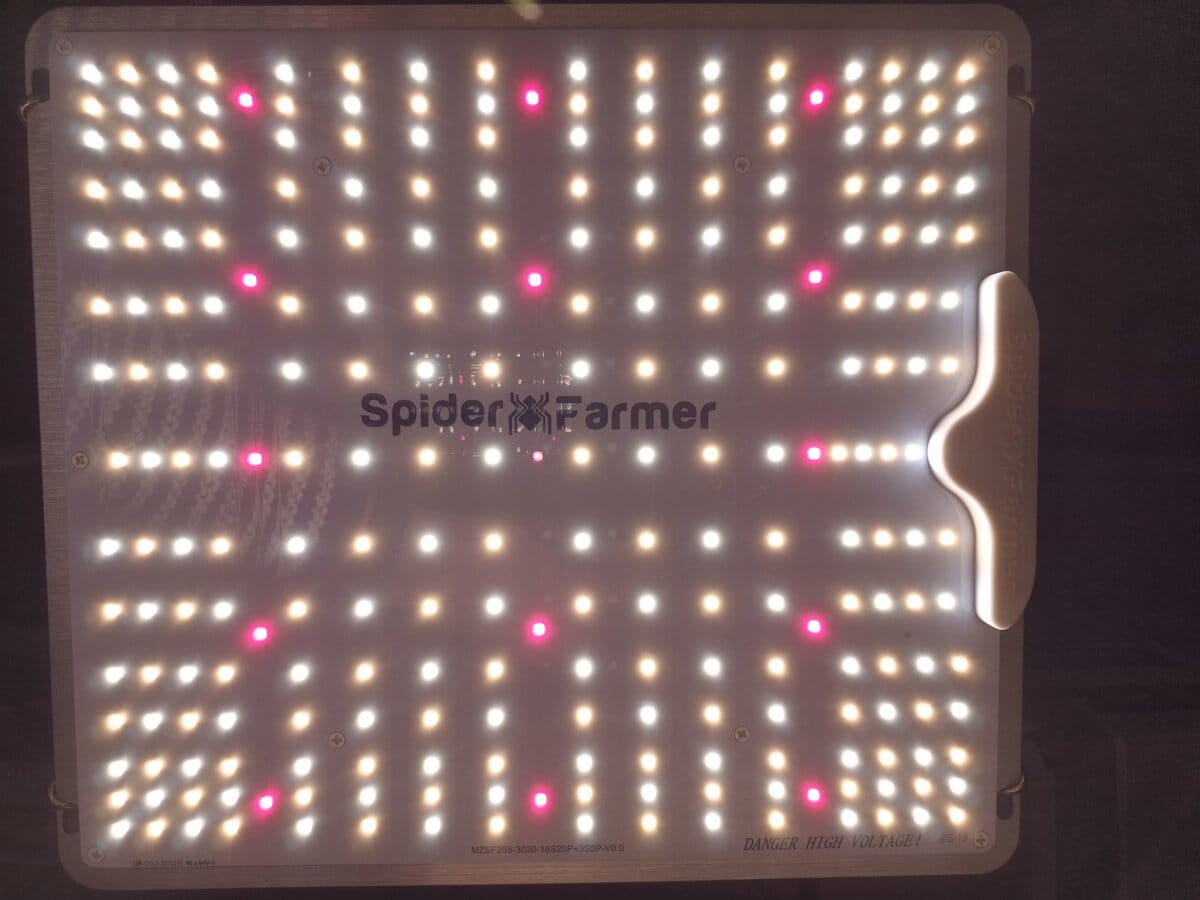
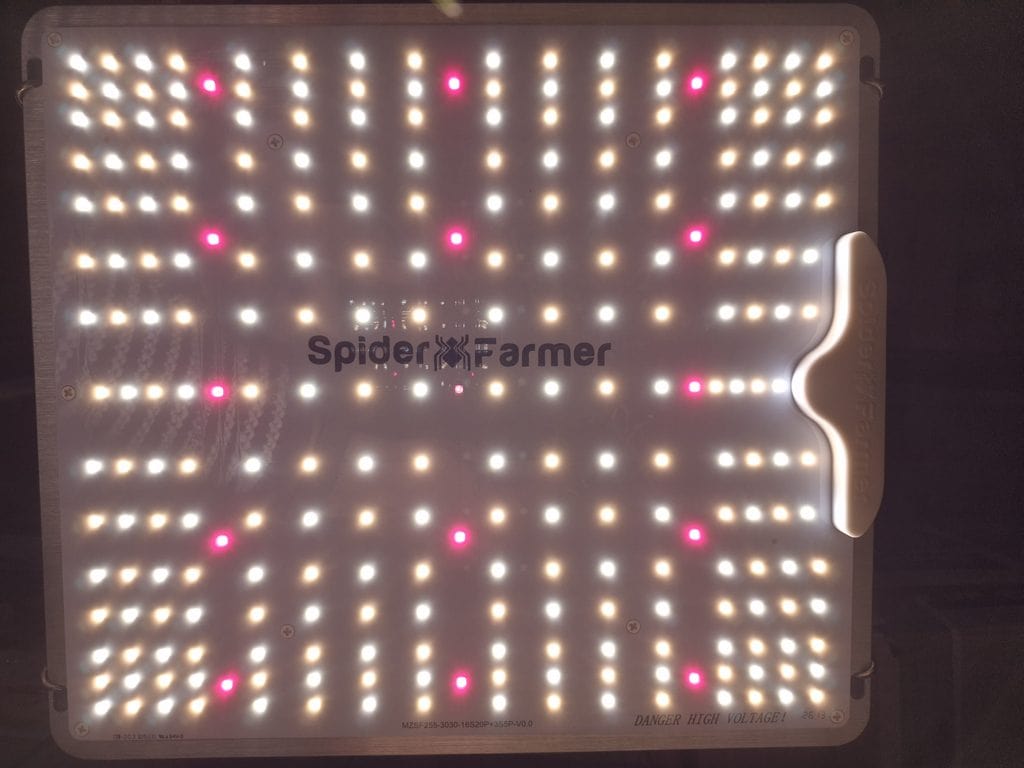
The Spider Farmer SF1000 is a budget-friendly 100W LED grow light panel designed for small indoor growing spaces. For this Spider Farmer SF1000 grow light review, I’ve been testing the light at home to assess its setup, coverage, controls, build quality and overall performance.
If you think you need more power or a larger growing area, see our Best LED Grow Lights UK guide for alternatives across a range of budgets.
HomeGrower rating: ⭐⭐⭐⭐☆ 4/5
Quick verdict: The Spider Farmer SF1000 is a compact 100W full-spectrum LED grow light that works well for one or two fruiting plants in a small indoor growing space.
I have been using the SF1000 with a tomato and chilli plant, and it has provided enough usable light for both. It has a built-in dimmer, silent passive cooling and is designed for roughly a 2 × 2 ft flowering area, which feels realistic in my experience. Its compact coverage is the main limitation, especially once plants become larger and spread beyond the centre of the panel.
It loses a star because a 150W grow light can provide noticeably more usable coverage, while the overall construction feels more budget than a mid-range model. For a relatively inexpensive 100W panel, though, the SF1000 offers a very good balance of output, simple controls and low running costs.


Spider Farmer SF1000 Setup, Controls and Build Quality
The Spider Farmer SF1000 is very simple to set up. It comes with adjustable ratchet hangers, so you can raise or lower the panel as the plants grow, and there is no separate control system or app to configure.
Personally, I hang mine from an open clothes rail in a garden room, but it would work just as well in a small grow tent, cupboard or other compact indoor growing space.
The built-in dimmer is one of the most useful features. You can reduce the output for seedlings or young plants, then increase it as plants become established and move into flowering and fruiting. For my tomato and chilli setup I have mainly been using the light at full power.
I run the SF1000 through a Tapo smart plug, which makes it easy to automate the daily light cycle without having to switch the grow light on and off manually. I usually run grow lights for around 14–16 hours per day depending on the plants and stage of growth.
You can read more about how I use it in my Tapo P110 Smart Plug Review.
The SF1000 is fanless. Heat is dissipated through the metal board rather than an active cooling fan, so the light runs silently. The panel does become warm during use, but that is normal for this type of LED grow light, and in my setup it never became overly hot.
The SF1000 also supports daisy chaining, so multiple compatible Spider Farmer lights can be linked together and controlled from one dimmer. That could be useful if you later expand your growing area rather than replacing the light completely.
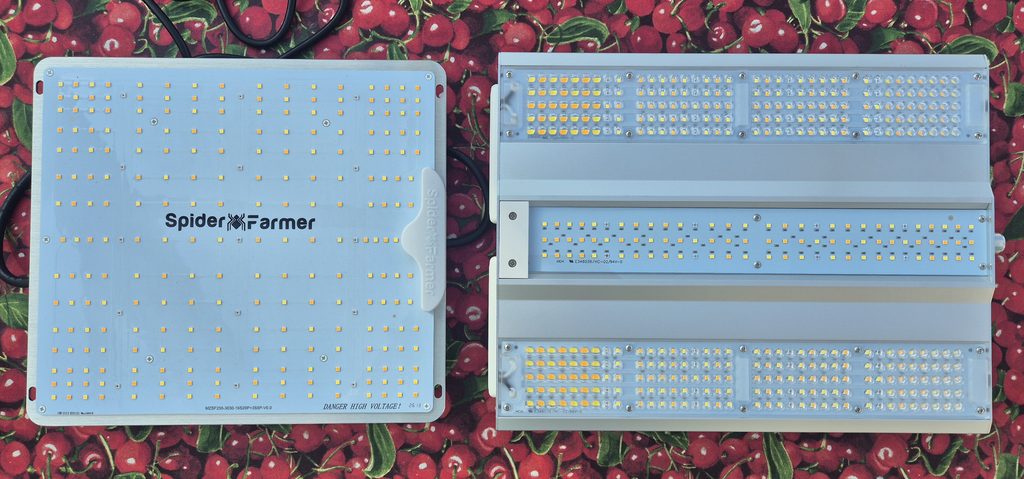
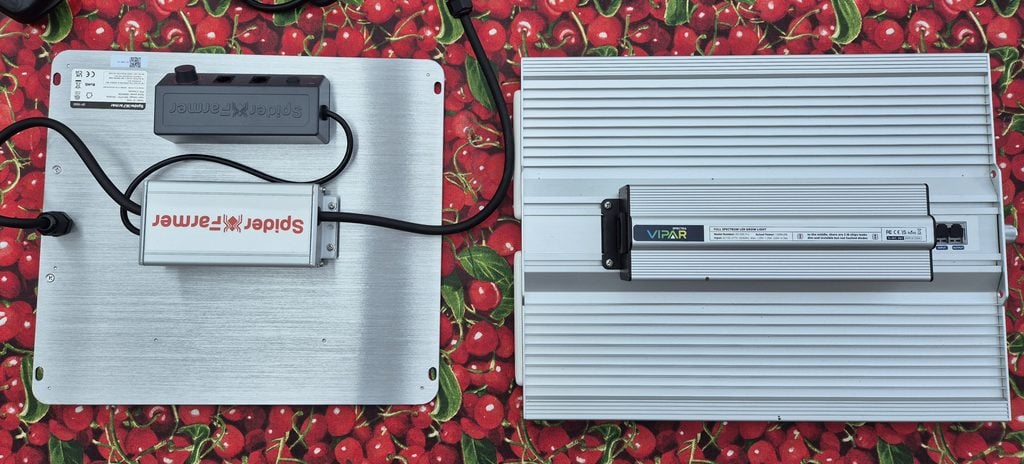
Build quality is decent for the price, although it does feel more like a budget light than the ViparSpectra XS1500 Pro I have also used. The ViparSpectra feels slightly more substantial and has the advantage of 150W output, whereas the SF1000 is lighter, simpler and cheaper.
That difference is also noticeable in practical coverage. The XS1500 Pro is a larger, wider light, and the extra 50W means it can be hung slightly further from the canopy while still delivering useful intensity. In practice, that gives it a broader usable footprint. I have previously used the XS1500 Pro over three mature plants, while I would be more comfortable limiting the SF1000 to around two fruiting plants.
However, it is worth noting that the ViparSpectra XS1500 Pro comes with a 2-year warranty, while Spider Farmer offers a 5-year limited warranty on the SF1000. The first two years provide the most comprehensive cover, with more limited support in later years.
You can read more about my experience with the larger 150W model in my ViparSpectra XS1500 Pro Review.
Below you can see both sides of the Spider Farmer SF1000 and ViparSpectra XS1500 Pro for comparison.
How Much Growing Area Does the SF1000 Really Cover?
Spider Farmer rates the SF1000 for around a 2 × 2 ft flowering area (70 * 70cm), and that feels realistic based on my own setup.
I have been using it over a tomato and chilli plant, and I would be comfortable recommending it for one or two mature fruiting plants, provided they are kept fairly close together under the centre of the panel.
The main limitation is simply the 100W output. The SF1000 can provide enough intensity for flowering and fruiting, but only across a relatively compact footprint. If you try to spread the light over too large an area, the plants around the edges will receive much less useful light.
For a small indoor setup, though, that compact coverage is not necessarily a problem. The SF1000 concentrates its 100W output over the kind of relatively small area it is designed for, without requiring you to pay for a larger light.
How Far Should the SF1000 Be From Plants?
Spider Farmer recommends changing the hanging height as plants develop rather than using one fixed distance throughout the grow.
For the SF1000, its guidance is around 61–76cm for germination, 61cm for seedlings, 46–61cm during vegetative growth and 30–46cm during flowering, with the dimmer gradually increased as the plants mature.
I would always start with the manufacturer’s recommendation and then adjust according to how the plants respond. Different species and growing conditions can tolerate different light levels, so the ideal height is not necessarily identical for every setup.
For fruiting plants like tomatoes and chillies, the flowering recommendation of around 30–46cm at full power is a sensible starting point. If plants are stretching or leaning towards the light, you may be able to bring it slightly closer. If the upper leaves become pale, curl upwards or show signs of stress, raise the panel.
The dimmer is useful here too. Young plants generally need less light, so there is little reason to run the SF1000 at full power close to seedlings. As plants become established and begin flowering and fruiting, you can increase both the intensity and the amount of useful light reaching the canopy.
If you are unsure how high to hang your light at each stage of growth, see my Grow Light Distance Chart UK for recommended starting distances and advice on adjusting the height based on how your plants respond.
How Long Should the SF1000 Be On Each Day?
The right light schedule depends on the type of plant and its stage of growth, so there is no single setting that works for everything.
For seedlings and young plants, around 14–16 hours of light per day is a sensible starting point. Established vegetative plants are often kept on a similar schedule.
Tomatoes and chillies can also be grown successfully with around 14–16 hours of light per day, because they do not need a strict short-day cycle to begin flowering and fruiting.
Some flowering plants are different. Photoperiod-sensitive plants are often switched to around 12 hours of light and 12 hours of darkness to trigger and maintain flowering. For these plants, the dark period is just as important as the light period, so keeping the schedule consistent matters.
I use a Tapo P110 smart plug to automate the SF1000, so the light switches on and off at the same time each day.
For a fuller breakdown by plant type and growth stage, see my How Long Should Grow Lights Be On? guide.
My Spider Farmer SF1000 Test Results
In my setup, the SF1000 has done what I wanted from a 100W grow light. I have been using it with a tomato and chilli plant, and it has provided enough usable light for both without needing a tent or complicated setup.
The main thing I noticed is that the coverage is realistic rather than generous. The SF1000 works best across a compact canopy, and the useful intensity drops away once you try to spread its 100W output over a much wider area.
The dimmer, silent operation and compact size make it easy to live with, and the light has not become excessively hot in use. For a budget 100W panel, I think the overall performance is strong.
There is also a closely related SF1000D version, with pricing that can vary relative to the standard SF1000. It is still a 100W dimmable light with similar coverage, but Spider Farmer lists a slightly lower total light output than the standard SF1000 I tested.

Final Verdict: Is the Spider Farmer SF1000 Any Good?
The Spider Farmer SF1000 is a good compact grow light for anyone who wants useful flowering power in a small indoor setup without moving up to a larger 150W or 200W panel.
In my setup, it has been simple to use, quiet, easy to position and powerful enough for fruiting plants. The dimmer is useful, the 2 × 2 ft flowering coverage feels realistic, and the 100W power draw keeps electricity use relatively modest.
The main limitation is coverage. If you want a broader canopy or more flexibility in plant spacing, I would move up to a larger and more powerful panel. Build quality also feels more budget than mid-range, although the five-year warranty is reassuring at this price.
For a small indoor setup, though, I think the SF1000 does exactly what a 100W grow light should do. I’d rate it 4 out of 5.