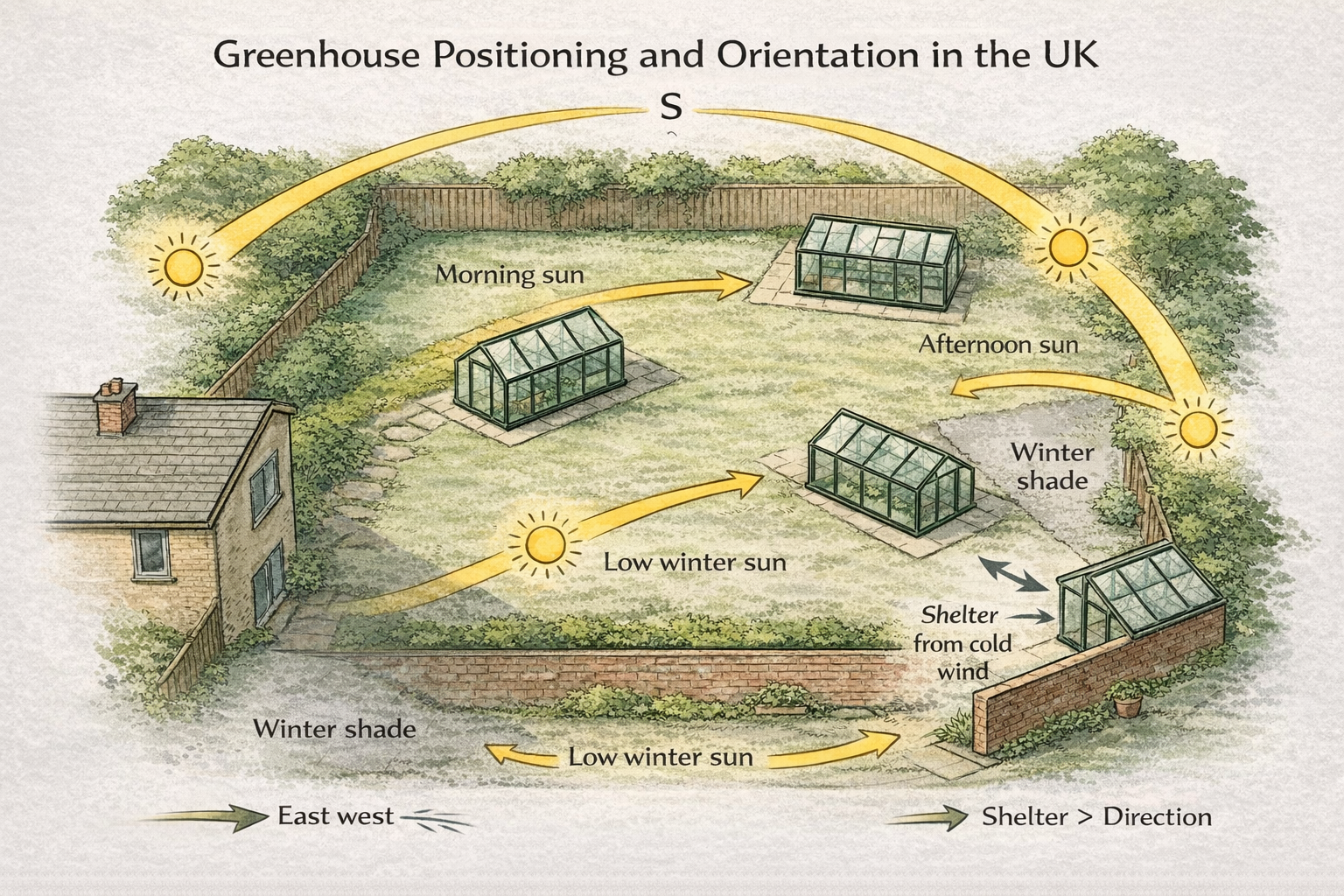
If you look up greenhouse orientation, you’ll almost always see the same confident advice:
“Face it south.”
That advice isn’t wrong — but in most real gardens, you don’t get to choose the perfect spot, only the best one available.
Most of us are dealing with fences, neighbouring houses, brick walls, narrow plots, shade at certain times of day, and gardens that don’t neatly line up with a compass. Add in the UK’s low winter sun, long summer days, frequent cloud cover, and damp conditions, and “perfect” orientation quickly becomes theoretical.
This guide explains what greenhouse orientation and positioning actually change in the UK, what they don’t, and how to make sensible, practical decisions when space and conditions are less than ideal.
It sits within our wider HomeGrower Guide to Greenhouses and Polytunnels, which maps out how all these decisions fit together — from planning and placement through to day-to-day use.
🧭 Why Greenhouse Orientation Is Over-Simplified
We’re often told there’s one right way to do this, but in a real UK garden you’re usually just trying to find the spot that causes the fewest problems.
Orientation is not a single rule — it’s a set of trade-offs:
- Light timing vs light quantity
- Winter warmth vs summer overheating
- Morning drying vs afternoon heat
- Theory vs what your garden actually allows
In practice, position nearly always matters more than compass direction, and things like insulation and ventilation often have a bigger impact on results than orientation alone.
Think of orientation as a multiplier, not a magic fix.
☀️ The UK Sun Path (Without the Astronomy)
Understanding how the sun behaves in the UK explains why generic advice falls apart.
🌫️ Winter reality
- The sun stays low in the southern sky
- Days are short
- Shadows are long
- Even south-facing greenhouses receive limited direct sun
🌤️ Summer reality
- Days are long
- The sun rises in the north-east and sets in the north-west
- East- and west-facing greenhouses get plenty of light
- Overheating becomes a bigger issue than heat loss
Key point:
Orientation mainly affects when light and warmth arrive — not whether you can grow successfully at all.
🧱 North–South vs East–West Orientation
(What Actually Changes — and What Doesn’t)
This is where many guides overstate the importance.
✅ What orientation really changes
- The timing of sunlight across the day
- Which side warms first
- How evenly light hits beds and staging
❌ What it doesn’t decide
- Whether a greenhouse “works”
- Whether UK crops will grow
- Overall success for most home gardeners
In broad terms:
- North–south orientation spreads light a bit more evenly
- East–west orientation concentrates light earlier or later
For typical small and medium UK greenhouses, this difference is real but modest.
If orientation were critical, most successful UK growers would be struggling — and they aren’t.
🌅 Morning Sun vs 🌇 Afternoon Sun
(Damp, Frost Recovery, and Overheating)
This distinction usually matters more than compass direction.
🌅 Morning-sun bias
Pros
- Condensation dries earlier
- Lower fungal pressure
- Faster recovery after cold nights
Cons
- Slightly less late-day warmth in winter
🌇 Afternoon-sun bias
Pros
- Warmer evenings in spring and autumn
- Marginally more heat late in the day
Cons
- Higher overheating risk in summer
- Damp can linger longer after cold nights
In UK conditions, early drying is often more valuable than chasing extra evening heat.
🧱 Is It Ever a Good Idea to Put a Greenhouse Against a Brick Wall?
Yes — sometimes it’s a very smart choice, especially in exposed UK gardens.
But it’s a conditional advantage, not a guaranteed one.
🌬️ Weather protection (the biggest benefit)
A solid wall:
- Blocks prevailing winds
- Reduces draught-driven heat loss
- Creates more stable winter temperatures
In windy or open gardens, shelter often matters more than orientation.
🧱 Thermal mass (small but useful)
Brick and masonry:
- Absorb heat during the day
- Release it slowly overnight
This won’t replace heating, but it can:
- Reduce sharp night-time drops
- Take the edge off spring and autumn frosts
The effect is most noticeable in:
- Lean-to greenhouses
- Well-sealed structures
- Setups with some insulation already in place
🌧️ Protection from driving rain
A wall can:
- Shield one side from wind-driven rain
- Keep frames and fixings drier
- Improve long-term durability
⚠️ When walls cause problems
Walls work against you when:
- They’re north-facing and stay cold
- They block low winter sun
- Ventilation isn’t planned properly
Cold brick can act as a heat sink and create damp pockets if airflow is poor. A wall always increases the importance of good ventilation, which is why lean-to greenhouses can perform extremely well in the UK — but only when ventilation is designed properly.
This is why lean-to greenhouses can perform extremely well in the UK — but only when ventilation is designed properly.
🧩 Orientation vs Position
(Why Obstructions Matter More Than Angles)
A theoretically perfect orientation can be undone by:
- Fences casting winter shade
- Houses blocking low southern sun
- Trees shading afternoon light
- Narrow plots restricting airflow
A greenhouse with:
- Clear exposure
- Good airflow
- Minimal winter shading
will outperform a “perfectly oriented” greenhouse tucked into a gloomy corner.
Uninterrupted light beats ideal direction.
🔧 How Greenhouse Orientation and Positioning Interact With Everything Else
Orientation never works in isolation.
🧤 Orientation & insulation
Orientation affects how heat is gained — but good greenhouse insulation controls how long that heat is kept, which is why insulation often matters more than fine-tuning compass direction.
🌬️ Orientation & ventilation
Greenhouses that receive strong afternoon sun are more prone to overheating, which makes effective greenhouse ventilation far more important than orientation tweaks.
🪟 Orientation & glazing
Diffuse glazing reduces sensitivity to direction. Clear glazing exaggerates it.
🔥 Orientation & heating
Orientation can slightly affect heating demand, but insulation, sealing, and frost protection strategies matter far more than direction alone.
⚖️ When Orientation Really Matters (and When It Barely Does)
Orientation matters most when:
- Using a lean-to greenhouse
- Growing very early or very late
- Relying heavily on passive solar gain
- Managing persistent damp or fungal issues
Orientation matters least when:
- Insulation is decent
- Ventilation is well designed
- Space constraints dominate placement
- You’re growing seasonally, like most UK gardeners
🧠 Common Greenhouse Orientation Myths (Gently Corrected)
“South-facing is always best.”
Only if it isn’t shaded and overheating is managed.
“Wrong orientation ruins a greenhouse.”
Poor airflow and damp ruin greenhouses.
“Orientation decides yields.”
Consistency, timing, and airflow matter more.
✅ A Practical UK Positioning Checklist
Before worrying about compass points, prioritise:
- ☀️ Longest uninterrupted light window
- 🌬️ Good airflow potential
- 🌅 Early drying if possible
- 🧱 Shelter from prevailing winds
- 🔧 Practical year-round access
Get three out of five right, and orientation becomes a secondary concern.
🧭 How This Fits Into Your Wider Greenhouse Setup
Orientation sets the baseline conditions, but:
- Insulation controls losses
- Ventilation prevents extremes
- Heating fills specific seasonal gaps
Orientation provides context — it doesn’t provide control.
A greenhouse that works with your garden will always outperform one chasing theoretical perfection.
📎 Related Articles
If you’re planning a greenhouse setup, these guides build on the ideas above:
- HomeGrower Guide to Greenhouses and Polytunnels
The main resource hub covering greenhouse and polytunnel types, placement, and how everything fits together. - How to Use a Greenhouse (or Polytunnel)
A practical guide to day-to-day greenhouse use, from managing temperature and airflow to seasonal growing routines. - How to Heat a Greenhouse in the UK
When heating is worth it, when it isn’t, and how to keep plants protected without wasting energy.