
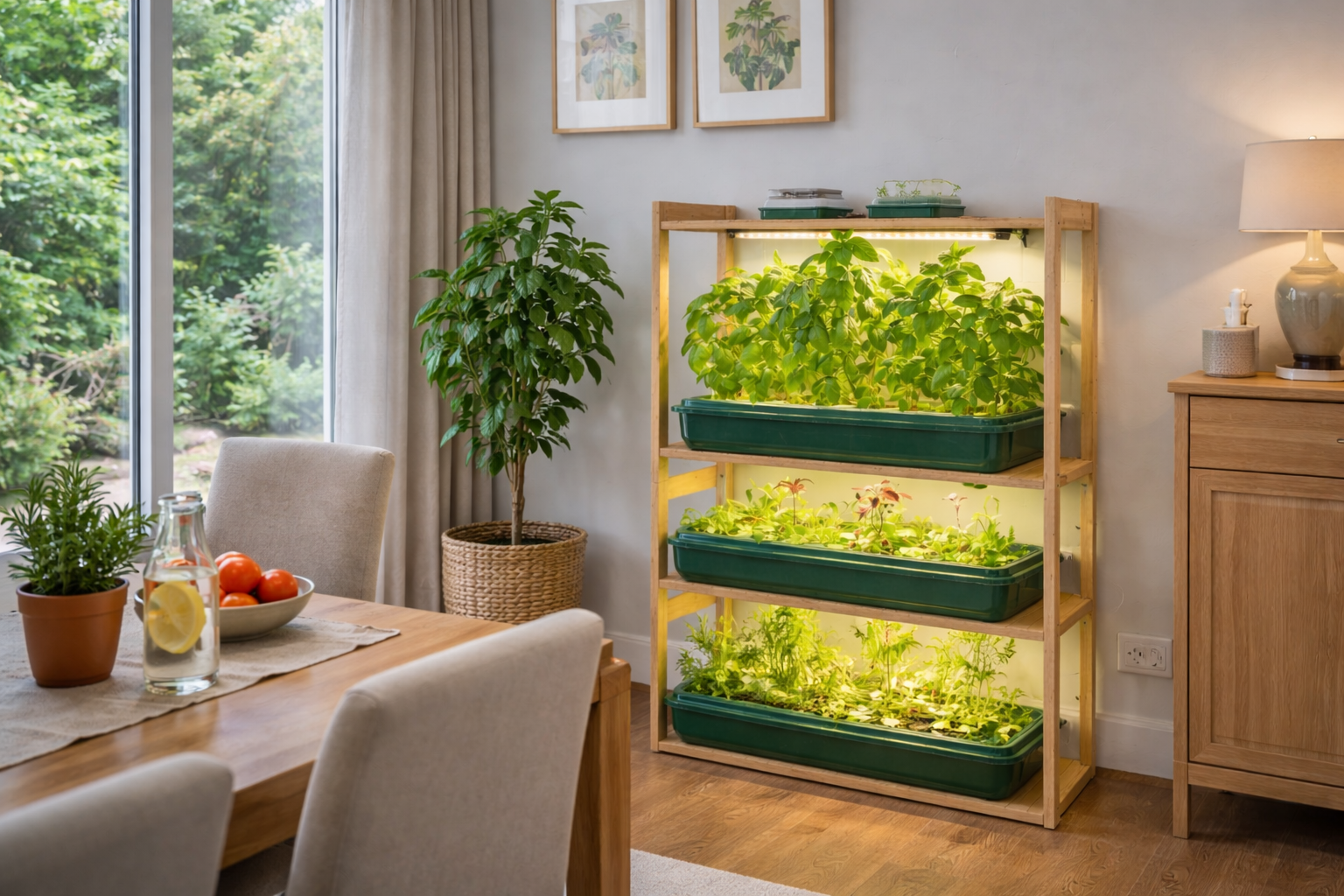
If you grow herbs or salad indoors, one question comes up surprisingly often:
Are grow lights bad for the environment?
It’s a fair concern. Grow lights use electricity, and electricity production has environmental impacts.
But the answer isn’t as simple as yes or no. The environmental impact of grow lights depends on how much electricity they use, what you’re growing, and how efficiently that crop can be produced indoors.
To understand the real picture, it helps to look beyond the electricity used by the light itself. Farming, transport, refrigeration, packaging and food waste all contribute to the footprint of the food we buy. That doesn’t automatically make indoor growing greener, but it gives a fairer comparison.
If you’re new to indoor lighting, our HomeGrower guide to grow lights explains how grow lights work, how much power they use, and how to choose the right setup.
The Bigger Picture: Where Our Food Comes From
Around 58% of the food consumed in the UK was produced in the UK in 2025, according to figures from the UK Department for Environment, Food & Rural Affairs, with the remainder coming from the EU and further afield.
For fresh fruit and vegetables, the UK is often more dependent on imports, especially outside the domestic growing season.
Many everyday foods travel long distances before reaching supermarket shelves, including:
- fresh herbs
- salad leaves
- tomatoes
- peppers
- chillies
That journey typically involves several stages:
- farming and irrigation
- washing and processing
- plastic packaging
- refrigerated transport
- chilled supermarket storage
- household food waste
Indoor growing can remove some of those stages, particularly transport, packaging and refrigeration, but it replaces them with electricity use at home.
So the fairest comparison is not simply “grow lights use electricity, therefore they are environmentally bad.” The real question is whether the energy used indoors is reasonable for the amount and type of food produced.
How Much Electricity Do Grow Lights Use?
The environmental impact of grow lights depends mainly on how large the setup is.
Small herb lights can use very little electricity, while larger lights for fruiting plants or bigger growing areas use considerably more.
| Grow Light Setup | Typical Daily Electricity Use |
|---|---|
| Small herb light (10W) | ~0.16 kWh |
| Small indoor grow light (50W) | ~0.8 kWh |
| Medium grow light (100W) | ~1.6 kWh |
Figures assume the grow light runs for 16 hours per day.
If you want to estimate the running cost of your own setup, try the Grow Light Running Cost Calculator, which calculates daily, monthly and yearly electricity use based on wattage and runtime.
Electricity is usually the main ongoing environmental cost of indoor growing, but the numbers make more sense when you put them into perspective.
Putting Grow Light Electricity Into Perspective
Looking at grow lights alone can make them seem energy-hungry. In reality, many everyday household activities use similar or larger amounts of electricity.
| Activity | Approx. Energy Use |
|---|---|
| 10W herb grow light for 16 hours | ~0.16 kWh |
| Laptop used for a working day | ~0.4–0.6 kWh |
| Washing machine cycle | ~0.5–1 kWh |
| 100W grow light for 16 hours | ~1.6 kWh |
| Traditional tumble dryer cycle | ~3–5 kWh |
This doesn’t mean grow lights have no environmental impact. It simply helps put the numbers into context. A small herb light uses relatively little electricity, while a 100W light running for 16 hours a day is a much more significant energy user.
Driving vs Grow Lights: Another Perspective
Driving provides another useful sense of scale. A typical petrol car can produce several kilograms of CO₂e on a 10-mile round trip, depending on the vehicle and driving conditions.
That is far more than the emissions associated with running a small 10W herb light for a day, although the exact comparison depends on the carbon intensity of the electricity being used.
The point is not that grow lights are emission-free, but that scale matters. Running a small 10W herb light for a day is a very different environmental proposition from running a powerful indoor-growing setup, and both are small compared with many everyday transport emissions.
Real Example From My Setup
In my own indoor growing setup, I used a Tapo P110 smart plug with energy monitoring to check the real power draw of a SANSI LED bulb. It was using about 9 watts.
Run for around 16 hours per day, that works out at:
- 0.144 kWh per day
- about 4.3 kWh per month
- roughly £1.10 per month at an electricity price of 26.11p/kWh
For herbs, seedlings and other small growing areas, a setup like this can provide useful supplemental light without using much electricity.
The Hidden Environmental Factor: Food Waste
One of the biggest environmental costs of food is something many people overlook: waste.
Fresh herbs and salad can be particularly easy to waste because they are often bought in larger quantities than a recipe needs and have a relatively short usable life once opened.
We’ve all done it: bought a plastic-sleeved bunch of mint for one mojito or a Sunday roast, used three sprigs, and watched the rest turn into a black, slimy mess in the fridge a few days later.
That’s not just £1.50 wasted — it’s the carbon cost of a chilled supply chain ending in the bin.
Home growing can still help reduce waste, especially with herbs and small amounts of salad. You can harvest only what you need rather than buying a whole bunch or bag, although a small indoor setup is unlikely to produce all the salad a household eats.
Good Crops for Indoor Growing
Indoor growing generally makes most sense for compact crops that give repeated harvests or are expensive and waste-prone when bought fresh.
Good examples include:
- basil
- parsley
- coriander
- lettuce
- rocket
- asian greens
- chillies
These crops often:
- fit into relatively small growing areas
- allow repeated or selective harvesting
- are relatively expensive for the amount you actually use
- can spoil quickly once bought
- may otherwise be imported outside the UK growing season
A healthy basil plant can provide repeated small harvests over a long period, potentially reducing how often you need to buy fresh basil.
Poor Crops for Indoor Growing
Some crops need too much space, time or artificial light to make much sense indoors, especially when they are already produced very efficiently outdoors or commercially.
Examples include:
- potatoes
- carrots
- onions
- cabbage
- grains
For staple crops like these, commercial or outdoor growing is generally far more energy-efficient than trying to produce them entirely under artificial light at home.
Indoor growing is usually better suited to herbs, leafy crops and other produce where freshness, repeated harvesting or reduced waste matter more than producing cheap calories.
A Counterintuitive Example: Tomatoes
Many people assume local food always has the lowest environmental impact. Tomatoes show why things are more complicated.
Tomatoes grown in heated greenhouses in northern Europe can require significant energy, particularly during winter.
Meanwhile, tomatoes grown in southern Spain can often rely on unheated greenhouses and natural sunlight before being transported north by truck.
In some cases, the extra transport emissions are smaller than the energy used for greenhouse heating, so imported tomatoes can have a lower footprint than locally grown winter tomatoes.
Growing crops like tomatoes indoors is possible, but they require much stronger lighting than herbs or salad greens. If you’re curious what that involves, see our guide to the best LED grow lights for indoor growing.
Why UK Winter Light Changes the Discussion
A lot of indoor-growing advice online comes from sunnier climates, where winter light levels can be much higher than they are in the UK.
Britain is very different.
In a typical UK winter, days are short and light levels can be poor for long periods, especially in overcast weather.
Expecting a basil plant to thrive on a north-facing UK windowsill in midwinter is often unrealistic.
In these conditions a small LED grow light can provide the extra light needed to keep herbs and seedlings growing more reliably through winter.
Running Grow Lights During Off-Peak Electricity
If you’re on a time-of-use tariff such as Octopus Agile or Economy 7, running grow lights during cheaper periods can reduce their running cost.
Plants can adapt to a shifted light schedule, but they still benefit from a consistent daily dark period. If you run grow lights overnight, keep the light and dark cycle regular rather than changing it from day to day.
Running lights overnight can:
- reduce electricity costs
- make use of cheaper off-peak periods
- sometimes coincide with periods of lower-carbon electricity
A simple timer or smart plug makes this easy to automate.
HomeGrower Rule of Thumb
If a crop is compact, gives repeated harvests and needs relatively little artificial light, indoor growing is easier to justify environmentally. Herbs, leafy greens and microgreens are good examples.
Large crops such as potatoes, cabbages or cauliflower are much harder to justify entirely under artificial light. In bright spaces such as conservatories, though, grow lights can still be useful as supplemental lighting rather than the plant’s only light source.
The Grow Light Itself Has an Environmental Cost
Electricity is not the only environmental impact. Grow lights also require LEDs, drivers, aluminium, plastics and other materials to manufacture, and eventually they have to be disposed of.
That is another reason to choose a reasonably efficient, well-made light and use it for as long as possible rather than repeatedly replacing cheap units.
Indoor Growing Isn’t About Replacing Farming
Indoor growing is not a replacement for commercial agriculture. Staple crops are generally produced far more efficiently outdoors and at scale than they could be under grow lights at home.
Where indoor growing can make sense is as a supplement: producing herbs, leafy greens and other small crops at home, especially when they can be harvested repeatedly.
And for many people, it is also simply an enjoyable hobby. Like most hobbies, it has an environmental footprint, but that footprint can be kept relatively small by using efficient LEDs, choosing sensible crops and avoiding more lighting than the plants actually need.
📎 Related articles
- Grow Lights Explained: A Complete Guide
A broader overview of grow light types, setups, and how indoor lighting works in UK homes. - Grow Light Wattage Explained
A clear explanation of real power draw, wattage myths, and how to compare lights sensibly. - Grow Light Efficiency Explained: Diodes & Drivers
How efficiency affects real-world electricity use, heat, and getting more usable light per watt.