
One of the first questions beginners ask is simple: how often should you change hydroponic water?
The usual answer online is often “every one to two weeks”, but in real life it depends on the system, the crop, the reservoir size and how healthy the water looks.
For many small indoor hydroponic systems, especially when growing herbs or salad leaves, you may not need to fully change the water every week. In some cases, you can top up the reservoir with water and nutrients through a short crop, then clean everything properly after harvest.
That said, there are times when a full water change is the safer option. If the water smells, looks cloudy, develops algae, the roots become slimy, or the plants slow down unexpectedly, it is usually better to refresh the nutrient solution rather than keep topping it up.
If you are completely new to this growing method, start with my beginner guide on how to grow with hydroponics, which explains the basic setup, nutrients, lighting and pH in more detail.
The Short Answer: How Often Should You Change Hydroponic Water?
For most beginner hydroponic systems, a good practical rule is:
- Top up with water as needed when the reservoir level drops.
- Add nutrients carefully according to the instructions for your system or nutrient feed.
- Fully change the water every one to three weeks if the crop is long-running, the reservoir is small and being used for more than a few weeks, or the water quality starts to decline.
- Clean the reservoir properly between crops, especially with countertop systems and indoor hydroponic gardens.
For a short herb or lettuce crop, it can be perfectly possible to top up the water and nutrients until harvest, then do a full clean-out afterwards.
For longer crops, warm rooms, heavy-feeding plants or reservoirs that start to smell or drift, more regular water changes are sensible.
Hydroponic Water Is Really Nutrient Solution
In hydroponics, the water is not just water. It is a nutrient solution. The plant roots sit in, or are regularly fed by, water containing dissolved plant food.
Over time, plants do not take up every nutrient at exactly the same rate. They may use more nitrogen, potassium, calcium or trace elements depending on their growth stage.
Water is also used by the plant or lost through evaporation. As the water level drops, the remaining solution can become stronger. This is one reason why endlessly topping up with more nutrients is not always a good idea.
Over time, several things can change inside the reservoir:
- The nutrient balance can shift.
- The pH can drift.
- Salts can build up.
- Oxygen levels can fall.
- Algae can develop if light reaches the water.
- Old root material can affect water quality.
However, this does not mean old hydroponic water instantly becomes bad. With short, forgiving crops such as basil, mint, lettuce and other leafy greens, you can often get through a full growing cycle with careful topping up, especially if the plants look healthy and the water stays clean.
How Often Should You Change Hydroponic Water by System Type?
The best answer depends on the size and type of hydroponic system you are using. A small countertop system behaves very differently from a larger deep water culture reservoir or a recirculating multi-plant setup.
Small countertop systems
These are often topped up during short crops, then cleaned properly after harvest. This can work well for herbs and salad leaves if the water stays clear and the roots look healthy.
Deep water culture buckets
These are often changed every one to two weeks, especially with larger or hungrier plants. The more heavily a plant feeds, the more likely the nutrient balance is to shift.
Kratky jars
These are often topped up carefully rather than fully changed. The important point with Kratky is to maintain an air gap for roots. Do not simply refill to the very top once air roots have formed.
Larger reservoirs
These are often changed every two to three weeks if stable, although pH and nutrient strength still need watching.
Seedlings and cuttings
These should be handled gently, usually with weaker nutrients and changes as needed. Young roots are less forgiving than established plants.
What Counts as a Large Hydroponic Reservoir?
A large reservoir is not the same thing as a small indoor herb garden. In home hydroponics, I would usually think of a larger reservoir as something around 20 litres or more, with bigger systems often using 40, 50 or 100 litres of nutrient solution.
The reason this matters is stability. A few litres of water can change quickly. Nutrient strength can rise as water is used, the temperature can move with the room, and pH can drift faster.
A larger reservoir changes more slowly because there is more water to buffer those changes.
A simple way to think about it:
- Small reservoir: usually a few litres, as found in many countertop hydroponic gardens.
- Medium reservoir: roughly 10–20 litres, depending on the setup.
- Large reservoir: around 20 litres or more.
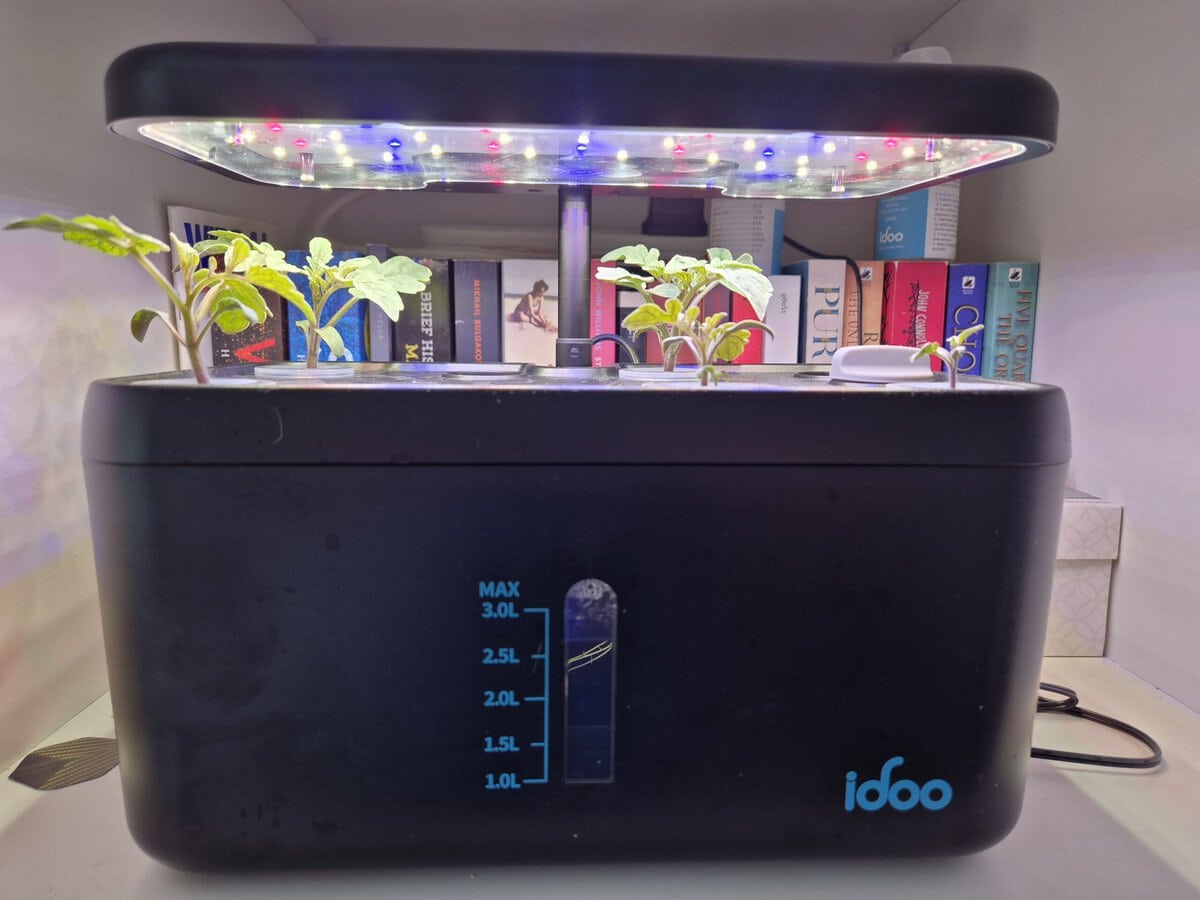
A small countertop unit, such as an 8-pod indoor hydroponic garden, is not a large reservoir. It is a small, convenient system designed for herbs, salad leaves and compact plants.
That does not make it worse, but it does mean you should judge it differently from a larger DIY hydroponic setup.
If you are still choosing a setup, my guide to the best hydroponic growing systems compares small countertop gardens, multi-pod indoor systems and more flexible hydroponic options.
Can You Just Top Up Hydroponic Water?
Yes, you can top up hydroponic water, and in many beginner systems you will need to. As plants grow, the reservoir level drops. Some of that water is used by the plant, and some may be lost through evaporation.
The important point is that topping up and changing the water are not the same thing.
- Topping up means adding more water, and sometimes more nutrients, to keep the system running.
- Changing the water means emptying the old nutrient solution and replacing it with a fresh mix.
For short crops, topping up can be enough. For longer crops, or if you keep adding nutrients without ever resetting the solution, the nutrient balance can become less predictable.
A Simple Top-Up Rule of Thumb
One of the easiest places to get confused is whether you should add plain water, nutrients, or both.
As a simple beginner rule:
- If the reservoir has only dropped a little, top up with plain water.
- If you are replacing a large amount of water, such as around half the reservoir, add a weaker nutrient dose or follow the nutrient instructions for a partial refill rather than guessing.
- If you are unsure, go slightly weaker rather than stronger.
This is not a perfect scientific rule, but it is safer for beginners. It is usually easier to correct a slightly underfed herb plant than one that has been overfed with a nutrient solution that is too strong.
This is especially true in small countertop systems, where the reservoir volume is low and nutrient strength can change quickly.
My Practical View for Small Countertop Systems
With small countertop hydroponic systems, I would not be too dogmatic. If you are growing a short crop of basil, lettuce or herbs, and everything looks healthy, topping up through the crop can work well.
For example, with an iDOO-style 8-pod system, it is possible to grow basil through to harvest by topping up both water and nutrients rather than fully changing the reservoir every week.
That does not mean it is the perfect textbook method, but it is a realistic beginner method when:
- The crop is short.
- The water stays clear.
- There is no bad smell.
- The roots look healthy.
- The plants are growing strongly.
I cover the strengths and limits of that kind of setup in my iDOO hydroponic system review, including why these small systems are convenient but not the same as a larger hydroponic reservoir.
The key is to watch the plant and the water. If the basil is growing strongly, the leaves look good, the roots are not slimy, and there is no bad smell, you probably do not need to panic just because a week has passed.
On the other hand, if the water starts to look stale, the roots turn mushy, or the plant suddenly declines, it is time to change the solution and clean the reservoir.
When Should You Change Hydroponic Water Sooner?
A fixed calendar is less useful than learning the warning signs. Sometimes a reservoir can run happily for weeks. Other times, the water needs changing sooner.
Change the hydroponic water sooner if you notice:
- A bad smell from the reservoir.
- Cloudy or murky water instead of a clean-looking nutrient solution.
- Slimy, mushy roots, especially if they smell bad or start falling apart.
- Algae growth in the reservoir or around the grow deck.
- Sudden drooping even though the plant has enough light and water.
- Very slow growth after a previously healthy start.
- Repeated pH problems if you are testing pH.
- Nutrient burn, such as brown leaf tips after repeated feeding.
Light brown roots are not always a problem. Some liquid nutrients, especially those with iron or trace elements, can naturally tint roots a light brown colour.
If the roots are still firm and not slimy, it may just be cosmetic staining rather than root rot. The bigger warning signs are bad smell, mushy texture and roots that are falling apart.
HomeGrower Pro Tip: Watch the Room Temperature
Your hydroponic reservoir is not separate from the room it sits in. If your system is in a warm kitchen, conservatory, sunny windowsill or near a radiator, the water can go stale much faster.
Warm water holds less oxygen and can encourage algae and bacterial growth. This is one reason two people using the same hydroponic system can have very different experiences.
If your reservoir seems to go cloudy, smelly or “off” quickly, do not immediately assume you need better nutrients.
First, look at where the system is sitting. Moving it to a cooler, steadier spot can sometimes fix the problem more effectively than changing products.
Should You Add Nutrients Every Time You Top Up?
Not always. This is one of the easiest beginner mistakes.
When the water level drops, the plant may have used more water than nutrients. If you keep adding full-strength nutrients every time you top up, the solution can become too strong.
Too much nutrient can cause:
- Brown leaf tips.
- Stressed roots.
- Slower growth.
- Leaves that look dry, curled or burnt at the edges.
A safer approach is to top up with plain water some of the time, then refresh nutrients according to the instructions for your system.
If you use an EC meter, you can be more precise. If you do not, it is better to be cautious rather than keep adding more feed every time the reservoir drops.
With simple A+B hydroponic nutrients, always dilute them into water separately according to the instructions. Do not mix concentrated A and B nutrients directly together before adding them to the reservoir.
Do You Need to Check pH and EC?
You can grow simple herbs and salad leaves without obsessing over pH and EC, especially in beginner countertop systems. Many people start with the nutrients supplied with the system and still get a useful harvest.
However, pH and EC become more useful as you move beyond the simplest setups.
- pH tells you how acidic or alkaline the nutrient solution is. If pH drifts too far, plants may struggle to access certain nutrients even when those nutrients are present.
- EC gives an indication of nutrient strength. It helps you understand whether the solution is becoming too weak or too strong.
For beginners, I would not make meters compulsory on day one. But if you plan to grow longer-term crops, fruiting plants, larger hydroponic setups or repeated batches, a basic pH meter and EC meter can make reservoir changes much less of a guessing game.
How to Change Hydroponic Water
Changing hydroponic water is usually simple, but it is worth being gentle with the roots. The aim is to refresh the nutrient solution without shocking the plant.
- Switch off the system if it has a pump, light or aerator connected.
- Lift the grow deck carefully, supporting the plants so the roots are not torn.
- Empty the old nutrient solution from the reservoir.
- Rinse the reservoir with clean water.
- Wipe away algae or residue if needed.
- Refill with fresh water, ideally not very cold.
- Add nutrients correctly according to the instructions.
- Check pH if you use a meter.
- Return the plants and restart the system.
You do not need to scrub healthy roots. If roots are white, cream or lightly stained by nutrients, leave them alone. Focus on the reservoir, not aggressive root cleaning.
How Often Should You Clean the Hydroponic Reservoir?
As a minimum, clean the reservoir properly between crops. This is especially important with small indoor hydroponic systems where old root fragments, nutrient residue and algae can build up over time.
For a short basil, herb or lettuce crop, a practical routine is:
- Top up during the crop as needed.
- Watch for smell, cloudiness, algae and root problems.
- Harvest the crop.
- Empty and clean the reservoir before replanting.
For longer-running crops, it is better to clean or refresh more often. Fruiting plants, larger herbs and plants kept going for months place more demand on the nutrient solution than a quick batch of salad leaves.
Common Beginner Mistakes
Hydroponic water changes are not difficult, but there are a few common mistakes that can cause problems.
Adding Too Much Nutrient
More feed does not always mean more growth. If the reservoir keeps getting topped up with nutrient solution but never reset, the mix can become too strong.
Letting the Reservoir Run Too Low
Roots need access to water, nutrients and oxygen. If the level drops too far, pumps may struggle and roots can dry out.
Ignoring Bad Smells
Healthy hydroponic water should not smell rotten. A bad smell is one of the clearest signs that the reservoir needs attention.
Changing Water Too Aggressively
A full change is useful when needed, but constantly disturbing roots can stress small plants. Be gentle and avoid unnecessary root handling.
Treating Every System the Same
A small countertop herb garden, a Kratky jar and a large recirculating hydroponic system do not need exactly the same routine. Reservoir size, crop type and water condition all matter.
A Simple Beginner Routine
If you want a simple routine without overcomplicating things, this is a sensible starting point.
- Check the water level every few days.
- Top up when needed.
- Use nutrients according to the instructions.
- Look at the roots whenever you lift the grow deck.
- Smell the reservoir if growth seems off.
- Change the water if anything looks or smells wrong.
- Clean the system fully after harvest.
This is much more useful than following a rigid rule blindly. Hydroponics is partly about consistency, but it is also about observing the plant.
For another beginner-friendly overview of hydroponic growing, the RHS hydroponics guide is also worth reading, especially if you want a broader gardening reference alongside this practical indoor setup advice.
Final Thoughts
So, how often should you change hydroponic water? For many beginner systems, the honest answer is: as often as the crop and water condition require.
A full water change every one to two weeks is a cautious general rule, especially for longer crops, warm rooms, heavy-feeding plants or systems where nutrient balance matters more.
But for short herb and salad crops in small countertop systems, topping up through the crop and cleaning after harvest can work perfectly well if the plants are healthy and the water stays clean.
The main thing is not to ignore warning signs. Smelly water, cloudy solution, algae, slimy roots or sudden plant decline are all reasons to refresh the reservoir sooner.
If you came here wondering “how often should you change hydroponic water?”, the simplest beginner answer is this: top up carefully, avoid overfeeding, watch the roots and water, and clean the system properly between crops. If you’re still not sure about your specific setup, drop a comment below with what you’re growing and I’ll help you figure out a routine that works for your plants.