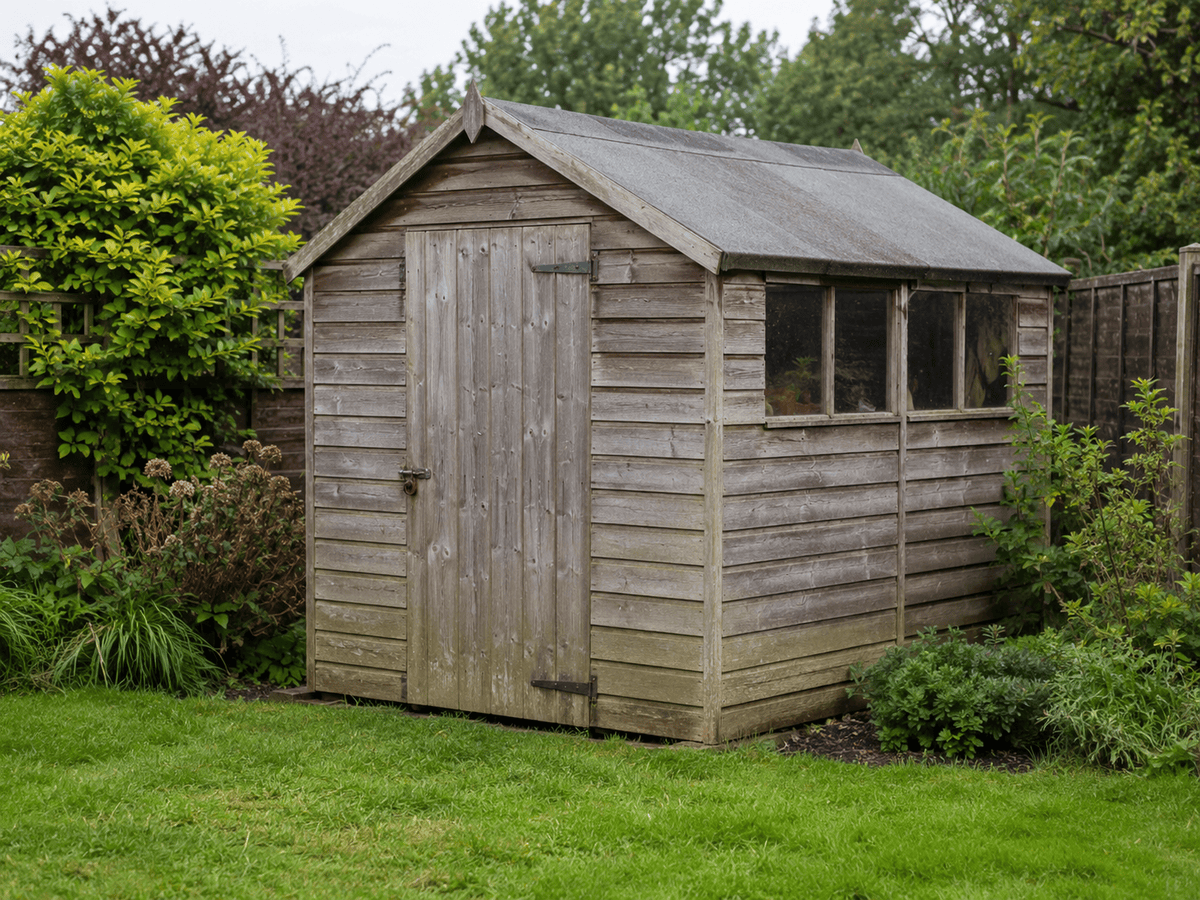
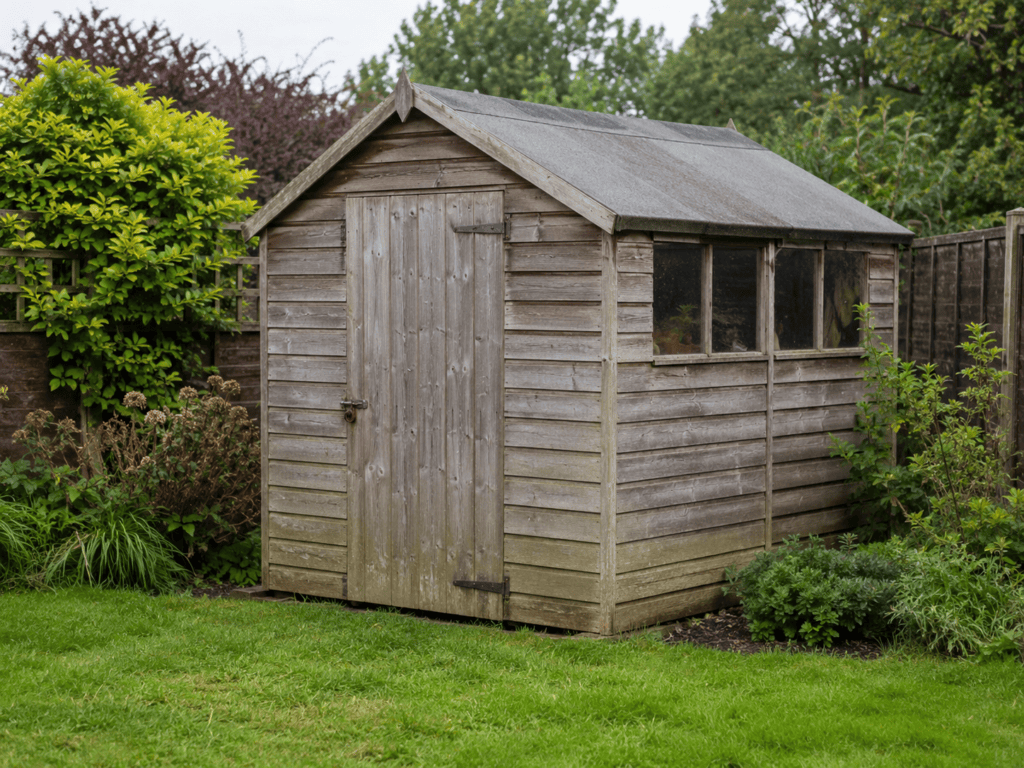
Wooden shed maintenance is not the same for every shed.
A new pressure-treated shed with a long anti-rot guarantee may need very little timber treatment for many years. An older shed with peeling paint, cracked boards or damp corners may need cleaning, sanding, filling, repairing and re-coating before it can be properly protected.
This guide explains how to look after a wooden shed in normal UK garden conditions. It covers 25-year anti-rot guarantees, pressure-treated timber, cheaper dip-treated sheds, paint, stain, oil, preserver, minor repairs and the basic checks that help a shed last longer.
It is written to support our main guide to the best wooden sheds in the UK, where we mainly recommend higher-quality pressure-treated sheds with long anti-rot guarantees. Those sheds are designed to reduce routine timber maintenance, but that does not mean every wooden shed on the market can be ignored for 25 years.
Quick Answer: Wooden Shed Maintenance
- A 25-year anti-rot guarantee usually means the timber is protected against rot, not that the whole shed needs no care for 25 years.
- Pressure-treated sheds need far less timber-treatment maintenance than cheaper dip-treated or untreated sheds, but the roof, base, doors and finish still need checking.
- Paint, stain and oil mainly control appearance and surface weathering. They do not fix soft, rotten or persistently damp timber.
Jump to:
What Shed Maintenance Really Involves
Looking after a wooden shed is not just about painting it every few years.
The main job is to stop the timber staying wet for long periods. That means keeping rain out, letting the shed dry properly after bad weather, and dealing with small problems before they turn into rot.
In practice, shed maintenance usually means:
Checking the roof for leaks or lifted felt.
Keeping leaves, soil and wet grass away from the lower boards.
Making sure air can move around the shed.
Refreshing paint, stain or oil when the finish starts to wear.
Checking for soft timber around the base, corners, doors and windows.
Repairing small cracks, gaps or damaged boards before water gets further in.
A wooden shed rarely fails because you missed one coat of paint. It usually fails because water is allowed to sit somewhere for too long — under the base, behind trapped leaves, through a leaking roof, or inside timber that was damaged and left untreated.
Does a 25-Year Shed Guarantee Mean No Maintenance?
A 25-year shed guarantee does not usually mean the whole shed will stay perfect for 25 years with no care at all.
In most cases, it refers specifically to an anti-rot guarantee on the timber. This is common with better pressure-treated sheds, where preservative has been forced deeper into the wood rather than simply brushed or dipped onto the surface.
The sheds we recommend in our Best Wooden Sheds UK guide are mainly higher-quality pressure-treated models with long anti-rot guarantees. That is one reason we favour them over very cheap wooden sheds.
But many budget sheds are not covered by the same level of guarantee. Some are dip-treated. Some rely on basic factory treatment. Some may need preservative soon after installation and then regular re-treatment afterwards.
So the practical rule is simple:
A 25-year anti-rot guarantee can reduce timber-treatment maintenance, but it does not make the whole shed maintenance-free.
You still need to look after the roof, base, doors, fixings and any decorative finish you choose to apply.
What a 25-Year Anti-Rot Guarantee Usually Covers
A long anti-rot guarantee usually covers the timber against rot or fungal decay, provided the shed has been installed and used according to the manufacturer’s instructions.
The exact terms depend on the manufacturer, so you should always check the product page and guarantee document for the shed you buy. It is also worth checking whether the guarantee needs to be registered after purchase. Some garden building guarantees have specific conditions, and it is much easier to deal with this when the shed is new than years later when you need to make a claim.
In practice, the shed will usually need to be:
Built on a firm, level and suitable base.
Kept off bare soil.
Allowed to drain properly.
Given enough airflow around the sides and underneath.
Used as a garden building rather than altered in a way that traps water.
The guarantee is not a promise that the shed will look new for 25 years. Timber changes colour. Doors move slightly. Roof coverings wear. Paint fades. Hinges and locks age.
That is normal outdoor wear, not necessarily a guarantee issue.
What a 25-Year Guarantee Usually Does Not Cover
A 25-year anti-rot guarantee is mainly about timber decay. It should not be treated as a blanket guarantee for every part of the shed.
In general, you should not assume a 25-year anti-rot guarantee covers:
Fading, greying or natural weathering of the timber.
Paint, stain or oil wearing away.
Roof felt lasting 25 years.
Leaks caused by damaged or neglected roof covering.
Movement caused by an unsuitable base.
Damage from standing water.
Broken glazing, locks, hinges or handles.
Storm damage.
Rot caused by poor installation or lack of ventilation.
Damage caused by modifying the shed incorrectly.
This is why “25-year guarantee” and “no maintenance” are not the same thing.
A good pressure-treated shed can remove the need for annual preservative treatment, but it still benefits from basic checks and sensible care.
A long anti-rot guarantee usually covers the timber against rot or fungal decay, provided the shed has been installed
Not Every Wooden Shed Has a 25-Year Guarantee
This distinction matters because many people compare wooden sheds only by size and price.
A cheaper wooden shed may look similar in a product photo, but it may not be treated to the same standard as a higher-quality pressure-treated shed. It may also come with a shorter guarantee and a higher maintenance burden.
That does not automatically make a cheaper shed a bad buy. If you only need basic storage and are happy to treat the shed regularly, a budget model can still make sense.
But the expectations are different.
A pressure-treated shed with a long anti-rot guarantee is usually the better choice if you want lower maintenance over time. A cheaper dip-treated or untreated shed is usually more hands-on. It may need treatment soon after installation, then regular re-coating to keep the timber protected.
| Shed type | Typical guarantee | Maintenance expectation | Best for |
|---|---|---|---|
| Pressure-treated shed with long anti-rot guarantee | Often 15–25 years, depending on manufacturer and product | Low timber-treatment maintenance, but still needs checks, roof care and sensible positioning | Buyers who want a longer-lasting, lower-maintenance wooden shed |
| Dip-treated shed | Often shorter than premium pressure-treated models | Usually needs regular preservative treatment, especially after installation and on exposed sides | Lower upfront cost if you are willing to maintain it |
| Untreated or lightly treated shed | Varies widely; may have limited protection | Needs prompt treatment with exterior wood preserver, then regular re-coating | Budget projects, custom finishing or short-term use |
| Older shed with worn finish | Usually no meaningful active guarantee | Needs inspection, cleaning, repairs, filling or board replacement before re-finishing | Repairing and extending the life of an existing shed |
Pressure-treated shed with long anti-rot guarantee
Typical guarantee: Often 15–25 years, depending on manufacturer and product.
Maintenance expectation: Low timber-treatment maintenance, but still needs checks, roof care and sensible positioning.
Best for: Buyers who want a longer-lasting, lower-maintenance wooden shed.
Dip-treated shed
Typical guarantee: Often shorter than premium pressure-treated models.
Maintenance expectation: Usually needs regular preservative treatment, especially after installation and on exposed sides.
Best for: Lower upfront cost if you are willing to maintain it.
Untreated or lightly treated shed
Typical guarantee: Varies widely; may have limited protection.
Maintenance expectation: Needs prompt treatment with exterior wood preserver, then regular re-coating.
Best for: Budget projects, custom finishing or short-term use.
Older shed with worn finish
Typical guarantee: Usually no meaningful active guarantee.
Maintenance expectation: Needs inspection, cleaning, repairs, filling or board replacement before re-finishing.
Best for: Repairing and extending the life of an existing shed.
⚠️ Want Less Maintenance?
Wooden sheds are attractive, traditional and easy to customise, but they are not always the lowest-maintenance option. Even a good pressure-treated shed still needs roof checks, airflow, a dry base and occasional attention.
If you want garden storage with less painting, staining or timber treatment, compare wooden sheds with plastic and metal alternatives before choosing.
- Best Plastic Sheds UK
Lower-maintenance resin and polypropylene sheds that do not need painting or staining. - Best Metal Sheds UK
Steel garden storage options where rust prevention, condensation and assembly are the main trade-offs.
How Long Is a Quality Pressure-Treated Shed Maintenance-Free?
A good pressure-treated shed can be very low maintenance, especially compared with a cheaper dip-treated shed.
For the timber itself, you may not need to apply annual preservative treatment. That is one of the main benefits of buying a better pressure-treated shed in the first place.
But “low maintenance” is a better phrase than “maintenance-free”.
In real UK garden conditions, a quality pressure-treated shed may avoid routine anti-rot treatment for many years, but you should still expect to:
Check the roof once or twice a year.
Keep the base clear of soil, leaves and standing water.
Make sure air can circulate around the shed.
Touch up any damaged decorative finish.
Adjust doors if the shed settles or timber moves.
Keep hinges and locks working smoothly.
Watch for cracks, gaps or soft timber around vulnerable areas.
The practical answer is this:
A quality 25-year pressure-treated shed can be close to maintenance-free for timber preservative, but not for the whole building.
Pressure-Treated vs Dip-Treated vs Untreated Sheds
Pressure-treated sheds are usually the easiest wooden sheds to live with.
During pressure treatment, preservative is driven deeper into the timber. This gives better protection against rot than a surface-level coating. It is one of the main reasons many better sheds come with longer anti-rot guarantees.
Dip-treated sheds are different. The timber is dipped or coated with preservative, but the treatment does not penetrate as deeply. These sheds are often cheaper, but they usually need more regular aftercare.
Untreated or lightly treated sheds need the most attention. If you buy one, you should treat it promptly with a suitable exterior wood preserver, paying particular attention to the lower boards, doors, corners and end grain.
For most people, pressure-treated timber is the better long-term choice. It costs more upfront, but it reduces the need for frequent timber treatment.
How Long Do Different Shed Finishes Last?
The lifespan of a shed finish depends on the product, the timber, the preparation and how exposed the shed is.
A south-facing wall that gets strong sun and driving rain may need attention sooner than a sheltered side tucked behind a fence. Rough-sawn timber behaves differently from smooth planed timber. Old peeling paint needs more preparation than fresh pressure-treated cladding.
Still, it helps to have realistic expectations.
| Finish or treatment | Typical lifespan before refresh | Best for | Main drawback |
|---|---|---|---|
| Pressure-treated timber left natural | Often many years with no annual preservative treatment, depending on the shed and guarantee terms | Lowest-maintenance new sheds | Timber will weather and grey over time |
| Basic shed or fence coating | Often around 1–3 years | Budget sheds and quick refreshes | Can fade quickly, especially on exposed sides |
| Better-quality shed or fence paint | Often around 3–6 years | Colour and simple weather protection | May need more coats and visible upkeep |
| Exterior wood paint | Often around 5–10 years with good preparation and suitable exposure conditions | Longest-lasting solid colour finish | More preparation; can peel if neglected |
| Wood stain | Often around 2–5 years depending on product, colour and exposure | A natural look with some colour and protection | Needs periodic re-coating |
| Wood oil | Often around 1–3 years; sometimes less on very exposed timber | Natural finish and easy spot repairs | Usually needs more frequent maintenance |
| Wood preserver | Varies widely; often used as a protective base treatment rather than a decorative final finish | Untreated, dip-treated or older vulnerable timber | May need overcoating with paint, stain or oil |
Pressure-treated timber left natural
Typical lifespan: Often many years with no annual preservative treatment, depending on the shed and guarantee terms.
Best for: Lowest-maintenance new sheds.
Main drawback: Timber will weather and grey over time.
Basic shed or fence coating
Typical lifespan: Often around 1–3 years.
Best for: Budget sheds and quick refreshes.
Main drawback: Can fade quickly, especially on exposed sides.
Better-quality shed or fence paint
Typical lifespan: Often around 3–6 years.
Best for: Colour and simple weather protection.
Main drawback: May need more coats and visible upkeep.
Exterior wood paint
Typical lifespan: Often around 5–10 years with good preparation and suitable exposure conditions.
Best for: Longest-lasting solid colour finish.
Main drawback: More preparation; can peel if neglected.
Wood stain
Typical lifespan: Often around 2–5 years depending on product, colour and exposure.
Best for: A natural look with some colour and protection.
Main drawback: Needs periodic re-coating.
Wood oil
Typical lifespan: Often around 1–3 years; sometimes less on very exposed timber.
Best for: Natural finish and easy spot repairs.
Main drawback: Usually needs more frequent maintenance.
Wood preserver
Typical lifespan: Varies widely; often used as a protective base treatment rather than a decorative final finish.
Best for: Untreated, dip-treated or older vulnerable timber.
Main drawback: May need overcoating with paint, stain or oil.
These are estimates, not promises. Always follow the instructions for the product you choose.
Shed Paint vs Wood Stain vs Oil vs Preserver
There is no single best shed finish for every garden.
The right choice depends on whether you care most about colour, low maintenance, natural appearance, easy repairs or long-term protection.
Leaving Pressure-Treated Timber Unfinished
If you buy a good pressure-treated shed, leaving it unfinished is a valid option.
This is the lowest-maintenance route. The timber already has anti-rot treatment, so you may not need to add annual preservative. Over time, the timber will weather naturally, often turning a softer grey or silver colour.
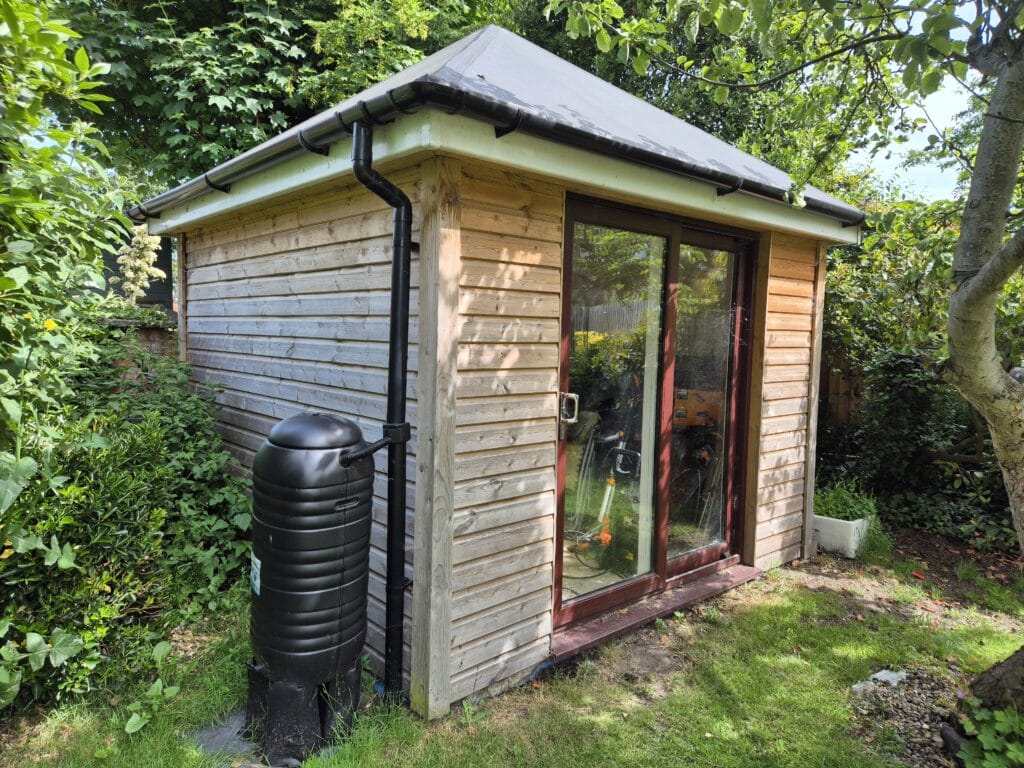
This custom timber garden room was left untreated for around four years, showing how external timber can naturally weather and silver without necessarily being rotten.
That does not mean the shed is being ruined. Natural greying is usually cosmetic.
This option suits people who want practical storage without repainting a shed every few years.
The downside is appearance. If you want a strong colour, a cleaner finish or a more decorative garden feature, you may prefer paint or stain.
Shed Paint
Shed paint is the best choice if you want colour.
It can make a plain wooden shed look much smarter, and it is useful if the shed is in a visible part of the garden. Greens, greys, blacks and soft natural tones can help a shed blend in better than raw timber.
The trade-off is maintenance.
Paint sits more on the surface than oil or penetrating stain. If it starts to crack, blister or peel, you may need to sand and prepare the surface before repainting. This is especially true on older sheds where the previous finish is already flaking.
Paint is best when appearance matters and you are willing to refresh it when it starts to look tired.
Wood Stain
Wood stain is often the best middle-ground finish for a shed.
It adds colour and weather protection while still allowing some of the timber grain to show through. It can look more natural than solid paint and is often easier to refresh.
A stain can be a good choice for pressure-treated sheds if you want to reduce greying while keeping a timber look. It can also work well on older sheds, provided the surface is clean, dry and properly prepared.
The downside is that stain still needs re-coating. It is lower effort than a badly peeling paint job, but it is not a once-only treatment.
Wood Oil
Wood oil gives a natural finish and is easy to patch locally.
Rather than forming a thick surface layer, oil tends to soak into the timber. This can make it less likely to peel than paint. It is often a good choice for people who like the look of wood and want a simple finish they can refresh in small areas.
The downside is that oil usually needs more frequent reapplication than a high-quality exterior paint or stain. On exposed shed walls, it may need attention every year or two.
Oil is a good option for appearance and easy upkeep, but not usually the longest-lasting choice.
Wood Preserver
Wood preserver is mainly about protection rather than decoration.
It is especially useful for untreated timber, dip-treated sheds, vulnerable lower boards and older sheds where the wood needs extra help before being painted or stained.
Some preservers are clear. Some are coloured. Some are designed to be overcoated. Others are intended as a final finish. Check the product carefully before using it.
On an old shed, preserver can be useful after cleaning and drying the timber, especially around lower boards, corners and end grain. But it will not reverse rot. Soft, crumbly timber needs repair or replacement, not just another coat of treatment.
Which Shed Finish Lasts the Longest?
If you want the least work, the best option is usually a pressure-treated shed left natural.
That may sound surprising, because it is not really a decorative finish at all. But for a quality pressure-treated shed, the key anti-rot protection is already in the timber. You can leave it to weather naturally and focus on roof checks, airflow and keeping the base dry.
If you want colour, a high-quality exterior wood paint or longer-lasting shed paint is usually the longest-lasting decorative choice.
If you want a natural timber look, stain is often a better balance than oil.
If you want easy spot repairs, oil is simple to refresh but normally needs doing more often.
A sensible ranking looks like this:
- Pressure-treated timber left natural — best for lowest maintenance.
- High-quality exterior wood paint — best for long-lasting solid colour.
- Wood stain — best balance of natural appearance and protection.
- Wood oil — best for a natural finish and easy patching.
- Basic shed or fence coating — best for budget refreshes, but usually shorter lived.
The right choice is not always the one that lasts longest. If your shed is tucked away behind the garage, low maintenance may matter more than colour. If it sits beside a patio, appearance may matter more.
Maintaining an Older Wooden Shed
Many people looking for shed maintenance advice are not starting with a new shed.
They already have an old shed that looks tired. The finish may be peeling, the timber may be grey, the door may be sticking, or the lower boards may be starting to soften.
In that situation, do not start by painting over everything.
Start by checking whether the shed is sound enough to maintain.
Brush away dirt, cobwebs, moss and loose flakes of old finish. Look carefully at the bottom boards, corners, door frame, window edges and any areas where rainwater runs down regularly.
Press suspicious areas gently with a screwdriver.
If the timber is firm, it may just need cleaning, sanding and re-coating.
If the timber is soft, spongy or crumbly, it is more likely to be rotten. Paint, stain or oil will not fix that.
Small Repairs: Filler, Cracks, Soft Timber and Damaged Boards
Exterior wood filler can be useful on an older shed, but only for the right kind of damage.
It is suitable for small cracks, old screw holes, dents, shallow gaps and minor surface damage in otherwise sound timber.
For exterior repairs, a two-part resin-based wood filler is usually a better choice than a cheap interior-style paste filler. It is more durable outside and less likely to shrink, soften or pop out after repeated wet weather.
It is not suitable for rescuing rotten boards.
If a board is soft, crumbling or wet through, it should usually be replaced rather than filled. The same applies if the lower cladding has started to break apart or the frame has become weak.
Use filler for small repairs. Use replacement timber for structural or rotten areas.
| Problem | Likely fix | Important note |
|---|---|---|
| Small cracks in sound timber | Clean, dry, fill with exterior wood filler, sand, then paint or stain | Do not fill damp timber |
| Old screw holes or dents | Use exterior wood filler before repainting | Best for cosmetic repairs |
| Flaking paint | Scrape, sand and clean before applying a new finish | Painting over loose paint usually fails quickly |
| Grey but firm timber | Clean and recoat with suitable stain, oil, paint or preserver | Greying is often cosmetic, not rot |
| Soft or crumbly lower boards | Replace the damaged boards or sections | Filler is not enough for rotten timber |
| Water entering from the roof | Repair or replace the roof covering before decorating the walls | Fix leaks first or the problem will return |
Small cracks in sound timber
Likely fix: Clean, dry, fill with exterior wood filler, sand, then paint or stain.
Important note: Do not fill damp timber.
Old screw holes or dents
Likely fix: Use exterior wood filler before repainting.
Important note: Best for cosmetic repairs.
Flaking paint
Likely fix: Scrape, sand and clean before applying a new finish.
Important note: Painting over loose paint usually fails quickly.
Grey but firm timber
Likely fix: Clean and recoat with suitable stain, oil, paint or preserver.
Important note: Greying is often cosmetic, not rot.
Soft or crumbly lower boards
Likely fix: Replace the damaged boards or sections.
Important note: Filler is not enough for rotten timber.
Water entering from the roof
Likely fix: Repair or replace the roof covering before decorating the walls.
Important note: Fix leaks first or the problem will return.
If your shed has several rotten boards, a sagging roof, badly warped doors or water coming through, it may need more than routine maintenance.
That is really a restoration job.
If your shed is already showing signs of rot, do not spend money on expensive paint just yet. It is better to work out whether the shed is a simple maintenance job, a salvageable repair, or something that would be cheaper to replace. We will cover that separately in a dedicated guide to restoring an old wooden shed.
How to Prepare a Shed Before Painting, Staining or Oiling
Preparation matters more than the finish itself.
Even a good shed paint will struggle if it is applied over dirt, algae, damp timber or loose old paint.
Before applying a new finish:
Choose a dry spell if possible.
Brush away loose dirt and cobwebs.
Remove algae or green growth.
Scrape off loose or flaking paint.
Sand rough edges and filled areas.
Let the timber dry properly.
Treat vulnerable or bare areas if needed.
Follow the coating instructions for number of coats and drying time.
Do not rush the drying stage. Trapping moisture under paint or stain can make the finish fail sooner and may encourage timber problems underneath.
Where Wooden Sheds Usually Need the Most Attention
Some areas of a shed are more vulnerable than others.
The lower boards are the biggest one. They are closest to splashback, damp ground, wet grass and trapped leaves. If a shed is going to rot, the base area is often where it starts.
Corners are also vulnerable because water can sit in joints and gaps.
Doors need checking because they move, swell, shrink and get used regularly. A sticking door may simply need adjustment, but it can also be a sign that the shed is settling unevenly.
Windows, glazing strips and trims can let water in if they loosen over time.
The roof matters most of all. A shed with a leaking roof will eventually suffer, even if the wall timber was treated well.
A Simple Wooden Shed Maintenance Checklist
Use this as a quick annual check.
| Task | How often | Why it matters |
|---|---|---|
| Check the roof covering | Once or twice a year, and after storms | Roof leaks can damage the shed faster than faded wall finish |
| Clear leaves and debris from around the base | A few times a year | Trapped damp material encourages rot around lower boards |
| Check lower boards and corners | At least once a year | These are common early failure points |
| Inspect paint, stain or oil | Once a year | Small touch-ups are easier than full re-coating |
| Check doors and hinges | Once or twice a year | Prevents sticking, sagging and unnecessary strain |
| Look for soft timber | Once a year | Rot is easier to deal with early |
| Improve airflow if needed | Whenever you notice damp or mould | Ventilation helps timber dry between wet spells |
Check the roof covering
How often: Once or twice a year, and after storms.
Why it matters: Roof leaks can damage the shed faster than faded wall finish.
Clear leaves and debris from around the base
How often: A few times a year.
Why it matters: Trapped damp material encourages rot around lower boards.
Check lower boards and corners
How often: At least once a year.
Why it matters: These are common early failure points.
Inspect paint, stain or oil
How often: Once a year.
Why it matters: Small touch-ups are easier than full re-coating.
Check doors and hinges
How often: Once or twice a year.
Why it matters: Prevents sticking, sagging and unnecessary strain.
Look for soft timber
How often: Once a year.
Why it matters: Rot is easier to deal with early.
Improve airflow if needed
How often: Whenever you notice damp or mould.
Why it matters: Ventilation helps timber dry between wet spells.
Don’t Forget the Roof
The roof is a separate maintenance issue from the timber guarantee.
A 25-year anti-rot guarantee on the shed walls and frame does not usually mean the roof felt will last 25 years. Felt, shingles, fixings and roof boards all have their own lifespan.
Standard shed felt is often the weakest part of a budget wooden shed. If you are installing a shed you plan to keep for many years, it can be worth upgrading the roof covering early rather than waiting for the original felt to fail.
Heavier-duty felt, shingles or EPDM rubber roofing can all be worth considering, depending on the shed and budget. EPDM is the most “fit and forget” option, but installation detail matters, so it deserves its own separate guide.
This is important because roof leaks can quietly ruin a wooden shed from above.
Check the roof after strong wind, heavy rain or winter weather. Look for lifted felt, torn edges, exposed nails, sagging boards or damp patches inside the shed.
If the roof covering is failing, fix that before spending time repainting the walls. Otherwise, water will keep getting in and the same problems will return.
We will cover this separately in a dedicated shed roof maintenance guide.
Should You Treat a New Pressure-Treated Shed?
You do not always need to treat a new pressure-treated shed straight away.
If the manufacturer says the shed does not require annual preservative treatment, there is usually no need to rush into applying extra anti-rot treatment just for the sake of it.
However, you may still choose to add a finish for appearance.
You might paint or stain a new pressure-treated shed because:
You want a specific colour.
You want to reduce greying.
The shed is in a very visible part of the garden.
You want extra water-shedding on exposed sides.
You prefer a more finished look.
If you do add paint or stain, make sure it is suitable for the timber and follow the product instructions. Some new treated timber needs time to dry before certain coatings are applied.
Should You Treat a Cheap New Shed Straight Away?
If the shed is dip-treated, untreated or only lightly treated, the answer is usually yes.
Cheaper sheds often need more help from the owner. That might mean applying a proper wood preserver soon after installation, then finishing with a suitable shed paint, stain or oil.
Pay particular attention to:
Bottom boards.
Door edges.
Corners.
End grain.
Areas near the roof line.
Any exposed cuts or drilled holes.
The lower parts of the shed matter most because they deal with splashback, wet grass and damp air near the ground.
If you buy a cheaper shed, the saving at checkout may be partly exchanged for more maintenance later.
How to Make a Wooden Shed Last Longer
The finish matters, but the basics matter more.
A well-positioned shed on a good base will usually last longer than a badly positioned shed with expensive paint.
To give a wooden shed the best chance:
Put it on a firm, level base.
Keep the timber off soil.
Allow airflow around the sides.
Avoid piling compost, leaves or logs against the walls.
Repair roof damage quickly.
Touch up exposed bare timber.
Pay special attention to cut ends. Even on pressure-treated timber, any fresh cut can expose more vulnerable end grain. If you trim a board, drill new holes or cut timber to size, brush a suitable exterior wood preserver onto the exposed end grain before it has a chance to soak up water.
Keep gutters or overhanging trees from dripping constantly onto one area.
Do not let plants grow tightly against the shed.
Recoat before the finish has completely failed.
If possible, leave a small gap around the shed so you can inspect and maintain all sides. A shed pushed tightly against a fence may look tidy, but the hidden side can stay damp and become difficult to repair.
Final Thoughts: Low Maintenance Does Not Mean No Care
A good wooden shed can last a long time, especially if it is pressure treated and built on a proper base.
The higher-quality sheds we recommend in our Best Wooden Sheds UK guide are chosen partly because long anti-rot guarantees reduce the need for constant timber treatment.
But not every wooden shed has that level of protection.
A cheaper dip-treated shed may need regular preservative treatment. An old shed may need repairs before it can be painted. A pressure-treated shed may not need annual anti-rot treatment, but it still needs roof checks, airflow, a dry base and occasional attention.
The best approach is to match your maintenance expectations to the shed you own.
If you want the lowest-maintenance wooden option, choose a good pressure-treated shed and accept that the timber may weather naturally.
If you want colour, use a good-quality exterior paint or stain and expect to refresh it over time.
If your shed is already old and damaged, deal with soft timber, cracks and leaks before applying a new finish.
That is the difference between simply painting a shed and actually helping it last.
📎 Related Articles
- Garden Sheds
The main HomeGrower shed hub, covering wooden, plastic and metal sheds, plus practical buying advice for UK gardens. - Best Type of Garden Shed
A plain-English comparison of wooden, plastic and metal sheds to help you choose the right material before buying. - Best Plastic Sheds UK
Lower-maintenance resin and polypropylene sheds that do not need painting, staining or timber preservative. - Best Metal Sheds UK
Steel garden sheds that avoid timber treatment, but have different trade-offs such as condensation, rust prevention and assembly.
FAQs
Does a 25-year shed guarantee mean no maintenance?
No. A 25-year shed guarantee usually refers to anti-rot protection on the timber, not the whole shed staying perfect without care. You should still check the roof, base, doors, finish and any signs of water damage.
Do pressure-treated sheds need treating every year?
Many pressure-treated sheds do not need annual preservative treatment. That is one of their main advantages. However, they still need basic checks and may need decorative paint or stain refreshed if you choose to apply one.
What is the lowest-maintenance finish for a wooden shed?
For a quality pressure-treated shed, the lowest-maintenance option is often to leave the timber unfinished and let it weather naturally. If you want colour, a good exterior paint or stain will usually need less frequent attention than oil.
How often should I paint a wooden shed?
It depends on the paint, preparation and exposure. Basic shed coatings may need refreshing every few years, while better-quality exterior paints can last longer if applied properly. Exposed sides usually need attention sooner than sheltered sides.
Is shed stain better than paint?
Shed stain is better if you want a more natural timber look and easier refreshing. Paint is better if you want solid colour. Paint can last well, but it usually needs more preparation when it starts to peel or flake.
Can I use wood filler on a shed?
Yes, but only for small repairs in sound timber. Exterior wood filler is useful for cracks, old screw holes and dents. It is not a fix for rotten, soft or crumbling boards.
Can I paint over an old shed?
You can, but only after preparation. Clean the shed, remove loose paint, sand rough areas, fill small cracks and let the timber dry. Do not paint over damp, dirty or rotten wood.
What should I do if the bottom of my shed is rotting?
First, find out why it is staying wet. Check the base, airflow, splashback and nearby soil or plants. Soft or crumbling boards usually need replacing rather than filling. After repair, treat and protect the area properly.
Does shed roof felt last as long as the timber guarantee?
Usually not. Roof felt is a separate maintenance item and may need repair or replacement long before a 25-year anti-rot guarantee ends. Check it regularly, especially after storms.
Are cheaper wooden sheds harder to maintain?
Often, yes. Many cheaper sheds are dip-treated or lightly treated rather than pressure treated. They can still be useful, but they usually need earlier and more regular preservative treatment than higher-quality pressure-treated sheds.