If you’re considering buying a solar generator, one of the first questions you’ll probably ask is simple:
What can a solar generator actually power?
Portable power stations — often called solar generators when paired with solar panels — are becoming increasingly common in UK homes. People use them for power cuts, sheds, garden offices, greenhouses, and small off-grid setups.
But there’s a lot of confusion online. Some appliances run easily from even a small unit, while others will drain the battery in minutes or won’t run at all.
This guide explains what a solar generator can realistically power in UK homes, sheds, and gardens, with practical examples rather than marketing claims.
If you’re new to portable power stations, it’s worth starting with The HomeGrower Guide to Home Solar Generators (UK), which explains how these systems work, how they’re charged, and when they actually make sense for UK homes.
🔎 Quick Answer: What Can a Solar Generator Power?
In most UK homes, a solar generator can comfortably power small electronics, lighting, and low-power appliances, but struggles with high-heat devices.
Typical things a solar generator can run include:
✔ phones and tablets
✔ laptops and computer monitors
✔ LED lighting
✔ Wi-Fi routers and Starlink
✔ fridges and freezers
✔ TVs and small electronics
✔ cordless tool chargers
✔ fans and greenhouse equipment
✔ LED grow lights
Things solar generators usually cannot run for long include:
✖ kettles
✖ electric ovens
✖ tumble dryers
✖ large heaters
✖ washing machines (heating cycle)
The exact answer depends on the power output (W) and battery capacity (Wh) of the generator, which we explain below.
Typical appliance power consumption varies widely depending on model and efficiency. Independent guidance from the Energy Saving Trust provides useful estimates for household electricity use.
⚡ How Solar Generator Power Works
Before looking at appliances, it helps to understand a few basic electrical terms.
Watts (W)
Watts measure power — how much electricity an appliance needs while running.
Examples:
| Device | Typical Power | What This Means for a Solar Generator |
|---|---|---|
| Phone charger | 5–20 W | Very easy to run even on small solar generators. |
| Laptop | 40–90 W | A typical everyday load that most generators handle comfortably. |
| LED bulb | 5–10 W | Lighting uses very little electricity, making it ideal for solar generators. |
| Fridge | 80–150 W | Usually manageable, though startup surge must be considered. |
| Kettle | 2500–3000 W | A good example of why many UK appliances exceed portable generator limits. |
A solar generator must be able to supply at least the wattage required by the appliance.
Continuous Output
This is the maximum power the generator can supply continuously.
For example:
- A 500W generator can run appliances totalling about 500W
- A 1000W generator can run appliances up to 1000W
If you exceed this limit, the inverter will shut down automatically to prevent damage. Understanding these limits is also important for safe operation, which we explain in our solar generator safety guide.
Surge Power
Some appliances briefly require extra power when starting.
Examples include:
- fridges
- pumps
- power tools
A generator rated at 1000W continuous might allow 2000W surge power for a few seconds to start these devices.
🔋 Watts vs Watt-Hours (Why Battery Size Matters)
Solar generators have two key specifications, and confusing them is one of the most common mistakes buyers make.
💡 The Golden Rule of Solar Generator Sizing
Watts (W)
→ Can the generator power the appliance at all?
Watt-hours (Wh)
→ How long can it run it before the battery runs out?
Think of it like a car:
- Watts = engine power
- Watt-hours = fuel tank size
Example:
| Generator Rating | What It Means in Practice |
|---|---|
| 1000W output | Can power appliances that draw up to around 1000W at any given moment. |
| 1000Wh battery | Could run a typical fridge (~120W) for roughly 8 hours if it ran continuously. |
So a generator might be powerful enough to run a fridge, but the battery size determines how long it can keep it running during a power cut.
Understanding this difference is crucial when comparing models in our guide to the best solar generators available in the UK.
🔧 Typical Appliances a Solar Generator Can Power
Below are approximate power requirements for common devices found in UK homes and garden buildings.
| Appliance | Approximate Power |
|---|---|
| Phone charger | 5–20 W |
| Laptop | 40–90 W |
| LED lighting | 5–10 W per bulb |
| Wi-Fi router | 8–15 W |
| Starlink Mini | ~25 W |
| Starlink Standard | 75–100 W |
| Small fridge | 80–150 W |
| Electric blanket | 50–120 W |
| Microwave | 800–1200 W |
| Kettle | 2500–3000 W |
| Fan heater | 1500–2000 W |
| Tool battery charger | 50–150 W |
| Circular saw | 1200–1800 W |
This quickly shows why generator size matters.
Electronics and lighting are easy to power. Appliances that produce heat are much harder.
⏱ Example Runtime (1000Wh Generator)
To make this more practical, here are rough runtime estimates for a 1000Wh solar generator.
| Device | Power | Estimated Runtime |
|---|---|---|
| Phone charger | 10 W | ~80–90 hours |
| LED light | 8 W | ~100 hours |
| Laptop | 60 W | ~13–15 hours |
| Wi-Fi router | 10 W | ~80 hours |
| Fridge (running) | 120 W | ~7–8 hours |
These numbers assume the appliance is running constantly.
The “Inverter Tax”
In reality, runtimes are usually 10–20% lower because the inverter consumes power just by being switched on.
You can think of this as the “inverter tax.”
The generator must convert battery power into standard UK mains electricity, and that process uses energy.
For very small devices like phones, it’s often more efficient to use the generator’s USB ports directly, which bypass the inverter and reduce wasted power.
❄️ A Note About Fridges
The table above assumes a fridge runs constantly, but that isn’t how refrigerators actually work.
A fridge typically runs for around 15–20 minutes each hour, then switches off once the temperature stabilises.
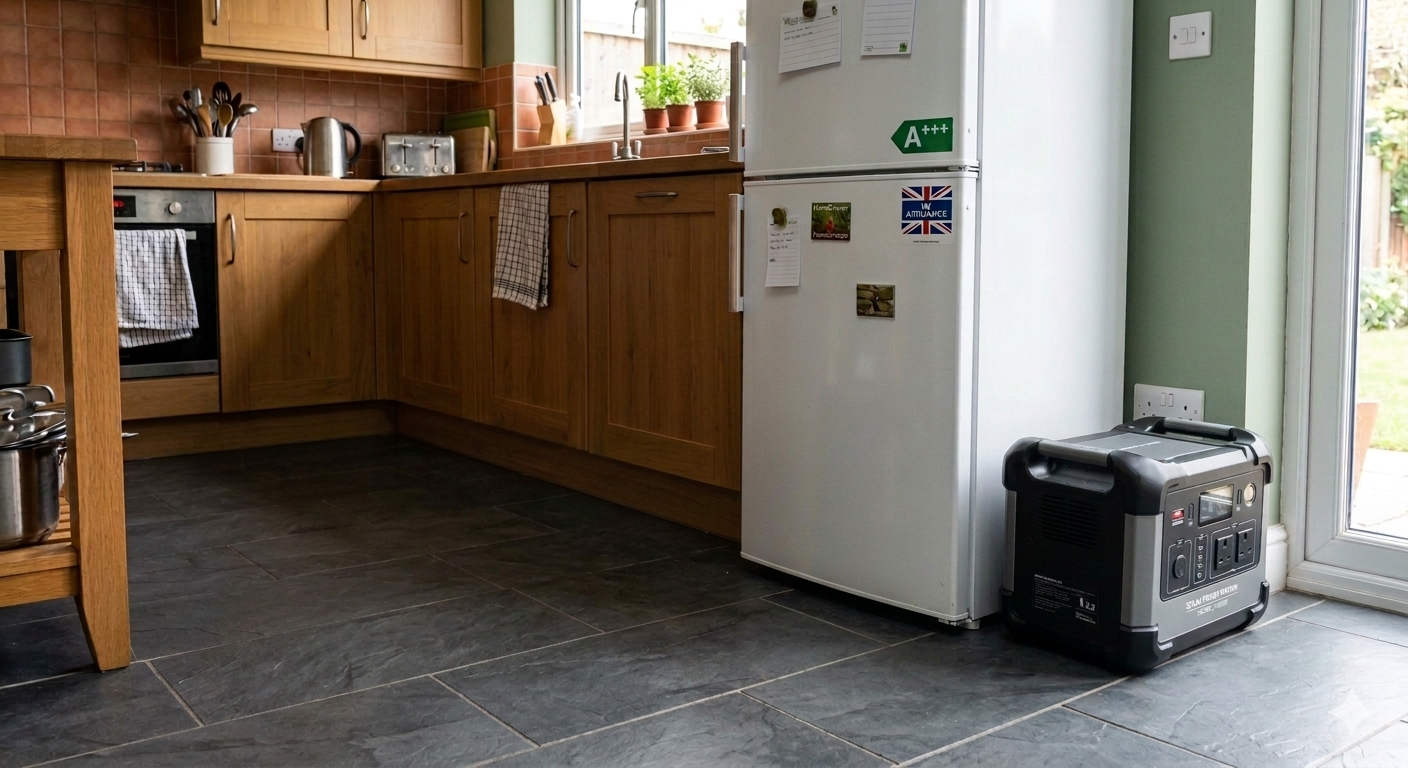
Because of this cycling behaviour, a modern efficient fridge-freezer can often run for 15–24 hours from a 1000Wh generator during a power cut.
This makes solar generators surprisingly useful as short-term food-safety backup power.
🔋 What a 500W Solar Generator Can Run
A 500W solar generator is typical of small portable units used for camping or light backup power.
It can comfortably run:
- phones and tablets
- laptops
- LED lighting
- Wi-Fi routers
- radios and small electronics
Example setup:
| Device | Power |
|---|---|
| Laptop | 60 W |
| Router | 10 W |
| LED lamp | 8 W |
Total load: 78W
This could run for many hours on a typical battery.
However, a 500W generator usually cannot run kitchen appliances or power tools.
What a 1000W Solar Generator Can Run
A 1000W solar generator is where portable power stations start becoming useful for home backup.
Typical uses include:
- running a fridge during a power cut
- powering internet equipment
- lighting several rooms
- charging cordless tool batteries
- running laptops and TVs
For many households, this size represents the best balance between portability and usefulness. However, standard UK kettles (2500–3000W) are still far too powerful for generators in this class.
🔌 What a 2000W+ Solar Generator Can Run
Large portable power stations in the 2000W–3000W range can run many everyday appliances.
They can often power:
- microwave ovens
- coffee machines
- electric blankets
- power tools
- fridges and freezers
- multiple electronics simultaneously
Example combined load:
| Device | Power |
|---|---|
| Fridge | 120 W |
| Lights | 40 W |
| Router | 10 W |
| Laptop | 60 W |
A total load of 230W is well within the capability of most mid-sized solar generators, leaving plenty of spare capacity for additional devices.
However, even large units still struggle with high-power heating appliances, which draw enormous amounts of electricity.
Generators in this size range include popular models like the EcoFlow Delta series, which are widely used for home backup, sheds and workshops. Our comparison of the best EcoFlow solar generators in the UK explains how the Delta and River models differ in capacity, output and real-world performance.
🌱 Garden and Shed Uses
For HomeGrower readers, solar generators are often most useful outside the house.
They provide power where running mains electricity would be expensive or inconvenient.
Shed Lighting
A small generator can power LED strip lights or bulbs for hours, making it ideal for sheds without electrical wiring.
Charging Tool Batteries
Cordless tool chargers are very manageable loads:
- mower batteries
- drill chargers
- hedge trimmer batteries
Most chargers draw 50–150W, which even small generators handle easily.
Running Grow Lights
Modern LED grow lights are surprisingly efficient.
| Light Type | Power |
|---|---|
| Small LED grow light | 20–50 W |
| Medium LED grow light | 100–200 W |
| Large LED grow light | 300–600 W |
This makes solar generators useful for propagation setups or emergency grow-light backups.
Propagation Heat Mats
Trying to heat a greenhouse air space with electricity requires huge amounts of power.
A better approach is propagation heat mats, which warm the soil directly.
| Device | Power |
|---|---|
| Propagation heat mat | 20–60 W |
These are far more practical for solar-powered growing setups.
Hybrid Greenhouse Heating
Because electric heaters quickly drain batteries, many growers use thermal mass instead.
Large black water barrels inside the greenhouse absorb heat during the day and release it slowly overnight, reducing the amount of electrical heating required.
This hybrid approach allows solar generators to focus on low-power equipment like heat mats and fans rather than trying to heat the entire space.
🚫 What Solar Generators Usually Cannot Power
Many appliances rely on heating elements, which draw enormous amounts of electricity.
Solar generators usually struggle with:
| Appliance | Typical Power |
|---|---|
| Kettle | 2500–3000 W |
| Fan heater | 1500–2000 W |
| Electric oven | 2000–3000 W |
| Washing machine heater | 1800–2200 W |
| Tumble dryer | 2000–3000 W |
Even if a large generator can run them briefly, the battery will drain extremely quickly.
Solar generators work best with:
- lighting
- electronics
- refrigeration
- low-power appliances
☕ A Practical Workaround: Travel Kettles
Standard UK kettles draw 2500–3000W, which is far beyond the capacity of most solar generators.
However, travel kettles often use 600–800W, which many 1000W generators can handle.
They take longer to boil — typically 4–5 minutes instead of 2 — but they make it possible to have a cup of tea in a shed or garden office without overloading the generator.
Similarly, a single induction hob set to low power can sometimes run at 700–900W, making it usable with larger generators.
⚠️ Safety Note
Every solar generator has a maximum inverter output.
If connected appliances exceed this limit, the system will shut down automatically.
To avoid problems:
- check the continuous watt rating
- leave spare capacity
- be cautious with appliances that have high startup surges
Our solar generator safety guide explains these limits in more detail and shows how to avoid common mistakes.
🔎 Conclusion
So what can a solar generator power?
In practice, portable power stations are excellent for:
- phones and laptops
- lighting
- routers and internet equipment
- fridges and freezers
- cordless tool charging
- shed and garden equipment
They are not designed to replace mains electricity for high-power appliances like kettles, ovens, or large heaters.
The key is choosing a generator large enough for the devices you realistically want to run.
❓ What Can a Solar Generator Power? Frequently Asked Questions
What can a solar generator power in a typical home?
A solar generator can power essential household devices such as fridges, routers, lighting, phones, laptops, and small appliances. They are ideal for power cuts, sheds, garden offices, and off-grid setups, but most portable models cannot run very high-power appliances like kettles or electric heaters.
Can a solar generator run a fridge or freezer?
Yes. Many portable solar generators can run a modern fridge or fridge freezer. Because fridges cycle on and off rather than running constantly, a 1000Wh solar generator can often keep a fridge running for many hours during a power cut.
Can a solar generator power a kettle?
Usually not. Most UK kettles draw around 2500–3000W, which exceeds the inverter output of many portable solar generators. Larger high-capacity models may be able to run a kettle briefly, but it will drain the battery very quickly.
How long can a solar generator power appliances?
How long a solar generator can power appliances depends on the battery capacity (watt-hours) and the power draw of the device. Low-power devices like routers or LED lights can run for many hours, while higher-power appliances will drain the battery much faster.
Can a solar generator power an entire house?
No. Portable solar generators are designed to run essential appliances rather than power an entire home. They work best as backup power for fridges, lighting, internet equipment, and small electronics during outages.
📎 Related Articles
- The HomeGrower Guide to Home Solar Generators (UK)
A complete UK guide explaining how portable solar generators work, how they’re charged, and when they make sense for home backup, sheds, and off-grid use. - Solar Generator Safety
A practical guide covering safe indoor use, inverter limits, battery risks, rain exposure, and the most common mistakes to avoid.