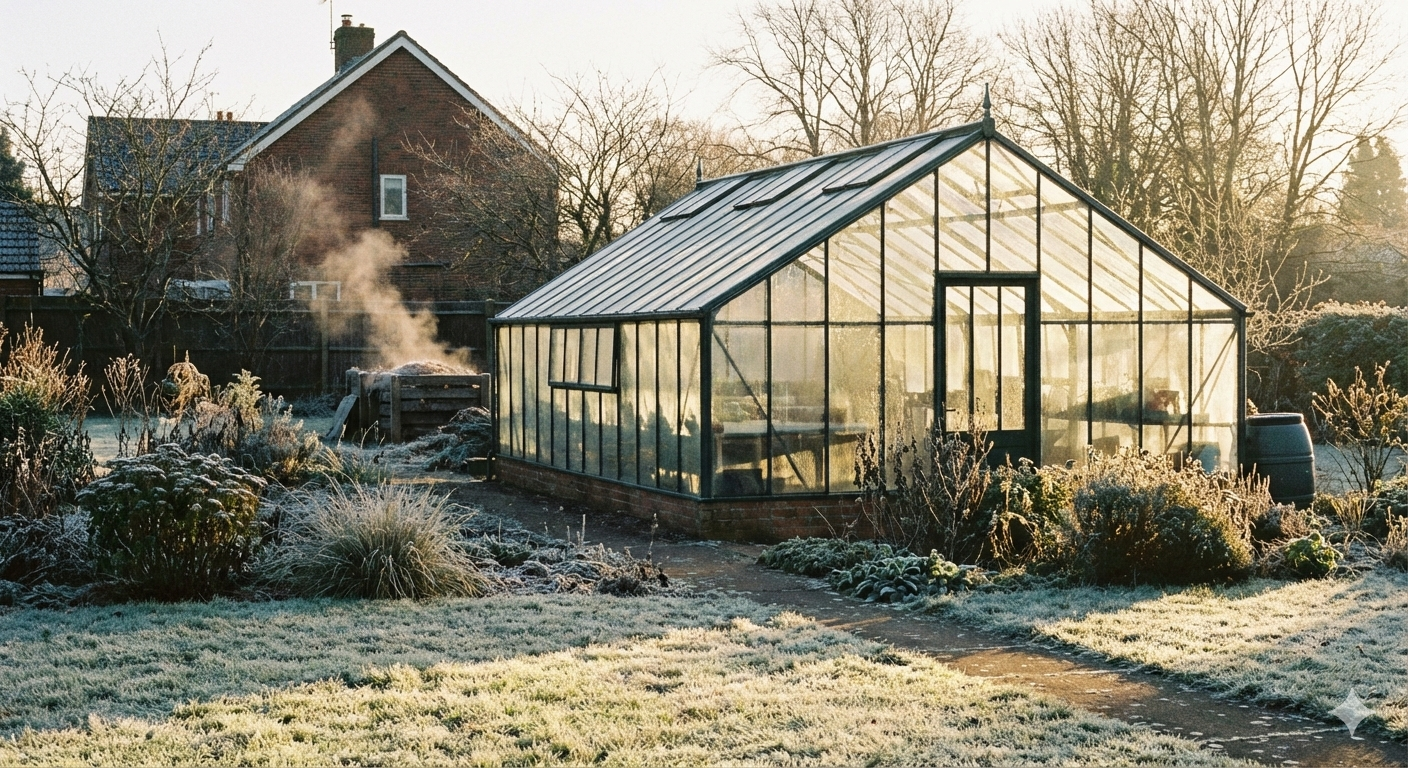
Early planting is one of the biggest advantages of greenhouse growing in the UK — and one of the easiest ways to lose plants overnight.
Our greenhouse sowing calendar gives a solid baseline for when to start, but real UK weather has a habit of intervening at about 3:00 AM. Clear nights, sudden cold snaps, and false springs can undo days of progress while you’re asleep.
This post explains how to protect plants from late frosts in a greenhouse, using practical, UK-specific methods that work in real conditions.
If you’re planning early sowing, it sits naturally alongside the HomeGrower Guide to Greenhouses & Polytunnels. It isn’t about ideal conditions — it’s about what to do when the forecast turns against you.
🌡️ What Counts as a “Late Frost” in the UK?
A late frost is any overnight temperature drop below 0 °C after plants have started active growth.
In the UK, these typically occur:
- Late February through April
- After mild spells that encourage early sowing
- On clear, still nights with little cloud cover
One of the most common assumptions is that a greenhouse is always warmer than outside. At night, that often isn’t true.
Seedlings are especially vulnerable because:
- They have thin cell walls
- Roots are shallow and exposed
- Growth can stall long before damage is obvious
🔬 The Science of the “Glass Fridge” Effect
On clear nights, greenhouses don’t just lose heat — they can over-cool.
This is caused by radiational cooling. Without clouds acting as a blanket, heat escapes rapidly through glass or polycarbonate and radiates into the night sky. When that happens, internal plant temperatures can drop below the outside air temperature.
At night, the greenhouse roof cools faster than the surrounding air, so plants lose heat by radiating to the cold roof — something that doesn’t happen in open ground.
Why this matters:
- Water freezes at 0 °C
- Many tender seedlings (tomatoes, peppers, basil) suffer permanent cell damage at −2 °C
- Damage can occur after just one hour at these temperatures
This is why frost protection is about slowing heat loss, not simply adding heat.
For additional independent advice on frost risk and plant protection, the Royal Horticultural Society publishes practical guidance for UK gardeners.
⚠️ Early Planting Risks (What Usually Goes Wrong)
Most late-frost damage isn’t bad luck — it’s timing and assumptions.
Common mistakes include:
- Trusting daytime warmth instead of overnight lows
- Watering late in the evening before a cold night
- Leaving vents open until temperatures have already dropped
- Assuming the greenhouse itself is enough protection
Cold stress doesn’t always kill plants outright. Often it:
- Stalls growth for weeks
- Weakens seedlings permanently
- Damages roots in ways that only appear later
🧣 The “Fleece Trap” (A Classic Beginner Mistake)
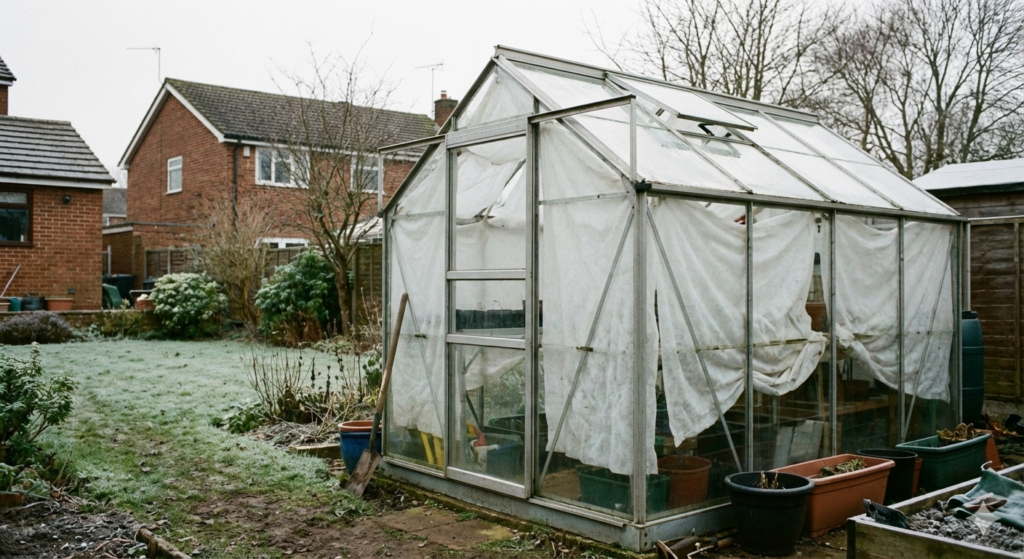
Horticultural fleece often looks untidy in use — that’s normal. The insulation comes from trapped air, not a neat fit.
Horticultural fleece is one of the most effective frost-protection tools — when used correctly.
The trap is simple:
If fleece becomes damp (from condensation or late watering) and touches the leaves, it conducts cold directly into the plant tissue.
A wet frost blanket resting on leaves can be worse than no fleece at all.
Pro tip:
Always keep fleece off the foliage. Use:
- Wire hoops
- Cane arches
- Upturned pots or trays
It’s the trapped still air that insulates — not the fabric itself.
🧰 Frost Protection Methods (Quick Comparison)
| Method | Best For | Cost | Pro Tip |
|---|---|---|---|
| Horticultural fleece | Seedlings & trays | Low | Two loose layers give extra protection |
| Water bottles / barrels | Larger greenhouses | Free | Paint black to absorb daytime heat |
| Bubble-wrap insulation | Whole structure | Medium | Line the north side only |
| Electric heating | Rare or tender plants | High | Always use a thermostat |
Most growers only need one or two of these — not all of them.
💧 The “Latent Heat” Secret (Why Midday Watering Helps)
Watering advice often sounds contradictory until timing is understood.
Moist soil holds more heat than dry soil. When watered earlier in the day, soil absorbs warmth from the sun and releases it slowly overnight, raising the minimum temperature around roots.
The balance:
- ✅ Water soil at midday or early afternoon
- ❌ Avoid wet foliage overnight (fungal risk)
Think of damp soil as thermal mass, not leaf hydration.
🌦️ The “False Spring” Trap (Very UK, Very 2026)
Recent years have brought more false springs — warm February spells followed by harsh March frosts.
A week of 14–15 °C can feel like permission to plant everything. It isn’t.
Reality check:
- February warmth is often temporary
- March frosts remain common
- The traditional “Ice Saints” in May are still a useful mental marker
In 2026, our climate is less a predictable cycle and more a series of surprises — this guide is your shock absorber. Enjoy early warmth, but keep fleece and backup protection ready.
🔌 When Heating Makes Sense (and When It Doesn’t)
Heating doesn’t need to be all-or-nothing.
In many greenhouses:
- Protecting roots matters more than warming air
- Small heaters outperform large ones in tight spaces
- Frost-free settings (2–5 °C) are often sufficient
If you’re considering heating, it’s worth understanding how to heat a greenhouse efficiently, including thermostat use and running-cost control. For most setups, heat works best as backup insurance, not a default.
📅 How This Fits with the Greenhouse Calendar
Your greenhouse sowing calendar is the plan.
This frost-protection guide is the override system.
Use the calendar to decide when to sow.
Use this guide when the forecast threatens to derail it.
If frost is forecast:
- Protect what’s already planted
- Delay what hasn’t gone in yet
- Adjust — don’t abandon — the plan
Calendars guide timing. Observation keeps plants alive.
⏱️ ❄️ Frost Emergency: 5-Minute Checklist
For when the forecast suddenly says −3 °C tonight
Before sunset
- Close vents and doors early
- Add fleece before temperatures drop
- Check fleece isn’t touching leaves
Early evening
- Move trays to lower shelves
- Group plants together
- Add thermal mass nearby
Do NOT
- Water in the evening
- Seal the greenhouse airtight
- Panic-heat without a thermostat
Next morning
- Remove fleece gradually
- Avoid sudden full sun on frozen plants
- Wait 24–48 hours before judging damage
Sometimes waiting one extra week beats rescuing stressed seedlings for a month.
🌱 Final Thought
Late frosts are normal in the UK. Losing plants to them doesn’t have to be.
With a few habits, low-cost protections, and realistic expectations, you can plant early confidently, not optimistically — and still stay aligned with your wider greenhouse plan.
Worried about the cost of keeping things frost-free? I use a smart plug to track exactly what my greenhouse heating costs in real time — see my Tapo P110 smart plug review to see how I monitor every penny.
📎 Related Greenhouse Guides
If you’re new to growing under cover, start with our complete guide below, then explore specific options and setups as you go.