If you’ve been researching indoor growing for any length of time, you’ve probably come across grow tents fairly quickly. They’re often presented as essential — but just as often, they’re poorly explained.
Some guides make them sound like specialist equipment. Others treat them as a shortcut to instant success.
The truth, as usual, sits somewhere in between.
A grow tent isn’t a magic box that grows plants for you. It’s a variable-reduction tool. It takes the unpredictable reality of a UK home — spare rooms, cupboards, fluctuating temperatures — and turns it into a more controlled, repeatable growing space.
This guide explains what grow tents actually do, when they make sense, what you need inside one, and what alternatives are worth considering — all from a practical, UK-home-focused perspective.
Most people don’t struggle because they buy the wrong equipment.
They struggle because the setup doesn’t quite fit their home.
What Is a Grow Tent (and Why People Use Them)
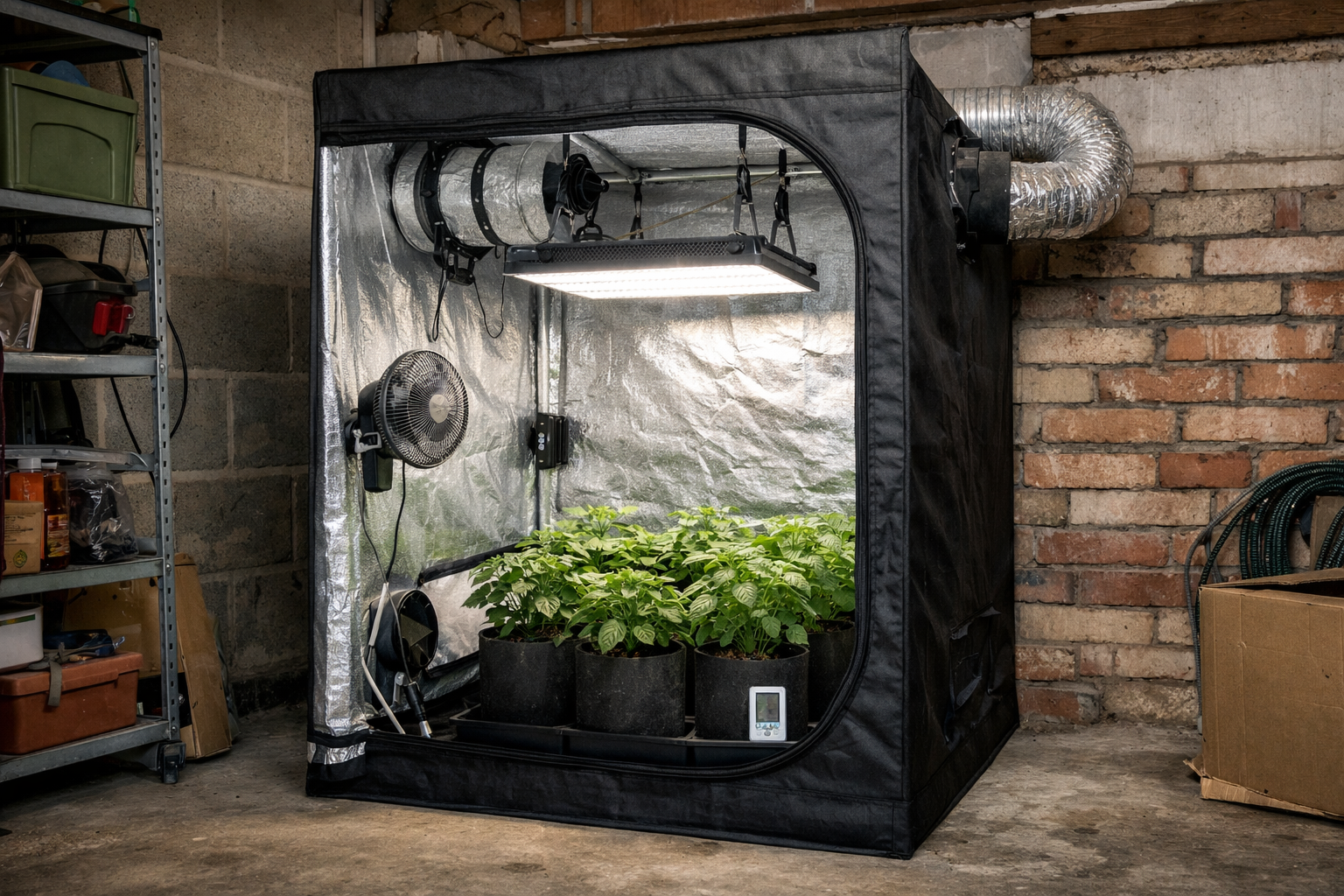
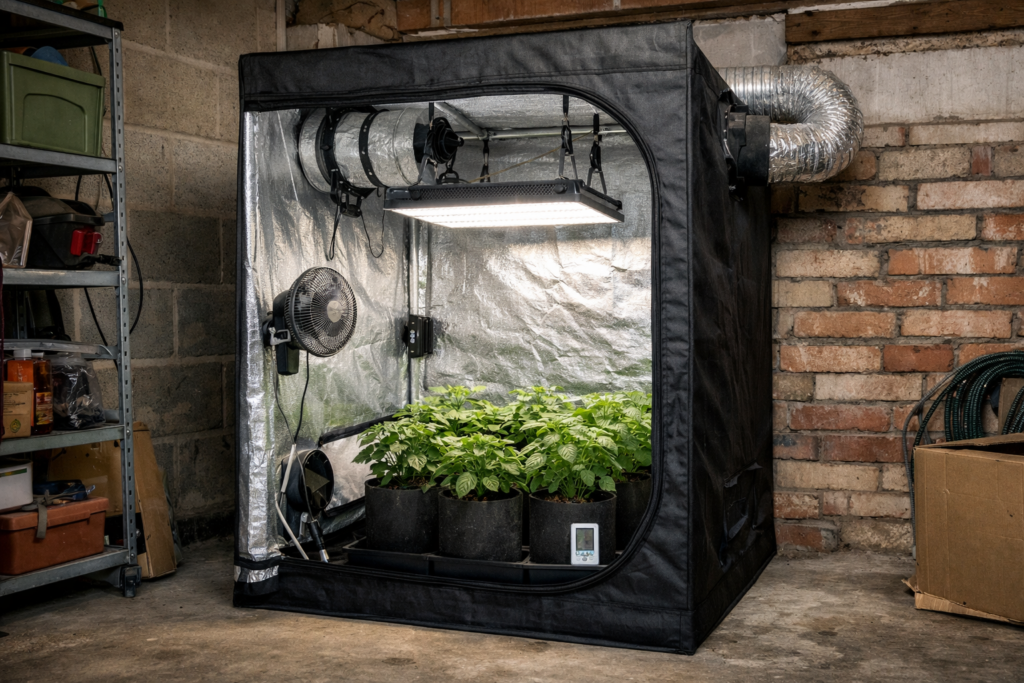
A grow tent is essentially a portable, reflective growing room. Instead of adapting an entire spare room or cupboard, a tent gives you a defined environment where light, airflow, and heat are easier to manage.
Growers use tents because they:
- Contain light efficiently – reflective walls keep usable light where plants need it
- Make ventilation predictable – built-in ports simplify airflow and heat removal
- Stabilise temperature and humidity – fewer external swings
- Keep growing discreet and contained – less light spill, less mess
In UK homes — where insulation quality, room size, and layouts vary wildly — this predictability is often the main advantage. That doesn’t mean a tent is the only way to grow indoors, but for many people it’s the most straightforward starting point.
📏 Grow Tent Sizes Explained (What the Numbers Really Mean)
Grow tents are usually described by floor size, not height. Common sizes include:
- 60 × 60 cm
- 80 × 80 cm
- 1 × 1 m
- 1.2 × 1.2 m
Height matters just as much as width. Taller tents give you:
- Better airflow
- More distance between light and plants
- Easier temperature control
Before choosing a size, it helps to ground things in reality.
What Size Grow Tent Do I Need?
| Grow Tent Size | Common Uses | Typical UK Fit |
|---|---|---|
| 60 × 60 cm | Compact grows | Herbs, chillies, small projects |
| 80 × 80 cm | Small home grows | Chillies, tomatoes, single plant |
| 1 × 1 m | Most home growers | Mixed crops, forgiving setup |
| 1.2 × 1.2 m | Higher output | Larger rooms or insulated sheds |
The 1-Metre Rule
If you have the space, a 1 × 1 m tent is usually the most forgiving size in a typical UK home. It’s large enough to buffer heat and humidity swings, but small enough to run quietly and efficiently.
Many people buy bigger tents “to grow into”. In practice, smaller, well-matched tents are often easier, quieter, and cheaper to live with long-term.
What You Actually Need Inside a Grow Tent
A grow tent on its own doesn’t grow anything. Think of it as the shell — everything inside needs to work together.
🌞 Grow Light
The heart of the setup. Tent size determines:
- How powerful the light needs to be
- How evenly plants are lit
- How much heat is introduced
Matching the light to the tent matters far more than buying the most powerful model available which is something we cover in our guide to the Best Grow Lights for Each Tent Size.
🌬️ Ventilation & Extraction
Even small tents need airflow. This usually means:
- An extraction fan
- A clear air intake path
Ventilation removes excess heat, refreshes air, and keeps conditions stable — especially important in smaller UK rooms where noise, humidity, and condensation can become problems quickly.
We explain how this works in practice, including extraction vs circulation, ducting, noise control, and venting air safely outside, in our Grow Tent Ventilation: UK Setup & Stealth Airflow guide.
If you’re at the point where you want to choose the right fan for your setup, we’ve also put together a practical comparison of the best grow tent extraction fans for UK homes, focusing on noise levels, airflow, control options, and running costs.
Heat and moisture are closely linked, which is why ventilation also plays a central role in controlling heat and humidity in a grow tent.
🔄 Circulation Fan
Inside the tent, a simple fan helps:
- Strengthen plant stems
- Reduce mould risk
- Even out temperature and humidity
⏱️ Timers & Monitoring
Timers automate light cycles. A basic thermometer and hygrometer stop you guessing. You don’t need a smart setup to grow well — consistency beats complexity.
Typical Grow Tent Setups (From Simple to Sensible)
Most home growers naturally fall into one of these patterns.
Entry-Level Home Setup
Small tent, LED grow light, basic extraction, clip fan. Reliable, quiet, and easy to manage.
Balanced Long-Term Setup
Medium tent, efficient lighting, and temperature-aware ventilation. This is where many UK growers settle.
High-Intervention Setup
Larger tents, stronger extraction, and environmental controllers. More control — but also more cost, noise, and responsibility.
There’s no single “best” setup — only what works reliably in your space. Our Best Grow Tent Setups guide breaks down a range of complete, balanced setups for different homes and growing goals.
DIY Grow Rooms & Cupboards (No Tent)
Not everyone wants or needs a tent. Some people grow successfully in:
- Wardrobes
- Cupboards
- Under-stairs spaces
- Converted airing cupboards
Pros
- Often cheaper if the space already exists
- Can be more discreet
- No tent frame to assemble
Cons
- Ventilation is harder to manage
- Heat builds up quickly
- Light efficiency is usually worse
- Moisture control becomes critical
In practice, many growers move from cupboard grows to small tents — simply because tents make airflow and heat management less fragile.
💷 Running Costs in the UK (What Really Affects the Bill)
Electricity is the main ongoing cost of indoor growing.
What matters most:
- Light wattage
- Hours of use
- How well excess heat is removed
Brand choice matters far less than matching wattage to tent size and avoiding wasted heat. Smaller, well-matched setups are often cheaper to run than oversized tents that never get used efficiently.
If you want precise numbers for your setup, use the Grow Light Running Cost Calculator. Although it was designed as a tool for grow lights, it works for any device for which you know the wattage.
Where to Put a Grow Tent in a UK Home
Location matters just as much as equipment.
Spare Rooms & Bedrooms
Common and practical — but noise, heat, and light leaks need managing. Even “quiet” fans produce a constant hum, which becomes noticeable in sleeping spaces.
Garages & Sheds
Plenty of space, but cold winters, damp, and insulation matter. Moisture control becomes critical.
Lofts / Attics
Lofts often sound appealing, but they’re usually the hardest places to grow successfully in the UK.
Common issues include:
- Extreme summer heat
- Cold winter swings
- Limited airflow
- Condensation near roof timbers
- Structural and fire-safety concerns
Loft grows can work — but only with careful planning and realistic expectations.
⚠️ Common Grow Tent Mistakes
- Buying a tent that’s too large “just in case”
- Oversizing the grow light
- Underestimating airflow needs
- Chasing perfect temperatures
- Assuming kits are always balanced
- Ignoring noise until it becomes a problem
Most issues don’t appear immediately. They creep in after a few weeks, when heat, humidity, or sound slowly become harder to ignore.
Is Using a Grow Tent Legal in the UK?
Grow tents themselves are completely legal.
What matters is:
- What you’re growing
- Electrical safety
- Tenancy or lease conditions
While the equipment is legal, some plants have specific legal restrictions in the UK. It’s always your responsibility to understand what applies to you.
For general guidance on household electrical safety and tenant responsibilities in the UK, you can refer to official advice on GOV.UK.
🚫 When a Grow Tent Might Not Be the Right Choice
A tent may be unnecessary if:
- You only grow a few herbs
- You have excellent natural light
- A windowsill or countertop system suits you better
- A mini greenhouse fits your space more naturally
The goal isn’t to use a tent — it’s to grow successfully with the least friction possible.
🌿 Final Thoughts
Grow tents aren’t magic — but they’re not hype either.
They’re best seen as a practical tool that simplifies indoor growing when matched properly to your home. There’s no perfect setup — just one that works reliably with your space and your routine.
If you understand your home first, choosing a tent becomes easier. If you choose the right tent size, everything else tends to fall into place.
📎 Related Articles
- Best UK Grow Tent Setups
A comparison of balanced, home-friendly grow tent setups — from simple beginner options to more controlled long-term systems. - Best Grow Lights for Every Tent Size
How to choose the right LED grow light for different tent sizes, balancing coverage, heat, efficiency, and running costs. - Grow Light Running Cost Calculator UK
Estimate the real electricity cost of running a grow tent setup based on wattage, daily use, and UK energy prices.