
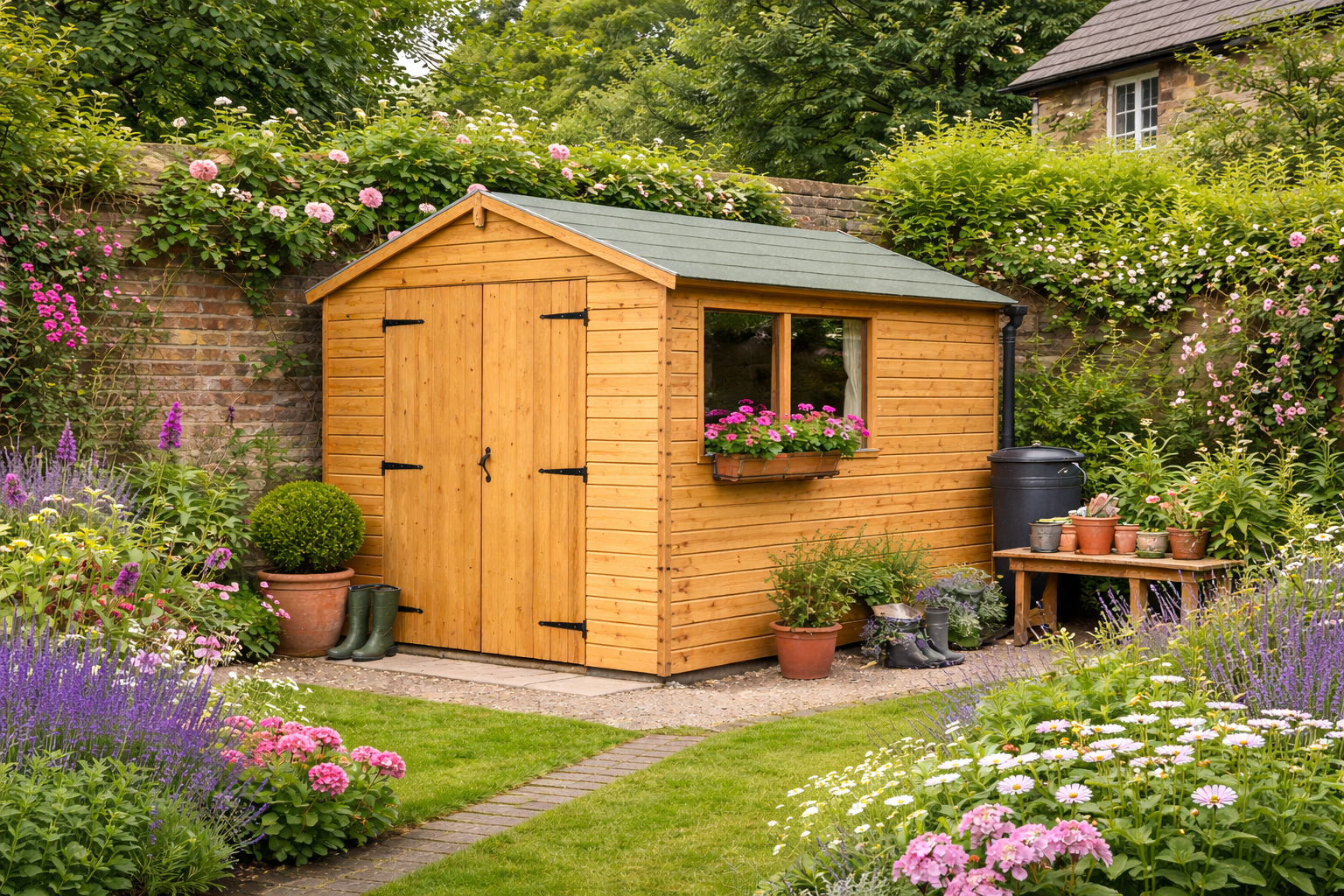
Garden sheds are the workhorses of the UK garden — yet they’re often the most under-planned purchase we make.
For many households, a shed starts life as somewhere to store a mower. Within a couple of seasons, it quietly evolves into a workshop, a potting space, or the practical hub of a more self-sufficient garden. The problem is that most sheds aren’t chosen for what they’ll become. They’re chosen on price, appearance, or a generic brochure description.
This guide is the reference point for all shed-related content on HomeGrower. It focuses on what actually matters in British conditions: moisture control, ground stability, access, and long-term usefulness. This isn’t about recommending a particular shed — it’s about helping you choose a structure that still works, and still stands, years down the line.
🌿 What Garden Sheds Are Actually Used for in the UK
In theory, a garden shed is “outdoor storage.”
In reality, UK sheds tend to fall into a few common roles:
- Tool and equipment storage – lawnmowers, spades, pots, compost, fencing bits
- Seasonal overflow – garden furniture, planters, covers, seed trays
- Workshop space – basic DIY, repairs, potting, tool maintenance
- Garden systems hub – water butts, irrigation parts, power leads, soil storage
- Transition space – hardening off plants, drying, staging, organising
What’s important is that most sheds slowly accumulate purpose. A shed bought “just for tools” often becomes essential infrastructure over time.
That’s why decisions around size, base, material, and placement matter far more than most people expect.
🏠 Planning Permission: What Usually Matters (High Level)
Most garden sheds in the UK fall under permitted development, but not all.
At a high level, planning issues tend to depend on:
- Shed height (especially with pitched roofs)
- Distance from boundaries
- Whether it’s behind the principal elevation of the house
- Use (storage vs living space)
- Listed buildings or conservation areas
Many problems arise not because people ignore the rules — but because they assume all sheds are exempt.
We cover the details, edge cases, and common mistakes in our guide on
do you need planning permission for a shed — including height limits, boundary rules, and conservation areas.
🛠️ Shed Bases & Ground Preparation (Conceptual)
A shed is only as good as what it sits on.
In the UK, ground conditions are rarely ideal:
- Variable soil stability
- Sloping or uneven ground
- Poor drainage
- Ground that expands, contracts, or shifts with seasonal moisture changes
A proper base isn’t about perfection — it’s about stability, drainage, and longevity.
At a conceptual level, a shed base needs to:
- Keep the structure level over time
- Prevent water pooling underneath
- Reduce rot, corrosion, and damp
- Match the shed’s weight and footprint
Poured concrete bases, paving slabs, timber frames, and plastic base systems each have strengths and trade-offs, and suit different garden conditions and uses.
If you’re planning a shed and want to translate these principles into a real-world base for your garden, our guide on how to prepare a shed base walks through the options step by step.
🧱 Shed Materials: Wood, Metal, and Plastic (Overview)
Most garden sheds fall into one of three material types: wood, metal, or plastic. Each behaves very differently in UK conditions — particularly when it comes to moisture, stability, maintenance, and how the shed is actually used over time.
There isn’t a single “best” material for every garden. The right choice depends on what you’re storing, how exposed the site is, and how much ongoing upkeep you’re comfortable with. We explore those trade-offs in detail in our guide on best type of garden shed, but the overview below explains the broad differences.
Wooden Sheds
Wooden sheds remain popular in UK gardens because they’re adaptable, easy to repair, and visually blend into most outdoor spaces. Their main trade-off is moisture sensitivity, which makes base choice, ventilation, and regular treatment especially important.
We look at construction quality, maintenance realities, and where timber sheds perform best in our guide to best wooden sheds UK.
In practical terms, this usually means thinking about:
- Traditional appearance
- Easy to modify or repair
- Sensitive to moisture if untreated
- Ongoing maintenance matters
Metal Sheds
Metal sheds appeal where rot resistance and fire safety matter, but they behave very differently to timber in damp UK conditions. Condensation control and anchoring tend to matter more than people expect.
Our guide to best metal sheds UK covers where metal works well — and where it often disappoints.
When choosing a metal shed, the key considerations tend to be:
- Non-rotting and fire-resistant
- Can suffer condensation
- Often lighter than expected
- Security varies by design
Plastic (Resin) Sheds
Plastic sheds are chosen mainly for low maintenance and resistance to rot, making them attractive in damp or shaded gardens. Their long-term performance depends heavily on base quality and structural design rather than the panels themselves.
We break down the strengths and limitations of resin designs in our guide to best plastic sheds UK.
The main pros and cons of plastic sheds are:
- Low maintenance
- Resistant to rot and rust
- Structural rigidity depends on quality
- Can struggle with heavy loads if poorly supported
Taken together, the differences between wood, metal, and plastic sheds are less about “best” and more about fit. In UK gardens, material choice usually comes down to how the shed will be used, how exposed the site is, and how much maintenance you’re willing to take on over time.
| Material | What It Does Well | Main UK Weakness | Maintenance Reality |
|---|---|---|---|
| Wood | Breathable, adaptable, easy to modify or repair | Vulnerable to damp, rot, and ground moisture | Ongoing – treatment and checks matter |
| Metal | Fire-resistant, secure, won’t rot | Condensation in cold, damp UK winters | Low – but airflow is critical |
| Plastic (Resin) | Rot-proof, low maintenance, quick to assemble | Structural rigidity varies by design | Very low – base quality matters more |
📏 Size, Placement & Access: The Bits People Regret Later
Most shed regret comes down to three things:
too small, poorly placed, or awkward to access.
Key considerations:
- Door width for mowers, wheelbarrows, and bulky items
- Headroom for shelving and movement
- Space around the shed for maintenance
- Access during winter when ground is soft or icy
- Proximity to where tools are actually used
In real UK gardens, space is finite — which makes planning more important, not less.
A slightly larger shed, placed with intention, usually causes fewer problems than a “just about fits” option squeezed into a corner.
🌧️ Weather, Damp & Ventilation in UK Conditions
The UK’s biggest shed enemy isn’t cold — it’s moisture.
Common long-term issues include:
- Condensation dripping onto tools
- Mould on stored items
- Rust and timber decay
- Soft floors and warped panels
Good shed performance comes from:
- Airflow (vents matter more than insulation for most sheds)
- Raised bases or drainage gaps
- Thoughtful storage (nothing pressed against walls)
- Understanding how temperature swings create condensation
Longevity is rarely about one feature — it’s about how the shed handles moisture over years, not months.
🔐 Security & Maintenance (High Level)
A shed is often the weakest security point in a garden.
Security depends less on locks and more on:
- Location and visibility
- Structural rigidity
- Door and hinge quality
- What’s stored inside
Maintenance is similar:
- Timber needs regular protection
- Metal benefits from airflow and rust prevention
- Plastic sheds still need checking for movement and fixings
A shed that’s easy to look after is more likely to be looked after.
🌱 Sheds, Storage & Self-Sufficiency
When sheds are planned properly, they stop being just outbuildings and become part of a wider garden system.
A well-planned shed can support:
- Food growing and seed storage
- Tool maintenance and repair
- Water and irrigation systems
- Backup power or garden electrics
- Seasonal organisation that reduces waste and duplication
In practical self-sufficiency, storage matters almost as much as growing.
A chaotic shed slows you down.
A well-used shed saves time, money, and effort over years.