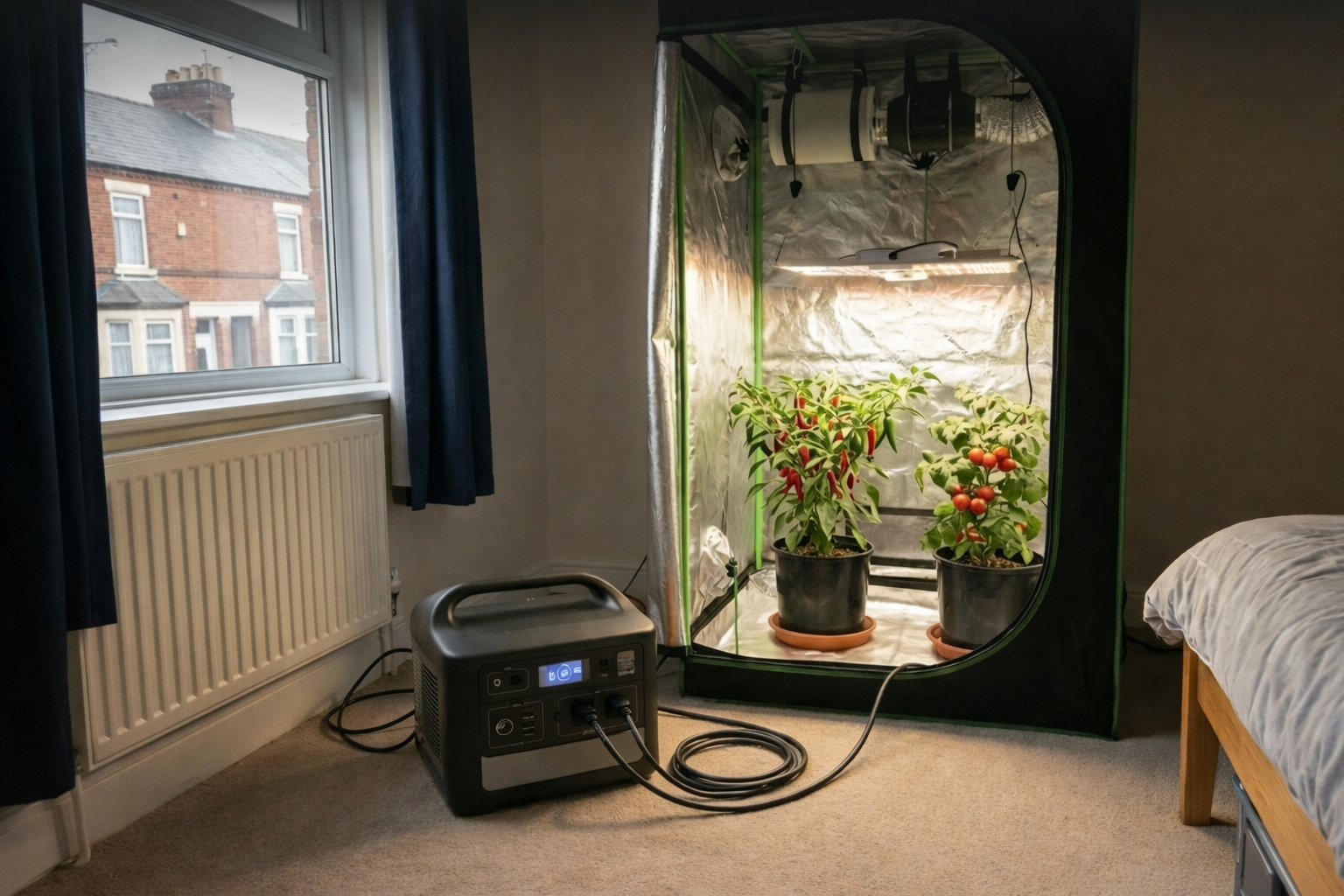
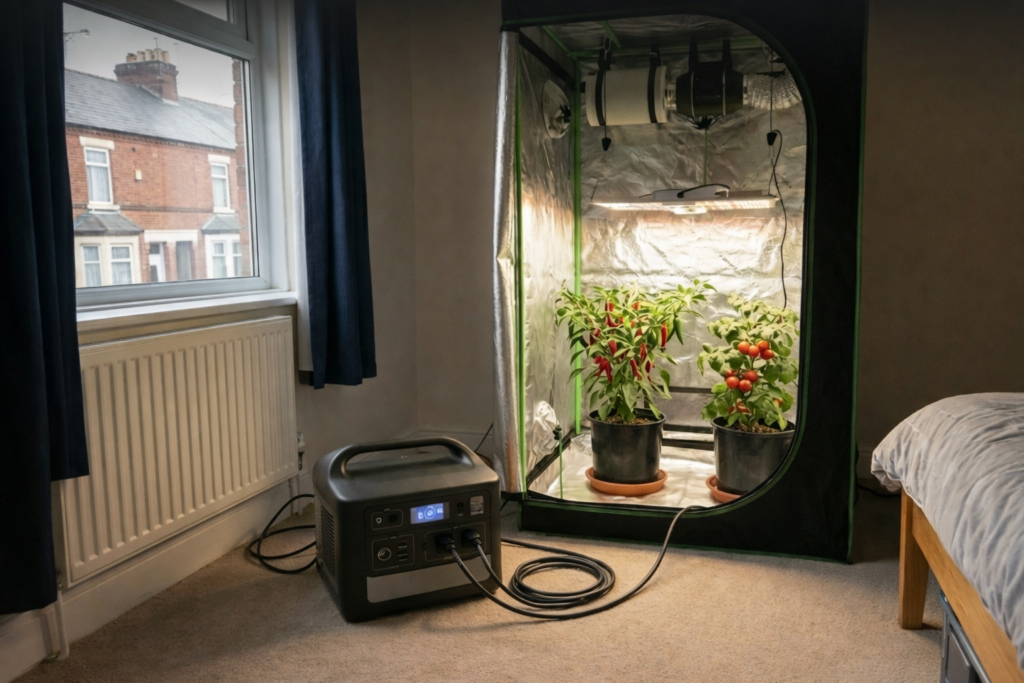
Indoor growing in the UK has always involved trade-offs — space, heat, noise, and running costs. But with electricity prices remaining high, running grow lights on solar generators is becoming a common question for UK home growers looking to reduce costs and gain flexibility indoors.
Can I realistically run grow lights using a solar generator?
Not to go fully off-grid.
Not to power a large grow room.
But to reduce electricity costs, manage noise, or add flexibility to a small indoor setup in a spare room, garage, or shed.
The answer is yes — sometimes. But only if expectations are realistic and the grow is designed with energy in mind.
This guide explains when solar generators make sense for UK home growers, where they don’t, and why efficiency and balance matter far more than headline “max output” numbers.
⚡ The Reality of Powering Indoor Growing
Before solar generators even enter the conversation, it’s important to understand how indoor growing actually uses electricity.
In most small UK setups, the grow light is the dominant load.
A modern LED grow light typically draws:
- 100W → 0.1 kWh per hour
- 200W → 0.2 kWh per hour
- 300W → 0.3 kWh per hour
Run that light for 12–18 hours a day and the cost adds up quickly — especially if the tent or light is oversized for the space.
This is why tent size and light choice are inseparable. Using a more powerful light than the space requires doesn’t just cost more upfront — it locks you into higher daily energy use for the life of the grow. This relationship is explored in Best Grow Lights for Every Tent Size, where the emphasis is on right-sizing, not chasing wattage.
Lighting isn’t the only draw, though.
Most indoor grows also include:
- An extraction fan (often running continuously)
- One or more circulation fans
- Timers or basic controllers
Individually, these are low-wattage devices. Together, they create a constant background load — the kind that quietly drains energy over time.
Ventilation is the clearest example. Good airflow stabilises temperature, controls humidity, and protects plants — but it also means electricity is being used 24/7. This is why ventilation design matters just as much as fan size, something we cover in Grow Tent Ventilation.
The key point is this:
Indoor growing isn’t a short, spiky power problem. It’s a steady, long-duration one.
That distinction is critical when batteries and solar are involved.
🔋 What a Solar Generator Actually Is (and Isn’t)
Despite the name, a solar generator doesn’t generate power on its own.
In practical terms, it’s:
- A battery (energy storage)
- An inverter (turns battery power into usable mains electricity)
- A charging system (from the grid, solar panels, or both)
In the UK, most people end up charging solar generators from the mains at least part of the time. Solar panels then supplement that charge when daylight allows — particularly in spring and summer.
There’s also a very UK-specific advantage that matters more than many people realise: load shifting.
Charging a battery overnight on cheap electricity — then using that stored energy to run lights during expensive evening peak hours — is often where the real savings come from. You’re not creating free power; you’re using cheaper power more intelligently.
For a deeper explanation of how these systems actually work in UK homes (without product pushing), see The HomeGrower Guide to Home Solar Generators (UK).
⏱️ Continuous vs Intermittent Loads (Why Grow Lights Catch People Out)
Not all electrical loads behave the same way.
Kettles, microwaves, and power tools are high-power but short-duration loads. Solar generators handle these surprisingly well.
Grow lights are the opposite.
They are moderate-power, long-duration loads — running for many hours, every day, with little variation.
Add to that:
- Extraction fans that rarely turn off
- Circulation fans running continuously
- Controllers and timers that never sleep
And energy drains steadily.
There’s also a hidden factor: the inverter itself uses power just to stay on. A fan that draws 20W might actually pull 25–30W from the battery once inverter losses are included. Over an 18-hour light cycle, those losses become meaningful.
This is why battery capacity (watt-hours) matters far more than peak output (watts).
🌤️ Running Grow Lights on Solar Generators: What Actually Works in the UK
Rather than theory, it helps to look at realistic UK-scale grow setups — and how solar behaves across the year.
A 100W LED Setup (Where Solar Genuinely Helps)
This is the most solar-friendly indoor grow.
Typical characteristics:
- Small tent or open grow area
- Efficient full-spectrum LED (~100W actual draw)
- Sensible extraction and circulation
Approximate daily energy use:
- Light: 1.2–1.8 kWh/day
- Fans & background loads: ~0.3–0.5 kWh/day
Total: ~1.5–2.3 kWh/day
Seasonal reality:
- Late spring & summer: Solar can make a meaningful contribution. On bright days it may cover fan loads and a large part — occasionally all — of the lighting cycle.
- Spring & autumn: Solar acts as a top-up. It slows battery drain and extends runtime but rarely powers the full cycle alone.
- Winter: Solar becomes a bonus only. Short days, low sun angle, and cloud cover mean panels often contribute very little.
The key takeaway:
A 100W grow is small enough that solar can meaningfully extend battery runtime for much of the year.
A 200–300W LED Setup (Where Limits Appear Quickly)
This is where expectations need tightening.
Typical characteristics:
- Medium tent
- 200–300W LED
- Stronger extraction due to higher heat output
Approximate daily energy use:
- Light: 2.4–5.4 kWh/day
- Fans & background loads: ~0.5–0.8 kWh/day
Total: ~3–6 kWh/day
Seasonal reality:
- Summer: Solar may offset part of the load but rarely keeps up with daily demand.
- Spring & autumn: Contribution is inconsistent and modest.
- Winter: Solar input is usually negligible.
At this scale, solar generators stop being about powering the grow and start being about reducing peak costs, noise, and stress.
This is also where efficient tent design becomes critical, something explored in Best UK Grow Tent Setups.
🔧 Why Some Solar Generators Cope Better Than Others
Without getting into specific models, it’s useful to understand why some systems handle grow setups better than others.
The differences usually come down to four things:
- Battery capacity (Wh): How long the system can run, not how powerful it feels.
- Charging speed: Faster grid charging matters in UK homes using off-peak tariffs.
- Solar input limits: Panels only help up to what the generator can actually accept.
- Inverter efficiency: Small losses compound over long grow cycles.
Rather than asking “Which generator is best?”, the more useful question is:
“Can this system store enough energy, recharge fast enough, and accept solar efficiently enough for my grow size?”
🏠 Practical UK Tips People Often Miss
- Keep the generator outside the tent. Tents trap heat, batteries hate heat, and generator cooling fans get loud when they’re hot.
- Be honest about winter. On a wet Tuesday in November, a portable solar panel is basically a very expensive floor mat.
- Use pass-through charging. If the battery hits zero while you’re out, the grid should take over automatically.
A Boring but Important Safety Note
One practical detail that’s easy to overlook is cable quality.
Don’t use cheap, thin extension leads between a solar generator and your grow light. Batteries can deliver a lot of current, and over a 12–18 hour light cycle, thin cables can get surprisingly warm.
Use short, heavy-duty extension leads, keep cables tidy, and make sure they’re well ventilated. It’s not exciting advice — but it keeps fire risk at effectively zero.
⚠️ Never Sacrifice Ventilation to Save Battery
If power runs low, do not turn off your fans to save energy.
A flat battery is annoying.
A tent full of mouldy plants because airflow stopped is a disaster.
Always prioritise extraction over lighting if you have to choose.
✅ When Solar Generators Make Sense — and When They Don’t
They make sense when you want to:
- Shift usage away from peak electricity rates
- Reduce noise in bedrooms or shared homes — with one caveat. Solar generators themselves have internal cooling fans, and cheaper units can be surprisingly loud under load or while charging. If noise matters, check user reviews specifically for fan noise, otherwise you may just be swapping one sound for another.
- Add resilience during outages
- Offset some grid usage, not eliminate it
They don’t make sense if you expect:
- Full off-grid operation year-round
- High-wattage flowering rooms
- Cold, uninsulated sheds
- UK winter solar to carry the load
🧠 Final Thought: Think in Systems, Not Products
Running grow lights on a solar generator isn’t about free power.
It’s about understanding where energy is used, where it’s wasted, and where efficiency actually pays off.
For UK home growers, the biggest wins usually come from right-sizing lights and tents first, then using solar generators as a supporting tool — not a replacement for the grid.
One overlooked bonus is that the same setup can double as emergency household power — keeping phones, laptops, lights, or even a fridge running during grid stress events. That dual purpose often makes the upfront cost far easier to justify to the rest of the household.
That systems-first mindset is what keeps indoor growing realistic, affordable, and sustainable in UK homes.
Core Guides on HomeGrower
- The Complete Guide to Home Solar Generators (UK) – How portable power stations work in real UK homes, including charging, capacity, and realistic expectations.
- Grow Lights Explained – How LED grow lights actually use power, why efficiency matters, and how to avoid oversizing your setup.
- Grow Tents Guide – How tent size, airflow, and layout affect heat, humidity, and overall electricity use in indoor growing.