
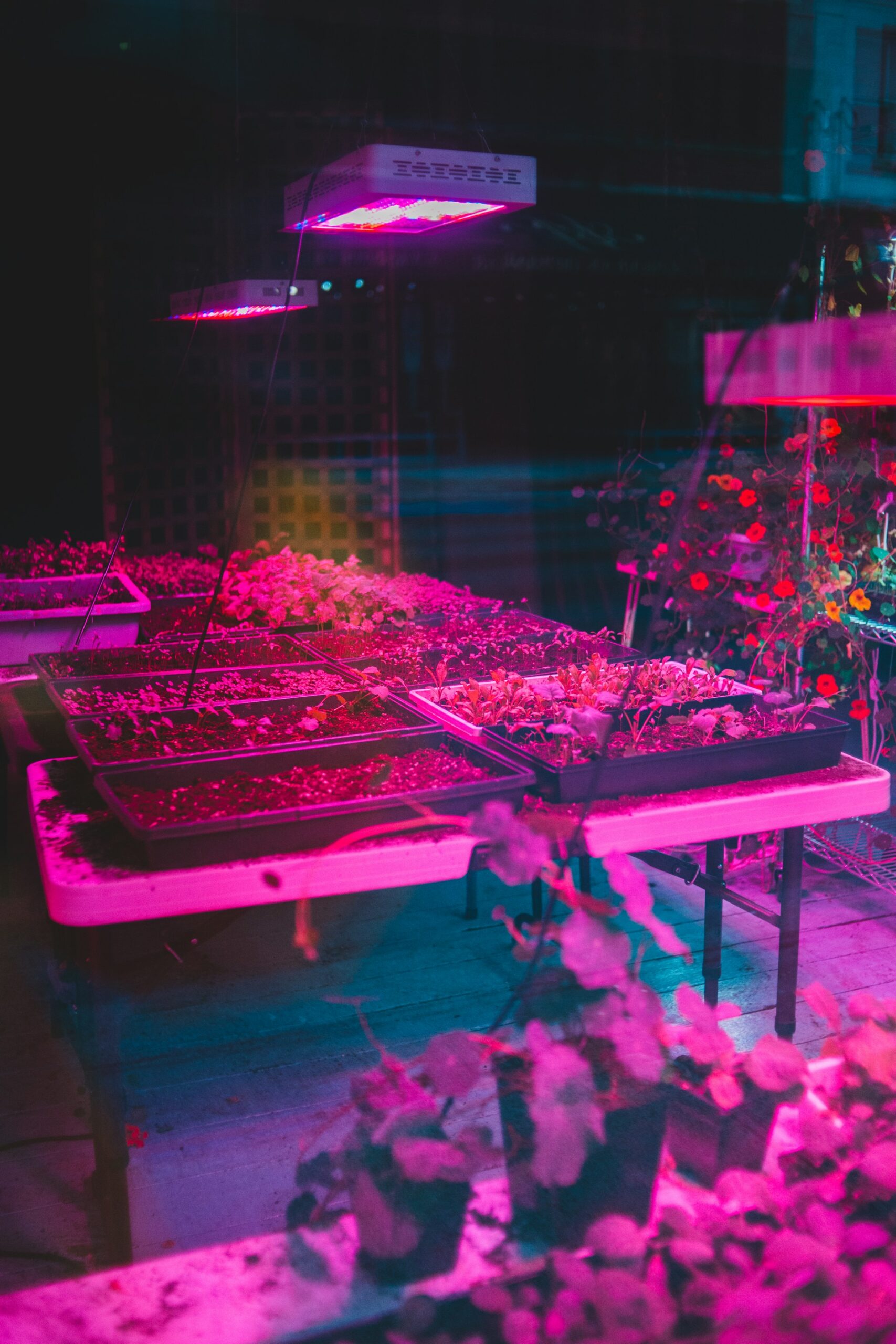
Walk down a UK street on a drizzly February evening and you’ll often spot it: a spare room glowing purple against the grey outside.
That light usually isn’t decorative — it’s coming from an older style of red and blue “blurple” grow light, once the default way to keep plants alive through a British winter.
For years, these lights were popular because they were cheap and effective. But as LED technology has improved — and electricity costs have risen — full spectrum white grow lights have become the more practical choice for most home setups.
If you’re wondering whether that purple glow still makes sense, or whether a normal-looking white LED would work better indoors, this guide breaks down full spectrum vs red and blue grow lights, explains why the technology has shifted, and which option actually suits a typical UK home.
For a broader overview of grow light types, setup, and how they’re used indoors, see our Grow Lights UK complete guide. That guide also links out to more focused deep-dive articles on specific topics, including light spectrum, distance, and timing.
What growers actually mean by “light spectrum”
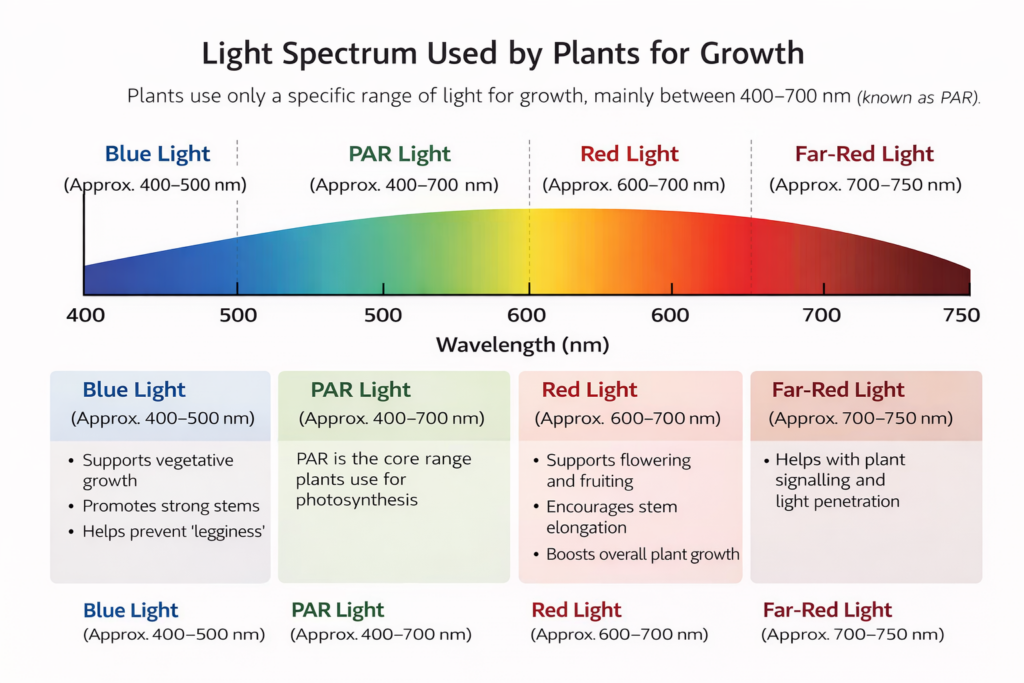
Plants don’t use all light equally. They respond to specific wavelengths, mainly within a range known as PAR (Photosynthetically Active Radiation), which sits roughly between 400 and 700 nanometres.
Within that range:
- Shorter wavelengths (blue) influence plant structure and leaf growth
- Longer wavelengths (red) influence flowering, fruiting, and stretch
Grow lights are simply different ways of delivering those wavelengths indoors.
A common question: can a red light panel work for plants?
I have a red light panel at home, and at one point I caught myself looking at my indoor plants and thinking: could I just point this at them? It’s red light, after all — and red wavelengths are important for plant growth.
The short answer is that while plants do respond very well to red light, they don’t thrive on it alone. Without enough blue light in the mix, growth tends to go in the wrong direction, producing taller, weaker plants rather than compact, healthy ones. That’s why grow lights are designed to balance multiple parts of the spectrum, not just focus on a single colour.
Red and blue grow lights: why they became popular
Early LED grow lights focused almost entirely on red and blue wavelengths because those colours are most directly absorbed during photosynthesis.
On paper, that approach made sense. Less wasted light, lower manufacturing costs, and acceptable results under controlled conditions.
In practice, though, this narrow spectrum creates problems once you move out of a sealed grow tent and into real living spaces.
Where red and blue lights fall down in UK homes
The biggest issue isn’t efficiency — it’s usability.
Under purple lighting, plants don’t look green. Leaves can appear grey or brown, which makes it harder to spot:
- Early nutrient deficiencies
- Overwatering or stress
- Pest issues like aphids or spider mites
By the time something looks obviously wrong, the plant is often already struggling.
There’s also the human factor. Purple light is harsh to live with. It’s fine in a garage or a closed-off shed, but unpleasant in kitchens, spare rooms, or anywhere you spend time in the evening.
Finally, there’s the quality trap. Many very cheap “1000W” red and blue lights sold online rely on outdated LED chips and inflated marketing claims. They draw power, but don’t convert it efficiently into usable light for plants.
So, what exactly is a “full spectrum” grow light?
Full spectrum grow lights take a broader approach. Instead of isolating just red and blue, they use white LEDs (often with additional red) to deliver a balanced spread across the PAR range.
To your eyes, they look like bright daylight. To plants, they provide usable light across all growth stages, from seedlings through to flowering.
Why this matters in everyday growing
With full spectrum lighting:
- Plants appear their natural colour, making problems easier to spot early
- Growth tends to be more balanced, with less stretching
- The space feels like a normal room rather than a lab
That makes a real difference in UK homes, where growing often happens alongside daily life rather than in dedicated grow rooms.
There is one trade-off. Full spectrum lights are bright, and light spill can be distracting at night. In most cases, that’s easily managed with a basic grow tent or simple light shielding.
A note on efficiency (and UK electricity costs)
You’ll often hear that red and blue grow lights are “more efficient”. That used to be true, but it doesn’t reflect how modern LEDs are built.
High-quality full spectrum lights now use more efficient diodes and better drivers, meaning they deliver more usable light per watt than many older blurple designs.
With UK electricity prices what they are, you don’t want to be paying to run a so-called “1000W” grow light that delivers little more usable light than a basic 50W bulb.
In simple terms, real wattage, build quality, and spectrum balance matter more than colour alone.
Full spectrum vs red and blue: a practical comparison
| Aspect | Full Spectrum | Red & Blue |
|---|---|---|
| Light appearance | Natural white | Purple |
| Growth stages | All-in-one | Often stage-specific |
| Plant visibility | Clear, natural colour | Distorted colour |
| Living spaces | Comfortable | Intrusive |
| Modern efficiency | Strong | Often outdated |
| Ease for beginners | High | Low |
How this fits with setup, distance, and timing
Spectrum is only one part of successful indoor growing. Light height, daily run time, and overall intensity matter just as much.
If you haven’t already, it’s worth pairing this guide with:
Together, these explain how to position and run your lights properly, regardless of which spectrum you choose.
So which should you actually choose?
For most UK home growers, full spectrum is the sensible default.
It’s easier to live with, easier to manage, and better suited to the way people actually grow indoors here — in spare rooms, kitchens, sheds, and flats, often through long grey winters.
Red and blue lights still have a place in tightly controlled or isolated setups, but they’re no longer the best all-round option for everyday indoor growing.
If you’re ready to compare real-world options, our Top 10 LED Grow Lights UK guide breaks down the most reliable full spectrum models by size, output, and use case.
For further reading from a trusted UK source, the RHS has a clear overview of how houseplants respond to artificial lighting indoors.
If you want to browse all our grow light guides and comparisons in one place, see our Grow Lights UK hub.
📎 Related Articles
Full spectrum vs red and blue grow lights: common questions
What is the difference between full spectrum vs red and blue grow lights?
The difference between full spectrum vs red and blue grow lights comes down to how much of the usable light spectrum they provide. Red and blue grow lights emit only two narrow wavelength bands that drive photosynthesis, while full spectrum grow lights deliver a broader range of wavelengths across the PAR spectrum (approximately 400–700nm). This wider output supports more balanced plant development, better visual monitoring, and greater suitability for indoor growing in UK homes.
Is full spectrum or red and blue grow lights better for indoor growing?
When comparing full spectrum vs red and blue grow lights for indoor growing, full spectrum lighting is generally the better choice for most home growers. Full spectrum lights support all growth stages with a single fixture, produce more natural-looking light, and make it easier to spot nutrient issues or pests. Red and blue grow lights can still grow plants effectively, but they are harder to live with and less forgiving in mixed-use spaces.
Are red and blue grow lights more energy efficient than full spectrum LEDs?
Red and blue grow lights were once considered more efficient because they focused only on wavelengths most strongly absorbed during photosynthesis. However, modern comparisons of full spectrum vs red and blue grow lights show that high-quality full spectrum LEDs often achieve equal or better efficiency in terms of usable light per watt. Improvements in LED diodes and drivers mean that spectrum balance is now more important than colour restriction alone.
Why do plants look unhealthy under red and blue grow lights?
Plants can appear unhealthy under red and blue grow lights because the narrow spectrum distorts natural leaf colour. In the full spectrum vs red and blue grow lights comparison, this is one of the main practical disadvantages of red and blue lighting. Yellowing leaves, early pest damage, or nutrient stress can be harder to detect under purple light, even when the plant is actively growing.
🏡 Explore More HomeGrower Hubs
Dive deeper into our core growing and self-sufficiency guides:
- Indoor Growing UK
Everything you need to grow herbs, vegetables and microgreens indoors all year round. - Grow Lights UK
Compare LED, fluorescent and full-spectrum grow lights for home growers. - Grow Tents UK
Reviews, setup guides and ideal tent sizes for beginners and experienced growers. - Outdoor Growing UK
Advice on raised beds, irrigation, composting and year-round food production. - Greenhouses & Polytunnels UK
Expert guidance for choosing, installing and using protected growing structures. - Garden Sheds UK
Buying guides, comparisons and storage advice for every UK garden. - Garden Tools & Equipment UK
Essential tools, equipment reviews and buying guides for efficient gardening. - Food Preservation UK
Learn dehydration, fermentation, freezing and long-term storage of home-grown produce. - Self-Sufficiency UK
Guides to home solar, emergency power, rainwater collection, off-grid watering and low-energy systems for more resilient living.
Or return to the HomeGrower homepage to browse all our latest guides and reviews.