
Let’s be honest — the UK isn’t exactly famous for its year-round sunshine.
If you’ve ever tried growing basil on a north-facing windowsill in November, you’ll already know the problem: pale, stretched stems that never really get going. For many home growers, light — not water or soil — is the main limiting factor.
This guide explains what grow lights are, how they work, and how to use them sensibly in UK homes. It’s designed as an overview — a map rather than a manual — and links out to deeper guides where practical decisions matter.
Whether you’re growing herbs in a flat, starting seedlings early, or running a small indoor setup in a shed or spare room, this page will help you understand the fundamentals before going further.
🌱 Is This Guide for You?
This guide is written for UK home growers who want to:
- Grow herbs or leafy greens indoors
- Start seedlings earlier in the year
- Supplement weak natural light in winter
- Grow plants in flats, spare rooms, sheds, or garages
- Understand grow lights before choosing one
It’s not aimed at commercial grow rooms or high-intensity setups — just realistic home growing.
🌤️ Do Grow Lights Really Work?
It’s a fair question. Can an artificial light really replace the sun?
Plants don’t actually need sunlight itself — they need usable light energy to photosynthesise. Grow lights provide that energy in a controlled way, which is why they can be so effective indoors.
Grow lights are particularly useful in the UK when:
- Daylight hours are short (autumn to early spring)
- Rooms are shaded or north-facing
- You want consistent, year-round growth
- Plants are grown away from windows altogether
They’re less necessary when plants already receive strong, direct daylight — for example in a bright conservatory during summer.
Grow lights aren’t magic, but used correctly they’re a reliable tool for indoor growing in our climate.
💡 Types of Grow Lights Explained (High Level)
Most home growers today will only encounter a few main types of grow lights.
LED Grow Lights
Modern LED grow lights are now the standard choice for home use. They’re energy-efficient, relatively cool running, and available in many shapes and sizes — from slim bars to full panels.
Fluorescent Lights
Fluorescent lights (such as T5 tubes) are sometimes used for seedlings or low-light plants. They’re gentler, but generally less efficient than modern LEDs.
Older Technologies (HPS / MH)
High-pressure sodium (HPS) and metal halide (MH) lights were once common but are now largely outdated for home use due to heat, power consumption, and space requirements.
This guide focuses on concepts rather than recommendations — detailed comparisons are covered elsewhere.
⚡ Understanding Grow Light Wattage (Why the Numbers Are Confusing)
If you’ve ever seen a grow light claiming to be “1000W” for the price of a takeaway, your instinct is probably right.
Wattage is one of the most misunderstood parts of grow lighting. At its simplest:
- Wattage measures electrical power use
- It does not directly tell you how much usable light reaches your plants
What matters far more is:
- The actual power draw
- How efficiently that power is converted into usable light
- How evenly the light is spread across your growing area
- The actual power draw
- How efficiently that power is converted into usable light
- How evenly the light is spread across your growing area
If you want to cut through the marketing noise and see how wattage actually affects your electricity bill, start with Grow Light Wattage Explained. From there, understanding why two lights with the same wattage can perform very differently comes down to efficiency — including diode quality and driver design — which we break down in Grow Light Efficiency.
Once you understand real power draw and efficiency, the next practical question is cost. To see how wattage, daily runtime, and your electricity unit rate translate into real numbers, you can use our Grow Light Running Cost Calculator (UK) to estimate daily, monthly, and yearly electricity costs for a typical home setup.
🌈 Light Spectrum (Without the Science Overload)
You’ll often see grow lights described as:
- “Full spectrum”
- “Red and blue”
- “Sunlight simulation”
In practice, most modern grow lights already provide the wavelengths plants need. For typical home growing, spectrum matters far less than marketing suggests.
For most UK growers:
- Overall light intensity
- Coverage
- Distance from plants
…have a much bigger impact than colour alone.
A clear, practical breakdown is covered in our full spectrum vs red and blue grow lights guide, which explains how spectrum choice really affects home growing.
⏱️ How Long Should Grow Lights Be On?
Plants don’t just respond to brightness — they respond to day length.
This is where many beginners go wrong. More light isn’t always better, and plants still need regular dark periods.
As a general rule:
- Most indoor plants do well with 12–16 hours of light
- Consistency matters more than exact timing
- Timers are one of the most useful (and underrated) tools
To make this easy to manage day to day, I use a smart plug with scheduling and energy monitoring — explained in more detail in my Tapo P110 smart plug review.
UK-friendly timing examples and common mistakes are covered in our guide to how long grow lights should be on.
📏 How Far Should Grow Lights Be from Plants?
Distance matters because light intensity drops quickly as you move away from the source.
Too close, and you risk:
- Leaf scorch
- Stress
- Overheating
Too far away, and plants often become:
- Weak
- Leggy
- Slow to develop
The correct distance depends on:
- Light output
- Plant type
- Growth stage
Rather than guessing, use a practical reference like our UK grow lights distance chart to set safe, effective spacing for your plants.
🏠 Setting Up Grow Lights in Real UK Homes
Most people aren’t working with dedicated grow rooms — they’re fitting lights into everyday spaces.
Common UK setups include:
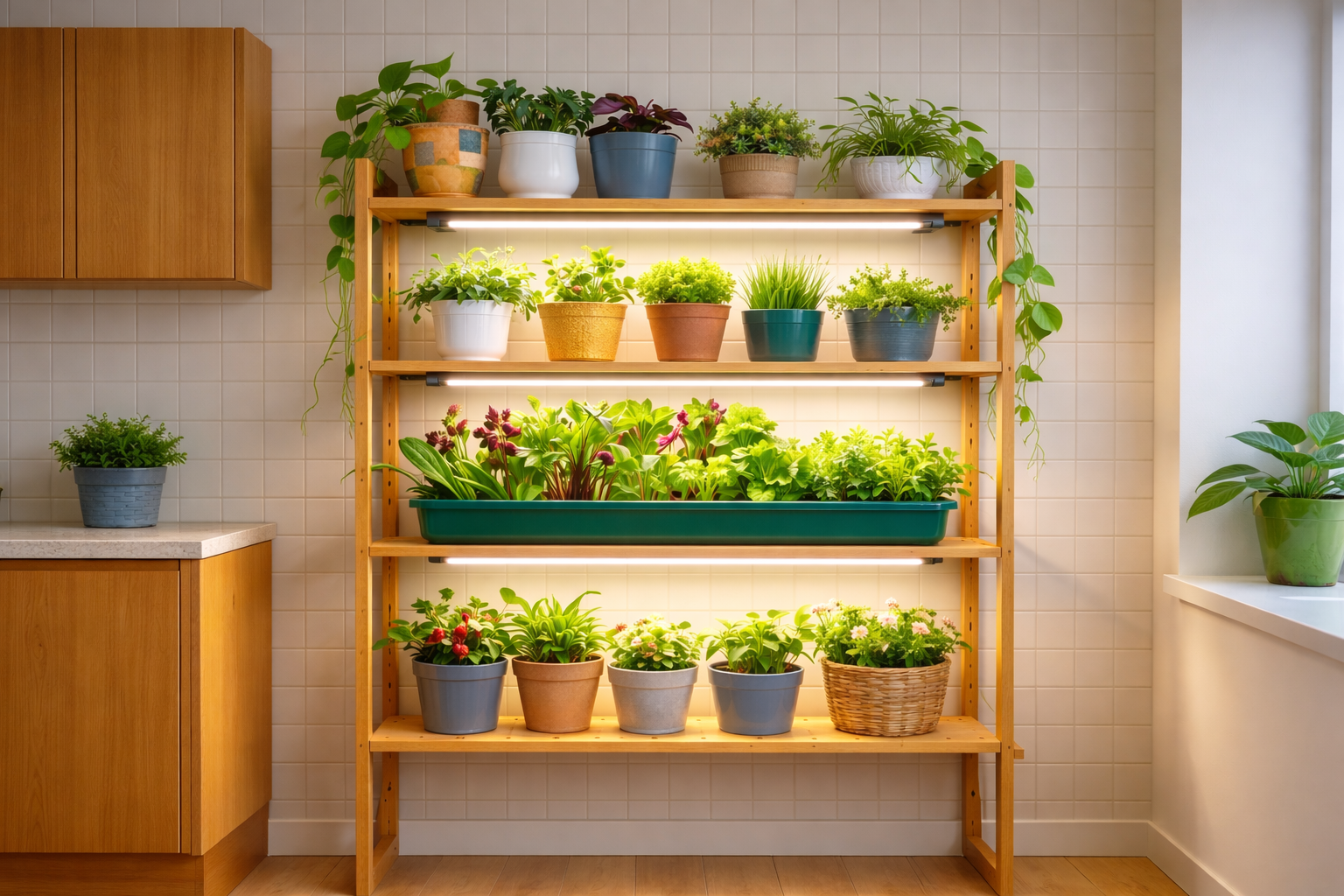
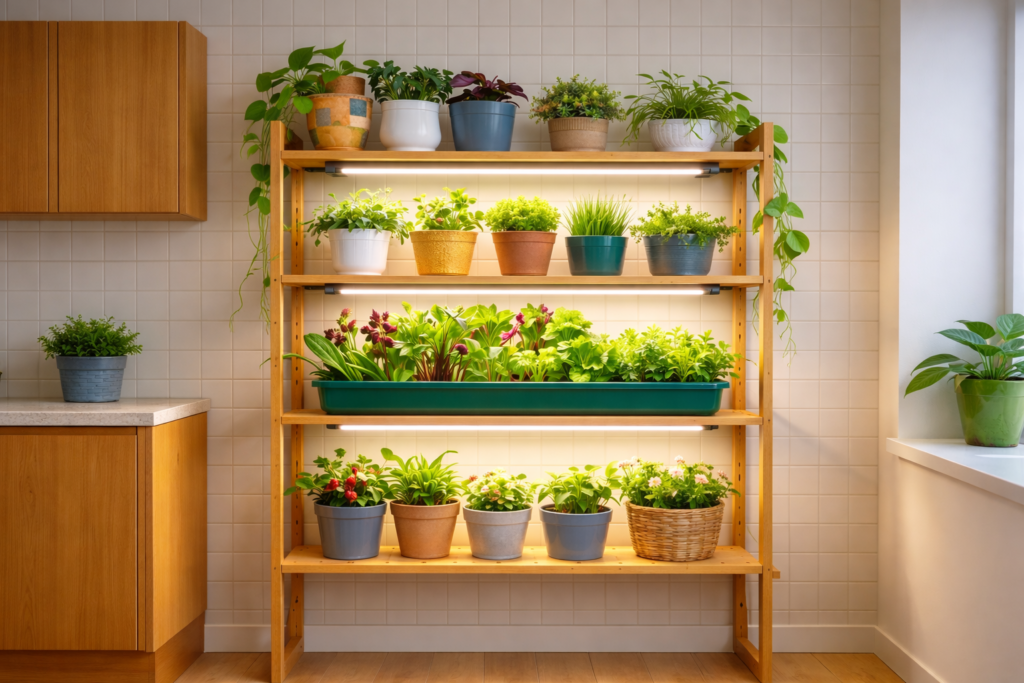
- Shelving units in spare rooms
- Utility rooms or box rooms
- Sheds and garages
- Shared living spaces
Real-world considerations matter:
- Secure mounting (nothing dangling over plants)
- Timers for consistency
- Safe use of extension leads
- Being mindful of light spill in shared rooms
Remember, even “efficient” LEDs are still an electrical load. You wouldn’t plug four kettles into one extension lead and leave them running all day — treat your grow light setup with the same level of respect.
For a step-by-step, home-friendly walkthrough, see our guide to setting up grow lights indoors.
🛡️ Grow Light Safety in UK Homes
Modern LED grow lights are significantly safer than the old-style bulbs of ten years ago, but they are still a piece of electrical equipment running for 12+ hours a day. In a typical UK house or flat, you need to be mindful of how you’re loading your circuits.
The “Golden Rules” of Grow Light Safety:
- Don’t Overload: You wouldn’t plug four kettles into one extension lead, and the same applies here. Avoid “daisy-chaining” cheap power strips together.
- Airflow is Key: Even “cool” LEDs have heat sinks or small fans. Never rest them directly against curtains, fabric, or the underside of a wooden shelf.
- The “Drip Loop”: Water and electricity are a bad mix. Always ensure your cables “loop” down before going into the plug, so any accidental splashes or condensation can’t run straight into the socket.
- Secure Mounting: If you are growing in a shed or a spare room, ensure your light is hung with proper ratchets or chains. A falling light is a fire risk and a plant-killer.
Used with common sense, a grow light is no more dangerous than a fridge or a television. The goal is to set it up so you can leave the house for the day without a second thought.
For a more detailed look at electrical loading, mounting, and everyday precautions, see our grow light safety guide for UK homes, which covers how to grow indoors safely without risking your electrics or your deposit.
🧠 Choosing the Right Grow Light (Before Looking at Products)
Before comparing models, it helps to think in terms of needs, not brands.
Start by matching the light to:
- The size of your growing area
- The type of plants you’re growing
- The time of year
- How often the space is used
This decision logic makes later choices much simpler — and helps avoid buying something that’s either excessive or underpowered.
If you want an overview of the most practical LED grow lights for UK home growers — without diving straight into specs — our best LED grow lights for indoor growing guide is a good place to start.
This guide builds on the concepts above and compares lights based on real power, coverage, and suitability for typical UK homes.
🎯 Beginner vs Budget vs Performance Expectations
Different growers prioritise different things.
- Beginners benefit most from reliability and simplicity
- Budget setups can work well for seedlings and leafy greens
- Higher-performance setups matter more for dense or year-round growing
Cutting costs is fine — but cutting the wrong corners often leads to disappointing results.
For practical examples, see our guides to the best grow lights for beginners and the best cheap grow lights for UK homes.
📐 Matching Grow Lights to Space Size
Coverage matters more than headline wattage.
A single shelf, a small tent, and a spare room all need very different lighting approaches. Think in terms of:
- Area covered
- Evenness of light
- Height available above plants
For space-specific guidance, our best grow lights for every tent size guide explains how to match coverage and light spread to different setups.
⚠️ Common Grow Light Mistakes (UK-Specific)
Some problems come up again and again:
- Trusting marketing wattage claims
- Ignoring electricity running costs
- Over-lighting small spaces
- Running lights too long without dark periods
Avoiding these early saves time, money, and frustration.
🌱 Final Thoughts
Grow lights don’t need to be complicated to be effective.
For most UK home growers, success comes from understanding a few fundamentals — how light affects plants, how much is enough, and how to use it safely in everyday spaces. Once those basics are in place, the details become much easier to navigate.
Whether you’re growing herbs on a shelf, starting seedlings early, or supplementing natural light through winter, a sensible setup will always outperform chasing specs or marketing claims.
Use this guide as a reference point, explore the deeper articles where you need more detail, and build your setup gradually. Indoor growing works best when it fits your space, your plants, and your lifestyle — not the other way around.
For further reading from a trusted UK source, the RHS has a clear overview of how houseplants respond to artificial lighting indoors.
If you want to browse all our grow light guides and comparisons in one place, see our Grow Lights UK hub.
📎 Key grow light guides
- How to Set Up Grow Lights Indoors
A practical, step-by-step guide to positioning, mounting, and running grow lights safely in UK homes. - Grow Lights Distance Chart UK
Clear guidance on how far grow lights should be from plants at different growth stages. - How Long Should Grow Lights Be On?
Explains daily lighting schedules, timers, and common mistakes for indoor growing in the UK. - Grow Light Wattage Explained
Breaks down what grow light wattage really means and how power draw affects light output and running costs.
❓ Grow Lights FAQs
❓ Do grow lights actually make sense for a UK home?
In the UK, grow lights are less about replacing the sun and more about filling the gaps our climate creates. They’re most useful from autumn through early spring, or in flats where windows are north-facing or overshadowed by nearby buildings. In these situations, grow lights help prevent plants from stretching weakly for light that simply isn’t available.
❓ What’s the biggest mistake beginners make with grow lights?
Buying for headline “power” instead of matching the light to the space. It’s very common to see an oversized, high-output light used over a small shelf or corner, which can lead to scorched leaves, unnecessary electricity use, and an impractical living space. Coverage and placement matter far more than the biggest wattage number on the box.
❓ Will a grow light noticeably increase my electricity bill?
For most small home setups, the cost is lower than many people expect. As a rough guide, a modern LED grow light drawing around 100 watts and running for 14 hours a day typically costs in the region of £3–£4 per month at current UK energy prices. Costs rise mainly when lights are oversized, inefficient, or left running far longer than plants actually need.
❓ How do I know if my grow light is at the right distance?
Plants are usually the best indicators. Leaves that bleach, curl, or develop dry, crispy edges often suggest the light is too close. Long, thin, “leggy” growth usually means the light is too far away. A sensible approach is to start around 12–18 inches above the plant and adjust gradually based on how it responds over several days.
❓ Are grow lights safe to use in normal living spaces?
When set up properly, modern LED grow lights are generally safe for use in homes. The main risks come from poor electrical practices — such as overloading extension leads, blocking ventilation, or placing lights near water. Using a quality timer, secure mounting, and a properly fused power strip goes a long way toward keeping setups safe and reliable.