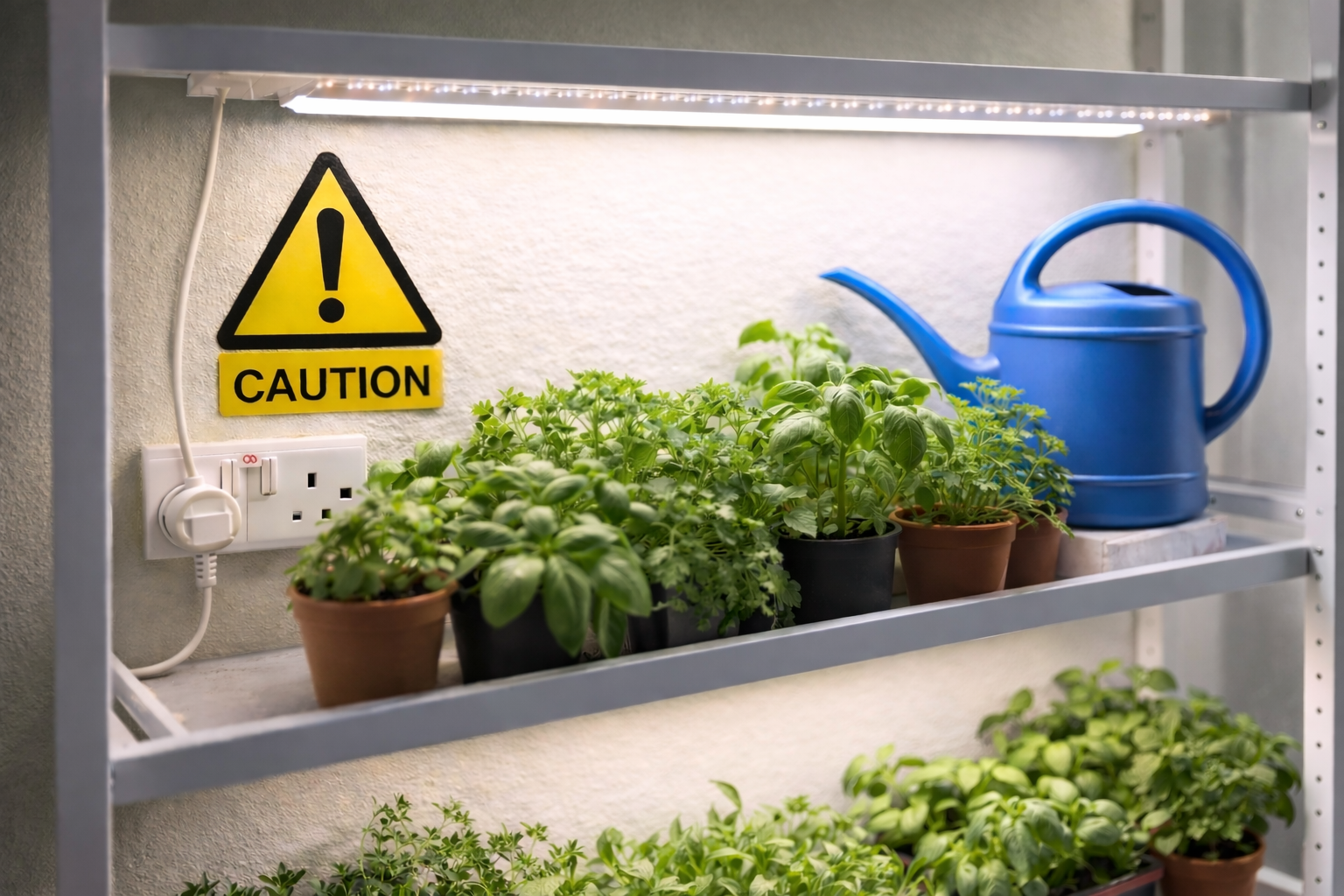

Grow lights are widely used in UK homes and, when set up correctly, are generally safe to run indoors. However, every grow light is different, and the manufacturer’s instructions should always take priority over any general advice.
This guide provides general grow light safety principles for using LED grow lights in typical UK homes, flats, sheds, and spare rooms. It’s designed to highlight common risks, sensible precautions, and everyday best practice — not to replace the specific guidance that comes with your equipment.
Before installing or running any grow light, always read and follow the manufacturer’s instructions, particularly around mounting, ventilation, electrical load, and recommended operating times.
If you’re new to grow lights and want a broader overview of how they work in UK homes, it’s worth starting with our Grow Lights Explained: A Complete Guide for UK Home Growers before focusing on safety specifics.
🛡️ Are Grow Lights a Fire Risk?
Modern LED grow lights are significantly safer than older lighting technologies, but they are still electrical devices designed to run for long periods. In most cases, safety issues don’t come from the lights themselves — they come from how they’re used.
The most common causes of problems include:
- Overloaded extension leads
- Poor ventilation
- Insecure mounting
- Running lights continuously without timers
Used sensibly, a grow light presents no greater risk than many other everyday household appliances.
🔌 Electrical Safety in UK Homes
Electrical setup is the most important safety consideration for indoor growing.
Avoid overloading sockets
Grow lights often run for 12–16 hours a day, which creates a continuous electrical load. Avoid plugging multiple high-draw devices into the same socket or extension lead.
A sensible rule of thumb is:
- One grow light per wall socket (or use a single, high-quality fused power strip)
- Avoid “daisy-chaining” cheap extension leads
- Use properly rated UK plugs and leads
If you wouldn’t plug several kettles into the same extension lead and leave them running all day, don’t do it with grow lights.
Use timers properly
Timers are one of the safest and most useful accessories for grow lights. They:
- Prevent lights being left on accidentally
- Reduce heat buildup
- Maintain consistent light cycles
Choose a timer rated for continuous loads and appropriate for the wattage of your light. Timers are also essential for maintaining healthy light–dark cycles — something explained in more detail in How Long Should Grow Lights Be On?
🧱 Mounting & Placement Safety
How a grow light is mounted matters just as much as how it’s powered.
Secure mounting
Grow lights should be:
- Fixed securely
- Unable to swing, fall, or shift
- Mounted using brackets, ratchets, chains, or stands designed for the load
A falling light isn’t just a plant-killer — it can damage surfaces, injure people, or create a fire risk.
If you’re unsure about mounting height or placement above plants, refer to Grow Lights Distance Chart UK to avoid placing lights unnecessarily close.
Allow airflow
Even “cool-running” LEDs produce heat. Never:
- Cover ventilation slots or fans
- Press lights directly against shelves, walls, or fabric
- Enclose lights in unventilated spaces
Always leave clear space around the light so heat can dissipate safely.
💧 Water, Humidity & Condensation
Indoor growing often involves watering, misting, and increased humidity — all of which need to be managed carefully around electrics.
Good practice includes:
- Keeping plugs and connections off the floor
- Positioning cables away from watering areas
- Avoiding dripping water onto light fittings
- Allowing condensation to evaporate before switching lights back on
A simple but effective habit is creating a “drip loop” in cables, so any water runs away from the plug rather than into it.
🏠 Using Grow Lights in Flats & Rented Homes
Grow lights are commonly used in rented properties, but setups should always be temporary and non-invasive.
Consider:
- Free-standing shelves or light stand systems instead of wall fixings
- Avoiding permanent wiring changes
- Managing light spill in shared living spaces
- Being mindful of noise from cooling fans
If you’re growing in a shared or compact space, our guide on How to Set Up Grow Lights Indoors covers practical home-friendly setups in more detail.
🚫 Common Unsafe Practices to Avoid
Most safety issues arise from a small number of avoidable mistakes:
- Buying unbranded or poorly certified lights (look for UKCA or CE marking)
- Blocking fans or heat sinks
- Running lights 24/7 without dark periods
- Ignoring damaged cables or loose plugs
- Using outdoor-rated equipment indoors without appropriate certification
If something looks poorly made or feels unsafe, trust that instinct.
✅ A Simple Grow Light Safety Checklist
Before leaving your grow light running unattended, check that:
- The light is securely mounted
- Ventilation is clear
- Power leads are not overloaded
- A suitable timer is in use
- Water sources are kept away from plugs and fittings
If all of those are true, your setup is likely sound.
When Extra Care Is Needed
Be particularly cautious if:
- You live in an older property with limited sockets
- You’re running multiple lights from one area
- You’re growing in sheds, garages, or outbuildings
- Your setup runs year-round
In these situations, keeping power loads conservative and setups simple is usually the safest approach.
Final Thoughts
Grow lights are a practical, widely used tool for indoor growing in the UK. When chosen sensibly and set up with basic electrical care, they are no more dangerous than many other household appliances.
Always follow the manufacturer’s instructions first, use common sense when it comes to power and mounting, and build setups that fit comfortably within your home rather than pushing limits.
Safety doesn’t require complex systems — just thoughtful planning and sensible habits.
For broader guidance on safe electrical use in UK homes, Electrical Safety First provides clear, independent advice on plugs, sockets, extension leads, and avoiding electrical hazards indoors.
If you want to browse all our grow light guides and comparisons in one place, see our Grow Lights UK hub.
📎 Related articles
- Grow Lights Explained: A Complete Guide for UK Home Growers
A clear overview of how grow lights work, when they’re useful, and how to use them sensibly in UK homes. - How to Set Up Grow Lights Indoors
Step-by-step guidance on mounting, positioning, timers, and everyday safety considerations. - Grow Lights Distance Chart UK
Helps prevent leaf scorch and stress by showing safe grow light distances for different plants and stages.
❓ Grow Light Safety FAQs
Are LED grow lights safe to run overnight in a UK home?
In most cases, yes — modern LED grow lights are designed for long runtimes, and many growers run them overnight to keep heat down or avoid light spill during the day. The real safety factors are setup quality and electrical load: use a properly rated timer, ensure good ventilation around the fixture, avoid overloaded extension leads, and follow the manufacturer’s guidance on duty cycle and clearances. If the light has a fan, keep vents unobstructed and avoid dusty, enclosed spaces.
How do I know if I’m overloading a socket or extension lead?
In UK homes, the limiting factor is often the extension lead or multiway adaptor rather than the wall socket itself. Check the power rating on the strip (usually shown in amps or watts) and compare it to the combined load of everything plugged in. As a practical rule, avoid daisy-chaining leads and avoid running multiple high-draw devices (heaters, kettles, tumble dryers) on the same circuit as your grow lights. If plugs, adapters, or cables feel hot, or if a timer clicks off unexpectedly, treat that as a warning sign and simplify the setup.
Does “1000W LED” on the box mean it’s unsafe or high power?
Not necessarily. Many budget lights use misleading “equivalent” labels, while the actual wall draw might be closer to 80–200 watts. For safety and running costs, the figure that matters is the real power draw (often listed as “actual power” or shown on the driver label). If you’re unsure how to interpret those numbers, the clearest explanation is in our guide to grow light wattage and real power draw.
What should I look for on the label for UK electrical compliance?
Look for UKCA marking (or CE marking) and a clear manufacturer name, model number, input voltage (typically 220–240V in the UK), and a rated power figure. Avoid unbranded listings with no traceable manufacturer details. A fused UK plug is a good sign for mains-powered lights; if the unit uses an adaptor/driver, ensure it’s correctly rated and not running hot.
Are grow lights safe to use in humid spaces like kitchens, sheds, or grow tents?
They can be, but humidity raises the bar for cable management and ventilation. Keep plugs and connections off the floor, avoid placing sockets directly under watering areas, and use a “drip loop” so moisture can’t run into the plug. In sheds and tents, condensation is common — so ensure airflow around the light and driver, and don’t cover vents or fans. If a fixture has an IP rating, treat that as helpful context, but still follow the manufacturer’s guidance on indoor use and placement.
How much clearance should I leave around an LED grow light for ventilation?
This varies by model, which is why the manufacturer’s clearance guidance matters. As a general principle, don’t press a light directly against a shelf underside or surround it with fabric, foil, or insulation. Leave space for heat sinks and fans to move air, and avoid mounting drivers in cramped, unventilated corners. If your light uses a fan, keep the intake/exhaust clear and check periodically for dust buildup.
Can I safely use grow lights with smart plugs or smart timers?
Yes, as long as the smart plug is rated for the continuous load of the light and is used within its specifications. Many smart plugs are designed for intermittent loads (like lamps) rather than long daily runtimes. Check the rated amps/watts, avoid cheap no-name units, and periodically feel the plug after a few hours of operation — it should be warm at most, not hot. If in doubt, a purpose-built timer rated for higher continuous loads is often the safer option.
What are the most common safety mistakes UK home growers make?
The main ones are electrical rather than horticultural: daisy-chaining extension leads, using low-quality adaptors, blocking ventilation, and running cables where they can be splashed or tripped over. The fix is usually simple: reduce the number of devices on a single lead, secure and tidy cables, keep connections away from water, and mount the light so it can’t fall or shift during day-to-day use.