If you’ve spent any time researching LED grow lights, you’ve probably noticed how quickly things get confusing. One product talks about Samsung LM301H EVO diodes, another highlights a Mean Well driver, while a third claims to be a “1000W equivalent” despite barely pulling a fraction of that from the wall.
It can start to feel like you need to understand electronics just to grow a few herbs indoors. You don’t.
This guide is designed to strip away the marketing noise and explain — in plain, practical language — what actually matters inside an LED grow light, and what doesn’t. No product pushing, no affiliate links, and no spec-sheet obsession. Just simple advice to help you better understand grow light efficiency.
If you’re new to indoor lighting or want a broader overview before diving into the details, our Grow Lights Explained: A Complete Guide covers the fundamentals of grow lights in UK homes.
💡 What a Grow Light Diode Actually Does
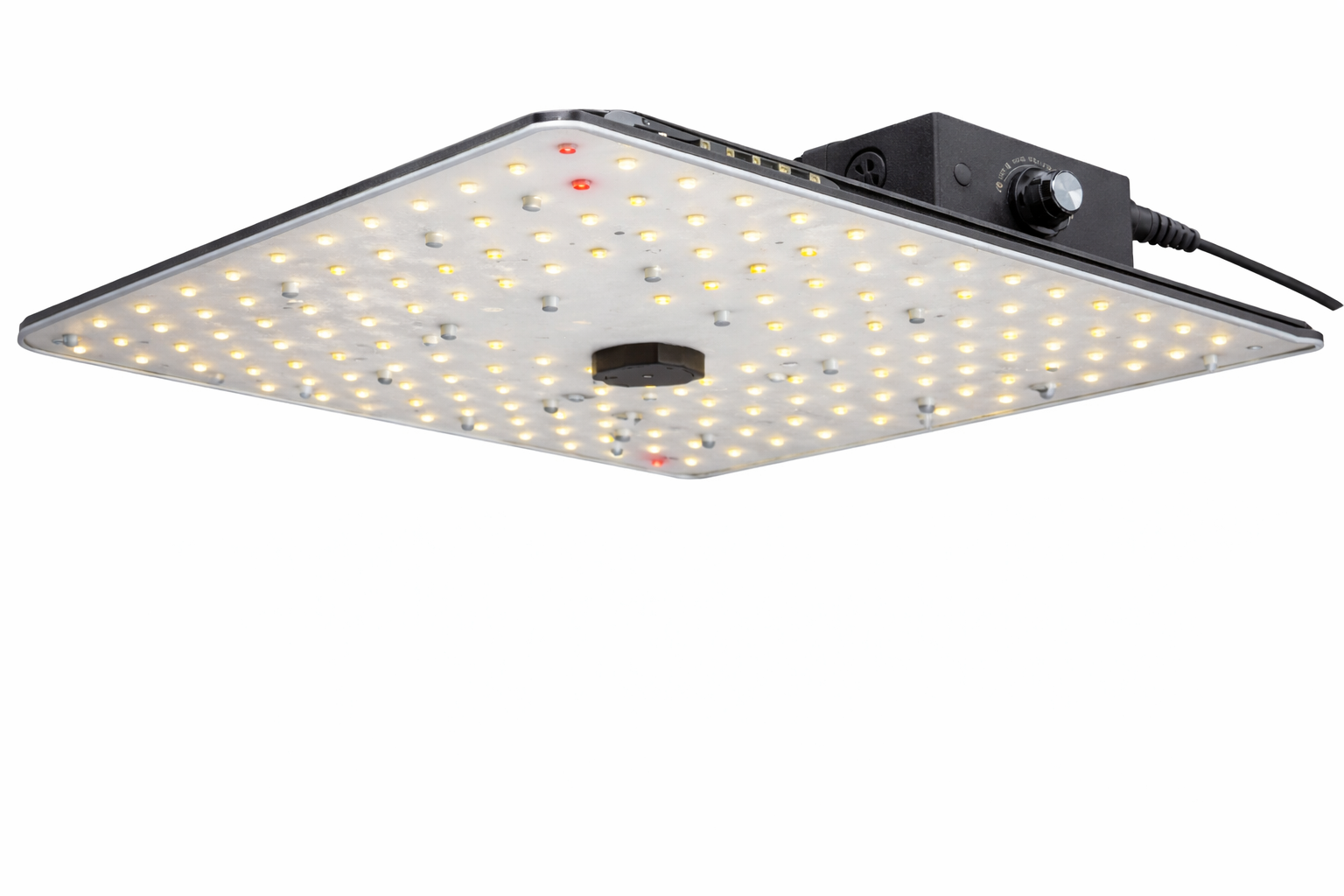
At the heart of every LED grow light are tiny components called diodes. A diode is the part that converts electricity into light. That’s its entire job.
Each diode emits photons — small packets of light energy that plants use for photosynthesis. Plants don’t recognise brand names, model numbers, or marketing claims. They respond to how much usable light reaches their leaves, and how evenly it’s delivered.
I like to think of a grow light not as a single powerful bulb, but as a team of tiny workers — the diodes — all pulling together to feed your plants.
Good grow lights tend to:
- Use reasonably efficient diodes
- Spread light evenly across the canopy
- Waste less energy as heat
Everything else is detail.
Samsung LM301 Diodes Explained (Plain English)
You’ll often see LED grow lights advertised as using Samsung LM301 diodes. This has become shorthand for “high quality”, but it’s worth understanding what that actually means.
Samsung LM301 refers to a family of LED diodes made by Samsung Electronics. They’re popular because they’re efficient, consistent, and widely available — not because they magically grow better plants.
LM301B vs LM301H
- LM301B
A proven, older revision that’s still very efficient and widely used. - LM301H
A slightly newer version designed to tolerate higher heat and humidity, with small efficiency improvements on paper.
In real-world home growing, the difference between these two is usually negligible. Both can perform extremely well in a well-designed light.
🔄 The Version Number Game (B → H → EVO)
The jump from LM301B to LM301H and then to LM301H EVO can look dramatic in marketing copy, but it’s best viewed as normal product evolution.
Manufacturers regularly release updated versions to keep products feeling current. Each new version tends to offer incremental gains, not breakthroughs.
Here’s the practical takeaway:
If you find a well-built grow light using a previous-generation Samsung diode at a noticeably lower price, it’s often a sensible choice. Your plants won’t notice a small difference in photon efficiency — but your wallet will notice a large discount.
Newer doesn’t automatically mean better value.
If you want to understand how different colours of light affect plant growth rather than focusing on diode branding, this is explained clearly in Full Spectrum vs Red and Blue Grow Lights.
🔌 Why Drivers Matter More Than Most People Realise
If diodes produce the light, the driver controls how that light is delivered.
The driver converts mains electricity into a stable, usable current for the LEDs. It also plays a big role in safety, reliability, and lifespan.
I like to think of the driver as the brain of the system.
A cheap driver is a bit like a flickering candle — inconsistent, unpredictable, and not something you’d be comfortable leaving unattended in a room for hours every day.
A high-quality driver, such as those made by Mean Well, is more like a modern fridge. You plug it in, it quietly does its job, and you don’t really think about it again.
This is the real reason people pay more for good drivers:
safety, stability, and long-term reliability — not higher yields.
Plants don’t care what brand your driver is. Your home does.
⚡ Efficiency Explained Without the Maths
You’ll often see grow light efficiency measured in µmol/J — micromoles of usable plant light produced per joule of electricity.
Stripped of jargon, efficiency simply means:
How much useful light you get for the electricity you pay for.
In the UK, where electricity prices have historically trended higher than much of the world, efficiency matters — but it needs to be kept in perspective.
This is where many people fall into what I think of as the efficiency trap.
If you spend significantly more upfront to gain a tiny efficiency improvement, it can take many years to break even — sometimes longer than you’ll even own the light. A well-built, reasonably efficient LED that lasts for years often represents better value than a cutting-edge model with marginal gains.
Efficiency is important. It just shouldn’t be viewed in isolation.
Why “1000W Equivalent” Doesn’t Mean Anything
Claims like “600W equivalent” or “1000W equivalent” aren’t based on any meaningful standard.
A grow light’s real output is determined by:
- The actual power it draws from the wall, and
- How efficiently that power is turned into usable light
Ignore equivalence claims entirely. They’re marketing shortcuts, not technical information.
We explain this in more detail in Grow Light Wattage Explained.
⚠️ The Grow Light Noise Filter (TL;DR)
If you remember nothing else, this checklist will keep you grounded:
- ❌ Ignore: “1000W Equivalent” — it’s a made-up number
- ❌ Ignore: “Double your yield” claims — light doesn’t work like that
- ✅ Check: Actual wall power draw
- ✅ Check: Build quality and heat management
- ✅ Check: Warranty length — a long warranty often says more than a diode spec
This simple filter cuts through most of the noise instantly.
🌱 Do Beginners Actually Need Premium Components?
For most beginners, the honest answer is no.
When you’re starting out:
- Even light coverage matters more than diode revision
- Reliability matters more than chasing peak efficiency
- Simple, predictable performance beats impressive specs
Premium components make more sense when you’re running lights daily, year-round, and care about long-term durability and consistency. They’re nice to have — not essential to get started.
If you’re new to indoor growing and want a practical overview of suitable options, our Best Grow Lights for Beginners guide keeps things simple and realistic.
✅ Practical Summary: How to Use This Knowledge
When comparing grow lights elsewhere on HomeGrower, use this order of importance:
- Real wall power draw and realistic coverage claims
- Overall efficiency (without obsessing over small differences)
- Build quality and driver reliability
- Diode type — as a secondary consideration
Once you understand these basics, most grow light marketing becomes much easier to ignore.
You don’t need the newest diode name or the biggest wattage claim. A sensibly designed LED, used correctly, will grow healthy plants — whether you’re starting seeds on a windowsill or running a small indoor setup year-round.
For a broader, non-commercial horticultural perspective on artificial lighting for plants, the Royal Horticultural Society’s guidance on artificial light for plants provides a useful reference.
If you want to browse all our grow light guides and comparisons in one place, see our Grow Lights UK hub.
📎 Related articles
- Grow Lights Explained: A Complete Guide
A broader overview of grow light types, setups, and how indoor lighting works in UK homes. - Grow Light Wattage Explained
A clear explanation of real power draw, wattage myths, and how to compare lights sensibly.