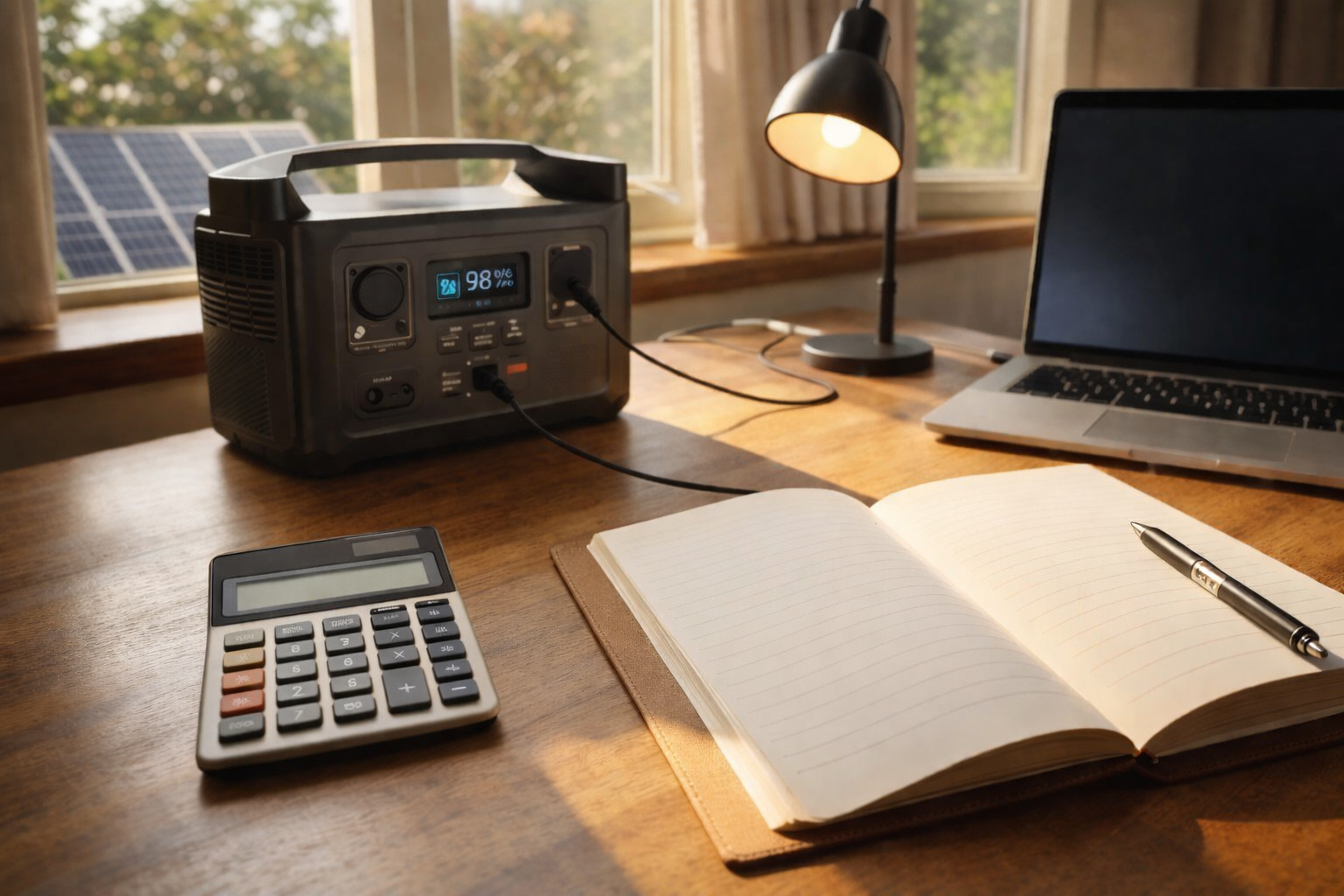
Solar generators are often described as producing free electricity. In practice, the reality is slightly more nuanced.
Once purchased, solar generators are extremely cheap to run — especially if they are regularly charged from solar panels. However, there are still a few real costs to consider, including grid electricity used for charging and the gradual wear of the battery over time.
Understanding these factors helps answer an important question: what are solar generator running costs in the UK?
In this guide we’ll break down the real numbers, including electricity costs, battery lifespan, and the true cost per kilowatt-hour of power.
If you’re new to the technology, you may want to start with our core HomeGrower Guide to Home Solar Generators.
The Short Answer: Solar Generators Are Very Cheap to Run
After the initial purchase, solar generators have very few ongoing costs.
The main running costs come from two sources:
• Electricity used when charging from the grid
• Long-term battery wear over thousands of charge cycles
If a generator is mostly charged from solar panels, the ongoing electricity cost can effectively drop close to zero.
Even when charging from the grid, the cost is simply the same as using electricity anywhere else in your home.
🔌 Example Running Cost (Typical UK Scenario)
Let’s take a common solar generator used in UK homes and garden setups.
EcoFlow Delta 2 (1024Wh battery)
If you charge it fully from the grid:
- Battery capacity: ~1 kWh
- Average UK electricity price (March 2026): ~28p per kWh
A full recharge therefore costs roughly:
≈ 28p
However, UK electricity prices are expected to fall slightly in April 2026, with the energy price cap projected to drop closer to 24.7p per kWh.
That would reduce the cost of a full recharge to around:
≈ 25p
In practical terms, that single charge could power things such as:
- LED grow lights for several hours
- laptops and phones for days
- small appliances or tools
All for roughly 25–30p per charge.
Energy prices in the UK can also change quickly depending on global energy markets. For example, spikes in oil or gas prices can push electricity costs higher, which is one reason some households look at solar generators as a way to reduce exposure to energy price volatility.
If you want to take a look at the current energy price cap, details can be found on the Ofgem energy price cap page.
📉 Smart Tariffs Can Reduce Running Costs Further
Some UK households now use smart electricity tariffs that vary throughout the day depending on wholesale energy prices.
Examples include tariffs such as Octopus Agile or Octopus Tracker.
During periods of low demand — often overnight — electricity prices can fall significantly.
It is not unusual to see prices drop to:
- 10p per kWh or less
- occasionally near zero during periods of high renewable generation
Charging a solar generator overnight at these rates can make grid electricity almost as cheap as solar power.
For households that already use smart tariffs, this can significantly reduce the effective running cost of a generator.
☀️ Charging From Solar: Essentially Free Energy
When charging from solar panels, the electricity itself costs nothing.
The only cost is the initial purchase of the panels.
Once installed, every charge from sunlight is effectively free.
This is why solar generators are popular for setups such as:
- garden offices
- greenhouses
- off-grid sheds
- camper vans
- emergency backup power
In these situations, the generator can recharge during daylight without increasing the household electricity bill.
🔋 The Hidden Efficiency Loss (The “Inverter Tax”)
One detail that many solar generator guides overlook is conversion efficiency.
Solar generators store electricity as DC battery power, but most appliances use AC wall-plug power.
Converting between these two forms of electricity is not perfectly efficient.
Most generators lose around:
15–20% of energy during conversion
In practical terms:
To deliver 1 kWh of usable AC power, the system may need around 1.2 kWh of stored energy.
This is sometimes called the “inverter tax.”
It’s a small detail, but it explains why batteries sometimes appear to drain slightly faster than simple wattage calculations suggest.
Standby Power: The Hidden Battery Drain
Another small detail that many new users overlook is standby power consumption.
When a solar generator’s AC inverter is switched on, it consumes a small amount of electricity even if nothing is plugged in.
Most units use roughly:
5–20 watts of power just to stay active.
That may not sound like much, but over time it adds up.
For example:
- 10W standby draw × 24 hours
- = 240 Wh per day
On a small 1 kWh battery, that could drain around 20–25% of the battery capacity without powering anything.
Pro tip:
If you’re not actively using the AC sockets, turn the inverter off. This avoids unnecessary battery drain and keeps running costs as low as possible.
📊 Cost Per kWh Over the Battery Lifetime
To understand the true running cost of a solar generator, we can spread the purchase price across the battery lifespan.
Example using a modern LFP battery system.
Typical generator price: ~£550
Battery lifespan: 3000 cycles
Battery capacity: 1 kWh
Total lifetime energy production:
3000 kWh
Hardware cost per kWh:
£550 ÷ 3000 ≈ 18p per kWh
Now add grid charging costs:
Grid electricity price: ~28p per kWh
Total cost per kWh if charged from grid:
≈ 46p per kWh
However, if the generator is charged mostly from solar panels, the grid electricity cost disappears — leaving only the 18p hardware cost per kWh.
Over many years of use, solar charging can therefore become significantly cheaper than buying electricity from the grid.
Why Modern LiFePO4 Batteries Changed Solar Generator Economics
Older portable power stations used standard lithium batteries (NMC chemistry). These batteries had much shorter lifespans.
Modern solar generators increasingly use LiFePO4 (LFP) batteries, which can last several times longer.
This dramatically reduces the true cost of electricity produced over the lifetime of the device.
| Battery Type | Typical Unit Cost | Cycle Life | Hardware Cost per Charge |
|---|---|---|---|
| Older lithium (NMC) | £500 | ~500 cycles | ~£1.00 |
| Modern LiFePO4 | £550 | ~3000 cycles | ~£0.18 |
Older lithium (NMC)
£500
~500 cycles
~£1.00
Modern LiFePO4
£550
~3000 cycles
~£0.18
This is one reason modern solar generators have become far more attractive in recent years. Even if the upfront cost is slightly higher, the much longer battery lifespan dramatically reduces the long-term cost per charge.
🌦 How UK Seasons Affect Solar Generator Running Costs
Solar generators behave differently in the UK compared with sunnier parts of the world.
One important factor is seasonal sunlight variation.
Solar panels produce much more electricity in summer than in winter.
For example, a 200W solar panel might generate roughly:
| Season | Typical Daily Output |
|---|---|
| Summer | 800–1000 Wh |
| Spring / Autumn | 300–600 Wh |
| Winter | 50–200 Wh |
Summer
800–1000 Wh
Spring / Autumn
300–600 Wh
Winter
50–200 Wh
In practice this means:
- In summer, even a modest solar panel can recharge a generator most days.
- In spring and autumn, charging is still possible but slower.
- In winter, solar charging may be limited and grid charging may be needed.
This seasonal pattern affects the true running cost of solar generators.
During bright months, most energy may come from solar panels. During winter, more energy may come from the grid.
The “80% Rule” for Solar Panels in the UK
Solar panels are rated under perfect laboratory conditions. In real-world UK conditions, output is usually lower.
Even on a clear day, most panels produce roughly:
70–85% of their rated wattage
This means a 200W solar panel will often deliver closer to:
140–170W in real conditions.
This reduction is caused by factors such as:
- atmospheric haze
- panel temperature
- sub-optimal sun angles
When estimating charging times for a solar generator, it’s sensible to assume roughly 80% of the panel’s rated power.
🌱 Why Solar Generators Still Work Well for Garden Use
Despite lower winter output, solar generators still work well for many home and garden uses.
This is because many outdoor electricity needs occur during the brighter months when solar output is highest.
Examples include:
- powering seedling grow lights in spring
- running irrigation timers
- charging cordless garden tools
- powering equipment in a garden office
In these situations, the generator often produces most of its energy during the same months when it is used most.
For a clearer idea of realistic usage, see our guide on What a Solar Generator Can Power.
What Actually Increases Running Costs?
Solar generators require almost no maintenance, but a few factors can increase long-term costs.
Frequent grid charging
If the generator is rarely charged from solar panels, electricity costs will rise.
Very heavy usage
Using a generator several times per day will gradually reduce battery lifespan.
Low-quality batteries
Older lithium batteries with fewer cycles have a higher long-term cost per kWh.
Modern generators using LFP batteries typically last much longer and reduce this issue.
⚖️ Solar Generator vs Petrol Generator Running Cost Comparison
Many people compare solar generators with traditional petrol generators for backup power.
Here is a simplified comparison using typical UK prices.
| Power Source | Typical Cost per kWh | Ongoing Costs |
|---|---|---|
| Solar generator (solar charged) | ~18p | Battery wear only |
| Solar generator (grid charged) | ~46p | Electricity + battery wear |
| Petrol generator | ~70p – £1+ | Fuel, oil, maintenance |
Solar generator (solar charged)
~18p
Battery wear only
Solar generator (grid charged)
~46p
Electricity + battery wear
Petrol generator
~70p – £1+
Fuel, oil, maintenance
Petrol generators can deliver higher peak power, but they also come with several disadvantages:
- ongoing fuel costs
- engine maintenance
- significant noise
- exhaust fumes
Petrol generators do have one major advantage: they can run continuously as long as fuel is available. Solar generators are limited by battery capacity and must be recharged once the stored energy is used. In practice, this means petrol generators are often better suited to very high power demands or extended outages where continuous power is required.
However, solar generators avoid fuel costs, noise, fumes, and engine maintenance, which makes them a popular option for quieter backup power and everyday use around the home or garden.
Are Solar Generators Cheaper Than Grid Electricity in the UK?
Solar generators do not always beat grid electricity on pure cost — especially if they are frequently charged from the mains.
However, when charged regularly from solar panels, they can produce electricity for far less than typical UK grid prices over the long term.
For many households, the biggest advantages are not just cost but flexibility and independence.
Solar generators can provide:
- backup power during outages
- electricity in sheds or gardens without wiring
- portable off-grid energy for camping or vans
- low-cost solar charging during summer months
This flexibility is what makes them increasingly popular for both homes and garden spaces.
Solar Generator Running Costs UK – Frequently Asked Questions
How much are solar generator running costs in the UK?
Solar generator running costs in the UK are typically very low. Charging a typical 1kWh solar generator from the grid costs around 25–30p based on current UK electricity prices. If the generator is charged using solar panels, solar generator running costs can be even lower because the electricity itself is essentially free once the panels are installed.
Are solar generator running costs in the UK cheaper than petrol generators?
In many situations, solar generator running costs in the UK are lower than running a petrol generator. Petrol generators require fuel, oil, and engine maintenance, which increases ongoing costs. However, petrol generators can run continuously as long as fuel is available, while solar generators are limited by battery capacity and need recharging once the stored energy is used.
Do solar generators increase electricity bills?
Solar generator running costs in the UK only increase electricity bills when the generator is charged from the grid. In that case, the generator simply uses electricity like any other appliance. If the generator is charged from solar panels, solar generator running costs are extremely low because no grid electricity is used.
How long do solar generator batteries last?
Most modern solar generators use LiFePO4 batteries rated for around 3000 charge cycles. Depending on usage, this means many solar generators can last 8–10 years before noticeable battery degradation occurs. This long lifespan helps keep solar generator running costs in the UK low over the lifetime of the device.
📎 Related Articles
- The HomeGrower Guide to Home Solar Generators (UK)
A complete UK guide to home solar generators, explaining how portable power stations work, realistic use cases, sizing, limitations, safety, and how they fit into self-sufficient living.
- Solar Generator Safety
A practical guide to using solar generators safely in UK homes and gardens, covering ventilation, battery care, charging safety, and common mistakes to avoid.
- Best Type of Backup Generator for Home Use?
A comparison of backup generator options for UK homes, including solar generators, petrol models, and other systems, helping you choose the right solution for outages and emergency power.