
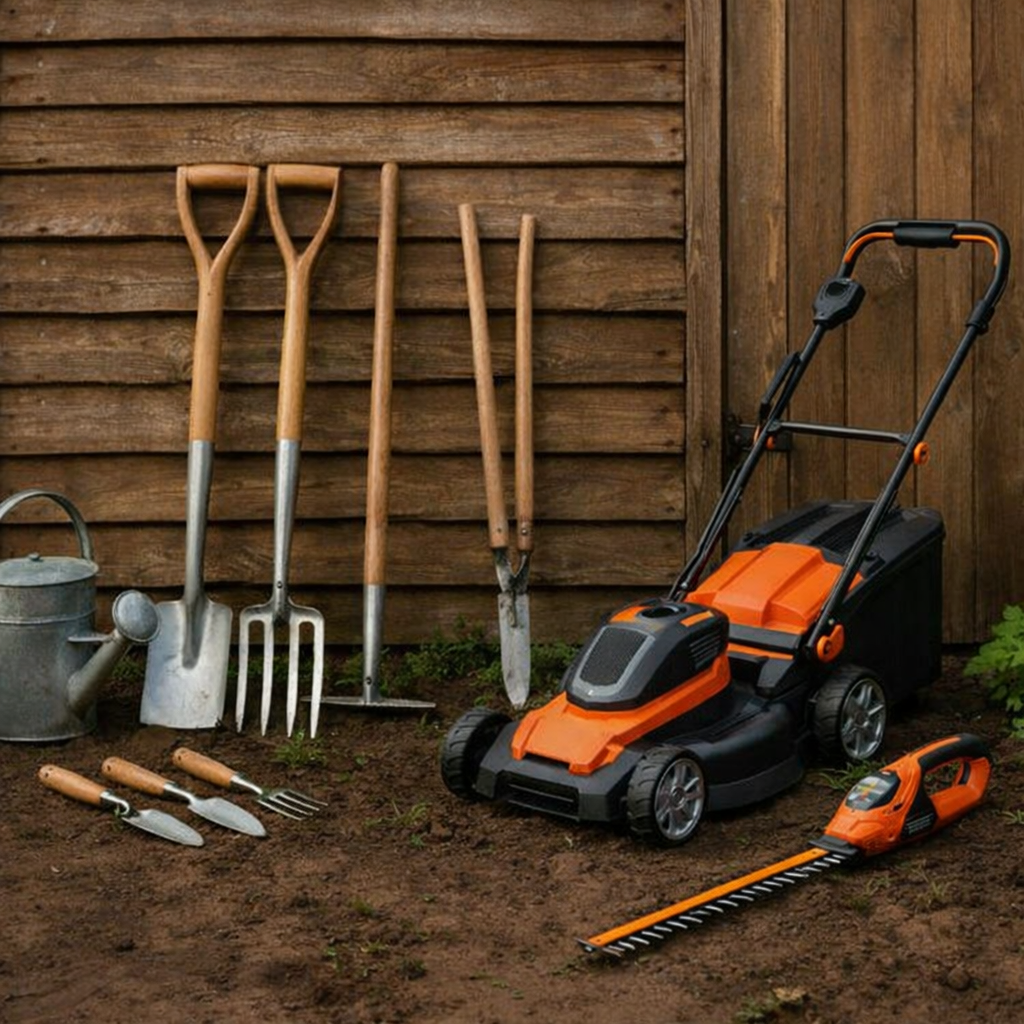
Most of us in the UK aren’t working with massive plots or perfect weather. We’re fitting gardening around work, family, and energy levels — usually with a modest garden, a small shed, and a fair bit of making do.
In that reality, tools either help you get the job done or quietly become the reason you put it off. A blunt pair of shears or a battery that’s always flat isn’t just annoying — it’s what turns simple jobs into chores and drains the enjoyment out of gardening.
This guide to garden tools and equipment isn’t interested in the latest shiny gadget. It’s about setting up a system of garden tools that actually works for your space, your routines, and our unpredictable climate — tools you buy once, look after, and rely on year after year through British winters.
This post focuses on how garden tools fit together as a system. If you’re looking for specific tool guides and hands-on reviews, they’re organised in the Garden Tools and Equipment UK hub.
🌿 What garden tools and equipment are actually used for in UK gardens
In practice, most garden work in the UK repeats the same few patterns:
- Managing growth rather than creating it
- Maintaining edges, access, and boundaries
- Moving organic material — soil, compost, clippings, leaves
- Resetting spaces seasonally rather than rebuilding them
Tools exist to reduce friction in these tasks. A good tool doesn’t transform a garden — it makes routine work calmer, safer, and more repeatable.
In smaller UK gardens especially, tools are rarely used at full capacity. Control, precision, and ease of handling matter more than power. A tool that comes out often and does its job quietly is more valuable than one that promises speed but rarely leaves storage.
🛠️ Hand tools vs powered tools: where each still matters
Powered tools are often framed as upgrades. In reality, they serve different roles.
Hand tools remain central where:
- Precision matters more than speed
- Space is tight or awkward
- Soil, plants, and paths overlap closely
- Noise and access are constraints
Powered tools earn their place when:
- Tasks are repetitive and time-heavy
- Physical strain becomes the limiting factor
- Growth needs regular control (lawns, hedges, edges)
Most well-run UK gardens rely on both. Problems arise when tools begin shaping decisions — cutting too often, trimming for convenience, or avoiding certain tasks entirely because the tools make them awkward.
A simple way to sense-check whether tools are supporting the garden — or starting to drive it — is to compare how different tool types behave in real UK conditions:
| Decision factor | Hand tools | Powered (corded) | Powered (cordless) |
|---|---|---|---|
| Best suited to | Precision, small spaces | Heavy, static work | Speed, frequent use |
| UK weather tolerance | All-weather | Avoid damp/rain | Moisture sensitive |
| Storage needs | Minimal | High (cables, reels) | Medium (charging space) |
| Longevity | Decades | High (motor life) | Medium (battery life) |
The aim isn’t to “upgrade” — it’s to balance effort, control, and sustainability.
⚡ Corded vs cordless tools: safety, reality, and why many UK gardens have moved on
On paper, corded tools still offer consistency and unlimited runtime. In practice, they introduce friction — and in UK gardens, that friction often shows up as safety concerns as much as inconvenience.
Trailing cables across damp grass, uneven paving, or tight borders increases the risk of trips, accidental cuts, and rushed setups. Even when used carefully, cords encourage compromises: avoiding certain areas, working in poorer weather than planned, or leaving jobs half-finished because setup feels like effort.
Cordless tools remove much of that friction. The benefits aren’t about raw power — they’re about how garden work actually happens:
- Faster, calmer setup for short jobs
- No cables underfoot or near cutting areas
- Easier movement around small, enclosed gardens
- Fewer safety trade-offs in damp or awkward conditions
For those reasons, I’ve personally moved almost entirely to cordless battery-powered tools for routine garden work. Not because they’re perfect, but because they make it easier to work safely, regularly, and without overthinking the setup. Tools that feel easy to use tend to get used — and that matters more than theoretical performance.
⛽ Battery vs petrol: where the balance has shifted
Petrol tools once dominated where power and endurance mattered. In large or commercial settings, they still have a role. In typical UK home gardens, however, they now come with downsides that are harder to justify:
- Noise and vibration
- Cold starts and maintenance overhead
- Fuel storage and degradation
- Emissions and restrictions in residential areas
Modern battery tools don’t replace petrol by matching it outright — they replace it by removing barriers. For most domestic workloads, the trade-off favours quieter operation, lower maintenance, and tools that can be picked up and used without preparation.
As with corded versus cordless, the decision isn’t about specifications. It’s about which tools support consistent, safe garden care without turning routine work into a production.
⚙️ Battery systems, compatibility, and long-term ownership
For many UK gardeners, the real commitment isn’t to individual tools — it’s to a battery ecosystem.
Once several tools share batteries and chargers, you’ve effectively built a small energy system. That system affects:
- Storage layout
- Charging habits
- Replacement costs
- How easily tools can be added or retired
This is why thinking in terms of platforms matters more than chasing features. Tools will wear out. Batteries will age. Systems that grow slowly and deliberately tend to remain usable far longer than those built reactively.
If you want a deeper look at how shared battery platforms shape long-term ownership, the Power Share Battery Systems Compared guide explores this from a system perspective rather than a product one.
For context, I’ve personally settled on a single cordless battery platform for my own garden tools, rather than mixing systems. In my case, that’s been the Worx PowerShare system — largely because it’s struck a workable balance between price, performance, and tool range for a typical UK garden.
That choice isn’t a recommendation so much as an example of how committing to one platform simplifies storage, charging, and long-term ownership once you start building a tool system over time.
📏 Tool choice vs garden size and workload
Garden size alone is a poor predictor of tool needs.
What matters more is:
- How intensively the space is used
- How fast growth needs managing
- Layout, access, and storage constraints
- How much time and physical energy you realistically have
A small garden with fast-growing hedges can demand more from tools than a larger, slower-moving space. Oversized tools add fatigue and storage problems. Undersized tools quietly increase strain over time.
Tools work best when sized to workload, not aspiration — especially in gardens designed for steady, long-term care.
🧰 Storage, maintenance, and safety in real UK homes
In practice, storage is often the limiting factor.
Sheds, garages, cupboards, and under-stairs spaces determine which tools actually get used. Good storage isn’t about neatness — it’s about reducing friction, preventing damage, and making safe handling automatic, particularly when tools are kept in garden sheds.
In many UK gardens, damp sheds and unheated garages are particularly hard on lithium-ion batteries over winter. Even when tools themselves are rarely used, cold and moisture quietly shorten battery life. Keeping batteries dry and frost-free often matters more than small differences between tool models.
Maintenance follows naturally from this. Clean tools last longer. Dry storage prevents corrosion. Simple routines beat occasional deep cleans. If you want a practical walkthrough of how to maintain cordless garden tools properly in UK conditions, see our maintenance guide.
🌱 Tools, self-sufficiency, and long-term garden care
Self-sufficiency isn’t about owning more equipment. It’s about reducing dependency on urgency, replacement, and outside intervention.
Well-chosen tools support:
- Consistent maintenance rather than bursts of effort
- Soil care, compost handling, and food growing
- Adaptation as seasons and needs change
Over time, the most valuable tools become almost invisible. They don’t demand attention — they quietly enable work to happen when it needs to.
🌿 A final thought on tools and time
The best garden tools aren’t the newest or the most powerful. They’re the ones that still work — physically and mentally — years down the line.
When tools fit your space, your routines, and your body, they stop feeling like equipment and start feeling like part of the garden itself. That’s when gardening becomes steadier, calmer, and more sustainable — not because you bought better tools, but because you built a system that respects how you actually live.