
When you purchase through links on our site, we may earn an affiliate commission at no extra cost to you.
If you want to collect rainwater in a UK garden, you don’t need to overthink it. Most water butts are very similar — the key is choosing the right size and shape for your space, not chasing brands or expensive designs.
You’ll see a lot of unbranded options online, but the reality is simple: a well-placed, properly installed budget water butt will usually perform just as well as a more expensive ‘premium’ one.
In this guide, we’ll show you some of the best water butts you can buy — from simple budget options to more premium designs, where you’re mostly paying for looks and space-saving shape rather than performance.
If you’re new to water butts, I’ve also put together a step-by-step guide on how to set one up properly — including positioning, levelling, and common mistakes to avoid.
🏆 Best Water Butts for UK Gardens
If you’re setting up a water butt in a UK garden, these are the options that make the most sense in real-world use — from simple budget setups to larger capacity and premium designs.
Typical price: ~£50–£70
Typical price: ~£30–£40
Typical price: ~£55–£70
Typical price: ~£200–£250
Here’s how the main options compare at a glance:
| Model | Capacity | Best For | Footprint | Kit? |
|---|---|---|---|---|
| Ward / Strata | 250L | Most UK gardens | ~60cm (round) | Usually no |
| Slimline Kit | 100L | Sheds & tight spaces | ~35–40cm | Yes |
| Barrel Kit | 210L | All-in-one setup | ~60cm | Yes |
| Tower | 350L+ | Patios & aesthetics | Tall, narrow | Varies |
By the time you add these separately, you can easily spend an extra £15–£25.
That’s why complete kits (like the slimline or barrel options above) are often the simpler — and sometimes cheaper — choice overall.
#1 Pick: Ward / Strata 250L Water Butt (Best for Most UK Gardens)

If you just want the straightforward answer, the Ward / Strata 250L is the one most UK gardens end up using — and for good reason. Just be aware it’s often sold as the tank only, so you’ll usually need to add a stand and diverter kit separately.
You’ll see these everywhere — from B&Q to local garden centres across the UK. “Ward” and “Strata” are often the same product under the same parent company, and there’s a reason they’re so common.
They aren’t fancy, but they’re the kind of thing you’ll see in gardens all over the UK — simple, durable, and built to just get on with the job
- 250L capacity — ideal for typical UK rainfall
- Simple, proven design
- Widely available and reliable
- Easy to position next to sheds, fences, or walls
In practice, a 250L butt like this will fill surprisingly quickly off a typical house roof — often after just a couple of decent rainy days.
Note: These are often sold as the tank only. You’ll usually need to add a stand and diverter kit separately.
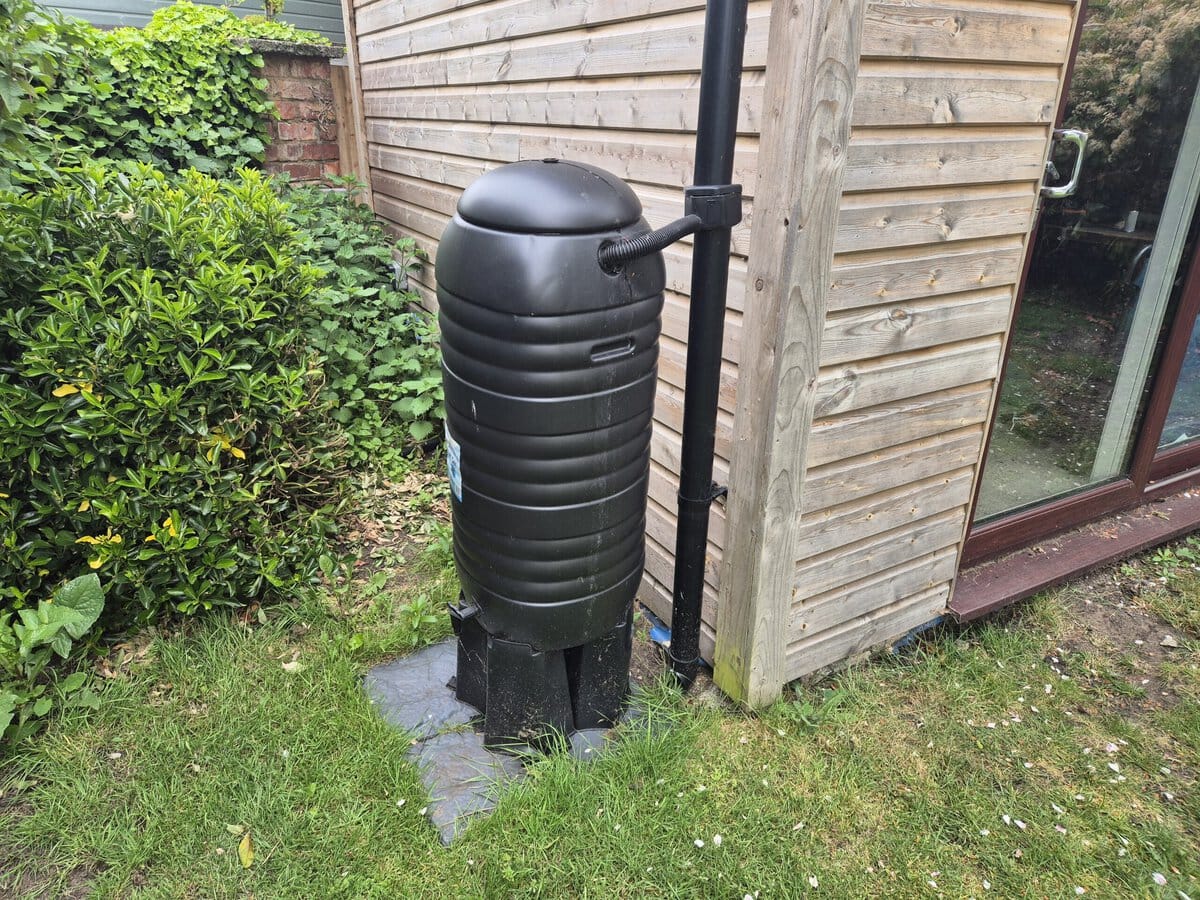
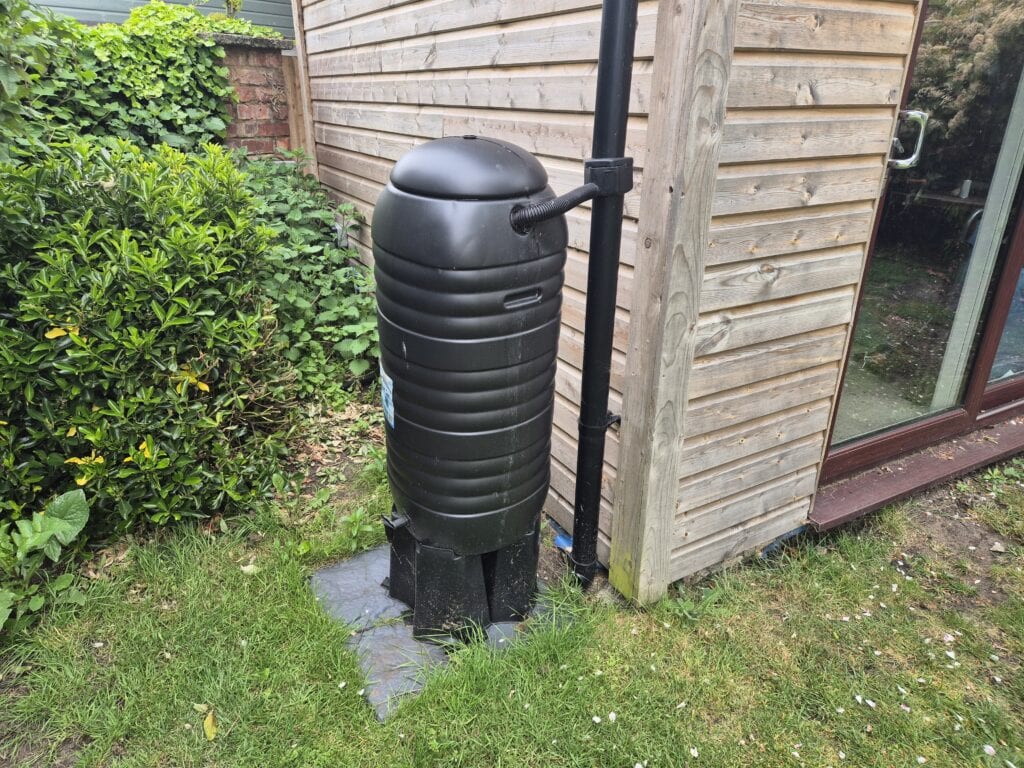
Best for Small Spaces: 100L Slimline Water Butt Kit

If you’re working with a narrow wall, patio, or side return, a 100L slimline water butt is usually the easiest option.
They’re also ideal for sheds. A standard 6×4 shed roof can fill a 100L butt in a single night of heavy UK rain — which is why this size works so well in practice.
In day-to-day use, you’ll tend to use most of that capacity. With a larger 250L tank, you often won’t fill or use the full volume — so much of the extra capacity goes unused.
- Narrow footprint — fits tight spaces
- Usually includes a full kit
- Easy to set up for first-time setups
Real-world tip:
The included stands on slimline kits are often lightweight, clip-together designs. They can feel a bit leggy or unstable. If you can, place it directly on paving slabs rather than soil — it makes a big difference to stability over time.
Make sure the base is perfectly level (ideally paving slabs). A tall, narrow tank holding 100kg of water on uneven ground is surprisingly easy to tip.
Best Complete Kit (All-in-One Setup): 210L Barrel Water Butt Kit

If you’d rather keep things simple, a standard 200–210L barrel kit is a straightforward all-in-one option.
These are the classic round water butts seen in UK gardens — simple, effective, and widely available.
- Good capacity for regular watering
- Often includes a full setup kit (stand, tap, and diverter)
- Easy to install without sourcing extra parts
They do take up more horizontal space, so they’re better suited to open areas rather than tight walls.
Best Premium Option: Tower Water Butt (350–450L)

Tower-style water butts are designed mainly for appearance and space efficiency.
- Large capacity in a smaller footprint
- Modern, cleaner look
- Better suited to visible areas like patios and walls
The one practical advantage? Gravity.
Because they’re taller, you get slightly better flow from the tap due to the extra head pressure — simply the weight of water above it.
That said, they don’t collect rainwater any differently — so you’re mostly paying for the design and shape rather than improved performance. They make the most sense where space is tight or where the water butt will be on display
Quick Comparison
- Ward / Strata (250L): Best overall — medium footprint (~60cm), usually tank only
- Slimline kit (100L): Narrow (~35–40cm) — best for small spaces and sheds, full kit included
- Barrel kit (210L): Medium footprint (~60cm) — best all-in-one setup, full kit included
- Tower (350–450L): Tall and narrow — best for patios and aesthetics
Watch Out: “Kit” vs “Tank Only”
This is where most people get caught out.
Some listings only include the tank — no tap, no diverter, no stand. Buying these separately can easily add £15–£20 to the total cost.
If you want a simple setup, look for a full kit to avoid the hassle of buying parts seperately.
What Size Water Butt Do You Actually Need?
For most UK homes, a 100–250L water butt is a good starting point, but the right size depends just as much on how much you garden as your space.
UK rainfall means even small butts can fill quickly when it rains — especially when connected to a typical house roof — but longer dry spells and heavier watering can empty them just as fast.
- 100L: Light use — small gardens, patios, or occasional watering
- 200–250L: Most homes — a good balance for regular watering
- 300L+: Keen gardeners — larger gardens, frequent watering, or making the most of wetter periods
One Upgrade Worth Knowing About
Most standard water butts come with a basic plastic tap. These can be stiff to turn — especially with cold or wet hands — and often only give a slow trickle.
If you plan to connect a hose, it’s worth upgrading to a brass 3/4″ ball valve tap. This lets you clip a Hozelock connector straight on, so you can run a short hose to nearby pots instead of carrying a watering can.
It’s a small upgrade, but it makes everyday use much easier.
Are Expensive Water Butts Worth It?
In most cases, no.
More expensive models don’t collect more water — they simply:
- Look better
- Fit differently in your space
- Offer larger capacity
A basic water butt installed properly will almost always outperform an expensive one installed poorly.
Setup Matters More Than the Model
The biggest difference isn’t the water butt — it’s how you install it.
If you’re not sure how to set one up, see our full step-by-step guide on how to set up a water butt.
Getting the base level, height right, and diverter properly fitted makes far more difference than the model you choose.
Final Thoughts
Water butts are one of the simplest and most effective upgrades you can make to a garden.
You don’t need premium designs or big brands — just choose the right size, set it up properly, and it will quietly get on with it’s job for years.
For most people, a straightforward 200–250L model is all you need.
If you want a broader overview, the RHS has a useful guide to water butts and rainwater collection worth a look.
FAQs
What size water butt do I need?
For most UK homes, a 100–250L water butt is enough. The best water butts for smaller gardens or sheds tend to be around 100L, while regular watering or larger spaces benefit from 200–250L or more.
Do water butts fill quickly in the UK?
Yes — even the best water butts can fill quickly during periods of rain, especially when connected to a house roof. However, longer dry spells mean stored water can also be used up quickly.
Do I need a stand for a water butt?
A stand isn’t essential, but it makes it much easier to fill watering cans and improves flow from the tap. Many of the best water butts either include a stand or can be easily paired with one.
Are expensive water butts worth it?
In most cases, no. The best water butts are usually simple, well-placed models that match your space, rather than expensive designs. Premium options mainly offer improved looks or space-saving shapes.