
This page may contain affiliate links. If you choose to buy through them, HomeGrower may earn a small commission at no extra cost to you.
Growing seedlings indoors in the UK early in the year isn’t as simple as putting them on a windowsill and hoping for the best. In January and February, natural light levels are low, days are short, and even a bright window often isn’t enough to stop young plants becoming leggy and weak. By March, you can get the occasional sunny day, but it often turns out to be a “false spring” — followed by long stretches of grey weather that still don’t provide enough consistent light.
This SANSI grow light bulb review is based on my testing at home in the UK, where I wanted to get a head start with seedlings without investing straight away in a full grow light setup.
After a bit of research, I decided to try the SANSI grow light bulb (E27) — a simple, low-cost option that screws into a standard lamp. No fixtures, no complicated setup — just a bulb I could use with a floor lamp I already had in the house.
It meant I could start testing it immediately in a real home environment, rather than building a dedicated indoor growing setup first.
I tested the 10W version, which is best suited to seedlings and small indoor setups — and its limitations become clear as plants grow. There are higher wattage versions of this bulb that are more capable, which I’ll cover in a later review.
If you’re new to grow lights, this kind of setup sits at the very simple end of the scale — and I’ve broken down the different types in more detail in my HomeGrower Guide to Grow Lights.
🌿 Our Quick Verdict
★★★★☆
A simple E27 grow light bulb that works well for seedlings and small indoor setups — but limited coverage means it’s not suited to larger trays or growing areas.
After testing the SANSI 10W grow light bulb in my own home, I’d rate it 4 out of 5 stars for my use. It’s an easy way to get started with indoor growing, especially if you want something that just screws into a normal lamp without needing a full grow light setup. Used at the right distance and with some thought around positioning, it performs well for seedlings and early growth.
- Simple E27 bulb — works with standard lamps
- Clean white light (no harsh purple glow)
- Good for seedlings and small indoor setups
- Easy to position and start using immediately
- Works best with reflective surroundings
- Limited coverage — light drops off quickly at the edges
Best for: seedlings, small trays, and simple indoor growing setups in UK homes
Avoid if: you need to light larger trays, multiple plants, or a wider growing area
If you want a simple, low-cost way to support seedlings indoors without setting up a full grow light system, this is where it makes the most sense:
See the SANSI 10W Grow Light Bulb on Amazon UK
What This Bulb Is Like to Use
The SANSI grow light bulb (E27) is one of the simplest ways to get started with indoor growing. It’s just a standard screw-in bulb, which means you can use it in a normal lamp without needing a dedicated grow light setup.
That simplicity is a big part of the appeal. You can set it up in minutes, move it around easily, and fit it into a normal home environment without it feeling like a full indoor growing system.
It also produces a clean white light (around 4000K), so it looks much more like normal lighting compared to the purple glow you get from some grow lights. That makes it far easier to live with indoors.
One of the big advantages of that is simply usability. It doesn’t turn a room purple, and you can actually see your plants properly — which makes it much easier to spot things like yellowing leaves or early pest issues.
However, it’s important to be clear about what this is not.
This isn’t a full grow light system, and it’s not designed to evenly light a large area. It behaves more like a focused spotlight than a wide panel, which means it works best over a small space — such as a seed tray or a single plant.
In practice, that means it’s ideal for:
- Seedlings and early growth
- Small pots or individual plants
- Supplementing weak natural light indoors
But it’s not well suited to:
- Larger trays or multiple plants spread out
- Full indoor growing setups
- Situations where you need even coverage across a wider area
If you go in expecting a simple, targeted light source, it works well. If you expect it to behave like a full grow light, you’ll be disappointed.
If at this point you’re thinking you might need something with more coverage or power, I’ve compared the best LED grow lights in the UK in a separate guide — including options that are far better suited to larger trays and more consistent indoor growing.
If you’re working to a tighter budget, there are also cheaper options that offer wider coverage than this bulb, which I’ve covered in my guide to the best cheap grow lights.
Key Specs
The SANSI 10W bulb is marketed with a few key specifications — but what matters is how those translate into real use.
- 10W (150W equivalent)
The “150W equivalent” is mostly a marketing comparison to traditional bulbs. What matters in practice is that this is a relatively low-power grow light, which is why it works best at close range. - 4000K full spectrum light
This is why the bulb looks like normal white light rather than purple. It’s much easier to use in a home environment, and still suitable for supporting plant growth. - PPF: 16 μmol/s
This is a measure of how much usable light the bulb produces for plants. In simple terms, it’s on the lower side — which matches what I saw in practice. It’s enough for seedlings, but not strong enough to cover a large area. - 60° beam angle
This is one of the most important specs. It means the light is quite focused, which explains why it’s strong directly underneath the bulb but drops off quickly at the edges. This is exactly what I found when using it over a larger tray. - Coverage: around 2 x 1 ft (veg stage)
This is a theoretical figure under ideal conditions. In real use, coverage is more limited unless you position the light carefully and use reflective surroundings to make the most of it.
Which SANSI Bulb Should You Choose?
At this point, the main question becomes whether the 10W bulb is enough for your setup, or if it’s worth stepping up to a higher wattage version.
The difference isn’t just brightness — it’s how much area you can realistically cover and how precisely you need to position the light. The 10W works well in a small, controlled space, but the higher wattage bulbs give you more flexibility as your plants grow.
Here’s how they compare in real use:
| Use Case | 10W (Tested Here) | Higher Wattage (24W–40W) |
|---|---|---|
| Best for | One seed tray or a couple of plants | Larger trays or multiple plants |
| Distance | 10–20 cm (needs to be close) | 30–50 cm (more flexibility) |
| Coverage | Small, focused area | Much wider usable area |
| Ease of setup | Very simple, low cost | Slightly more setup needed |
| Overall | Good starting point | Better long-term solution |
How I Set It Up (And Tested It in a Real UK Home)
Rather than setting this up once and leaving it, I ended up trying a few different positions and environments around the house to see what actually worked best.
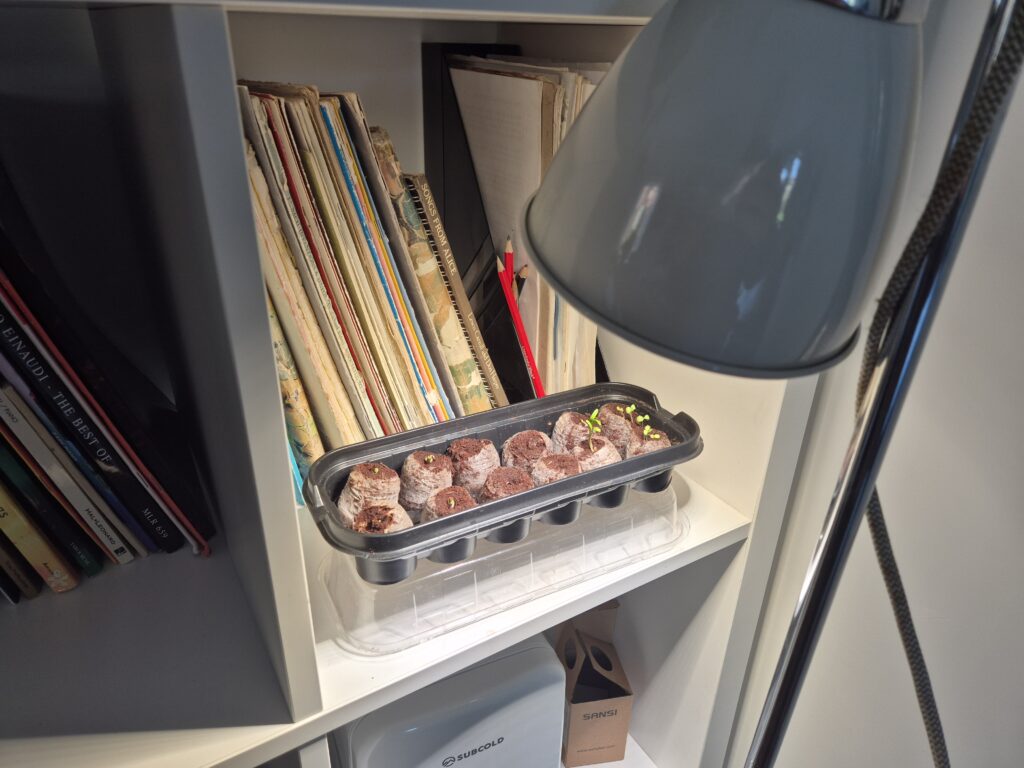
I started by using the SANSI bulb in a tall floor lamp, with my seedlings placed on a shelf unit. This worked reasonably well, mainly because the shelves were white, which helped reflect light back onto the plants. Even with a relatively low-powered bulb, that made a noticeable difference.
However, the main issue with this setup was control. Adjusting the height of the light was awkward (see how I had to raise up the tray by placing it on the lid), which made it difficult to keep the bulb at a consistent distance as the seedlings grew.
To improve that, I switched to an adjustable desk-style lamp (the kind with an articulated arm). This made a big difference straight away, as I could position the bulb much more precisely and control the distance properly. I even ended up measuring the distance to keep things consistent, which is more important than it might sound with a bulb like this.
One thing I noticed with this setup is that the bulb is quite heavy due to the ceramic heat sink. On lighter desk lamps, especially spring-loaded ones, the head can start to droop slightly over time — so it’s worth using a lamp with a solid adjustment mechanism if you want to keep the positioning accurate.
The other downside of this setup was the environment. Placing the seedlings on a wooden floor meant there was very little light being reflected back onto the plants, so overall efficiency dropped compared to the white shelf. That’s something I found consistently — even simple white surfaces make a noticeable difference by reflecting light back onto the plants, so adding some white backing behind the tray is an easy way to improve things.
In the end, the best results came from combining both ideas.
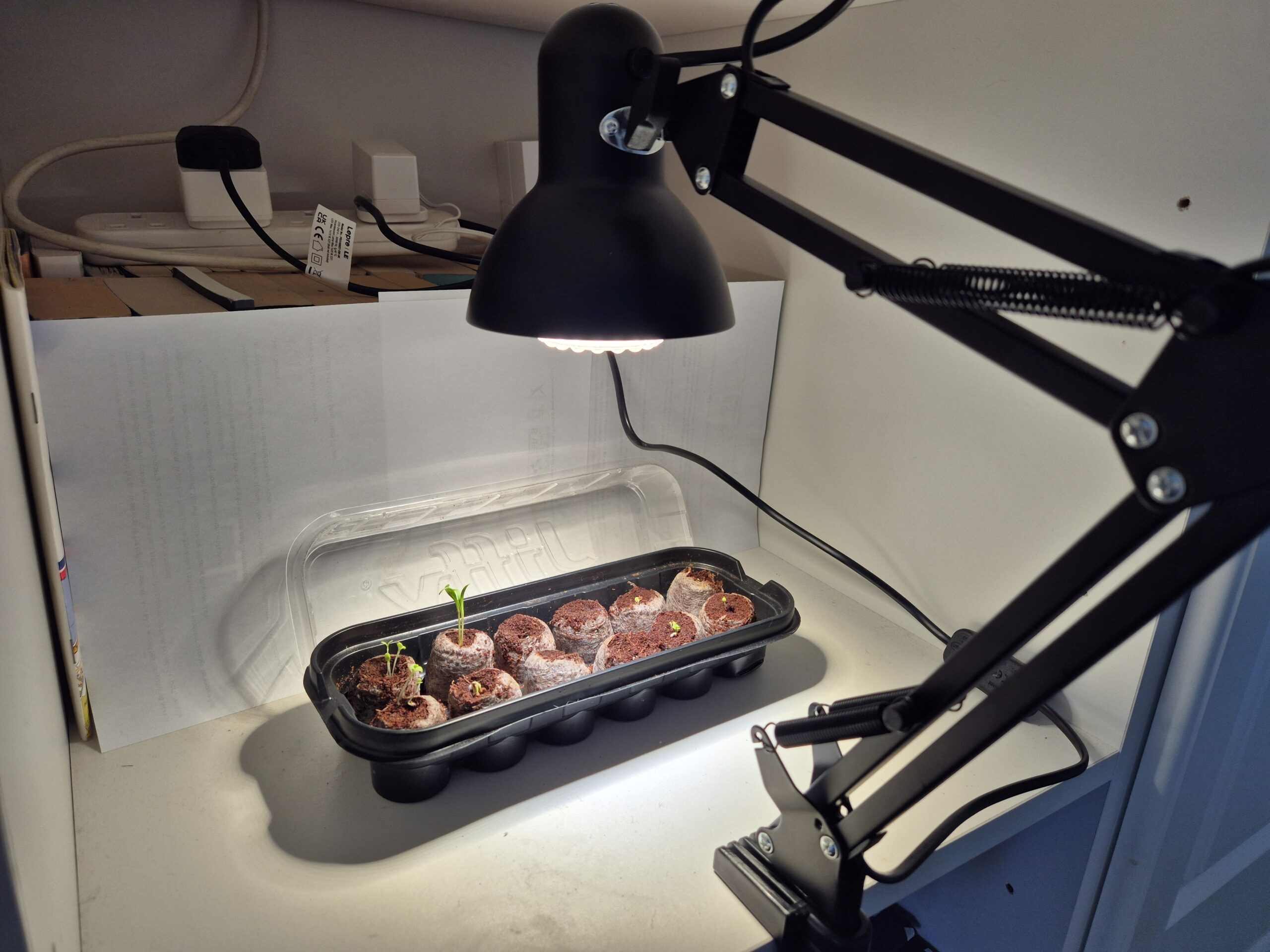
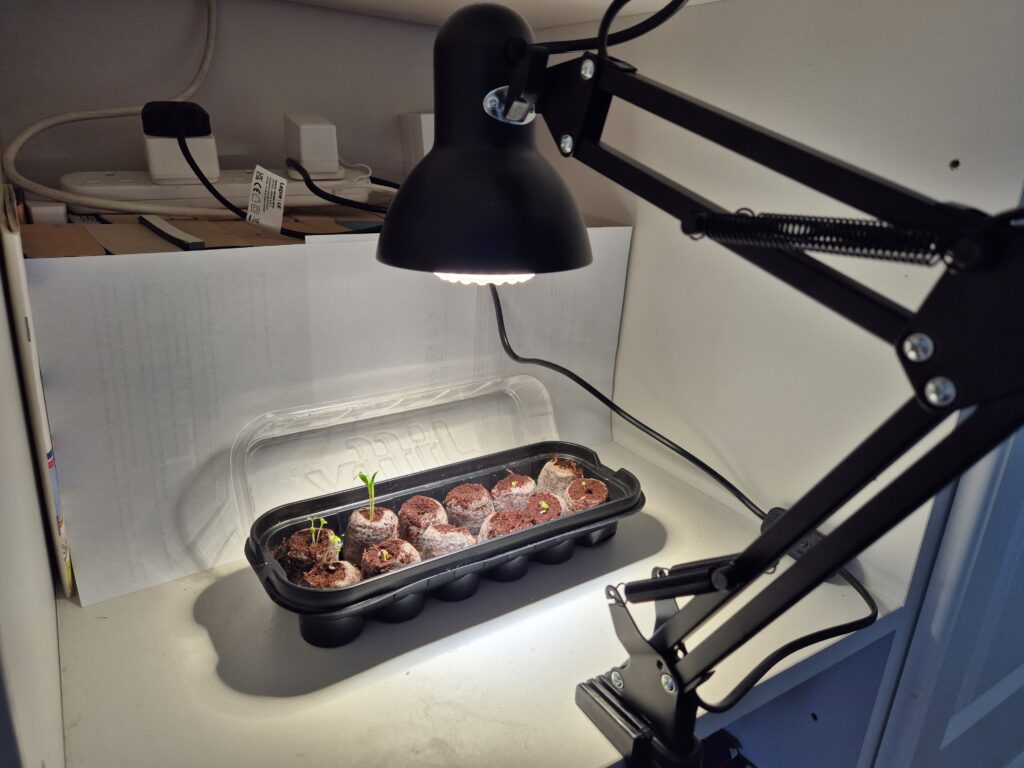
I used the adjustable lamp for proper positioning, but clamped it onto a shelf unit and added white backing (using paper behind the plants) to improve reflection. This gave me much better control over distance while also making the most of the available light.
That final setup felt far more consistent and practical for everyday use — and it’s the one I’d recommend if you’re using a bulb like this, as shown in the image at the top of the article.
Distance & Positioning (What Actually Matters)
One of the biggest factors with a bulb like this is distance — and it makes far more difference than most people expect.
Because the SANSI 10W bulb isn’t especially powerful, it needs to be positioned fairly close to your plants to have any real effect. If it’s too far away, seedlings will start to stretch and become weak very quickly.
That’s why I ended up being quite deliberate about positioning. Using an adjustable lamp made it much easier to keep the light at a consistent height, and I even measured the distance rather than guessing.
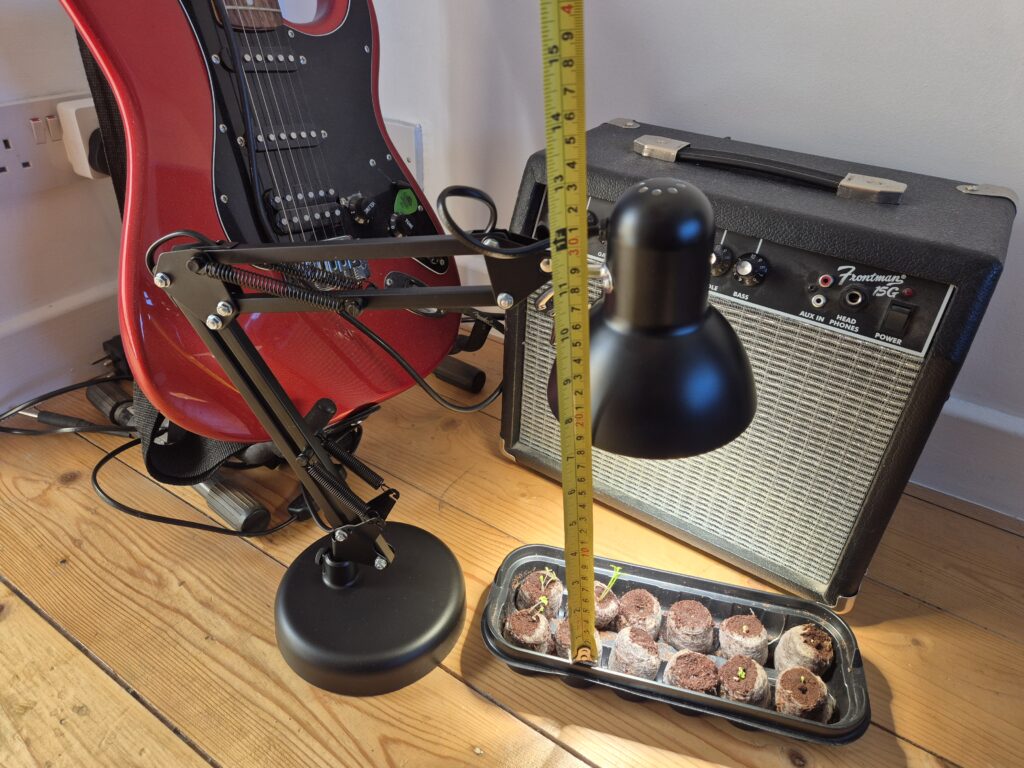
Measuring distance properly — small adjustments make a big difference with lower-powered grow bulbs.
In practice, I found the sweet spot was roughly 10–20 cm above the seedlings.
- At around 10–15 cm, the light is strong enough to support compact, healthy growth
- Closer than that, and you start to reduce coverage too much
- Beyond 20 cm, the light quickly loses effectiveness and seedlings begin to stretch
That last point is important.
Because the light is quite focused (due to the beam angle), bringing it closer improves intensity but reduces coverage. So you’re always balancing:
- enough light strength
- against how much area you’re trying to cover
This is where the limitations of the 10W version start to show. You can get good results, but only within a fairly small, controlled space.
It’s also where positioning and environment start to matter more. Using reflective surfaces (like white shelves or backing) helps make the most of the available light, while darker surroundings reduce its effectiveness.
If you like the simplicity of the SANSI bulb format but need much more coverage than the 10W offers, the 40W version is a major step up on paper, with claimed veg coverage of 9.2 sq ft versus 2 sq ft for the 10W. This would enable you to cast light over more than 4 times the area, covering several seedling trays or plants. Follow the link below and you will be able to take a look at the various sizes of Sansi Bulbs available.


Results (What Growth Was Actually Like)
In terms of results, the SANSI 10W bulb did what I wanted it to do — it supported early seedling growth well, especially compared to relying on natural light alone in January and February.
Seedlings germinated reliably and grew steadily when the light was positioned correctly. Keeping the bulb within that 10–20 cm range made a noticeable difference, and the plants stayed reasonably compact rather than stretching excessively.
For small trays and early stages, it worked.
Where things started to change was as the seedlings developed and needed more space.
I moved them into a larger trough once they had established, which is where the limitations of this bulb became much more obvious.
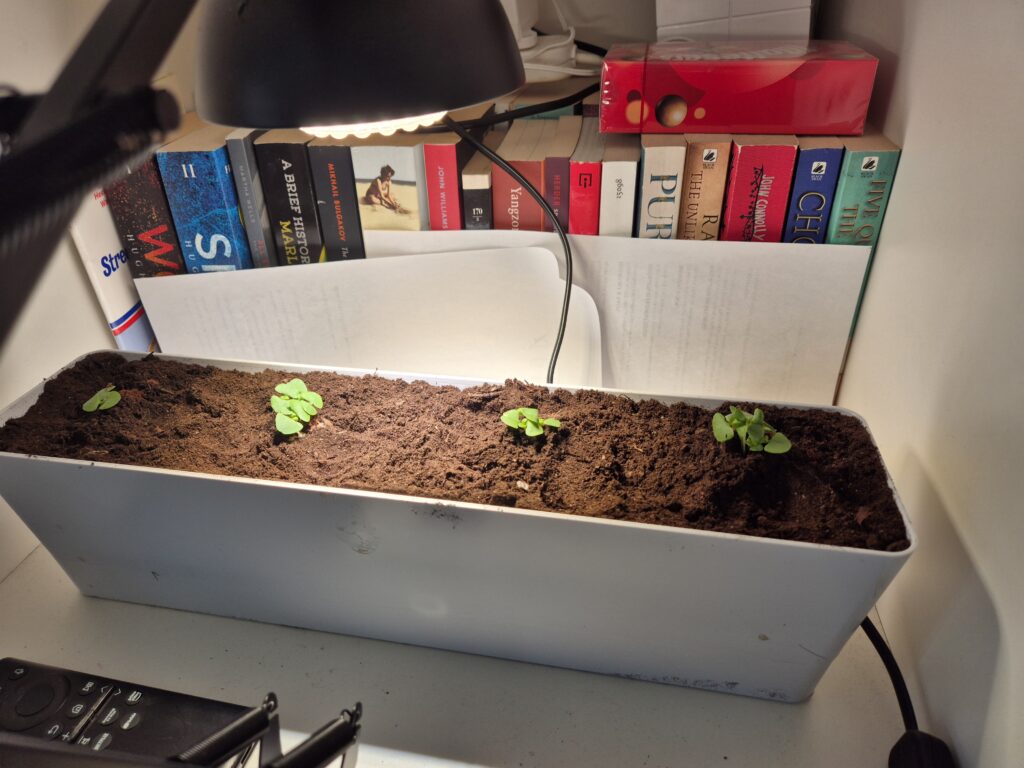
The light simply doesn’t spread far enough. You get a strong central area directly under the bulb, but it drops off quite quickly towards the edges. That meant the plants at the sides weren’t getting the same level of light as those in the middle.
At that point, I had to adapt the setup.
Some of the seedlings (like lettuce, spinach, and chives) were moved into the conservatory, where they could handle cooler conditions and benefit from natural light instead. I have carried on using the sansi grow light here on one set of seedlings for the first half of that day (conservatory faces in a more northerly direction) to give it boost and will later compare with the unboosted seedlings here.
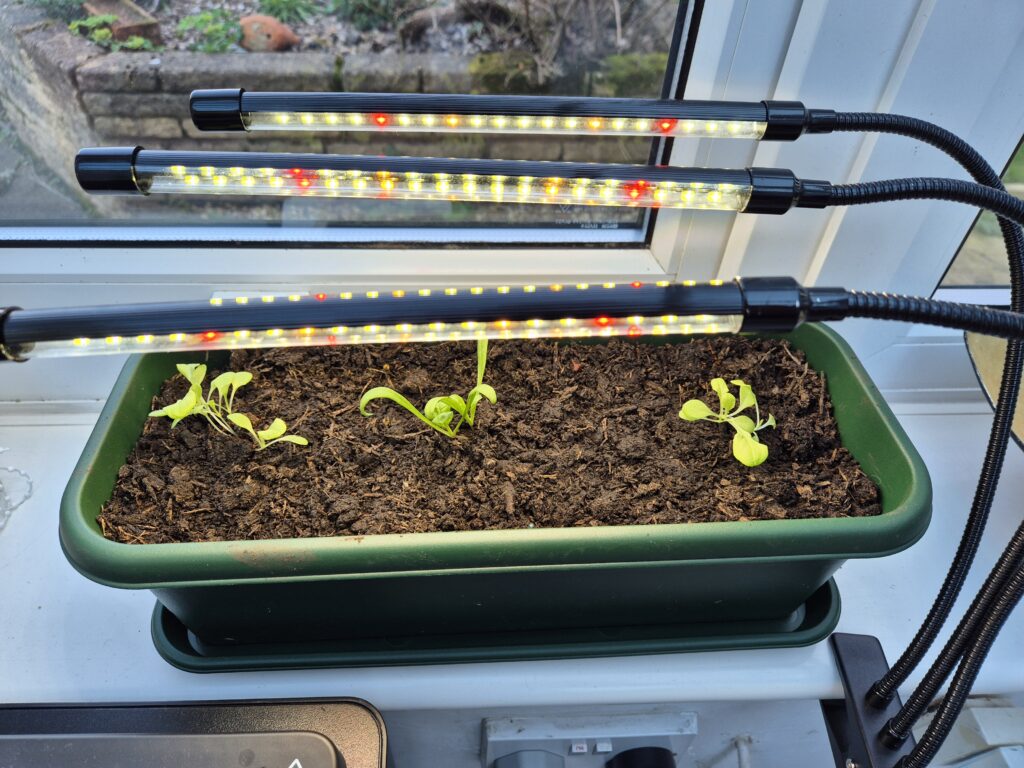
For more light-sensitive plants like basil, I have switched to my Wolezek goosneck grow light as this gives a more even and wider light coverage as shown in the image below. For more details, you can read my Wolezek Goosneck Grow Light Review.
Who This Is For (And Who It Isn’t)
The SANSI 10W grow light bulb makes the most sense if you’re looking for a simple, low-cost way to support early plant growth indoors.
It works particularly well if you:
- want to start seedlings earlier in the year in the UK
- only need to light a small tray or a couple of plants
- prefer a simple setup using a normal lamp
- are happy to position the light carefully for best results
It’s also a good option if you don’t want a full grow light setup in your home. The white light and compact design make it much easier to live with day-to-day.
However, it’s not the right choice if you:
- need to light a larger tray or multiple plants evenly
- want a more “set and forget” system
- are planning a more serious indoor growing setup
One small but important limitation is that the bulb itself doesn’t include any kind of timer.
In practice, that means you either need to switch it on and off manually, or use something external. I used a smart plug for this, which made it easy to automate the light cycle without changing the setup — I’ve covered that in more detail in my Tapo P110 smart plug review.
Running a 10W bulb for 10–12 hours a day costs very little, but using a smart plug like the Tapo P110 lets you automate the light cycle and track exactly how much energy it’s using.
Should You Buy the SANSI Grow Light Bulb?
The SANSI 10W grow light bulb is a good fit if you want a simple way to support seedlings indoors without setting up a full grow light system.
In a small, controlled setup, it works. Used close to the plants and with some thought around positioning, it’s enough to get seedlings started and keep them growing steadily through the darker months.
But it’s not a solution that scales.
As soon as your plants grow larger or spread out, the limits become clear. The light is too focused to cover a full tray evenly, and you either need to move plants around, split them into different spaces, or switch to something more powerful.
That’s exactly how I ended up using it — a straightforward starting point for early growth, before moving on to a larger light where coverage became more important.
If you’re expecting a simple, targeted light for seedlings, it makes sense.
If you’re planning to grow more than that, it’s better to start with something more capable.
📎 Related Articles
SANSI Grow Light Bulb Review: FAQs
Is the SANSI grow light bulb good for seedlings?
Yes — in this SANSI grow light bulb review, the 10W version performed well for seedlings when positioned close to the plants. It’s a simple way to prevent leggy growth early in the season, but it works best over a small, controlled area.
How far should the SANSI grow light bulb be from plants?
In my testing, keeping the SANSI grow light bulb around 10–20 cm from the plants gave the best results. Because the light is quite focused, distance matters — too far away and the effect drops off quickly.
Can one SANSI grow light bulb cover a full seed tray?
Not evenly. As shown in this SANSI grow light bulb review, the light works more like a spotlight, with strong intensity in the centre but weaker coverage at the edges. It’s best suited to smaller trays or individual plants.
Do you need a timer with a SANSI grow light bulb?
Yes, a timer makes things much easier. The SANSI grow light bulb doesn’t have one built in, so using a smart plug or timer helps maintain a consistent light cycle without needing to switch it on and off manually.