
This page may contain affiliate links. If you choose to buy through them, HomeGrower may earn a small commission at no extra cost to you.
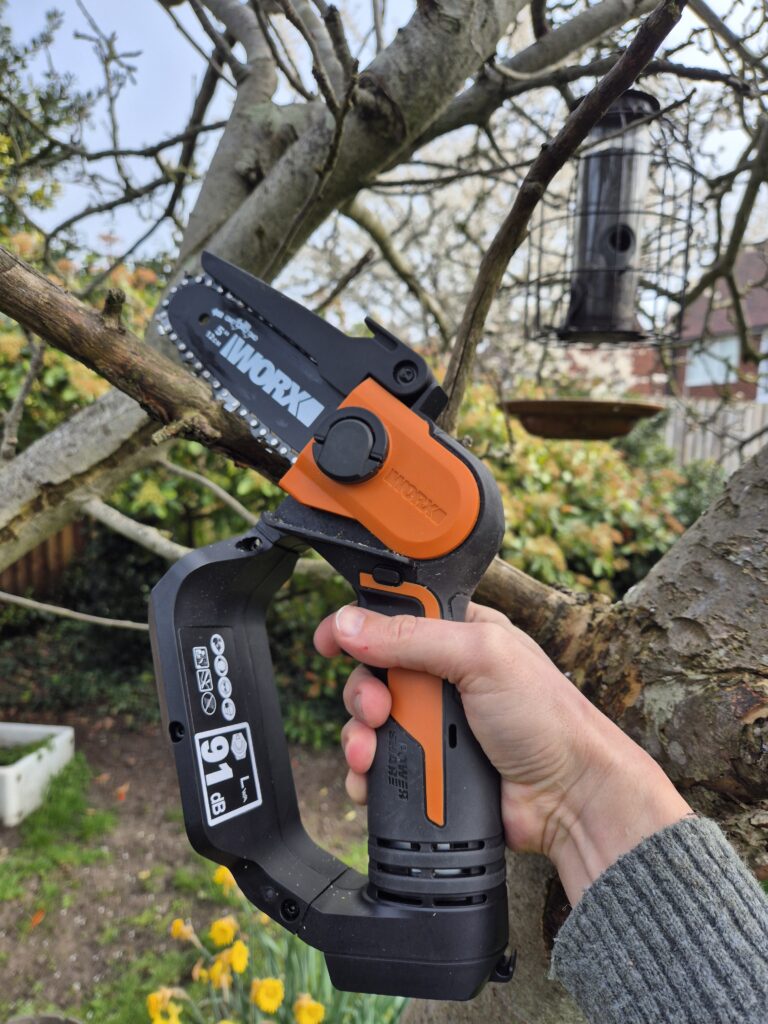
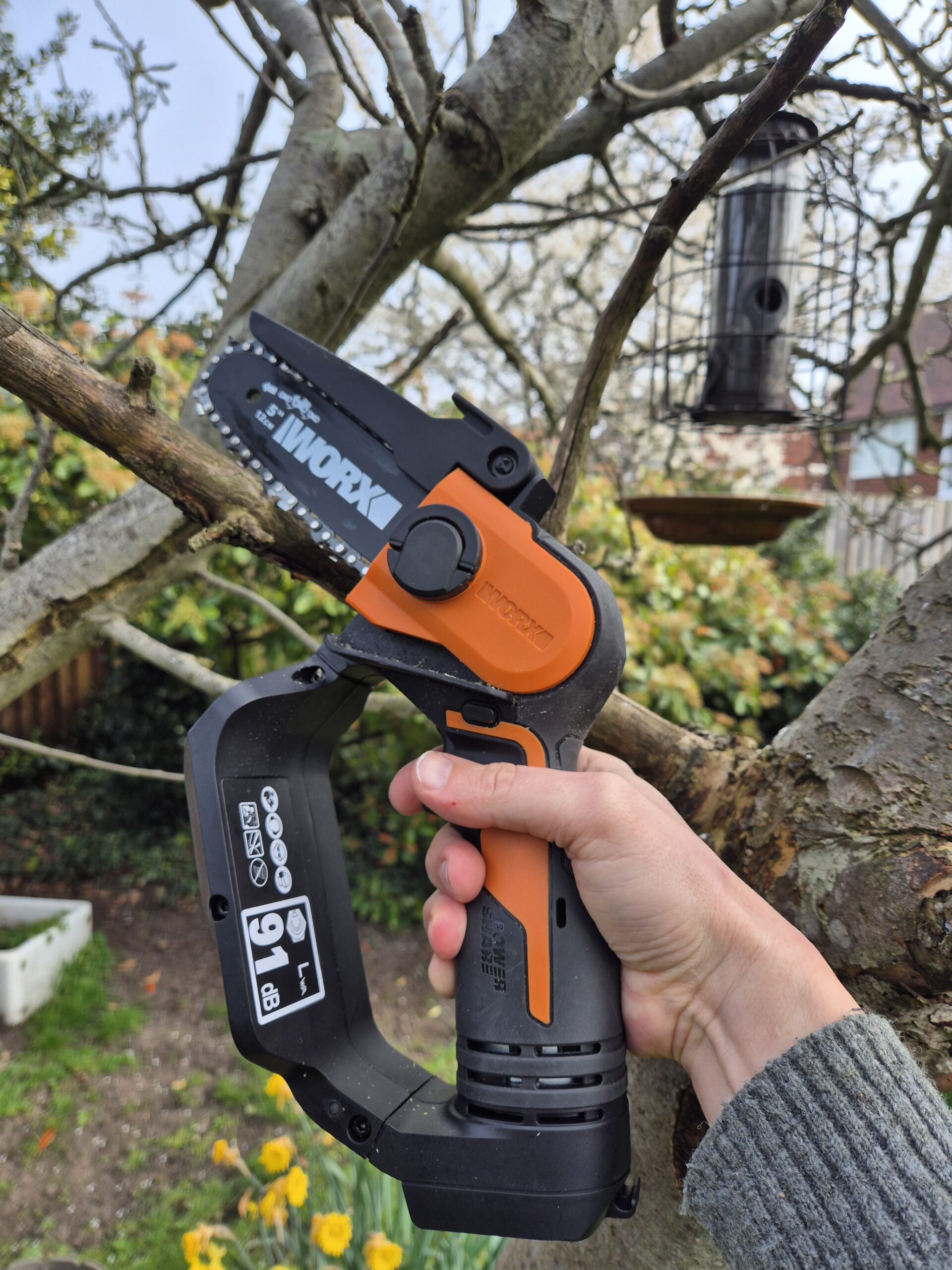
A lightweight, one-handed pruning tool — but in most UK gardens, it’s rarely the best tool for the job.
I bought the Worx mini chainsaw to fill what I thought was a useful gap — something quicker than loppers for thicker hedge branches, but lighter and easier than a full chainsaw.
In this Worx WG324E review, I’m sharing how it’s performed in my own garden — and why it’s a tool I rarely reach for.
It works, but most of the time there’s simply a better option — especially if you already have a hedge trimmer and basic pruning tools.
If you’re interested in how this fits into the wider Worx ecosystem, see my guide to Worx PowerShare garden tools.
🌿 Our Quick Verdict
★★★☆☆
A lightweight one-handed mini chainsaw that works well for small pruning jobs — but in most UK gardens, it’s rarely the best tool for the job.
After using the Worx WG324E in my own garden, I’d rate it 3 out of 5 stars for my use. It cuts small branches easily and is convenient to pick up with one hand, but I’ve found I almost always reach for loppers or a hedge trimmer instead. The cuts aren’t as clean, it can feel awkward to position, and it needs more adjustment and maintenance than expected.
- Lightweight and easy to use one-handed
- Cuts small branches quickly with minimal effort
- Compatible with the Worx PowerShare battery system
- Less precise and clean than loppers for pruning
- Requires regular chain tension checks and manual oiling
Best for: occasional one-handed pruning of small-to-medium branches where convenience matters
Avoid if: you want clean, precise cuts or already have good loppers and hedge trimming tools
If you specifically want a lightweight, one-handed cutting tool for quick pruning jobs, this is where it makes the most sense:
See the Worx WG324E Mini Chainsaw on Amazon UK
Note: The Worx WG324E is often sold in different versions. The “E.1” kit usually includes a battery and charger, while the “E.9” is tool-only. If you don’t already have PowerShare batteries, make sure you’re buying the right version.
Worx WG324E Review: Key Features
| Feature | Details |
|---|---|
| Model | Worx WG324E |
| Battery system | 20V Worx PowerShare |
| Bar length | 12cm |
| Max cutting capacity | Approx. 8–10cm in real-world use (less on fibrous wood like buddleia) |
| Use style | Designed for one-handed use |
| Chain tensioning | Tool-free adjustment |
| Chain lubrication | Manual oiling required (no automatic oil tank) |
| Best for | Occasional pruning of small-to-medium branches |
One of the main benefits of the Worx WG324E is that it uses the PowerShare battery system, meaning the same battery works across a wide range of Worx tools.
In practice, that does make ownership easier — especially if you already have other Worx tools, as you can swap batteries between them.
However, while the system itself is a strong point, it doesn’t change how often you’ll actually need this particular tool.
If you want to compare Worx with other cordless systems like Ryobi and Bosch, I’ve covered that in my PowerShare battery systems comparison guide.
My Real-World Experience
The mini chainsaw does exactly what it claims — it cuts small branches quickly and is easy to handle.
But in practice, I’ve found it doesn’t get used much.
Most of the time:
- I want a clean cut → loppers are better
- I’m trimming a hedge → hedge trimmer is faster
- I need reach → pole tools make more sense
It ends up sitting in a middle ground where it’s only occasionally useful.
Where It Falls Short
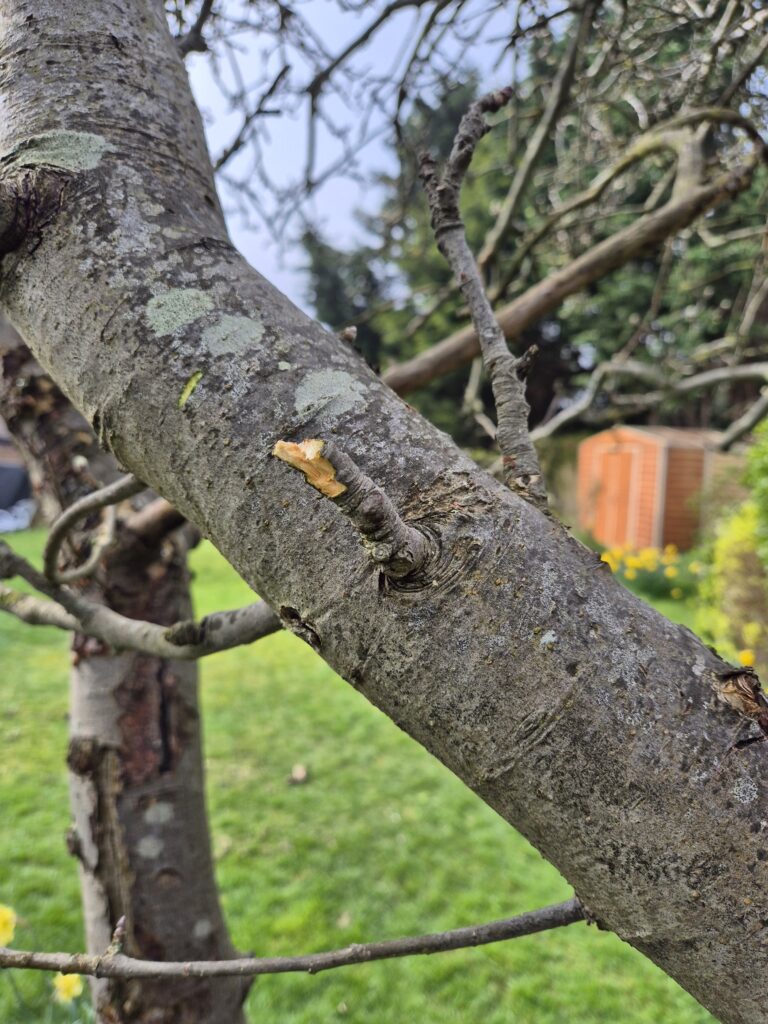
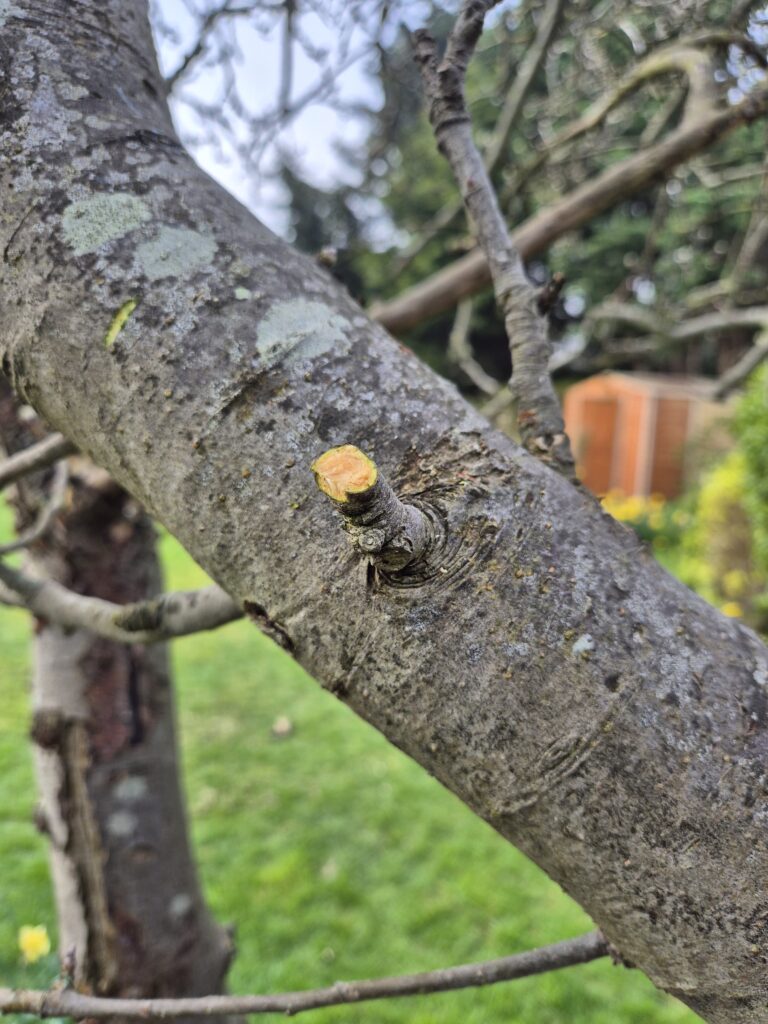
Left: Worx WG324E chainsaw cut (rough and splintered). Right: clean lopper cut on the same type of branch.
The biggest issue is cut quality and control.
Compared to proper loppers:
- Cuts are less clean
- More likely to tear fibres
- Harder to position precisely
That matters for plant health and overall finish.
It also feels slightly awkward to line up, especially inside hedges where space is tight.
⚠️ Debris & Safety (Important)
One thing I noticed quickly is how messy the cuts can be.
Because the chain tends to tear and splinter rather than slice cleanly:
- Small bits of wood can fly off during cutting
- You can get chips and fibres flicking back toward you
That’s fairly normal for chainsaws, but it’s easy to underestimate with a small, one-handed tool like this.
👉 Safety glasses are essential when using it.
It’s not something I’d use casually without eye protection — especially when cutting hedge growth or springy branches.
🌿 Buddleia, “Springy” Wood & Why It Struggles
The issue really showed up when cutting buddleia (the plant butterflies love and that seems to grow everywhere).
This type of wood is:
- Fibrous
- Flexible (“springy”)
- Prone to snagging
Instead of slicing cleanly, the chain can:
- Grab
- Bounce slightly
- Or “whip” the branch rather than cutting cleanly
This is exactly where traditional tools outperform it.
Better Alternatives in Most Gardens
For most UK garden setups, a combination of hedge trimming and proper pruning tools will cover nearly everything.
For regular hedge maintenance, a standard hedge trimmer is far more efficient — in my case, the Worx WG261E handles the majority of cutting much faster and more cleanly.
For taller hedges or harder-to-reach areas, a pole hedge trimmer makes much more sense than trying to manoeuvre a mini chainsaw at awkward angles — I’ve found the Worx WG252E far more practical for this.
If you’re comparing options more broadly, it’s also worth looking at a full breakdown of the best cordless hedge trimmers for UK gardens.
If you want clean, precise cuts that heal properly — especially on fruit trees — a good pair of bypass loppers will outperform a mini chainsaw every time. I’ll be covering these in a dedicated guide soon.
⚠️ Chain Coming Loose (Important)
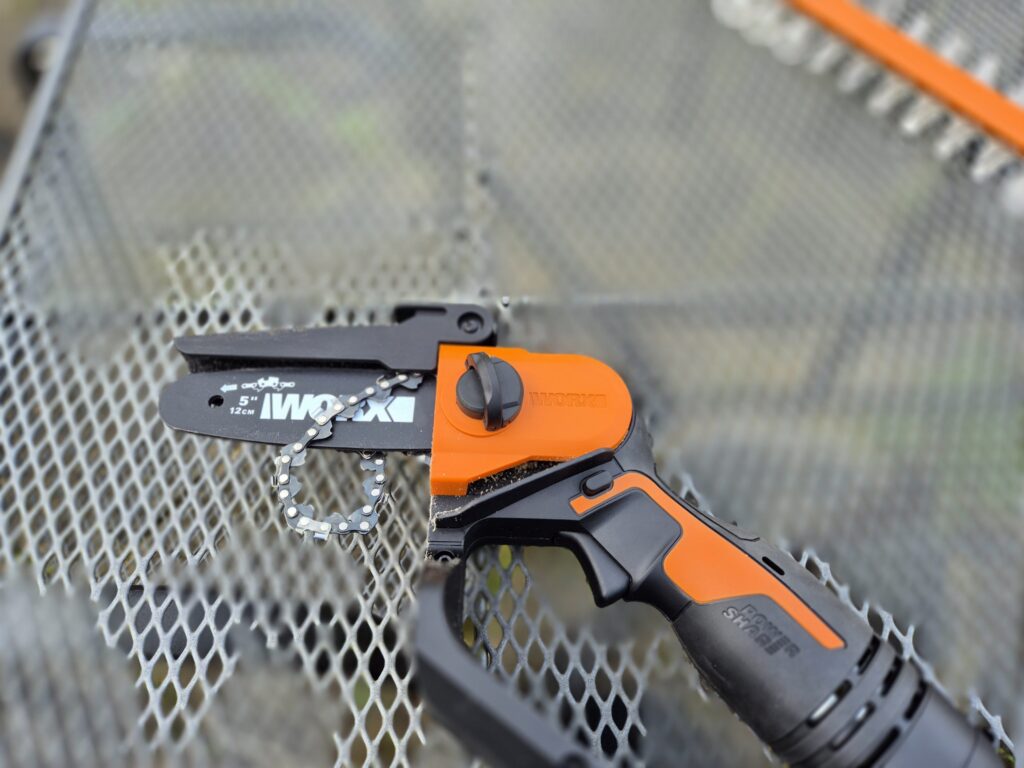
The chain can loosen during use — make sure it’s properly seated and tensioned before cutting.
This is something I ran into early on.
While cutting a thicker branch, the chain actually came off completely. It turned out the chain had loosened and wasn’t properly tensioned. Looking back, I don’t think it was correctly tensioned out of the box.
What to check
- Chain sits correctly in the guide bar groove
- No sag underneath
- Still moves freely by hand
How to fix it properly (what actually works)
- Loosen the side cover using the plastic tension knob
- Take a second to make sure the chain is fully seated in two places:
- Around the drive sprocket (inside the housing)
- Along the guide bar groove
- Check that the cutting teeth are facing the correct direction (forward along the top of the bar)
- Now the important part:
👉 As you tighten the plastic knob, pull the guide bar slightly away from the body of the tool - Keep that outward pressure while tightening — this is what actually creates proper chain tension
- Tighten until:
- The chain sits snug with no sag underneath
- But can still be moved by hand with a bit of resistance
Once set correctly, it stayed in place — but it’s something you need to monitor.
🔧 Chain Oil & Heat (Easy to Miss)
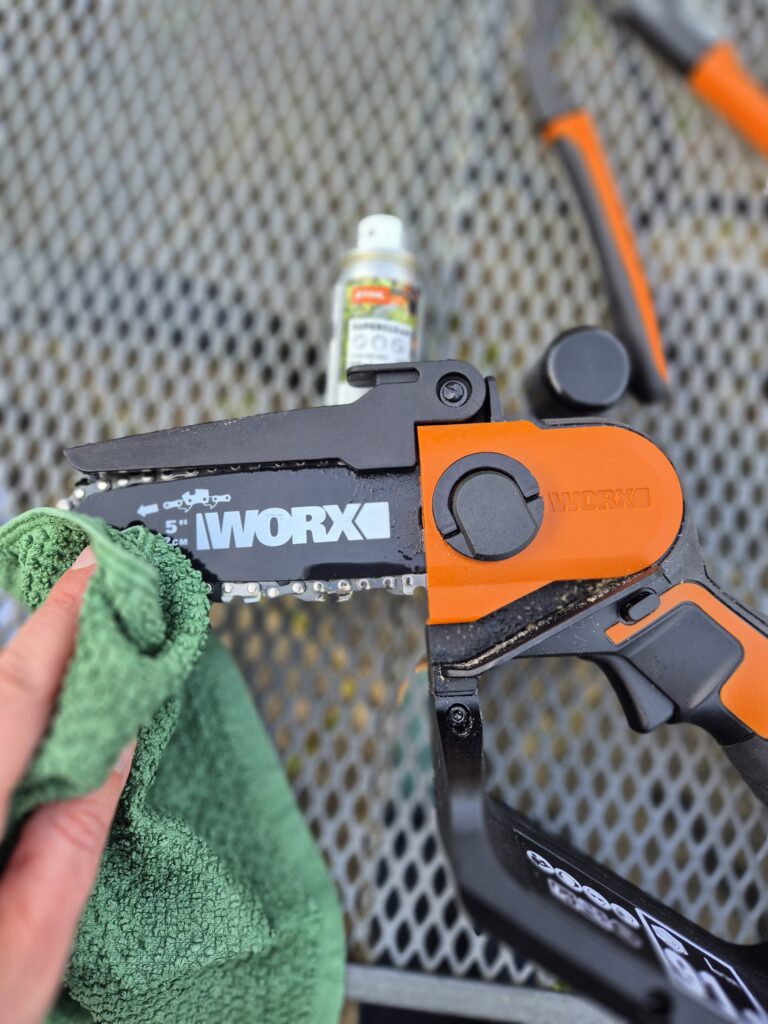
Cleaning and lightly oiling the chain after use — this model requires manual lubrication.
One thing that isn’t obvious at first is that this tool doesn’t have an automatic oiling system — so you need to manage maintenance yourself.
After using it, I spray the chain with Stihl resin solvent and wipe off the excess. This works well for removing sap and residue, especially after cutting hedge growth.
I already had this spray because it’s excellent for cleaning hedge trimmer blades, so it’s useful as part of a general garden tool maintenance setup.
However, it’s worth noting this is a cleaner rather than a dedicated chain oil — so for longer-term use, a proper chain oil is still recommended to keep everything running smoothly.
It’s quick to do, but it’s another small step that makes the tool feel less “grab and go” than simpler options like loppers.
If you want to keep your tools working properly long-term, I’ve covered this in more detail in my guide to maintaining cordless garden tools.
🔧 Maintenance & Setup
This isn’t quite a “grab and go” tool.
To keep it working properly:
- Check chain tension regularly
- Keep the chain aligned
- Clean debris after use
- Manually oil the chain
Because everything is smaller, small issues show up quickly.
⚠️ One-Handed Use (Worth Saying)
Worx designed this to be used one-handed — that’s the main appeal.
But in practice:
👉 Just because you can use it one-handed doesn’t always mean you should.
Keep your free hand well clear — this thing will bite if you’re not careful.
Battery Performance (2Ah vs 4Ah)
I’ve mainly used this with a 2Ah battery:
- Works fine for small jobs
- Limited runtime
A 4Ah battery will:
- Last longer
- Feel slightly stronger
But it doesn’t change how often you actually need the tool.
If you think this mini chainsaw is right for your garden, you can check the latest price and availability below.


Final Verdict
The Worx mini chainsaw works — but in a typical UK garden, it’s not a tool you’ll use often.
Pros:
- Lightweight and easy
- Convenient for quick cuts
Cons:
- Not as clean as loppers
- Awkward in tight spaces
- Chain requires regular adjustment
- Needs manual oiling
👉 For me, it’s a situational tool rather than a must-have
📎 Related Guides
- The HomeGrower Guide to Garden Tools and Equipment
A system-level guide to how garden tools, battery platforms, storage, and long-term use fit together in real UK gardens. - Worx PowerShare Garden Tools Guide
A breakdown of the Worx cordless system, including how different tools perform and how the PowerShare batteries fit together.
❓ Worx WG324E Review – FAQs
Is the Worx WG324E mini chainsaw worth it?
In this Worx WG324E review, I found it works well for small pruning jobs, but in most UK gardens it’s often beaten by loppers or hedge trimmers. It’s best seen as a convenience tool rather than an essential one.
What size branches can the Worx WG324E cut?
The Worx WG324E has a 12cm bar, but in real-world use it handles branches around 8–10cm comfortably. Thicker or fibrous wood (like buddleia) can be more difficult and may lead to rough cuts.
Does the Worx WG324E need chain oil?
Yes — unlike larger chainsaws, the Worx WG324E doesn’t have an automatic oiling system. You need to manually apply oil to keep the chain running smoothly and reduce wear.
Why does the chain come loose on the Worx WG324E?
The chain can loosen if it isn’t properly tensioned or seated on the guide bar and sprocket. In this Worx WG324E review, I found it’s important to pull the bar outward while tightening to get proper tension.
Is a mini chainsaw better than loppers?
For most pruning jobs, loppers are actually better. They give cleaner cuts, require no maintenance, and are easier to control. The Worx WG324E mini chainsaw is more useful for quick, one-handed cutting rather than precision pruning.