Grow tent ventilation is one of the most misunderstood parts of indoor growing — especially in UK homes.
Many growers focus first on lights, tents, or nutrients, only to run into heat, humidity, or smell problems later. In reality, most of these issues come down to one thing: poor grow tent ventilation.
If you’re still getting to grips with how tents, lights, airflow, and environment all fit together, ventilation sits at the centre of the wider HomeGrower guide to grow tents, because it’s the system that allows everything else to work properly.
Done right, grow tent ventilation runs quietly in the background and keeps conditions stable. Done badly, it turns growing into a constant battle — with your plants, your energy bill, and sometimes the people you live next to.
🌬️ What Grow Tent Ventilation Actually Does
Grow tent ventilation isn’t just about smells or fresh air.
A proper grow tent ventilation system:
- Removes excess heat produced by grow lights
- Carries away moisture before it becomes condensation
- Replaces depleted CO₂ with fresh air
- Prevents stagnant air pockets around leaves
- Keeps temperature and humidity predictable, not reactive
If warm, moist air can’t leave the tent efficiently, no amount of internal fans or smart controllers will fix the problem.
This is why ventilation underpins both grow tent temperature control and heat and humidity management — airflow is the mechanism that makes those guides work in real homes.
🔁 Extraction vs Circulation (The Budget-Saving Priority)
One of the biggest mistakes beginners make with grow tent ventilation is confusing extraction with circulation.
Extraction (the lungs of the system)
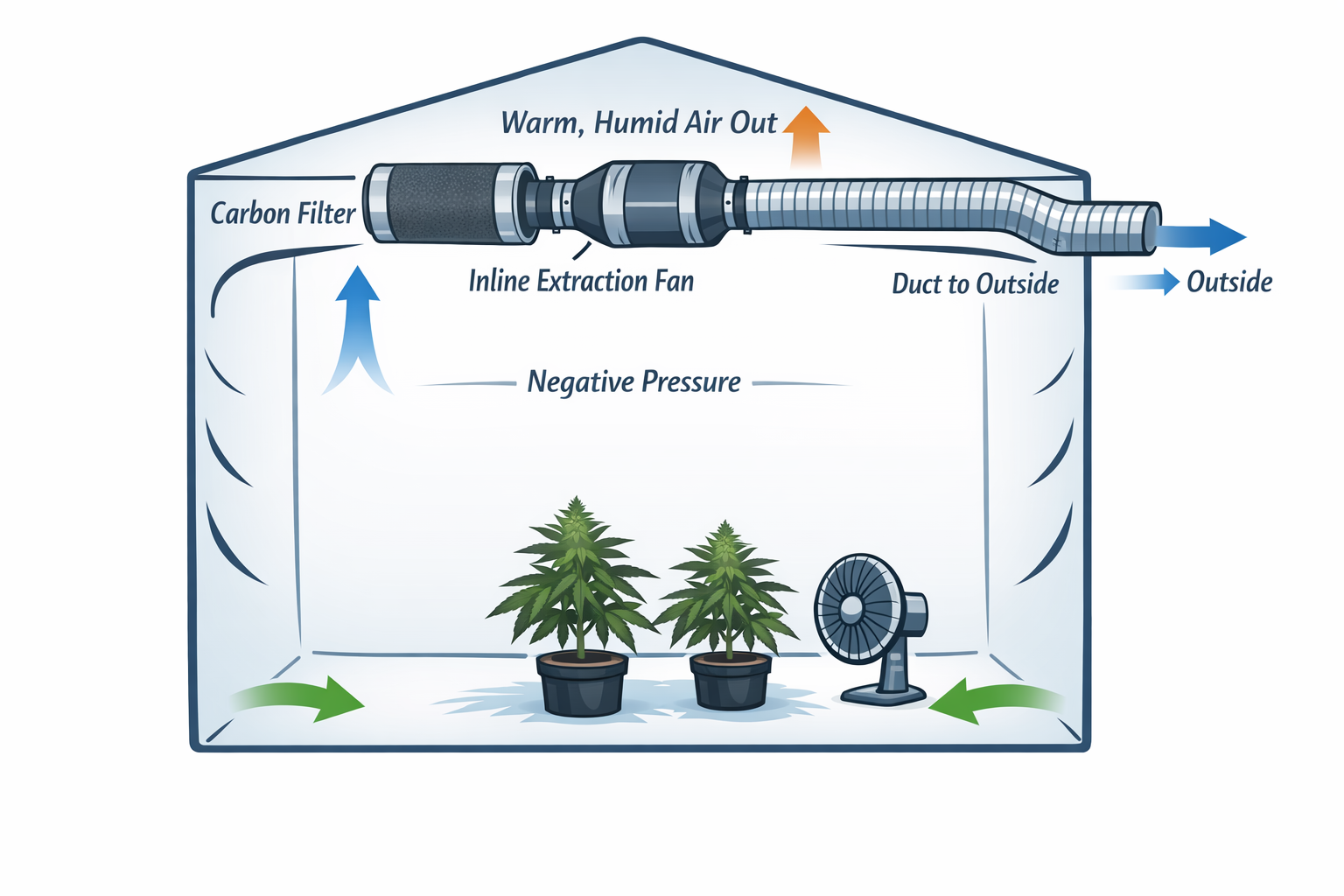
Extraction removes air out of the tent using an inline fan and ducting.
This is what:
- Controls heat
- Controls humidity
- Creates negative pressure
- Pulls fresh air into the tent automatically
If you’re trying to decide where to spend money first, extraction always comes before extra clip fans.
This is why extraction capacity plays such a big role in well-designed UK grow tent setups.
Circulation (important, but secondary)
Circulation fans move air around inside the tent.
They:
- Strengthen stems
- Reduce mould risk
- Prevent damp microclimates on leaves
They do not remove heat or humidity from the tent.
💡 A useful way to think about it:
- Extraction = lungs
- Circulation = blood flow
You need both — but you don’t buy gym shoes before you can breathe.
Passive Intake vs Active Intake (What Works in UK Houses)
Once air is extracted, fresh air has to come in. In grow tent ventilation, this happens in two ways.
Passive intake (best for most UK growers)
Passive intake uses the tent’s mesh vents or intake flaps.
As the extractor pulls air out, fresh air is drawn in automatically.
This works well when:
- The tent is small to medium sized
- You’re growing in a spare room or box room
- The house isn’t sealed airtight
For most UK homes, passive intake is all that’s needed.
Active intake (rarely worth it)
Active intake uses a second fan to push air into the tent.
It’s usually only useful if:
- The tent is very large
- Ducting runs are long and restrictive
- The tent is in a sealed loft or cupboard
In normal houses, it often just adds noise without solving the real issue.
📉 Negative Pressure (Why Tent Walls Should Pull In)
Negative pressure is one of the clearest signs your grow tent ventilation is working.
You’ll notice it when:
- Tent walls pull in slightly
- Smells stay inside the tent
- Air always moves into the tent, not out
If the tent balloons outward, airflow is unbalanced — usually too much intake or not enough extraction.
This matters even more in UK homes where tents often sit close to bedrooms or neighbours.
🔥 How Grow Tent Ventilation Removes Heat and Humidity
Once you understand this, most problems make sense.
- Heat rises, so extraction removes it from the top of the tent
- Moist air travels with warm air, so humidity leaves at the same time
- Fresh air replaces both automatically
This is why proper grow tent ventilation stabilises temperature and humidity together.
Trying to fix humidity with gadgets before fixing airflow usually leads to higher costs and more frustration.
🏠 Common Grow Tent Ventilation Problems in the UK
1. Fan noise and vibration (the neighbour problem)
In terraced houses and flats, a vibrating fan can sound like a drone in the room below.
A fan sitting directly on a floorboard or shelf can transmit noise through the structure — not just the air.
Fix:
Hang fans with straps, use soft ducting, and avoid rigid contact with walls or floors.
2. “Spaghetti” ducting and sharp bends
Every sharp bend in ducting reduces airflow.
As a rough rule:
- Each 90° bend reduces effective airflow by 20–30%
Three tight bends can leave your fan doing half the work the box claims.
Fix:
Keep ducting short, straight, and gently curved wherever possible.
3. Carbon filter in the wrong place
For smell control, the carbon filter should ideally sit inside the tent, with air being pulled through it.
This ensures:
- All air leaving the tent is scrubbed
- Smells never reach the fan or ducting
Pushing air through a filter at the end is less efficient and often noisier.
4. Venting into bedrooms in winter (the wet window warning)
This is a classic UK mistake.
If you vent warm, moist tent air into a cold bedroom, the moisture condenses on the glass. Over time, this leads to black mould around window frames.
Fix:
Vent as close to a window, chimney, or exit point as possible, and keep the room’s own ventilation open.
5. Assuming cold weather solves humidity
Cold outdoor air doesn’t help if it can’t enter and leave the tent properly.
Many UK growers still struggle with damp tents in winter.
Fix:
Focus on airflow, not outside temperature.
🌍 Venting Directly Outside (The Best Option)
If you have the option, venting your grow tent directly to the outside through an external wall is usually the best solution.
This works in a similar way to a boiler flue: warm, humid air is removed from the house entirely, rather than being redistributed indoors.
Direct external venting:
- Prevents condensation and mould inside the home
- Keeps smells fully contained
- Reduces the total duct length and number of bends
- Often allows the fan to run quieter at lower speeds
A simple wall vent or louvred grille is usually sufficient. As with any external vent, it’s important to check building rules if you’re renting, and to ensure the outlet is weather-protected.
🧮 How to Check If Your Fan Is Big Enough
A healthy grow tent should replace all its air once per minute.
Step 1: Calculate tent volumeV=Length×Width×Height
Step 2: Convert to hourly airflowV×60
Step 3: Add resistance allowance (carbon filter + ducting)Required Fan Power=(V×60)×1.25
This gives a realistic minimum fan rating in m³/h.
💷 When Better Ventilation Saves You Money
Good grow tent ventilation often means you don’t need:
- Dehumidifiers
- Heaters
- Higher-wattage lights
By stabilising conditions naturally, airflow reduces reliance on energy-hungry fixes — a big deal with UK electricity prices.
🔇 Silent Grow Tent Ventilation Checklist (UK Homes)
Use this quick checklist if you’re growing near other people:
- Hang extraction fans instead of resting them on solid surfaces
- Use larger-diameter ducting to reduce fan speed and noise
- Keep ducting runs short with minimal bends
- Place the carbon filter inside the tent, before the fan
- Vent air as close to an external exit as possible
If your tent is quiet, stable, and unobtrusive, you’re doing it right.
How Grow Tent Ventilation Fits the Bigger Picture
Grow tent ventilation connects directly to:
- Grow tent temperature control
- Heat and humidity management
- Grow light choice
- Tent size and layout
That’s why it sits at the centre of every reliable indoor grow setup — and why so many problems disappear once airflow is handled properly.