If you’ve spent any time looking at grow lights online, you’ve probably seen models advertised as “600W”, “1000W”, or even “2000W” — yet when you plug them in, they clearly don’t behave like a 1000-watt electrical appliance. They don’t heat the room the same way, and they don’t trip breakers.
A genuine 1000-watt traditional grow light, on the other hand, is not something most people would want running for 12–16 hours a day in a typical UK home environment.
This confusion around grow light wattage is one of the biggest pain points for beginners, especially when electricity prices are high and indoor growing usually happens in spare rooms, flats, sheds, or utility spaces rather than purpose-built grow rooms.
Understanding what wattage actually means — and what it doesn’t — helps you avoid poor comparisons, unexpected running costs, and unrealistic expectations.
For a broader overview of grow light types, setup, and indoor use, see our Grow Lights UK complete guide, which also links out to more detailed deep-dive articles on topics like light spectrum, distance, and timing.
Why a “1000W” Grow Light Isn’t 1000 Watts
When a grow light is advertised as “1000W”, that number almost never refers to how much electricity it actually uses.
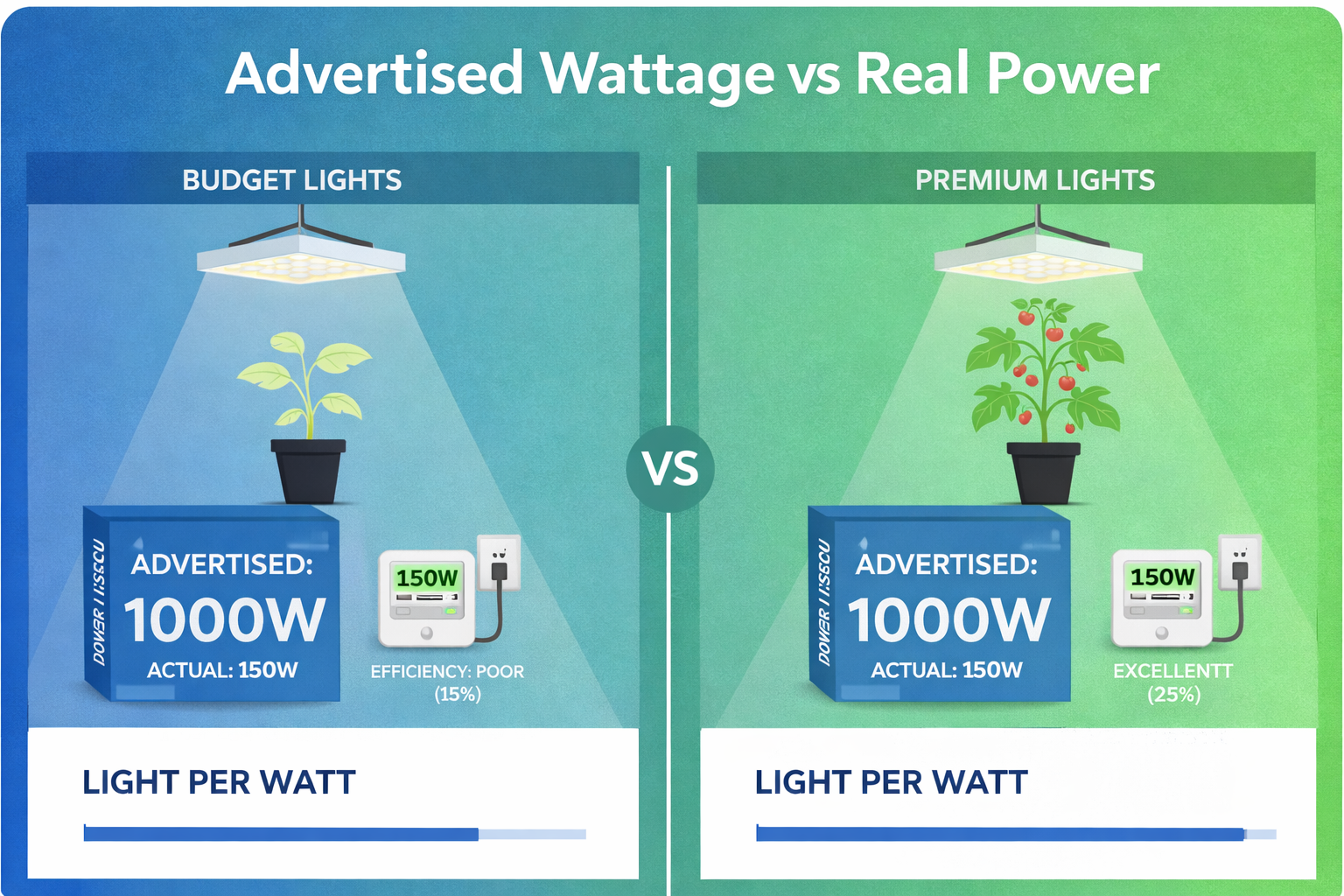
Instead, it usually means “equivalent to a 1000W traditional grow light” — a comparison to older technologies like HPS or metal halide lamps. In reality, most of those “1000W” LEDs you see on Amazon or eBay are actually drawing closer to 150W from the wall, sometimes even less.
This is often called marketing wattage or “equivalent” wattage. While it isn’t completely made up, it’s used loosely, and there’s no standard definition. One brand’s “1000W” light can perform very differently from another’s, even if the numbers look similar.
The important bit is simple: the number in the product name is rarely the number your electricity meter sees.
That distinction matters in real UK homes, where power usage, heat, and long daily run times all have practical consequences.
What Grow Light Wattage Actually Measures
Wattage, in plain terms, is a measure of how much electricity a light uses.
It doesn’t tell you how bright the light looks, how much usable light plants receive, or how efficiently that electricity is turned into growth. Two grow lights that both draw 150 watts can perform very differently depending on the quality of the LEDs, drivers, optics, and heat management.
💡 In short: Wattage is really just a measure of your electric bill. It tells you how much power you’re paying for, but it doesn’t promise that your plants are actually getting a good meal.
Why Wattage Used to Matter More (Before LEDs)
Before LEDs became common, grow lighting was dominated by technologies like high-pressure sodium (HPS), metal halide (MH), and fluorescent tubes.
These lights were relatively inefficient and fairly consistent in design. As a result, wattage acted as a rough but useful proxy for light output. A 600W HPS lamp was reliably brighter than a 250W one, and growers could make reasonable assumptions based on wattage alone.
That’s where the habit of using wattage as shorthand for “power” and “coverage” comes from.
How Modern LED Grow Lights Changed the Rules
LEDs changed the rules completely. Because they’re so much more efficient, the old “watts = brightness” shortcut growers relied on for decades just doesn’t work anymore.
A well-designed LED grow light using quality diodes and drivers can produce more usable plant light at 100 watts than a poorly designed unit at 300 watts. This is why comparing lights purely by advertised wattage no longer works.
Spectrum also plays a role in how efficiently light is used by plants, which is why colour and balance are discussed separately in guides like Full Spectrum vs Red and Blue Grow Lights, rather than being bundled into a single wattage number.
Advertised Wattage vs Wall Draw vs Usable Light
To make sense of grow light specifications, it helps to separate three different ideas that are often muddled together.
📢 Advertised wattage
This is the headline number used in marketing. It often reflects an “equivalent” figure rather than real power consumption.
🔌 Actual wall draw
This is how much electricity the light pulls from the socket. It determines running costs, heat output, and how much load you’re placing on your electrics.
🌱 Usable light output
This is the portion of emitted light plants can actually use for photosynthesis. It depends on efficiency, spectrum, and design — not just watts.
Only the last two really matter in practice, and they aren’t always proportional.
Why Efficiency Matters More Than Wattage
Efficiency is about how much useful plant light you get for each watt of electricity consumed.
💡 If you have two grow lights that both pull 100 watts, but one is built with better LEDs and drivers, you’re effectively getting extra growth for the same monthly cost. Over a full winter grow, that difference adds up — not just in plant performance, but on your electricity bill as well.
This is why many beginner-friendly recommendations focus less on headline wattage and more on consistent real-world performance, something you’ll see reflected in guides like Best Grow Lights for Beginners and comparison articles such as Top 10 LED Grow Lights UK.
🇬🇧 What Grow Light Wattage Means for UK Homes
In the UK, wattage isn’t just a plant growth number; it’s a practical household consideration. Most of us aren’t growing in giant industrial warehouses; we’re tucking plants into spare bedrooms, chilly sheds, or the corner of a kitchen.
⚡ The “Nasty Surprise” Bill With UK energy prices being what they are, “wattage” is basically code for your monthly budget. If you haven’t checked the actual wall draw, a light running for 16 hours a day can land like a lead weight when your electric bill arrives. Knowing the real number means you can plan your budget before you ever flip the switch.
🔌 The Socket Stress Test Then there’s the safety side. Most UK homes rely on standard sockets and the occasional extension lead. While LEDs are much safer than the old-style bulbs, you still have to be sensible. You wouldn’t dream of plugging four kettles into one extension lead and leaving them on all day—and the same logic applies here. If a light genuinely drew 1000W, it would be a massive electrical load for a domestic plug.
🔥 The “Space Heater” Effect Finally, wattage equals heat. Even “cool” LEDs generate warmth. In a small, insulated UK box room or a flat, a light with a high power draw can turn a closet into a sauna very quickly.
By ignoring the big “marketing” numbers and looking at the real wattage, you aren’t just helping your plants—you’re making sure your hobby actually fits into your home without tripping the breakers or overheating the spare room.
Common Beginner Mistakes When Comparing Grow Lights
⚠️ A lot of disappointment with grow lights comes from the same few misunderstandings.
Common mistakes include choosing the light with the biggest number on the box, assuming higher wattage automatically means wider coverage, or ignoring running costs and heat altogether. Cheap lights can look impressive on paper but fall short in day-to-day use.
This is why price-focused comparisons like Best Cheap Grow Lights UK work best when wattage is understood in context rather than taken at face value.
Why Wattage Alone Is a Poor Buying Shortcut
Wattage isn’t meaningless, but on its own it’s incomplete.
It won’t tell you how much usable light your plants receive, how efficiently electricity is being used, or how well a light fits into a real UK home. Understanding wattage simply helps you ask better questions and avoid misleading comparisons.
Once you grasp what watts actually represent, choosing a grow light becomes calmer and more informed — and when you do decide to compare specific models, the buying guides make far more sense.
For further reading from a trusted UK source, the RHS has a clear overview of how houseplants respond to artificial lighting indoors.
If you want to browse all our grow light guides and comparisons in one place, see our Grow Lights UK hub.
📎 Related Guides
- Grow Lights UK
Our complete guide to grow light types, setup basics, and choosing the right light for your space. - Grow Lights Distance Chart UK
Clear guidance on how far grow lights should be placed from plants at each growth stage to avoid burn or stretching. - How to Set Up Grow Lights Indoors
A step-by-step guide covering positioning, mounting, airflow, and timers for reliable indoor grow light setups. - How Long Should Grow Lights Be On?
Explains daily light cycles for seedlings, leafy greens, and fruiting plants, helping balance healthy growth with energy use. - Best Indoor Grow Lights UK for Beginners
A practical starting point for choosing simple, efficient LED grow lights that work well in typical UK homes.
❓ Grow Light Wattage FAQs
Why is grow light wattage still used if it’s so misleading?
Wattage isn’t inherently misleading — it’s just often misused. In older grow lighting systems, wattage closely correlated with light output, so it became a convenient shorthand. Many LED manufacturers still rely on that habit, even though modern LEDs vary enormously in efficiency. The problem isn’t wattage itself, but treating it as a performance guarantee.
Is “actual wall draw” the most important wattage figure to look for?
Actual wall draw is the most honest indicator of running cost and electrical load, which makes it especially important in UK homes. However, it still doesn’t tell the full story on its own. Two lights drawing the same power can deliver very different results depending on how efficiently that electricity is converted into usable plant light.
Why do some efficient grow lights use the same wattage but perform better?
Efficiency is about how well each watt is used. Higher-quality LEDs, better drivers, improved optics, and effective heat management allow more of the electricity to become useful light rather than wasted heat. This is why two 150W grow lights can produce noticeably different growth, even though they cost the same to run.
Does higher wattage always mean more heat?
Not always. While higher wattage generally means more energy moving through the system, how that energy is managed matters just as much. Poorly designed lights often dump excess energy as heat, while well-designed LEDs spread and dissipate heat more effectively. This is why some lower-quality lights feel hotter than better ones using the same power.
Can I estimate grow light coverage based on wattage?
Only very roughly, and with caution. Wattage alone doesn’t account for beam angle, light distribution, or efficiency. Coverage is better judged by real-world performance and design rather than headline wattage numbers, especially with LEDs marketed using “equivalent” ratings.
Budget lights rely more heavily on large headline numbers because they’re easy to compare and easy to market. Premium manufacturers tend to understate performance or focus on measured output and build quality instead. This doesn’t mean budget lights are useless — only that their claims need to be interpreted carefully.
Is lower wattage always better for UK indoor growing?
Lower wattage reduces running costs and electrical strain, which is important in UK homes, but it still needs to match your growing space and plant needs. The goal isn’t the lowest wattage possible, but the right balance between efficiency, coverage, and practical home constraints.
What’s the safest way to compare grow lights without getting misled?
Ignore headline wattage claims and focus instead on actual power draw, build quality, and realistic coverage for your space. Understanding wattage helps you rule out poor comparisons, but the best decisions come from looking at how a light behaves in real indoor conditions rather than how it’s labelled.